
 Login
Login Register
 Submit a Paper
 Propose a Special lssue
 Open Access
ARTICLE

Enhancement of Gas–Liquid Mixing in Side-Blown Smelting via Sinusoidal Pulsed Swirling Injection
1 State Key Laboratory of Complex Nonferrous Metal Resources Clean Utilization, School of Metallurgical and Energy Engineering, Kunming University of Science and Technology, Kunming, China
2 Department of Energy and Power Engineering, School of Metallurgical and Energy Engineering, Kunming University of Science and Technology, Kunming, China
3 Yunnan Key Laboratory of Clean Energy and Energy Storage Technology, School of Metallurgical and Energy Engineering, Kunming University of Science and Technology, Kunming, China
4 The School of Energy and Power Engineering, Chongqing University, Chongqing, China
* Corresponding Author: Xiaohui Zhang. Email:
Fluid Dynamics & Materials Processing 2026, 22(3), 5 https://doi.org/10.32604/fdmp.2026.076426
Received 20 November 2025; Accepted 06 March 2026; Issue published 31 March 2026
 View Full Text
 Download PDF
Abstract
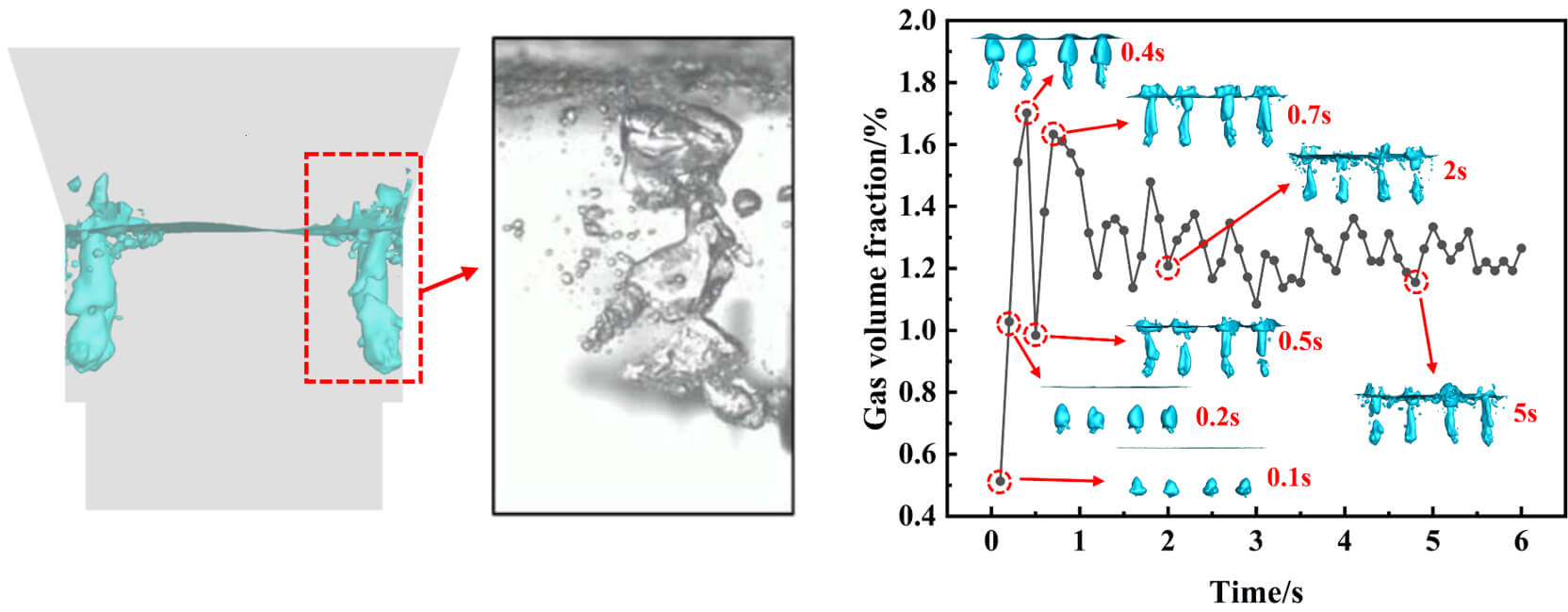
To overcome the limited mixing efficiency associated with conventional steady-state side blowing in molten pool smelting, this study proposes a gas injection strategy that combines a swirl lance configuration with sinusoidal pulsed blowing. Using a volume-of-fluid (VOF) multiphase flow framework coupled with the Realizable k–ε turbulence model, the performance of constant-velocity blowing is systematically compared with sinusoidal pulsed blowing over a range of amplitudes (5, 10, and 15 m/s) and frequencies (0.5, 1, and 2 Hz). The results demonstrate that sinusoidal pulsed blowing markedly enhances gas–liquid mixing within the melt pool relative to constant-speed injection. Mixing efficiency increases with blowing amplitude, while its dependence on pulse frequency is nonlinear. Within the investigated parameter space, the optimal configuration, an amplitude of 15 m/s and a frequency of 1 Hz, raises the average gas volume fraction by 8%, reduces the mixing dead-zone area by 81%, and expands the active mixing region by 25%. Overall, the imposed sinusoidal pulsing promotes bubble breakup beneath the free surface, leading to more complete bubble collapse, intensified turbulent agitation, and, ultimately, improved gas–liquid mixing.Graphic Abstract
Keywords
Cite This Article
 Copyright © 2026 The Author(s). Published by Tech Science Press.
This work is licensed under a Creative Commons Attribution 4.0 International License , which permits unrestricted use, distribution, and reproduction in any medium, provided the original work is properly cited.
 Downloads
 Citation Tools
