
 Login
Login Register
 Submit a Paper
 Propose a Special lssue
 Open Access
ARTICLE

Particle-Size-Dependent Reactivity and Graded Utilization of Water-Cooled Ferronickel Slag in Cement-Based Materials
1 School of Civil Engineering, Architecture and Environment, Hubei University of Technology, Wuhan, China
2 Key Laboratory of Intelligent Health Perception and Ecological Restoration of Rivers and Lakes, Ministry of Education, Hubei University of Technology, Wuhan, China
3 Centre for Advanced Innovation Technologies, VSB-Technical University of Ostrava, Ostrava-Poruba, Czech Republic
* Corresponding Author: Xingyang He. Email:
(This article belongs to the Special Issue: Low-carbon Civil Engineering Materials: Materials Processing, Fluids and Medium Transport)
Fluid Dynamics & Materials Processing 2026, 22(6), 1 https://doi.org/10.32604/fdmp.2026.081547
Received 04 March 2026; Accepted 27 May 2026; Issue published 30 June 2026
 View Full Text
 Download PDF
Abstract
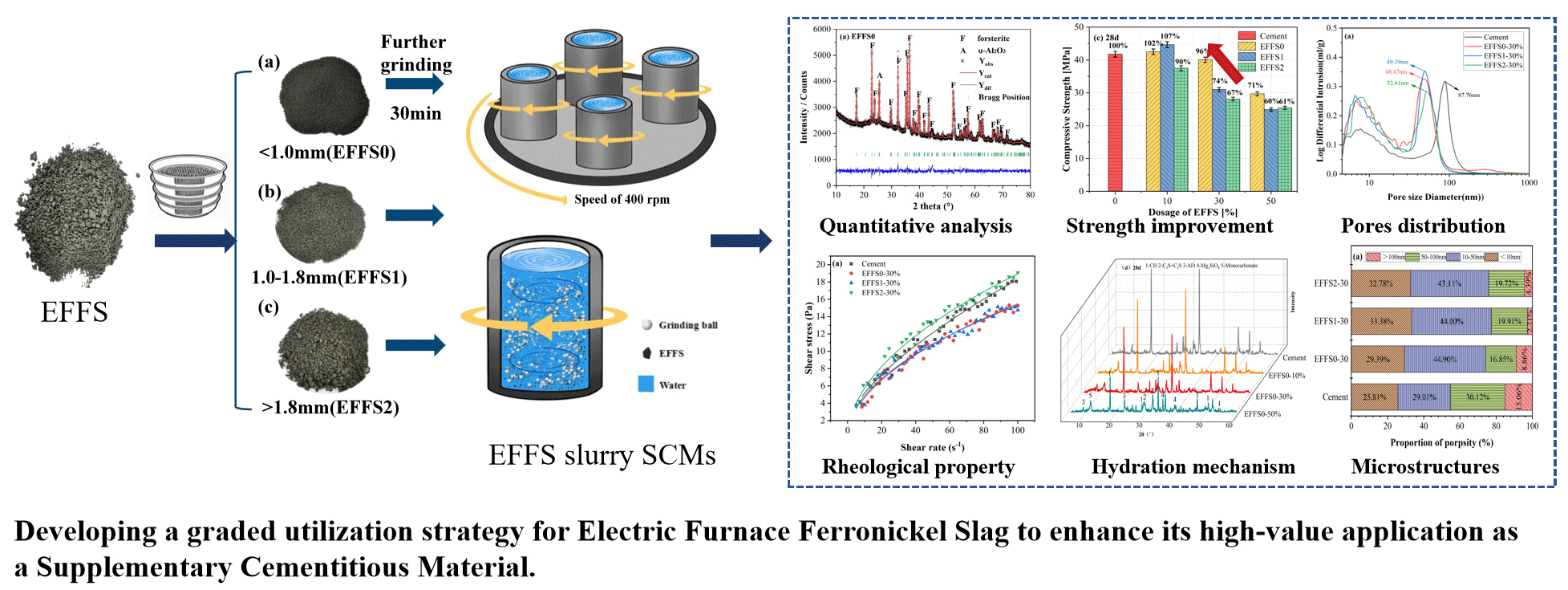
The utilization of water-cooled electric furnace ferronickel slag (EFFS) in concrete remains constrained by its intrinsically low pozzolanic reactivity as a supplementary cementitious material (SCM) and its inadequate volumetric stability when employed as aggregate. This study systematically investigates the compositional characteristics of this slag across different particle-size fractions and proposes a wet-grinding activation strategy to enhance its pozzolanic performance. In particular, cement pastes incorporating 10%, 30%, and 50% ultrafine EFFS derived from three original size fractions are comprehensively evaluated in terms of rheological behavior, compressive strength, hydration characteristics, and microstructural evolution. The results demonstrate pronounced size-dependent differences in phase composition. The amorphous phase content of EFFS particles smaller than 1.0 mm (EFFS0) reaches 54.04%, which is 19.72% higher than that of particles larger than 1.8 mm (EFFS2). The higher amorphous content leads to enhanced pozzolanic activity and improved mechanical performance. Mortars containing 30% ultrafine EFFS0 exhibit favorable strength development, with the 28-day compressive strength reaching 96% of that of the plain cement control and showing a 29% increase relative to the corresponding EFFS2 mixture. Based on these findings, a graded utilization strategy for water-cooled EFFS is proposed: The finer and more reactive fractions are suitable for SCM applications after activation, whereas the coarser fractions are more appropriate for non-cementitious applications, such as aggregate utilization.Graphic Abstract
Keywords
Cite This Article
 Copyright © 2026 The Author(s). Published by Tech Science Press.
This work is licensed under a Creative Commons Attribution 4.0 International License , which permits unrestricted use, distribution, and reproduction in any medium, provided the original work is properly cited.
 Downloads
 Citation Tools
