
 Login
Login Register
 Submit a Paper
 Propose a Special lssue
 Open Access
ARTICLE
Enhancing Energy Efficiency in Vapor Compression Refrigeration Systems Using Phase Change Materials
1 Unité de Recherche Appliquée en Energies Renouvelables (URAER), Centre de Développement des Energies Renouvelables (CDER), Ghardaia, 47133, Algeria
2 Laboratory of Biomaterials and Transport Phenomena, University of Medea, Medea, 26000, Algeria
3 Biotechnology, Water, Environment and Health Laboratory, Abbes Laghrour University, Khenchela, 40000, Algeria
4 CIP Team, Institute of Chemical Sciences of Rennes, ISCR—UMR6226, CNRS, Ecole Nationale Supérieure de Chimie de Rennes, University Rennes, Rennes, 35000, France
5 School of Engineering, Merz Court, Newcastle University, Newcastle upon Tyne, NE1 7RU, UK
* Corresponding Author: Abdeltif Amrane. Email:
Frontiers in Heat and Mass Transfer 2025, 23(4), 1129-1149. https://doi.org/10.32604/fhmt.2025.067734
Received 11 May 2025; Accepted 25 June 2025; Issue published 29 August 2025
 View Full Text
 Download PDF
Abstract
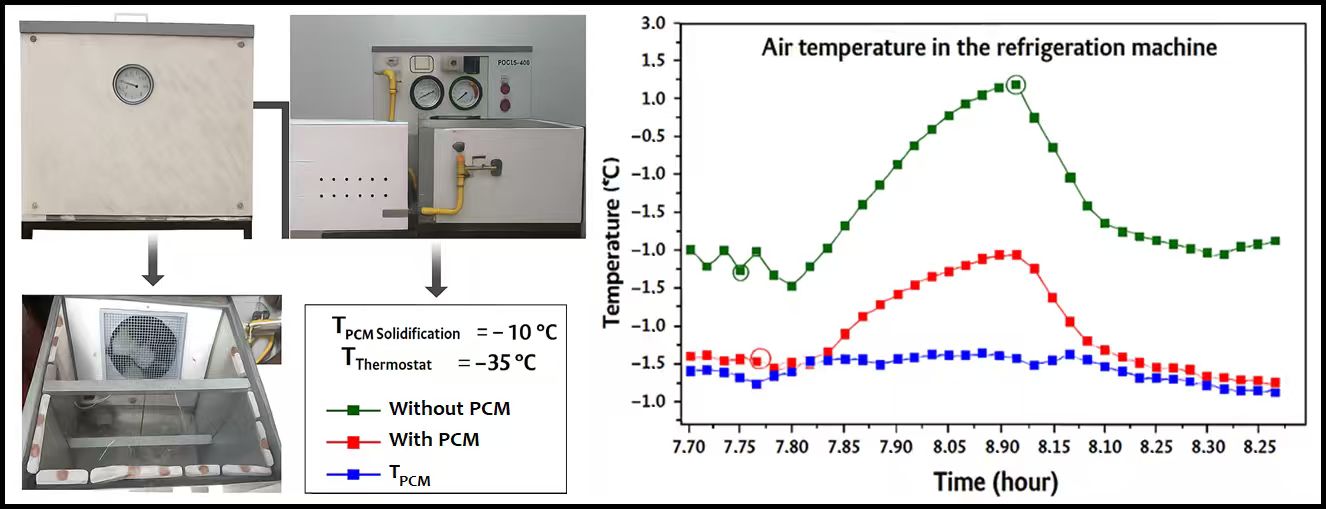
Refrigeration systems are essential across various sectors, including food preservation, medical storage, and climate control. However, their high energy consumption and environmental impact necessitate innovative solutions to enhance efficiency while minimizing energy usage. This paper investigates the integration of Phase Change Materials (PCMs) into a vapor compression refrigeration system to enhance energy efficiency and temperature regulation for food preservation. A multifunctional prototype was tested under two configurations: (1) a standard thermally insulated room, and (2) the same room augmented with eutectic plates filled with either Glaceol (−10°C melting point) or distilled water (0°C melting point). Thermocouples were calibrated and deployed to record air and PCM temperatures during freeze–thaw cycles at thermostat setpoints of −30°C and −35°C. Additionally, a defrosting resistor and timer were added to mitigate frost buildup, a known cause of efficiency loss. The experimental results show that PCM-enhanced rooms achieved up to 10.98°C greater temperature stability during defrost cycles and reduced energy consumption by as much as 7.76% (from 0.4584 to 0.4231 kWh/h). Moreover, the effectiveness of PCMs depended strongly on thermostat settings and PCM type, with distilled water demonstrating broader solidification across plates under higher ambient loads. These findings highlight the potential of PCM integration to improve cold-chain performance, offering rapid cooling, moisture retention, and extended product conservation during power interruptions.Graphic Abstract
Keywords
Cite This Article
 Copyright © 2025 The Author(s). Published by Tech Science Press.
This work is licensed under a Creative Commons Attribution 4.0 International License , which permits unrestricted use, distribution, and reproduction in any medium, provided the original work is properly cited.
 Downloads
 Citation Tools
