
 Login
Login Register
 Submit a Paper
 Propose a Special lssue
 Open Access
REVIEW
Hot Wall Condensers in Domestic Refrigerators: A Review of Enhancements from Past to Present, Performance Parameters, and Future Perspectives
1 Graduate School of Natural and Applied Sciences, Department of Mechanical Engineering, Ege University, İzmir, Türkiye
2 Faculty of Engineering, Department of Mechanical Engineering, Ege University, İzmir, Türkiye
* Corresponding Author: Gürcan Durmaz. Email:
(This article belongs to the Special Issue: Enhancement Technologies for Fluid Heat and Mass Transfer)
Frontiers in Heat and Mass Transfer 2026, 24(2), 5 https://doi.org/10.32604/fhmt.2026.075332
Received 29 October 2025; Accepted 22 January 2026; Issue published 30 April 2026
 View Full Text
 Download PDF
Abstract
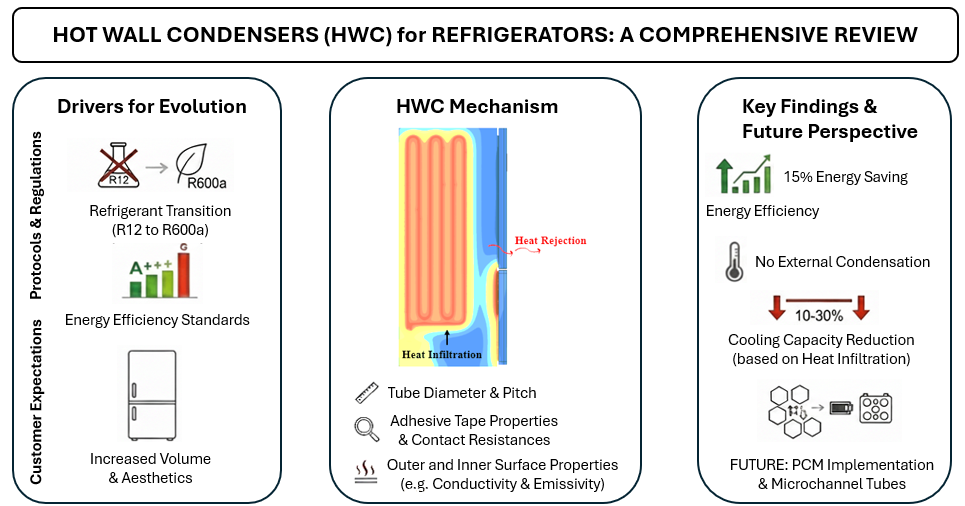
This study examines the evolution of condenser technologies in household refrigerators, focusing on the potential for improving energy efficiency with hot-wall condensers (HWCs). Factors influencing this development, including refrigerant changes, consumer expectations, global regulations, and environmental factors, are evaluated. Design features, advantages, disadvantages, limitations, and comparisons with other condenser types are presented for HWCs. The review identifies key parameters affecting HWC performance: pipe diameter and pitch, outer surface material properties, adhesive tape properties, and contact resistances. The effects of environmental factors such as ambient temperatures and heat transfer coefficients are also considered. The results indicate that HWCs can increase energy efficiency and reduce energy consumption by up to 15%. Furthermore, the risk of water condensation on HWC refrigerator surfaces is low, even in high-humidity environments. However, designs should also consider heat leakage into the refrigerated compartments; research indicates this infiltration can lead to a 10%–30% reduction in cooling capacity. The article also provides information on potential parameters that have not been previously studied and will guide future research. Design and integration are critical for successful implementation. Future research should focus on improving HWC designs and developing optimization strategies for efficient and sustainable cooling solutions.Graphic Abstract
Keywords
Cite This Article
 Copyright © 2026 The Author(s). Published by Tech Science Press.
This work is licensed under a Creative Commons Attribution 4.0 International License , which permits unrestricted use, distribution, and reproduction in any medium, provided the original work is properly cited.
 Downloads
 Citation Tools
