
 Login
Login Register
 Submit a Paper
 Propose a Special lssue
 Open Access
ARTICLE
Tailored Phosphate Glass Powders for Augmented Flame Retardancy and Ceramicization in Silicone Rubber
1 State Key Laboratory of Fire Science, University of Science and Technology of China, Hefei, 230026, China
2 Suzhou Key Laboratory for Urban Public Safety, Suzhou Institute for Advanced Research, University of Science and Technology of China, Suzhou, 215123, China
3 Yankuang Energy Group Co., Ltd., Zoucheng, 273500, China
* Corresponding Author: Weizhao Hu. Email:
Journal of Polymer Materials 2025, 42(2), 531-548. https://doi.org/10.32604/jpm.2025.065040
Received 01 March 2025; Accepted 04 June 2025; Issue published 14 July 2025
 View Full Text
 Download PDF
Abstract
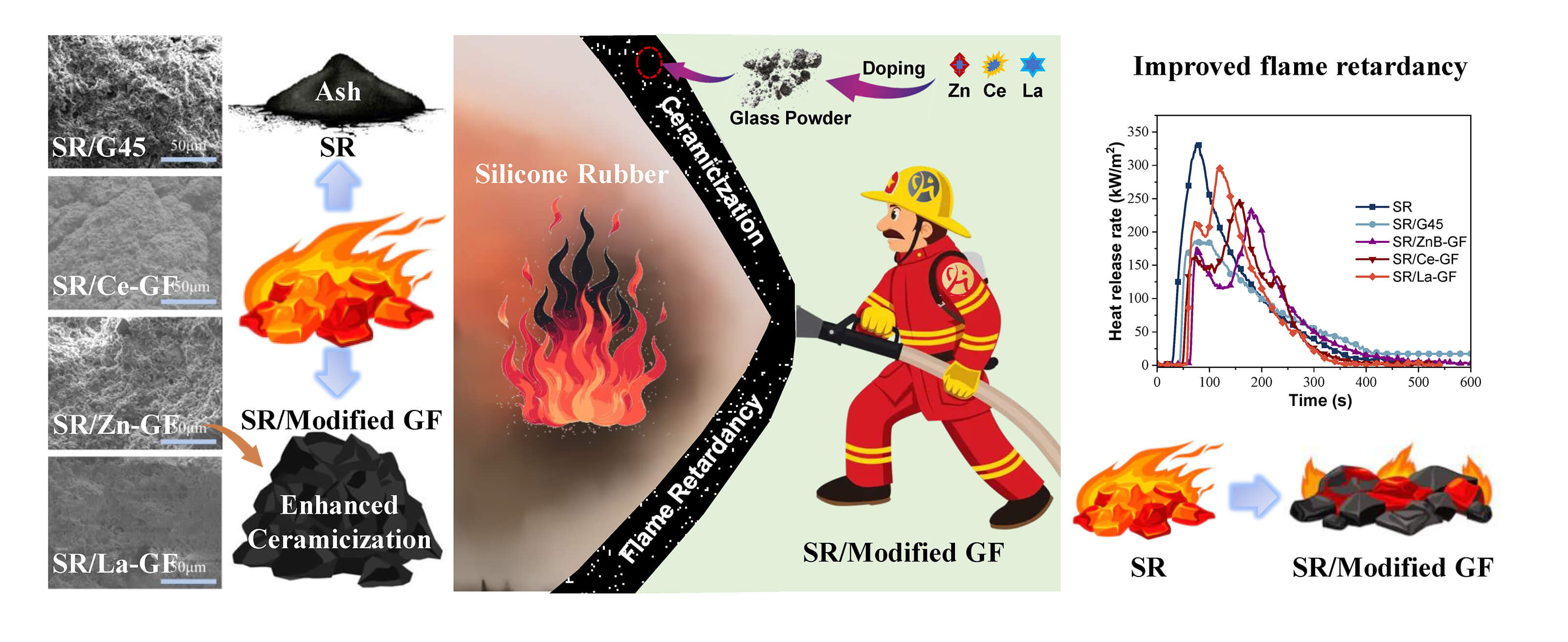
Silicone rubber (SR) exhibits superior breathability and high-temperature resistance. However, SR is prone to degradation under extreme heat or combustion, limiting its effectiveness in mitigating secondary hazards. In this study, phosphate glass powder was used to calcinate zinc borate, lanthanum oxide, and cerium oxide. Methylphenyl polysiloxane was then grafted onto the surface of the glass powder, resulting in the modified powders designated as Methylphenyl polysiloxane-grafted zinc borate-modified phosphate glass powder (GF-ZnBM), Methylphenyl polysiloxane-grafted lanthanum oxide-modified phosphate glass powder (GF-LaM), and Methylphenyl polysiloxane-grafted cerium oxide-modified phosphate glass powder (GF-CeM). The modified powders were subsequently incorporated into silicone rubber composites to enhance the ceramicization capability of silicone rubber at high temperatures. Specifically, GF-CeM and GF-LaM significantly increased the limiting oxygen index (LOI) to 33% and reduced the tendency for combustion propagation. Additionally, GF-CeM notably contributed to enhancing ceramicization strength. The presence of cerium oxide helps in the melting of the glass powder and enhances its adhesion to the silicone rubber matrix. SR/ZnB-GF exhibited the lowest activation energy among the tested composites, along with the best protective capability. The inclusion of modified glass powder has a minor impact on the rheological properties, indicating that the composite retains its ability to flow and deform under stress. This confirms that the material remains flexible under normal conditions and forms a ceramic structure when heated, thereby exhibiting self-supporting properties. This study provides a practical methodology for the targeted modification of glass powders, thereby further enhancing the fire safety of silicone-based composites.Graphic Abstract
Keywords
Supplementary Material
Supplementary Material FileCite This Article
 Copyright © 2025 The Author(s). Published by Tech Science Press.
This work is licensed under a Creative Commons Attribution 4.0 International License , which permits unrestricted use, distribution, and reproduction in any medium, provided the original work is properly cited.
 Downloads
 Citation Tools
