
 Login
Login Register
 Submit a Paper
 Propose a Special lssue
 Open Access
REVIEW

Multifunctional Carbonaceous Nanoreinforced Polymeric Nanofibers—Bridging Fundamental Aspects to Technological Resolves
National Center for Physics, Quaid-i-Azam University Campus, Islamabad, Pakistan
* Corresponding Author: Ayesha Kausar. Email:
(This article belongs to the Special Issue: Synthesis, Characterization, and Applications of Polymer-based Nanocomposites)
Journal of Polymer Materials 2026, 43(1), 3 https://doi.org/10.32604/jpm.2026.078233
Received 26 December 2025; Accepted 28 February 2026; Issue published 03 April 2026
 View Full Text
 Download PDF
Abstract
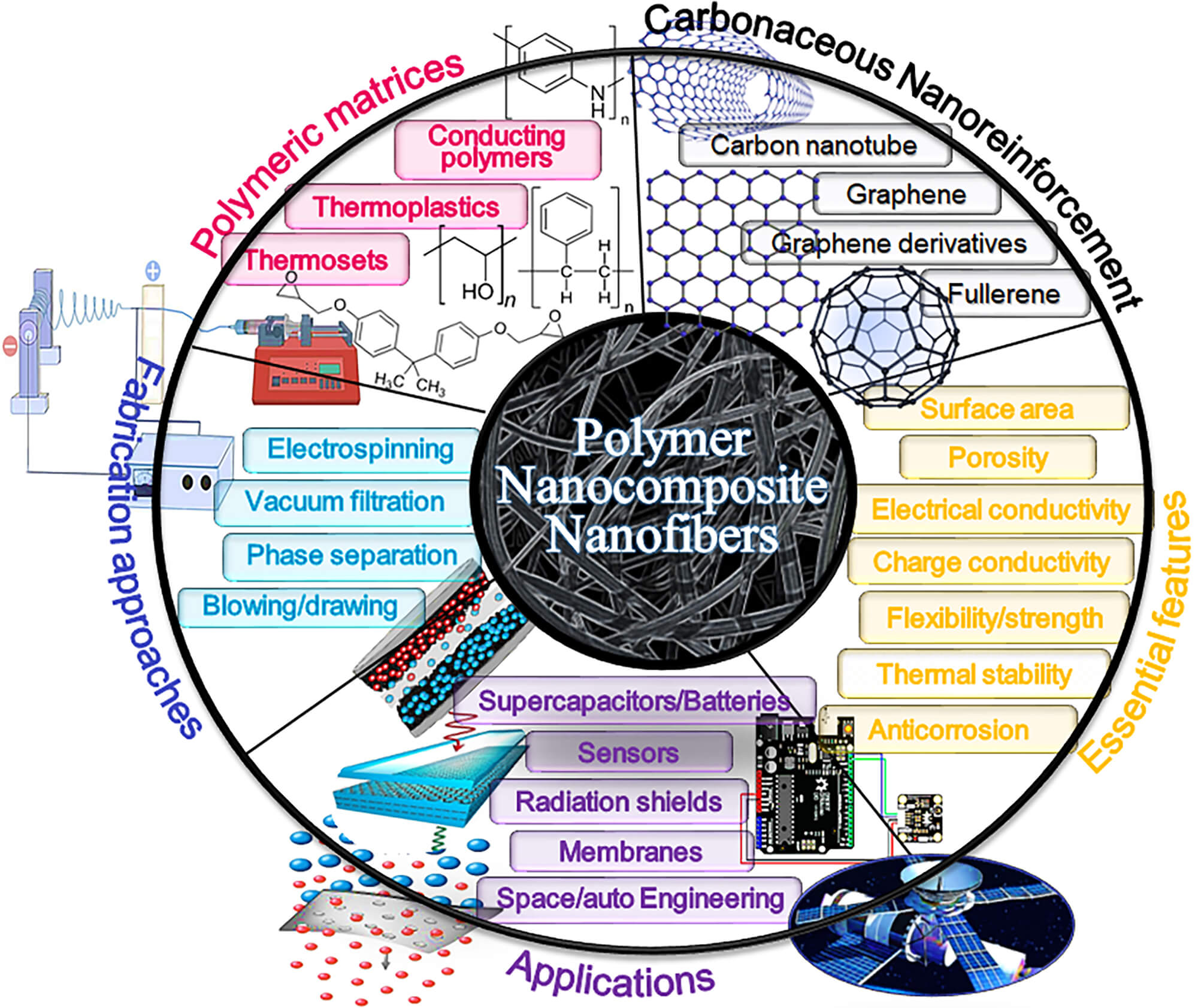
Purpose of this novel review article is to unfold the current scientific worth of high performance polymer nanocomposite nanofibers, owing to growing scientific interests in this field. Accordingly, this state-of-the-art manuscript has been systematically categorized into distinct sections related to (i) fundamentals of carbonaceous nanoreinforcements, (ii) design-structure-property-performance aspects of different categories of polymer nanocomposite nanofibers (conducting polymers, thermoplastics, and thermosets with carbonaceous nanofillers (carbon nanotubes, graphene, fullerene), and then (iii) existing scientific worth (energy devices, electronics, space/defense, environmental sectors), future prospects, challenges, and conclusions. As per literature to date, polymer/carbonaceous nanocomposite nanofibers had myriad of advantageous physical characters (morphologies, electrical/charge conduction, thermal conduction, mechanical/thermal resistance, anticorrosion, permeability, radiation absorption). Notably, among conducting polymer nanofibers, polyaniline/carbon nanotube nanofibers revealed superior specific capacitance (~380 Fg−1) due to interfacial synergies and electron/charge transfer. Moreover, poly(3-hexylthiophene):phenyl-C61-butyric acid methyl ester/fullerene nanofibers revealed power conversion efficiency ~3.6%. Out of thermoplastic systems, poly(vinyl alcohol)/carbon nanotube nanofibers have been designed for piezoelectric sensors (pressure sensitivity ~0.28 kPa−1) and toxic metal ion sensors (lead(II)). In addition, cellulose/carbonaceous nanocomposite nanofibers have been applied for supercapacitor electrodes (specific capacitance ~250 Fg−1) and electromagnetic interference shielding effectiveness (~64–70 dB). Furthermore, epoxy/carbon nanotube nanocomposites revealed ~20%–40% enhancements in tensile strength and shear strength due to load transfer properties. As per literature, technological performance of these materials depends upon types/amount of polymers, nanocarbons, and processing methods/parameters used. Owing to novelty of topic, outline, and literature coverage, this review will serve as an all-inclusive guide for concerned field researchers to carry out further industrial scale advancements in the field of nanocomposite nanofibers.Graphic Abstract
Keywords
Polymers; nanocomposites; nanofibers; carbon nanotube; graphene; electrospinning; supercapacitors; sensors; space; membranes
Cite This Article
APA Style
Kausar, A. (2026). Multifunctional Carbonaceous Nanoreinforced Polymeric Nanofibers—Bridging Fundamental Aspects to Technological Resolves. Journal of Polymer Materials, 43(1), 3. https://doi.org/10.32604/jpm.2026.078233
Vancouver Style
Kausar A. Multifunctional Carbonaceous Nanoreinforced Polymeric Nanofibers—Bridging Fundamental Aspects to Technological Resolves. J Polym Materials. 2026;43(1):3. https://doi.org/10.32604/jpm.2026.078233
IEEE Style
A. Kausar, “Multifunctional Carbonaceous Nanoreinforced Polymeric Nanofibers—Bridging Fundamental Aspects to Technological Resolves,” J. Polym. Materials, vol. 43, no. 1, pp. 3, 2026. https://doi.org/10.32604/jpm.2026.078233
 Copyright © 2026 The Author(s). Published by Tech Science Press.
This work is licensed under a Creative Commons Attribution 4.0 International License , which permits unrestricted use, distribution, and reproduction in any medium, provided the original work is properly cited.
 Downloads
 Citation Tools
