
 Login
Login Register
 Submit a Paper
 Propose a Special lssue
 Open Access
ARTICLE

Mechanical Performance and Deformation Mechanisms of Additively Manufactured Lattice Structures under Quasi-Static Compression and Finite Element Analysis
1 Department of Mechanical & Manufacturing Engineering, Faculty Engineering & Built Environment, Universiti Kebangsaan Malaysia, Bangi, Selangor, Malaysia
2 Institute of Advanced Materials and Technology, Guangdong University of Technology, Guangzhou, 510006, China
* Corresponding Author: Nabilah Afiqah binti Mohd Radzuan. Email:
Journal of Polymer Materials 2026, 43(2), 18 https://doi.org/10.32604/jpm.2026.077219
Received 04 December 2025; Accepted 17 March 2026; Issue published 30 June 2026
 View Full Text
 Download PDF
Abstract
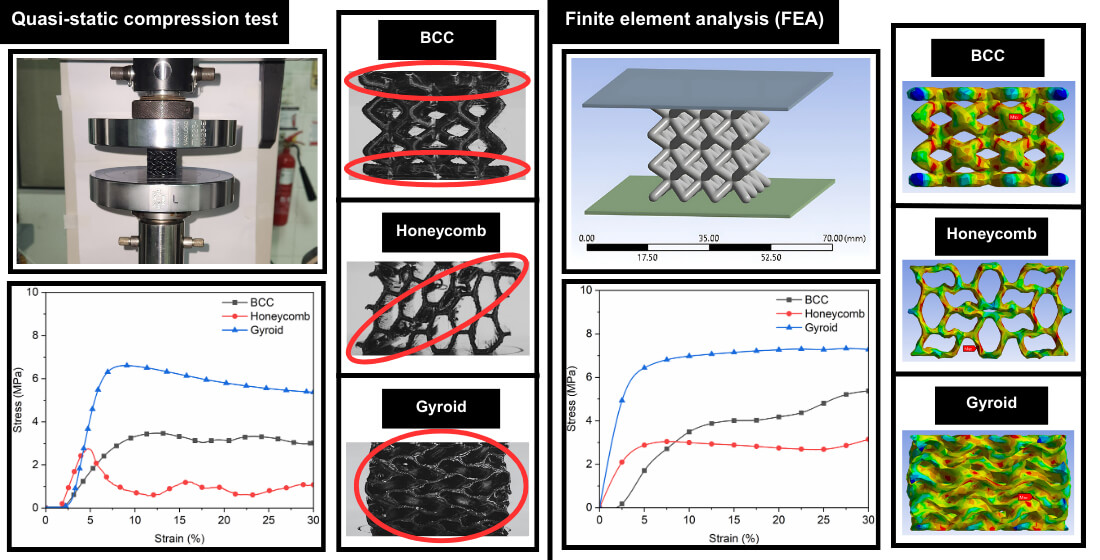
Lattice structures fabricated through additive manufacturing (AM) offer exceptional strength-to-weight ratios, as their geometries allow them to carry high loads with far less material than solid components. When paired with polylactic acid (PLA), they combine biodegradability with ease of processing, allowing the structures to be produced efficiently while also offering an environmentally friendly material option. However, comparative studies across different lattice types under uniform conditions remain limited, as many existing studies only focus on a single geometry type. Therefore, this study investigates the compressive performance of PLA lattice structures, which include body-centered cubic (BCC), honeycomb and gyroid, fabricated using fused deposition modelling (FDM). To ensure consistent mechanical performance and mitigate variability from commercial filaments, the PLA filaments used were produced in-house from raw pellets. This approach enhances material homogeneity and repeatability, which is critical for reliable comparative analysis. Quasi-static compression tests and finite element analysis (FEA) were conducted to evaluate the mechanical properties and deformation mechanisms. Results revealed that the gyroid structure outperformed the other structures, showing a 44% higher elastic modulus (199.56 MPa) and 60% higher compressive strength (6.64 MPa). The continuous topology of the gyroid structure enabled a uniform stress distribution throughout the lattice and enhanced energy absorption by promoting progressive deformation under load. Simulation results aligned with experimental trends, though slight overestimations occurred due to idealized modelling such as perfect geometry and material homogeneity. This work provides validated numerical models and practical insights for designing sustainable lightweight components in engineering applications.Graphic Abstract
Keywords
Cite This Article
 Copyright © 2026 The Author(s). Published by Tech Science Press.
This work is licensed under a Creative Commons Attribution 4.0 International License , which permits unrestricted use, distribution, and reproduction in any medium, provided the original work is properly cited.
 Downloads
 Citation Tools
