
 Login
Login Register
 Submit a Paper
 Propose a Special lssue
 Open Access
ARTICLE

Partial Oxidation of Diacrylates to Produce Epoxy-Acrylate Hybrid Monomers: Precursors for Ambient-Curable Polymeric Epoxy Resins
Graduate School of Science and Engineering, Yamagata University, Yonezawa, Japan
* Corresponding Author: Bungo Ochiai. Email:
# Present address: Faculty of Engineering, Osaka Institute of Technology, Osaka, Japan
Journal of Polymer Materials 2026, 43(2), 9 https://doi.org/10.32604/jpm.2026.078288
Received 28 December 2025; Accepted 14 April 2026; Issue published 30 June 2026
 View Full Text
 Download PDF
Abstract
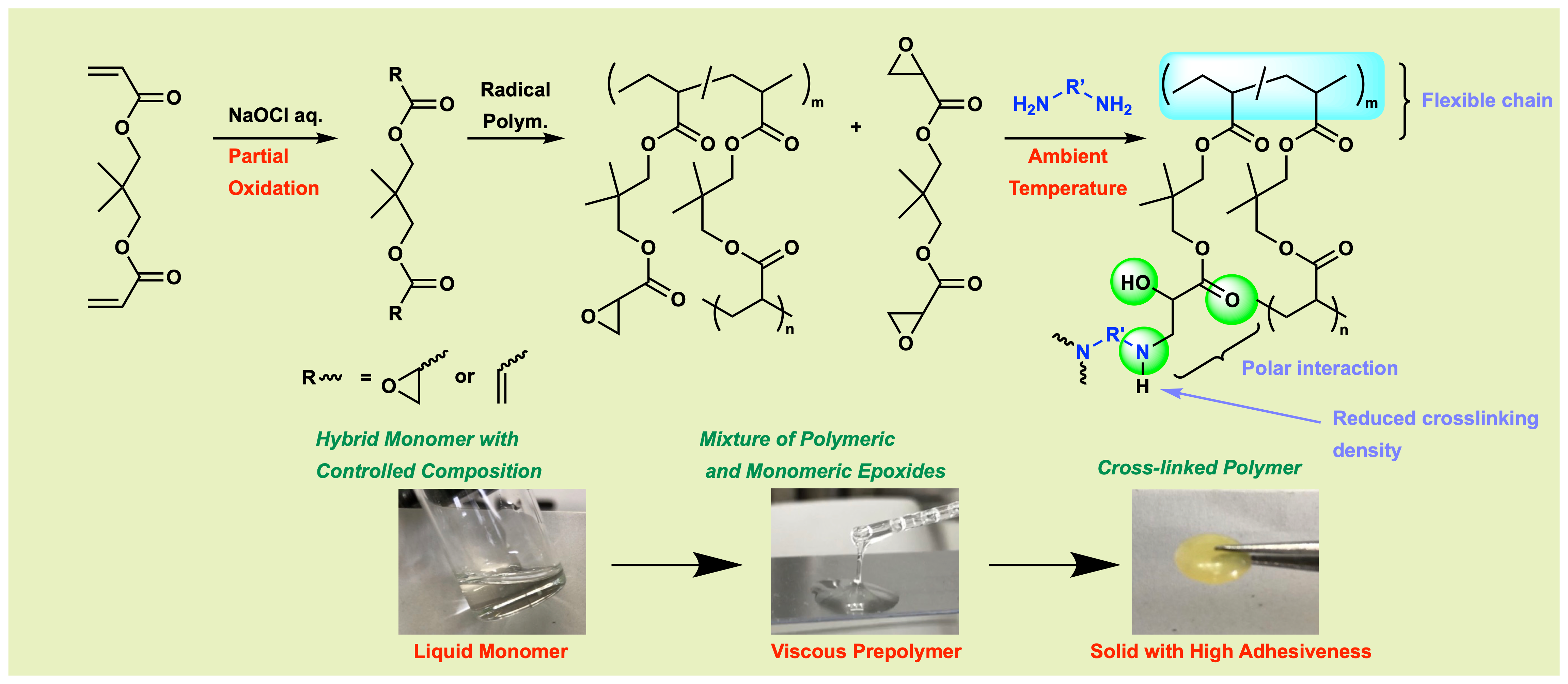
Epoxy-acrylate hybrid systems are extensively employed in adhesives, coatings, and composites; however, conventional formulations often rely on toxic monomers such as glycidyl methacrylate (GMA). This study introduces a sequentially curable epoxy-acrylate hybrid system based on novel hybrid monomers containing both glycidate and acrylate groups, synthesized via the partial oxidation of a diacrylate. Radical polymerization of monomers with a glycidate content exceeding 80% yielded viscous prepolymers consisting of epoxy-functionalized polymers and residual low-molecular-weight glycidates. These prepolymers were subsequently cured with amines at ambient temperature to form crosslinked networks. The gel fraction exceeded 90% when cured with diethylenetriamine, demonstrating efficient curing. The resulting cured materials exhibited significantly enhanced lap-shear adhesion strength (>1.6 MPa) compared to those obtained from monomeric analogs (<1.14 MPa). This improvement is attributed to the synergistic effects of polar ester groups, flexible polymeric spacers, and a loose network structure resulting from the reduced nucleophilicity of γ-keto secondary amine intermediates, as supported by density-functional-theory calculations. This two-stage curing approach provides a GMA-free, ambient-curable polymeric epoxy resins, offering a safer and more versatile strategy for the molecular design of high-performance hybrid materials.Graphic Abstract
Keywords
Supplementary Material
Supplementary Material FileEpoxy resins find widespread application in paints, electronic devices, adhesives, and coatings, primarily due to their excellent mechanical properties, chemical resistance, and strong adhesion. These attributes stem from their robust three-dimensional network structures and the ability to tailor curing processes and final material properties through the selection of diverse curing agents [1,2]. Given their broad versatility, epoxy resins function effectively as both primary matrices and additives to enhance the performances of other polymer materials. For example, glycidyl methacrylate (GMA), which contains both a radically polymerizable methacryloyl group and an epoxy group, is widely used for hybridizing polymers prepared by radical polymerization, such as polyacrylates, and epoxy curing systems [3–5]. Reactive polymers based on GMA facilitate the formation of phase-separated structures, crosslinked networks, and multi-stage curing systems, which improve impact strength, chemical resistance, and workability. However, the toxicity of GMA—affecting ocular, digestive, respiratory, and dermal systems [6]—and its potential carcinogenicity have prompted a critical search for safer alternatives.
To address the challenges of combining vinyl polymers and epoxy resins, various strategies have emerged, including the use of epoxy oligomers terminated with acrylate [7–11] or methacrylate [12] groups and the curing of epoxides with vinyl polymers bearing reactive side chains [13] or terminal groups [14,15]. Epoxy oligomers or prepolymers bearing (meth)acrylates, often termed “epoxy acrylates”, are typically prepared by reacting epoxy-terminated monomers [7,11,12] or oligomers [8–10] with (meth)acrylic acid. While epoxy acrylates offer advantages such as faster curing and low-temperature processes, resulting in high performances [16,17], their storage stability is often insufficient. Nevertheless, such hybridization has expanded the molecular design landscape for cured materials, leading to products with tailored properties.
Our group has proposed glycidates, which are epoxides prepared by the oxidation of acrylates [18,19], as safer alternatives. Since various multifunctional acrylates are commercially available, their partial epoxidation is expected to yield a variety of monomers having both glycidate and acrylate moieties. Notably, glycidates demonstrate lower toxicity compared to their glycidyl ether analogs. For instance, neopentyl glycol diglycidate (NPG), a compound used in this study, caused 50% cell death for E. coli in a medium containing 10 mg mL−1 NPG, whereas the corresponding glycidyl ether, neopentyl glycol diglycidyl ether (NPGE), resulted in over 90% cell death [20].
Furthermore, amine curing of glycidates proceeds smoothly at ambient temperature, achieving higher adhesive strength compared to the analogous glycidyl ether-based curing [21]. The resulting cured materials are degradable via hydrolytic and enzymatic treatments, with degradability controlled by polarity of substituents [22]. Curing NPG with cyclic acid anhydrides also yields crosslinked polyesters with high adhesive strength [23]. Biodegradation of these cured polyesters proceeds efficiently in compost through the predominant cleavage of ester linkages originating from the glycidate monomer. In contrast, analogous crosslinked polyesters of NPGE are not degradable, despite containing ester linkages originating from the connection of the glycidate and acid anhydride units [23].
Building on these findings, this study expands the application of glycidates to a two-stage epoxy curing system derived from polymeric epoxy resins. This was achieved by synthesizing and polymerizing glycidate/acrylate (GA) mixed monomers prepared by the partial oxidation of neopentyl glycol diacrylate, followed by crosslinking reactions of the resulting prepolymers (Fig. 1). Neopentyl glycol was selected as a safe diol segment due to its very low toxicity (oral LD50 in rats: 3200–6920 mg kg−1) [24]. Liquid GA monomers were synthesized, and their polymerization yielded viscous prepolymers composed of epoxy-containing polymers and the diglycidate monomer (PGA). Subsequent curing of these prepolymers with amines at room temperature produced cured materials with high adhesive strengths, demonstrating the potential of this glycidate-acrylate hybrid system as a safer and more effective platform for epoxy-acrylate hybrid materials.

Figure 1: Amine curing of glycidate-based polymers prepared by radical polymerization of partially epoxidized diacrylate.
Neopentyl glycol diacrylate (NPA) (>89.0%), lauryl sulfobetain (>98.0%), 2,2′-azobisisobutyronitrile (AIBN) (>98.0%), diethylenetriamine (DETA) (>98.0%), and m-xylylenediamine (XDA) (>99.0%) were purchased from Tokyo Chemical Industry (Tokyo, Japan). Ethyl acetate (>99.5%), tetrahydrofuran (THF) (>99.5%), 5% NaOCl aq. (Extra pure grade), trisodium citrate dihydrate (>99.0%), magnesium sulfate (>98.0%), dehydrated toluene (>99.5%), and N,N-dimethylformamide (DMF) (>99.0%) were purchased from Kanto Chemical (Tokyo, Japan). NPG was prepared as reported [18–20]. All the reagents were used as received.
2.2.1 Synthesis of GA Monomers by Partial Oxidization of NPA
NPA (5.31 g, 5.00 mmol), lauryl sulfobetain (2.7 g, 32 mol% to NPA), and 5wt% NaOCl aq. (0.6–2.4 eq.) were added in a 200-mL round bottom flask. The mixture was stirred at 40°C. Then, the organic fraction was extracted with ethyl acetate (100 mL). The organic layer was washed sequentially with a saturated aqueous solution of trisodium citrate (80 mL) and brine (80 mL, three times) and dried with MgSO4. After filtration, the concentrated residue was purified by SiO2 gel column chromatography eluted with ethyl acetate. For the calculation of yields, ethyl acetate was evaporated under a vacuum.
2.2.2 Radical Polymerization of GA Monomers
To avoid spontaneous polymerization, GA was treated as solution. Toluene was added to the ethyl acetate solution of GA obtained in the above-mentioned procedure. Then, ethyl acetate was evaporated to obtain toluene solutions of GA. The concentration of GA was adjusted to 2.0 mol/L, and the toluene solution of GA (1.50 mL, 3.00 mmol of GA monomers) and AIBN (4.9 mg, 1.0 mol%) were added to a 20-mL round bottom flask. The polymerization was carried out under a nitrogen atmosphere. The conversion of the vinyl group was monitored by 1H NMR spectroscopy. Viscous products were obtained after evaporation of toluene under reduced pressure.
2.2.3 Curing of PGA with Amines
PGA90/10 (conversion of C=C > 99%) (150 mg) and DETA (60–107 μL) or XDA (27–82 μL) were added to a glass vial. The mixture was cured at room temperature (ca. 25°C) for 24 h. The gel fractions were determined by removing soluble fractions by Soxhlet extraction with THF and drying under reduced pressure at 60°C overnight.
1H NMR spectra were measured on a JEOL ECX-400 (400 MHz) spectrometer using tetramethylsilane as an internal standard. Fourier transform infrared (FTIR) spectra were measured on a Shimadzu (Kyoto, Japan) IRSpirit spectrometer equipped with a Shimadzu QATR-S attenuated total reflection accessory with a diamond disk with a step of 4 cm–1. Differential scanning calorimetry (DSC) measurements were conducted on a Seiko Instruments (Tokyo, Japan) DSC6200 instrument at a scanning rate of 10°C min−1 under N2 flow. The glass transition temperatures (Tgs) were determined as the midpoints of the baseline shifts. Size exclusion chromatography (SEC) analysis was conducted on a Tosoh HLC-8220 GPC instrument equipped with a differential refractive index detector and polystyrene-gel tandem columns of Tosoh TSKgel Super AW 3000, Super AW 4000, and Super AW 5000. THF was used as an eluent (flow rate = 1.0 mL min−1) at 40°C. Single lap shear stress tests were conducted on an Imoto Machinery (Kyoto, Japan) IMC-90FE material testing machine with a load cell (20–1000 N) at a tensile rate = 5 mm min−1. A mixture of an epoxide and an amine with the equimolar amount of the epoxy and amine groups was applied between two rectangular aluminum plates and was cured at 25°C for 6 h. The size of adhesion part was 25 mm × 12.5 mm. Triplicate measurements were conducted.
All the calculations were performed using density functional theory (DFT) at the B3LYP level [25,26] using the Gaussian 09 Revision D. 01 program package [27]. Three-dimensional structures were visualized using Avogadro software. Geometry optimizations were carried out without symmetry constrains using the 6-31G+ basis set. The highest occupied molecular orbital energies (EHOMO) were calculated for molecules solvated in methanol using the polarizable continuum model at the 6-311G+(d,p) level. Fukui functions (fk–) were calculated as the differences of charge model 5 (CM5) charges of N and N–1 electronic species. The Cartesian coordinates of the optimized geometries are provided in Table S1.
3.1 Synthesis of Glycidate-Acrylate Hybrid Monomers
Hybrid GA monomers with various compositions of glycidate and acrylate moieties were prepared by the oxidation of NPA using varying amounts of aqueous NaOCl solution in the presence of lauryl sulfobetaine as a phase transfer catalyst (Scheme 1 and Table 1). The monomers are abbreviated as GAx/y, where x and y represent the molar ratios of glycidate and acrylate moieties, respectively. Yields decreased as the glycidate content increased, likely due to hydrolysis of ester and glycidate groups occurring under highly basic conditions. However, the byproducts in the aqueous layer containing residual NaOCl were not analyzed to avoid the potential hazards associated with concentrated oxidants during workup. GAx/y monomers with acrylate contents greater than approximately 20% were prone to spontaneous polymerization of the acrylate moieties, leading to the formation of insoluble products during isolation or storage. Consequently, these GA monomers were stored as ethyl acetate solutions prior to use (Fig. S1). In contrast, GAx/y with acrylate contents lower than 20% exhibited sufficient storage stability. For instance, GA87/13 remained stable in a refrigerator for several months without solvent. Although precise control of compositions within a 5% margin was challenging, the resultant ratios varied slightly between batches conducted under the identical conditions (e.g., GA77/23 and GA82/18). This variation is possibly attributed to the gradual degradation of NaOCl during storage [28]. Thus, subsequent experiments used GA monomers with compositions specific to each batch, which may differ slightly from those listed in Table 1.

Scheme 1: Synthesis of monomers bearing glycidate and acrylate moieties.

3.2 Radical Polymerization of Glycidate-Acrylate Hybrid Monomers
The radical polymerization of GA monomers was investigated in toluene (2 M) using AIBN (1 mol%) as an initiator (Scheme 2 and Table 2). Polymerization of GA49/51 and GA67/33 at 60°C resulted in the formation of insoluble products within 30 min due to the crosslinkage originating from the residual NPA. Conversely, the polymerization of GA81/19 and GA88/12 at 60°C proceeded homogeneously, yielding viscous products. However, residual acrylate moieties remained in these products, indicating that higher temperatures are necessary for complete conversion. Notably, GA monomers with the acrylate contents of approximately 20% (ranging from GA79/21 to 82/18) achieved nearly quantitative acrylate conversion after polymerization at 70°C for 12 h. In contrast, polymerization at 80°C led to the formation of insoluble solids. This is likely due to the chain transfer reactions at the methylene group adjacent to the oxygen, which occur during the polymerization of various acrylates [29]. Meanwhile, the polymerization of GA88/12 at 80°C yielded a viscous liquid with complete acrylate conversion. These resulting viscous liquids were soluble in common organic solvents such as ethyl acetate, THF, and DMF.

Scheme 2: Radical polymerization of GA hybrid monomers.

The radical polymerization kinetics were monitored using 1H NMR spectroscopy. For GA81/19, complete conversion of the acrylate moieties was achieved within 10 h at 70°C, whereas the polymerization at 60°C remained incomplete (Fig. 2). In contrast, the polymerization of GA88/12 required higher temperature to reach completion. Quantitative conversion was attained at 80°C within 8 h, while at 70°C, the conversion plateaued at approximately 90% after 4 h (Fig. 3). This reduced polymerizability of GA88/12 likely stems from the lower concentration of acrylate moieties in the reaction system. The resulting polymerized products are abbreviated as PGA, followed by the compositions of their corresponding monomers (e.g., PGA82/18 for the polymer derived from GA82/18).

Figure 2: Conversion of C=C groups over time during radical polymerization of GA81/19 in 2 M toluene solution at 70°C (●) and 60°C (○) monitored by 1H-NMR spectroscopy (CDCl3, 400 MHz).

Figure 3: Conversion of C=C groups over time during radical polymerization of GA88/12 in 2 M toluene solution at 80°C (●) and 70°C (○) monitored by 1H-NMR spectroscopy (CDCl3, 400 MHz).
The products, PGA82/18 (Table 2, Run 4) and PGA88/12 (Table 2, Run 8), were confirmed to consist of NPG contained in GA monomers and polymers bearing glycidate side chains (Fig. 4). In the 1H NMR spectra, broad signals corresponding to the polymeric products were observed alongside sharp signals from low-molecular-weight glycidate species. The glycidate contents in PGA88/12 and PGA81/19 were calculated from the integral ratios of the epoxy protons (a, a′, b, and b′ in Fig. 4) and methyl protons in the neopentyl group (e and e′ in Fig. 4), yielding values of 90% and 82%, respectively. These ratios closely align with the glycidate contents in the starting monomers, confirming that the radical polymerization of the acrylate moieties proceeded selectively without observable side reactions involving the glycidate moieties. This selectivity is further supported by the fact that the soluble fraction of the crosslinked products obtained by the radical polymerization of GA67/33 (Table 2, Run 2) consisted almost entirely of NPG (Fig. S2).

Figure 4: 1H NMR spectrum of the products obtained by radical polymerization of GA82/18 at 70°C for 12 h in toluene (2.0 M) (CDCl3, 400 MHz).
SEC analysis revealed the coexistence of low- and high-molecular-weight fractions in PGA81/19 and PGA88/12 (Table 3 and Fig. 5). Both PGA81/19 and PGA88/12 contained high-molecular-weight fractions with molecular weights exceeding 105 Da, which can be attributed to the interchain polymerization of residual NPA. The relative contents of monomeric NPG and polymeric products were estimated from the peak areas of the elution corresponding to NPG at an elution time of 28 min and the higher-molecular-weight region. The calculated NPG/polymer ratios were 66/34 for PGA81/19 and 77/23 for PGA88/12. These NPG contents align well with the theoretical compositions calculated based on a statistical distribution of epoxidation, assuming the formation of NPG, GA, and NPA monomers. For GA81/19, the theoretical NPG/GA/NPA ratio is 66/31/4 (calculated ratio = 65.6/30.8/3.6), while for GA88/12, it is 77/21/1 (calculated ratio = 77.4/21.1/1.4). The higher NPA content in GA81/19 correlates with the higher Mn and broader Mw/Mn observed for PGA81/19, as NPA acts as a crosslinking agent during radical polymerization.


Figure 5: SEC profiles of (a) PGA81/19 and (b) PGA88/12 eluted by THF.
3.3 Curing of Polymers of Glycidate-Acrylate Hybrid Monomers
PGA, comprising glycidate-bearing oligomers and polymers along with residual NPG, was cured in bulk using DETA and XDA at an initial stoichiometry of [epoxy]0/[N–H]0 = 1/1.5 (Scheme 3 and Table 4). For this study, PGA90/10 and PGA82/18 were selected as the prepolymers. The initial mixtures of PGA and these amines were viscous liquids, which successfully transformed into insoluble solids after curing at ambient temperature for 24 h.

Scheme 3: Curing of PGA with amines.

The gel fraction of the product cured with DETA exceeded 90%, indicating highly efficient crosslinking. Both the gel fraction and Tg were higher than those of the cured products derived from PGA with lower (Run 2) or no (Run 3) acrylate conversion. This difference suggests that the polymeric glycidate effectively promoted crosslinking due to the presence of high-molecular-weight components bearing multiple epoxy side chains. The Tg values were also 20°C–30°C higher than those of cured products derived solely from NPG [18], likely because the high-molecular-weight segments restricted molecular motion within the crosslinked network.
Crosslinking via the ring-opening addition of amino groups to the epoxy ring was confirmed by FTIR spectroscopic analysis (Fig. 6). The characteristic epoxy ring peak at 868 cm−1, which is observable in the prepolymer spectrum, is unobservable in the spectrum of the cured product. The persistence of the ester linkage was confirmed by the signal at 1732 cm−1, while a new peak at 1645 cm−1 suggests the formation of amide groups. As discussed later, these amide groups likely result from the nucleophilic substitution of the ester moieties by the amines [30]. Additionally, the broad absorption around 3500 cm–1 in the spectrum of the cured product indicates the presence of hydroxy groups generated by the ring-opening of the epoxy rings and residual N–H moieties.

Figure 6: FTIR spectra of (a) the polymerized product of GA90/10 (conversion of acrylate > 99%) and (b) its cured products obtained by curing with DETA in the equimolar feed ratios of N-H to epoxide at room temperature for 24 h.
Furthermore, the effect of the amine feed ratio on the gel fraction was examined (Fig. 7). For polymers cured with DETA, high gel fractions were observed across a wide range of feed ratios. The maximum gel fraction was achieved at a 1.5 molar equivalent of N–H groups relative to the epoxy rings. This ratio corresponds to the equimolar amount of primary and secondary amine groups to the epoxy ring. The epoxy contents in the soluble fractions after Soxhlet extraction increased as the amine feed ratio decreased, which correlated with the lower gel fractions (Fig. 8). These higher epoxy contents in the soluble fractions at lower amine feed ratios demonstrate insufficient crosslinking. In contrast, epoxy moieties were undetectable in the soluble fractions obtained using more than 1.25 equivalents of N–H groups, where the gel fractions exceeded 80%. Concurrently, the contents of primary hydroxy group—produced by the nucleophilic substitution of the ester moieties by the amines to produce amide groups—increased. The observed decrease in gel fractions at higher amine feed ratios is attributable to this side reaction, which reduces the crosslinking density and leads to the elimination of neopentyl glycol.

Figure 7: Gel fractions of cured products obtained by curing of PGA90/10 (conversion of acrylate > 99%) with (a) DETA and (b) XDA with various feed ratios of N–H to epoxide after Soxhlet extraction with THF for 10 h.

Figure 8: Epoxy and alcohol contents in soluble fractions obtained by Soxhlet extraction of cured products of PGA90/10 and DETA with THF for 10 h.
The presence of epoxy groups at the stoichiometric N–H feed is attributable to the reduced reactivity of the secondary amine groups formed by the first addition of amines to the glycidate ring. When a primary amino group reacts with a glycidate, it forms a γ-keto secondary amine group, in which the carbonyl moiety reduces the nucleophilicity of the nitrogen atom through its electron-withdrawing effect. This reduced nucleophilicity likely diminishes the rate of the further addition of the secondary amine to epoxy rings, similar to the behavior observed in the aza-Michael addition of amines to acrylates [30,31]. This contrast is notable compared to the curing of glycidyl ethers with amines, where the second addition typically proceeds smoothly due to the electron-donating ability of the alkyl substituents, despite increased steric hindrance [32,33].
The reduced nucleophilicity of the γ-keto secondary amine was supported by DFT calculations using model amines: an amine with a γ-carbonyl group (Amine-C=O) representing the species reacted with a glycidate, and an amine with a γ-methyl group (Amine-Me) representing the species reacted with a glycidyl ether (Fig. 9, Table 5). The CM5 charge of the nitrogen atom in Amine-C=O is lower than that in Amine-Me, suggesting decreased electron density due to the electron-withdrawing carbonyl group. Additionally, the fk– value—derived as the difference in charges between the neutral (N) and cationic (N–1) species [34]—is also lower for Amine-C=O, indicating lower electrophilicity of its nitrogen atom. Furthermore, the lower EHOMO and local nucleophilicity index (Nk), which correlate well with experimental nucleophilicity [35,36], further supports this trend for Amine-C=O. The HOMO of Amine-C=O extends toward the C–O bond at the β-position due to the electron-withdrawing effect of the carbonyl group, visualizing the reduced nucleophilicity of the reacted amine moieties. These results, combined with the similar steric hindrance around the nitrogen atoms, confirm the reduced nucleophilicity of amine groups after the reaction with a glycidate group.

Figure 9: Structures and HOMO of model amines of (a) glycidate (Amine-C=O) and (b) glycidyl ether (Amine-Me).

The gel fractions of products cured with XDA were consistently lower than those cured with DETA, which can be attributed to the inherently lower nucleophilicity of the benzylic amine moieties in XDA [32]. For the XDA-cured samples, the maximum gel fraction was attained at a feed ratio of [epoxy]0/[NH]0 = 1/2.0. This ratio corresponds to the stoichiometric equivalence of the primary amine group to the epoxy ring. This result further supports the presumption that the second addition of the γ-keto secondary amine group to the glycidate group is unfavorable.
3.4 Adhesive Properties of Cured Glycidate-Acrylate Hybrid Polymers
The adhesive strength of the cured PGA systems was evaluated using single-lap shear tests at a tensile rate of 5 mm/min (Table 6). PGA90/10 was mixed with either DETA or XDA at a stoichiometric ratio ([N–H]0/[epoxy]0 = 1.0), applied between aluminum plates, and cured at 25°C for 6 h. The specimens bonded with PGA90/10 exhibited no failure even at loads exceeding the instrument’s maximum measurable stress of 1.6 MPa. This performance significantly surpasses the adhesion strengths achieved with the monomeric analogs: the glycidate (NPG, Run 2) and the glycidyl ether (NPGE, Run 1).

The superior adhesion of the amine-cured PGA90/10 is attributed to three primary factors (Fig. 10). First, the high concentration of ester groups enhances the adhesion of epoxy resins through polar interaction between the ester carbonyl groups, cooperatively with the amine and hydroxy groups, and the aluminum surface [37,38]. Second, the flexible and long polymeric spacer [39–43] facilitate stress dissipation, supported by the lower pencil hardness of the PGA90/10-DETA system compared to the cured NPG-DETA system. Specifically, the flexible polyacrylate chains effectively dissipate internal stress, despite their lower hardness [13,42]. Third, the loose crosslinking network—resulting from the slower second addition of the γ-keto secondary amine groups as described above [31]—further contributes to stress relaxation. Collectively, these mechanisms enhance the adhesion via the strengthened interfacial interactions and efficient stress dissipation within the adhesive layer. Additionally, as detailed in our prior work [21], the faster curing kinetics inherent to glycidates may also be a plausible factor for the enhanced adhesion.


Figure 10: Proposed mechanisms for the enhanced adhesion of the amine-cured PGA systems: (a) cooperative polar interactions between the PGA skeleton (ester, hydroxy, and amino groups) and the aluminum surface; (b) stress dissipation facilitated by the flexible polyacrylate chain motion; and (c) stress relaxation derived from the lower crosslinking density, originating from the reduced nucleophilicity of γ-keto secondary amine intermediates in glycidate curing compared to glycidyl ether curing.
A sequentially curable epoxy-acrylate hybrid system was developed using hybrid monomers bearing both glycidate and acrylate moieties, prepared via the partial oxidation of a diacrylate. Radical polymerization of monomers with glycidate contents exceeding 80% successfully produced viscous prepolymers, consisting of polymers with epoxy side chains and low-molecular-weight glycidates. Subsequent amine curing of these prepolymers proceeded efficiently at ambient temperature. To achieve high curing efficiency, quantitative conversion of the acrylate moieties was essential. These viscous prepolymers are promising candidates for B-stage epoxy applications.
The resulting cured products exhibited enhanced adhesion to aluminum plates (lap shear stress >1.6 MPa) compared to the cured products of analogous monomeric glycidyl ether and glycidate. While the absolute adhesive strength of the current system remains limited by the inherent flexibility of the neopentyl glycol-based polyacrylate backbone, this study provides critical chemical insights into the curing behavior of this GA monomer system. Specifically, the reduced nucleophilicity of the γ-keto secondary amine groups was identified as a key factor influencing the crosslinking behavior.
Importantly, this two-stage curing system enables the hybridization of polyacrylate and epoxides without the use of toxic and potentially carcinogenic GMA. Furthermore, this strategy is applicable to a wide range of commercially available multifunctional acrylates, offering extensive structural diversity. This work establishes a fundamental platform for designing next-generation epoxy-acrylate materials that balance tunable mechanical properties, ease of handling, and enhanced safety through strategic molecular designs.
Acknowledgement: We thank the kind advice from Tetsuya Hosomi of Nagase ChemteX Co. Inc.
Funding Statement: The authors received no specific funding for this study.
Author Contributions: The authors confirm contribution to the paper as follows: Conceptualization, Bungo Ochiai; methodology, Bungo Ochiai and Yuji Kamachi; software, not applicable; validation, Bungo Ochiai and Yoshimasa Matsumura; formal analysis, Bungo Ochiai and Yuji Kamachi; investigation, Yuji Kamachi; resources, Bungo Ochiai and Yoshimasa Matsumura; data curation, Bungo Ochiai and Yuji Kamachi; writing—original draft preparation, Bungo Ochiai and Yuji Kamachi; writing—review and editing, Bungo Ochiai, Yuji Kamachi, and Yoshimasa Matsumura; visualization, Bungo Ochiai and Yuji Kamachi; supervision, Bungo Ochiai; project administration, Bungo Ochiai; funding acquisition, Bungo Ochiai. All authors reviewed and approved the final version of the manuscript.
Availability of Data and Materials: The data that support the findings of this study are available from the Corresponding Author, Bungo Ochiai upon reasonable request.
Ethics Approval: Not applicable.
Conflicts of Interest: The authors declare no conflicts of interest.
Supplementary Materials: The supplementary material is available online at https://www.techscience.com/doi/10.32604/jpm.2026.078288/s1. Figure S1, 1H NMR spectra of GA88/12 in ethyl acetate and GA81/19 in toluene (400 MHz, CDCl3); Figure S2, 1H NMR spectrum of soluble fractions obtained by Soxhlet extraction of cross-linked product with THF (400 MHz, CDCl3); Table S1, Cartesian coordinates of Amine-C=O and Amine-Me calculated by DFT calculation.
References
1. Hajebi S, Payamani M, Fattahi H, Mortezaei M, Jalilolghadr S. Dual-curing epoxy thermosets: design, curing, properties and applications. Polym Rev. 2025;65(1):250–80. doi:10.1080/15583724.2024.2405684. [Google Scholar] [CrossRef]
2. Gziut K, Kowalczyk A, Schmidt B, Idzik TG, Sośnicki JG. Influence of methacrylate and vinyl monomers on radical bulk photopolymerization process and properties of epoxy-acrylate structural adhesives. Polymers. 2023;15(4):926. doi:10.3390/polym15040926. [Google Scholar] [PubMed] [CrossRef]
3. Wang T, Wang J, Chen W, Duan H, Xiao H, Wang J, et al. Toughening epoxy resins by modification with in situ polymerized acrylate copolymer composed of butyl acrylate and glycidyl methacrylate. High Perform Polym. 2015;27(2):177–82. doi:10.1177/0954008314542473. [Google Scholar] [CrossRef]
4. Cañamero P, Fernández-García M, de la Fuente JL. Adhesives based on poly (glycidyl methacrylate-co-butyl acrylate) with controlled structure: curing behavior and adhesion properties on metal substrates. Macromol Mater Eng. 2024;309(2):2300267. doi:10.1002/mame.202300267. [Google Scholar] [CrossRef]
5. Roig A, Ramis X, De la Flor S, Serra À. Dual-cured thermosets from glycydil methacrylate obtained by epoxy-amine reaction and methacrylate homopolymerization. React Funct Polym. 2021;159:104822. doi:10.1016/j.reactfunctpolym.2021.104822. [Google Scholar] [CrossRef]
6. Fernandes BJD, Couto RD. Toxicological alert: exposure to glycidyl methacrylate and cancer risk. Toxicol Ind Health. 2020;36(12):937–9. doi:10.1177/0748233720957816. [Google Scholar] [PubMed] [CrossRef]
7. Jeong WW, Kim JW, Suh KD. Ultraviolet-curable epoxy acrylate dispersions: effect of urethane acrylate anionomers on stabilizing and film properties. Colloid Polym Sci. 1998;276(11):976–83. doi:10.1007/s003960050336. [Google Scholar] [CrossRef]
8. Chattopadhyay DK, Panda SS, Raju KVSN. Thermal and mechanical properties of epoxy acrylate/methacrylates UV cured coatings. Prog Org Coat. 2005;54(1):10–9. doi:10.1016/j.porgcoat.2004.12.007. [Google Scholar] [CrossRef]
9. Park YJ, Lim DH, Kim HJ, Park DS, Sung IK. UV- and thermal-curing behaviors of dual-curable adhesives based on epoxy acrylate oligomers. Int J Adhes Adhes. 2009;29(7):710–7. doi:10.1016/j.ijadhadh.2009.02.001. [Google Scholar] [CrossRef]
10. Çanak TÇ, Kaya K, Serhatlı IE. Boron containing UV-curable epoxy acrylate coatings. Prog Org Coat. 2014;77(11):1911–8. doi:10.1016/j.porgcoat.2014.06.021. [Google Scholar] [CrossRef]
11. Binyamin E, Grossman E, Gorodnitsky M, Kam D, Magdassi S. 3D printing thermally stable high-performance polymers based on a dual curing mechanism. Adv Funct Mater. 2023;33(24):2214368. doi:10.1002/adfm.202214368. [Google Scholar] [CrossRef]
12. Bednarczyk P, Irska P, Gziut K, Mozelewska K, Ossowicz-Rupniewska P. Synthesis of hybrid epoxy methacrylate resin based on diglycidyl ethers and coatings preparation via cationic and free-radical photopolymerization. Int J Mol Sci. 2022;23(24):15592. doi:10.3390/ijms232415592. [Google Scholar] [PubMed] [CrossRef]
13. Escriba-Flores A, Fernández-Francos X, Ferrando F, Fabregat-Sanjuan A. Evaluation of the effect of coupling agent on the kinetic and mechanical properties of a 3D printable dual curing epoxy/acrylate system. Eur Polym J. 2025;229:113878. doi:10.1016/j.eurpolymj.2025.113878. [Google Scholar] [CrossRef]
14. Shukla SK, Srivastava D. Studies on the blends of modified epoxy resin and carboxyl-terminated polybutadiene (CTPB)—II: thermal and mechanical characteristics. J Mater Sci. 2007;42(9):3215–22. doi:10.1007/s10853-006-1359-y. [Google Scholar] [CrossRef]
15. Zaioncz S, Silva AA, Sirqueira AS, Soares BG. Toughening of epoxy resin by methyl methacrylate/2-ethylhexyl acrylate copolymers: the effect of copolymer composition. Macromol Mater Eng. 2007;292(12):1263–70. doi:10.1002/mame.200700227. [Google Scholar] [CrossRef]
16. Mason KS, Kim JW, Recker EA, Nymick JM, Shi M, Stolpen FA, et al. Multicolor digital light processing 3D printing enables dissolvable supports for freestanding and non-assembly structures. ACS Cent Sci. 2025;11(6):975–82. doi:10.1021/acscentsci.5c00289. [Google Scholar] [PubMed] [CrossRef]
17. Kim JW, Allen MJ, Recker EA, Stevens LM, Carter HL, Uddin A, et al. Hybrid epoxy-acrylate resins for wavelength-selective multimaterial 3D printing. Nat Mater. 2025;24(7):1116–25. doi:10.1038/s41563-025-02249-z. [Google Scholar] [PubMed] [CrossRef]
18. Moriwaki Y, Akaishi R, inventors; Oosaka Yuki Kagaku Kogyo, assignee. Preparation of α,β-epoxycarboxylic acid derivatives. Japan patent JP2892866B2; 1991 Aug 6. [Google Scholar]
19. Ochiai B, Hirano T. Facile synthesis of glycidates via oxidation of acrylates with aqueous solution of NaOCl in the presence of ammonium salts. Heterocycles. 2014;89(2):487–93. doi:10.3987/COM-13-12895. [Google Scholar] [CrossRef]
20. Ochiai B, Yano S, Soegawa K, inventors; Yamagata University, assignee. Novel polyfunctional glycidic acid ester compound, production method thereof and polymer using the same. Japan patent JP2015214497A; 2014 May 8. [Google Scholar]
21. Ochiai B, Soegawa K. Glycidate as a high-strength epoxy adhesive curable with amine under ambient conditions. Polymers. 2022;14(5):957. doi:10.3390/polym14050957. [Google Scholar] [PubMed] [CrossRef]
22. Ochiai B, Nakazawa Y, Matsumura Y, Kawai T. Hydrolytic degradation and biomineralization of amine-cured epoxy resin based on glycidate. Polym J. 2024;56(4):409–17. doi:10.1038/s41428-023-00880-8. [Google Scholar] [CrossRef]
23. Ochiai B, Yashima M, Soegawa K, Matsumura Y. Biodegradable epoxy thermosetting system with high adhesiveness based on glycidate-acid anhydride curing. ACS Macro Lett. 2023;12(1):54–8. doi:10.1021/acsmacrolett.2c00626. [Google Scholar] [PubMed] [CrossRef]
24. Fiume MM, Bergfeld WF, Belsito DV, Hill RA, Klaassen CD, Liebler DC, et al. Safety assessment of trimellitic anhydride copolymers as used in cosmetics. Int J Toxicol. 2020;39(3_suppl):74S–92S. doi:10.1177/1091581820958690. [Google Scholar] [PubMed] [CrossRef]
25. Becke AD. Density-functional thermochemistry. III The role of exact exchange. J Chem Phys. 1993;98(7):5648–52. doi:10.1063/1.464913. [Google Scholar] [CrossRef]
26. Lee C, Yang W, Parr RG. Development of the Colle-Salvetti conelation energy formula into a functional of the electron density. Phys Rev B. 1988;37(2):785–9. doi:10.1103/PhysRevB.37.785. [Google Scholar] [PubMed] [CrossRef]
27. Frisch MJ, Trucks GW, Schlegel HB, Scuseria GE, Robb MA, Cheeseman JR, et al. Gaussian 09, Revision D.01 [computer program]. Wallingford, CT, USA: Gaussian, Inc.; 2013. [Google Scholar]
28. Pişkin B, Türkün M. Stability of various sodium hypochlorite solutions. J Endod. 1995;21(5):253–5. doi:10.1016/S0099-2399(06)80991-X. [Google Scholar] [PubMed] [CrossRef]
29. Kim J, Lee S, Park Y, Jeon W, Kwon MS. Crosslinking of polymers from monofunctional acrylates via C-H bond activation. Polym Chem. 2025;16(21):2521–9. doi:10.1039/D5PY00239G. [Google Scholar] [CrossRef]
30. Chavelas-Hernández L, Hernández-Vázquez LG, Bahena-Martínez JD, Arroyo-Colín AB, Flores-Osorio SG, Navarrete-Vázquez G, et al. Aza-Michael additions of benzylamine to acrylates promoted by microwaves and conventional heating using DBU as catalyst via solvent-free protocol. Processes. 2024;12(1):34. doi:10.3390/pr12010034. [Google Scholar] [CrossRef]
31. Genest A, Binauld S, Pouget E, Ganachaud F, Fleury E, Portinha D. Going beyond the barriers of aza-Michael reactions: controlling the selectivity of acrylates towards primary amino-PDMS. Polym Chem. 2017;8(3):624–30. doi:10.1039/C6PY01802E. [Google Scholar] [CrossRef]
32. Rozenberg BA. Kinetics, thermodynamics and mechanism of reactions of epoxy oligomers with amines. In: Dušek K, editor. Epoxy resins and composites II. Berlin/Heidelberg, Germany: Springer; 1986. p. 113–65. doi:10.1007/BFb0017916. [Google Scholar] [CrossRef]
33. Mora AS, Tayouo R, Boutevin B, David G, Caillol S. A Perspective approach on the amine reactivity and the hydrogen bonds effect on epoxy-amine systems. Eur Polym J. 2020;123:109460. doi:10.1016/j.eurpolymj.2019.109460. [Google Scholar] [CrossRef]
34. Yang W, Mortier WJ. The use of global and local molecular parameters for the analysis of the gas-phase basicity of amines. J Am Chem Soc. 1986;108(19):5708–11. doi:10.1021/ja00279a008. [Google Scholar] [PubMed] [CrossRef]
35. Deuri S, Phukan P. A DFT study on nucleophilicity and site selectivity of nitrogen nucleophiles. Comput Theor Chem. 2012;980:49–55. doi:10.1016/j.comptc.2011.11.017. [Google Scholar] [CrossRef]
36. Jaramillo P, Domingo LR, Chamorro E, Perez P. A further exploration of a nucleophilicity index based on the gas phase ionization potentials. J Mol Struct Theochem. 2008;865(1–3):68–72. doi:10.1016/j.theochem.2008.06.022. [Google Scholar] [CrossRef]
37. Panda H. Epoxy resins technology handbook. In: Manufacturing process, synthesis, epoxy resin adhesives and epoxy coatings. 2nd ed. Delhi, India: Asia Pacific Business Press; 2019. [Google Scholar]
38. Ratna D. Modification of epoxy resins for improvement of adhesion: a critical review. J Adhes Sci Technol. 2003;17(12):1665–8. doi:10.1163/156856103322396721. [Google Scholar] [CrossRef]
39. Rao BS, Surendra P. Synthesis and characterization of difunctional benzoxazines from aromatic diester diamine containing varying length of aliphatic spacer group: polymerization, thermal and viscoelastic characteristics. Eur Polym J. 2016;77:139–54. doi:10.1016/j.eurpolymj.2016.02.003. [Google Scholar] [CrossRef]
40. Frigione ME, Mascia L, Acierno D. Oligomeric and polymeric modifiers for toughening of epoxy resins. Eur Polym J. 1995;31(11):1021–9. doi:10.1016/0014-3057(95)00091-7. [Google Scholar] [CrossRef]
41. Prolongo SG, del Rosario G, Ureña A. Comparative study on the adhesive properties of different epoxy resins. Int J Adhes Adhes. 2006;26(3):125–32. doi:10.1016/j.ijadhadh.2005.02.004. [Google Scholar] [CrossRef]
42. González Garcia F, Soares BG, Leyva ME, Simões AZ. Influence of aliphatic amine epoxy hardener on the adhesive properties of blends of mono-carboxyl-terminated poly (2-ethylhexyl acrylate-co-methyl methacrylate) with epoxy resin. J Appl Polym Sci. 2010;117(5):2762–70. doi:10.1002/app.31720. [Google Scholar] [CrossRef]
43. González Garcia F, Leyva ME, Oliveira MG, de Queiroz AAA, Simões AZ. Influence of chemical structure of hardener on mechanical and adhesive properties of epoxy polymers. J Appl Polym Sci. 2010;117(4):2213–9. doi:10.1002/app.31892. [Google Scholar] [CrossRef]
Cite This Article
 Copyright © 2026 The Author(s). Published by Tech Science Press.
This work is licensed under a Creative Commons Attribution 4.0 International License , which permits unrestricted use, distribution, and reproduction in any medium, provided the original work is properly cited.
 Downloads
 Citation Tools
