
 Login
Login Register
 Submit a Paper
 Propose a Special lssue
 Open Access
REVIEW

Thermal Insulation Performance of Natural Fibre-Reinforced Composites—A Comprehensive Review
Mechanical & Production Engineering Department, University of Mauritius, Réduit, 80837, Mauritius
* Corresponding Author: Raviduth Ramful. Email:
(This article belongs to the Special Issue: Advances in Eco-friendly Wood-Based Composites: Design, Manufacturing, Properties and Applications – Ⅱ)
Journal of Renewable Materials 2026, 14(1), 7 https://doi.org/10.32604/jrm.2025.02025-0116
Received 25 June 2025; Accepted 09 September 2025; Issue published 23 January 2026
 View Full Text
 Download PDF
Abstract
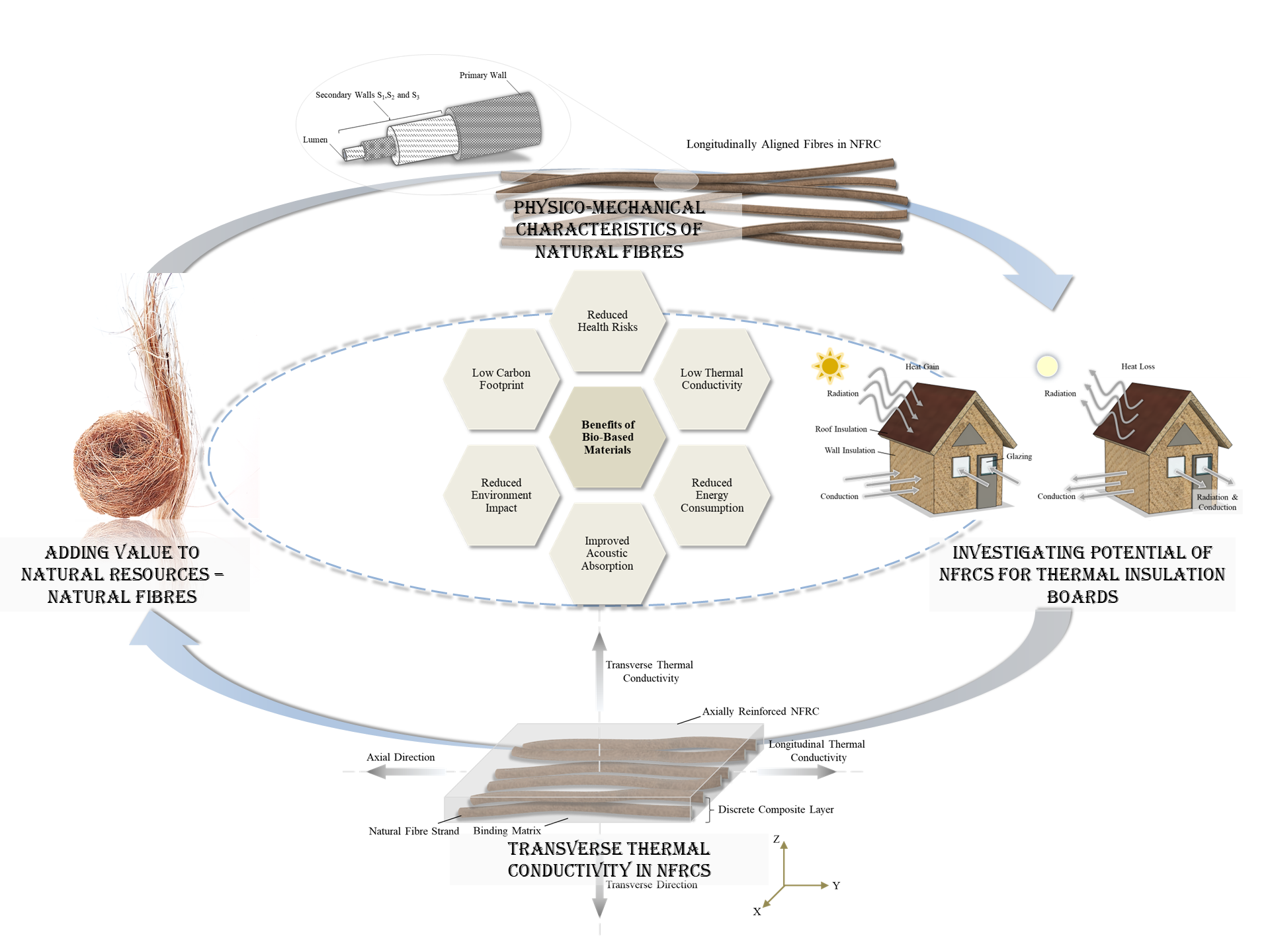
Typically used thermal insulation materials such as foam insulation and fibreglass may pose notable health risks and environmental impacts thereby resulting in respiratory irritation and waste disposal issues, respectively. While these materials are affordable and display good thermal insulation, their unsustainable traits pertaining to an intensive manufacturing process and poor disposability are major concerns. Alternative insulation materials with enhanced sustainable characteristics are therefore being explored, and one type of material which has gained notable attention owing to its low carbon footprint and low thermal conductivity is natural fibre. Among the few review studies conducted on Natural Fibre Reinforced Composite (NFRC) insulation boards, the multitude of factors and underlying mechanisms affecting their thermal conductivity performance have been sparsely covered. This review study aimed to address this gap by providing a holistic overview of some of the key intrinsic and extrinsic factors affecting the thermal conductivity performance of NFRCs. Key intrinsic factors pertaining to the microstructural features and to the physico-mechanical traits of NFRCs, namely the fibre lumen size, α, and the fibre-matrix thermal conductivity ratio, β, respectively, were found to largely affect the Transverse Thermal Conductivity (TTC) in NFRC boards. Extrinsic factors, which were found to indirectly affect NFRCs’ thermal conductivity, such as fibre pre-processing, composite manufacturing and environmental factors, were also covered. Some of the noteworthy NFRC features which were found to affect their thermal conductivity are volume fraction of fibres, bulk density and porosity. The findings of this study highlight the need for additional research investigation to address the foregoing limitations observed in NFRC thermal insulation boards by considering appropriate natural fibres, composition and fabrication techniques. The fabrication of high-grade NFRC boards, which will display an optimum balance between enhanced thermal insulation and long-term durability performance, could further replace conventionally used thermal insulation boards in the modern building and construction industry.Graphic Abstract
Keywords
Cite This Article
 Copyright © 2026 The Author(s). Published by Tech Science Press.
This work is licensed under a Creative Commons Attribution 4.0 International License , which permits unrestricted use, distribution, and reproduction in any medium, provided the original work is properly cited.
 Downloads
 Citation Tools
