
 Login
Login Register
 Submit a Paper
 Propose a Special lssue
 Open Access
ARTICLE

Sustainable Particleboards Based on Sugarcane Bagasse and Bonded with a Waste-Grown Black Soldier Fly Larvae Commercial Flour-Based Adhesive: Rheological, Physical, and Mechanical Properties
1 Dirección Técnica de Materiales Avanzados, Instituto Nacional de Tecnología Industrial (INTI), Buenos Aires, 1650, Argentina
2 Instituto de Calidad e Innovación Industrial (INCALIN), Universidad Nacional de San Martín (UNSAM), Buenos Aires, 1650, Argentina
3 Laboratorio de Investigaciones en Madera (LIMAD), Facultad de Ciencias Agrarias y Forestales, Universidad Nacional de La Plata, Diag. 113 N° 469, La Plata, B1904, Argentina
4 Consejo Nacional de Investigaciones Científicas y Técnicas (CONICET), Buenos Aires, 1425, Argentina
* Corresponding Author: Alejandro Bacigalupe. Email:
(This article belongs to the Special Issue: Renewable and Biosourced Adhesives-2023)
Journal of Renewable Materials 2026, 14(1), 2 https://doi.org/10.32604/jrm.2025.02025-0181
Received 16 September 2025; Accepted 27 October 2025; Issue published 23 January 2026
 View Full Text
 Download PDF
Abstract
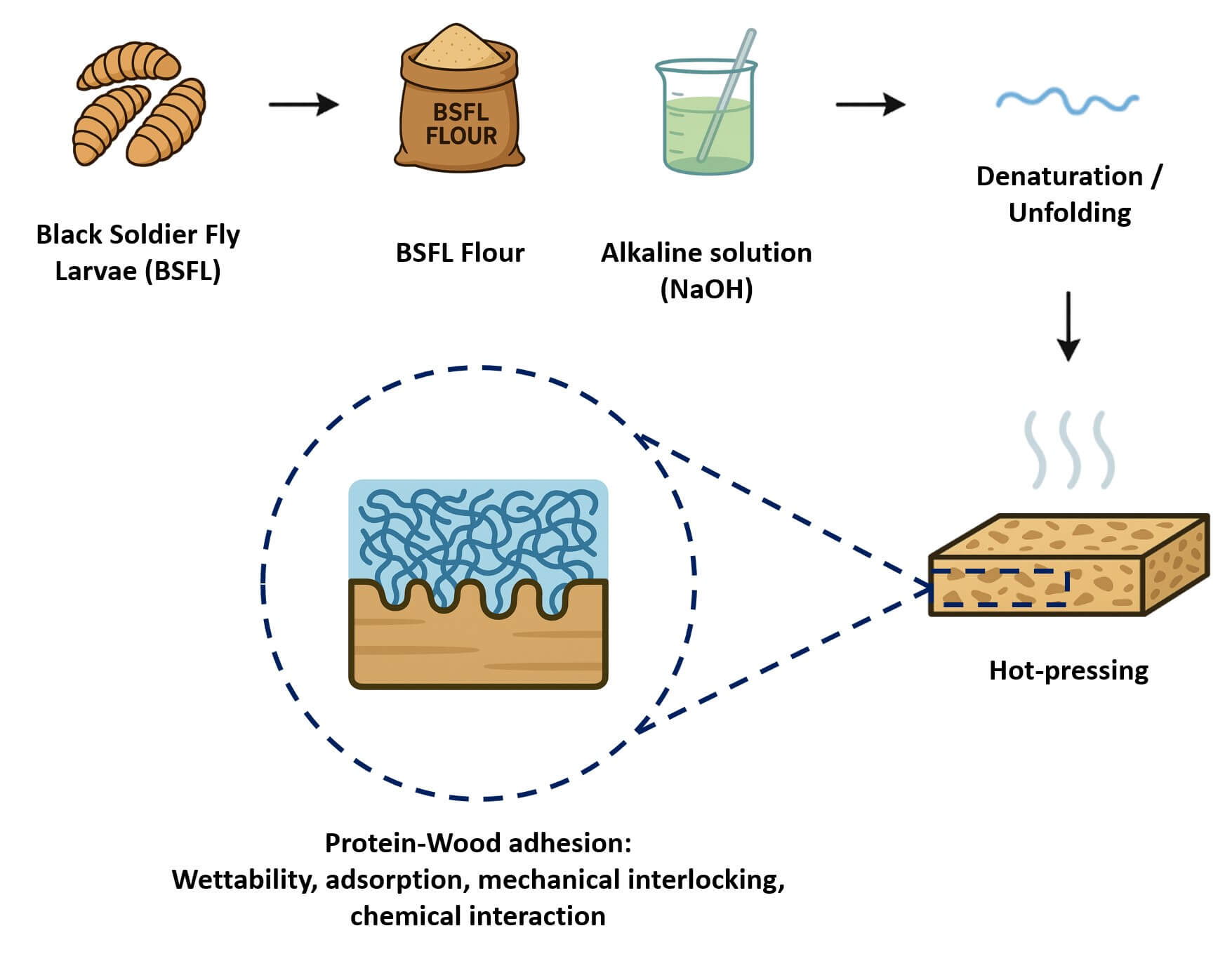
This study explores the use of black soldier fly larvae protein as a bio-based adhesive to produce particleboards from sugarcane bagasse. A comprehensive evaluation was conducted, including rheological characterization of the adhesive and physical–mechanical testing of the panels according to European standards. The black soldier fly larvae-based adhesive exhibited gel-like viscoelastic behavior, rapid partial structural recovery after shear, and favorable application properties. Particleboards manufactured with this adhesive and sugarcane bagasse achieved promising mechanical performance, with modulus of rupture and modulus of elasticity values of 30.2 and 3500 MPa, respectively. Internal bond strength exceeded 0.4 MPa, complying with European standard 312-3 specifications. For comparative purposes, a panel made with Eucalyptus grandis particles was also produced under the same conditions to demonstrate the versatility of the adhesive system. Compared to other bio-based and synthetic adhesives, this bio-based system showed competitive performance and derives from the bioconversion of organic residues. Protein adhesives were synthesized from Hermetia illucens larvae grown commercially on agricultural waste from potato chip production, emphasizing the renewable origin of both the biomass and the final adhesive. These results highlight the potential of insect proteins as sustainable and circular alternatives for the wood panel industry.Graphic Abstract
Keywords
Cite This Article
 Copyright © 2026 The Author(s). Published by Tech Science Press.
This work is licensed under a Creative Commons Attribution 4.0 International License , which permits unrestricted use, distribution, and reproduction in any medium, provided the original work is properly cited.
 Downloads
 Citation Tools
