
 Login
Login Register
 Submit a Paper
 Propose a Special lssue
 Open Access
ARTICLE

Effect of Green Lipid Treatments on the Morphological, Physical, Hygroscopic, and Mechanical Properties of Pineapple Leaf Fibres
1 Laboratory of Mechanics, Doctoral Training Unit in Engineering Sciences (UFD-SI), University of Douala, Douala, Cameroon
2 Department of Mechanical Engineering, ENSET, University of Douala, Douala, Cameroon
3 Laboratory of Wood Science-Chemistry & Technology, Department of Natural Environment & Climate Resilience, Democritus University of Thrace, 1 km Drama-Mikrochoriou, Drama, Greece
4 Department of Chemistry, Aristotle University of Thessaloniki, Thessaloniki, Greece
5 Laboratory of Studies and Research on Wood Material (LERMAB), University of Lorraine, Nancy, France
* Corresponding Authors: Achille Désiré Betené Omgba. Email: ; Benoit Ndiwe. Email:
Journal of Renewable Materials 2026, 14(3), 5 https://doi.org/10.32604/jrm.2026.02025-0201
Received 29 October 2025; Accepted 27 January 2026; Issue published 25 March 2026
 View Full Text
 Download PDF
Abstract
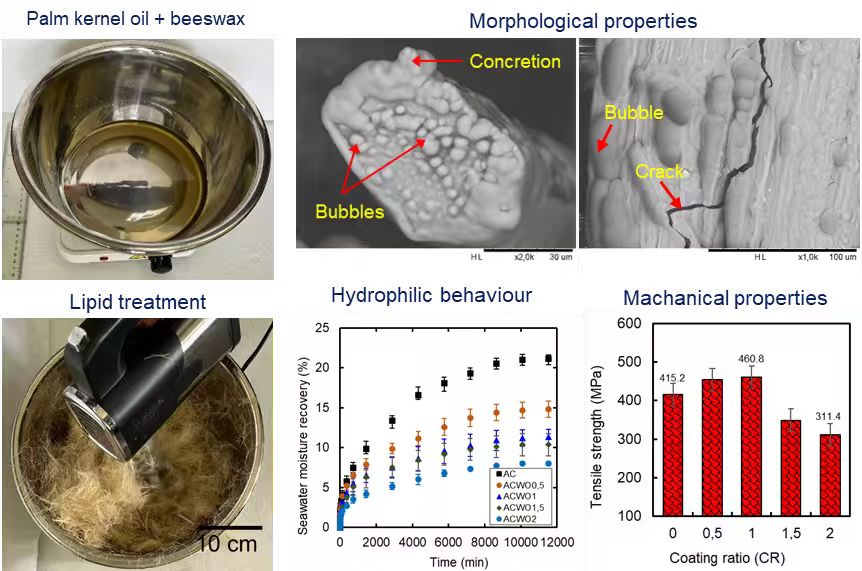
The high hydrophilicity of pineapple leaf fibres (PALF) limits their use in cement- and gypsum-based composites exposed to moisture. This study evaluates, for the first time, the combined effect of palm kernel oil and beeswax on the hygroscopic resistance and mechanical stability of PALF. The fibres were functionalised with three formulations (oil, wax, and a 1:2 oil/wax blend) applied at different mass ratios (CR = 0.5–2). Treatments increased the average bundle diameter by up to +46% (238 μm) and reduced density down to 1.06 g/cm3. Hygroscopically, water absorption decreased from 202.4% (raw fibres) to 76.3% (CR = 2), representing a maximum reduction of 59.4% in saline medium, while moisture regain dropped from 27.9% to 14.6% (−47.7%). The oil/wax blend proved most effective, simultaneously reducing water absorption (−51.2%) and moisture regain (−46.8%) at CR = 1. Mechanically, the fibres retained tensile strength (415.2 vs. 460.8 MPa, +11% at CR = 1) and exhibited enhanced ductility (+62.5%, with elongation at break increasing from 1.6% to 2.6%), without significantly altering Young’s modulus (12.3 to 10 GPa). Water absorption kinetics were accurately described by the Czel and Mohsenin models (R2 > 0.98). These findings clearly demonstrate that bio-based lipid coatings can provide an eco-friendly alternative to conventional chemical treatments. They improve hygroscopic resistance and preserve mechanical integrity of PALF, providing original quantitative data for their integration into durable cement- and gypsum-based composites subjected to humid or cyclic wet-dry conditions.Graphic Abstract
Keywords
Cite This Article
 Copyright © 2026 The Author(s). Published by Tech Science Press.
This work is licensed under a Creative Commons Attribution 4.0 International License , which permits unrestricted use, distribution, and reproduction in any medium, provided the original work is properly cited.
 Downloads
 Citation Tools
