
 Login
Login Register
 Submit a Paper
 Propose a Special lssue
 Open Access
ARTICLE

Tailoring the Properties of Balsa and Pulai Wood Sponge through Dual-Stages Delignification as a Potential Bio-Based Adsorbent
1 Study Program of Forest Products Science and Technology, Department of Forest Products, Faculty of Forestry and Environment, Post-Graduate School (SPs) IPB University, Bogor, Indonesia
2 Forest Products Department, Faculty of Forestry and Environment, IPB University, Bogor, Indonesia
3 Research Center for Biomass and Bioproducts, National Research and Innovation Agency (BRIN), Serpong, South Tangerang, Indonesia
4 Faculty of Forestry, Universitas Tanjungpura, Pontianak, West Kalimantan, Indonesia
* Corresponding Authors: Imam Wahyudi. Email: ; Sarah Augustina. Email:
(This article belongs to the Special Issue: Advances in Eco-friendly Wood-Based Composites: Design, Manufacturing, Properties and Applications – Ⅱ)
Journal of Renewable Materials 2026, 14(3), 7 https://doi.org/10.32604/jrm.2026.02025-0161
Received 14 August 2025; Accepted 27 January 2026; Issue published 25 March 2026
 View Full Text
 Download PDF
Abstract
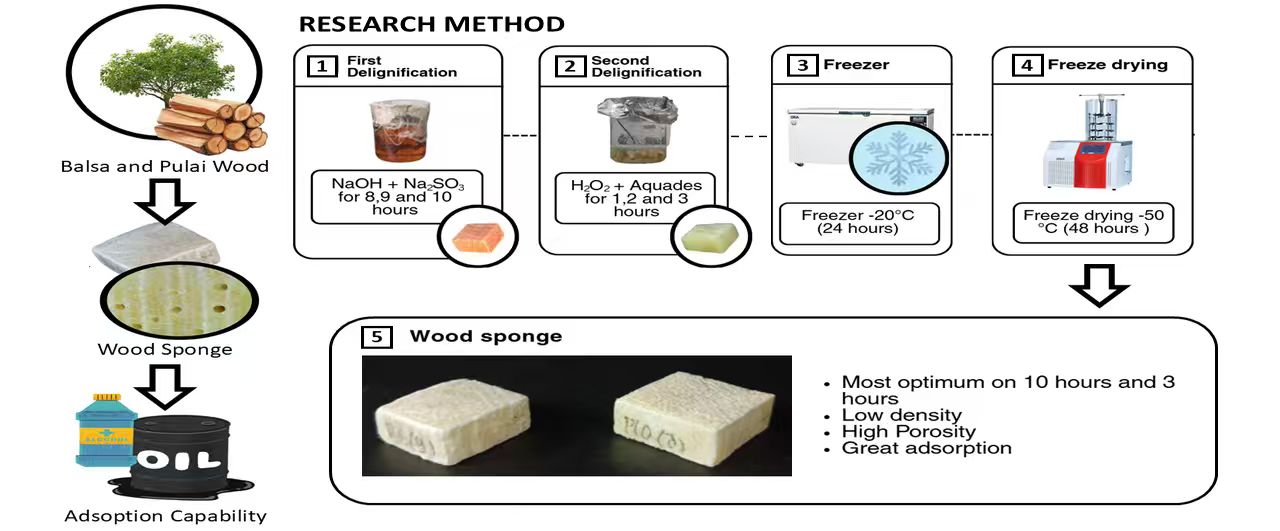
The increasing need for efficient, sustainable, and environmentally friendly adsorbent materials has driven interest in bio-based alternatives. Conventional silica-based adsorbents, while effective, are often brittle and energy-intensive to produce. In contrast, wood offers a renewable and low-energy option with natural porosity suitable for adsorption. This study investigated the fabrication of wood sponge from tropical balsa (Ochroma bicolor) and pulai (Alstonia scholaris) wood through a dual-stage delignification process as a novel bio-based adsorbent. The process involved alkaline treatment using sodium sulfite (Na2SO3) and sodium hydroxide (NaOH) at 100°C for 8, 9, and 10 h, followed by bleaching process using hydrogen peroxide (H2O2) at 100°C for 1, 2, and 3 h. The treated samples were then rinsed to neutral pH, frozen at −20°C for 24 h, and freeze-dried at −50°C for 48 h. The results revealed a notable reduction in density and specific gravity, accompanied by increased weight loss and pore diameter size with prolonged delignification process. Optical changes showed increased translucency and layered structures, particularly in balsa wood. FTIR analysis confirmed a reduction in lignin and hemicellulose content, validating the chemical modification within the treated samples. The resulting wood sponges exhibited good porosity and adsorption capacity, ranging from 1.3 to 5.7 g/g. The optimal treatment—10 h of alkaline delignification followed by 3 h of H2O2 bleaching—demonstrated the highest performance, highlighting the potential of tropical wood species as efficient, biodegradable, and eco-friendly adsorbent materials.Graphic Abstract
Keywords
Cite This Article
 Copyright © 2026 The Author(s). Published by Tech Science Press.
This work is licensed under a Creative Commons Attribution 4.0 International License , which permits unrestricted use, distribution, and reproduction in any medium, provided the original work is properly cited.
 Downloads
 Citation Tools
