
 Login
Login Register
 Submit a Paper
 Propose a Special lssue
 Open Access
ARTICLE

High Lignin Content Polymer Filaments as Carbon Fibre Precursors
1 Department of Polymer Engineering, Institute for Polymers and Composites (IPC), University of Minho, Campus of Azurem, Guimarães, 4800-058, Portugal
2 Centre for Innovation in Polymer Engineering (PIEP), University of Minho, Campus of Azurem, Guimarães, 4800-058, Portugal
3 Centre of Biological Engineering (CEB), University of Minho, Campus of Gualtar, Braga, 4710-057, Portugal
4 LABBELS—Associate Laboratory, Braga, 4710-057, Portugal
* Corresponding Authors: Rui Ribeiro. Email: ; Maria C. Paiva. Email:
Journal of Renewable Materials 2025, 13(10), 1859-1880. https://doi.org/10.32604/jrm.2025.02025-0071
Received 24 March 2025; Accepted 03 June 2025; Issue published 22 October 2025
 View Full Text
 Download PDF
Abstract
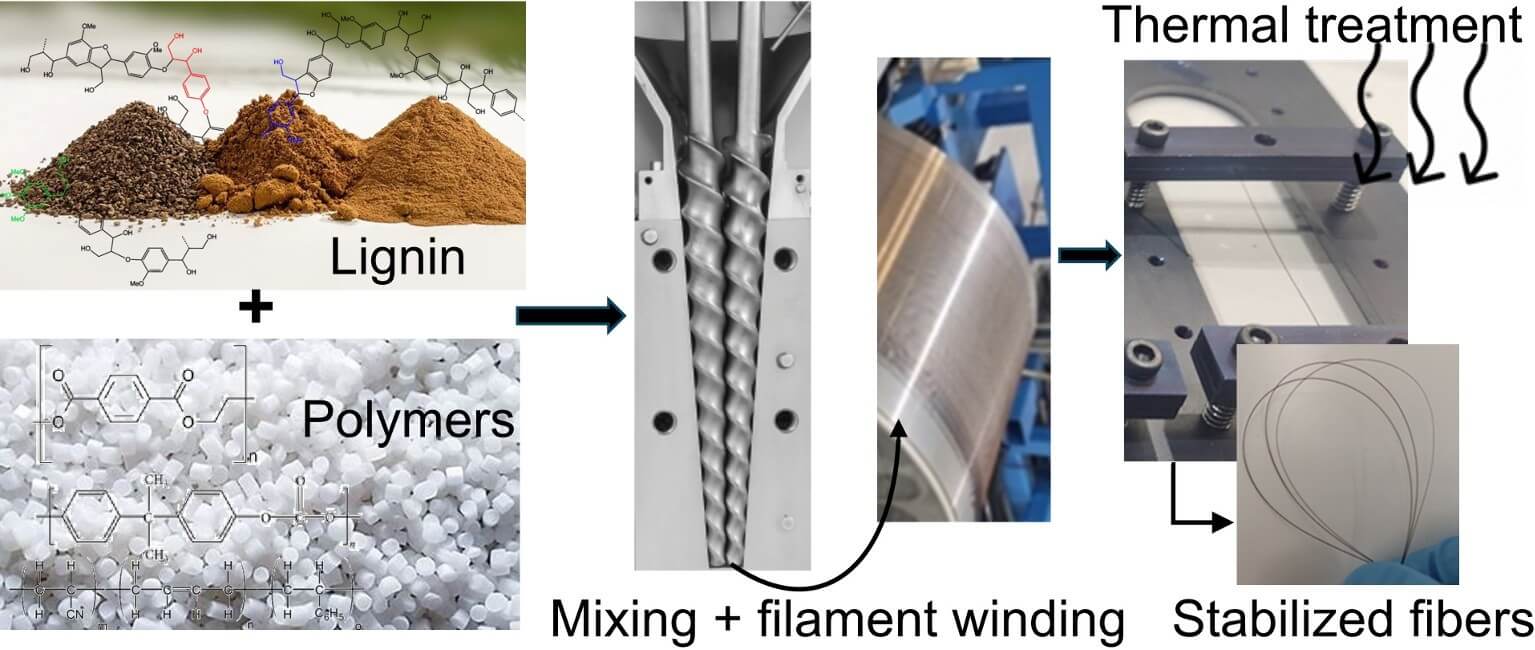
The growing environmental awareness, the search for alternatives to fossil resources, and the goal of achieving a circular economy have all contributed to the increasing valorization of biowaste to produce bio-based polymers and other high-value products. Among the various biowaste materials, lignin has gained significant attention due to its high aromatic carbon content, low cost, and abundance. Lignin is predominantly sourced as a byproduct from the paper industry, available in large quantities from hardwood and softwood, with variations in chemical structure and susceptibility to hydrolysis. This study focuses on softwood lignin obtained through the LignoForce™ technology, comparing the thermal and chemical characteristics, and stability, of a recently produced batch with that of a batch that has been stored for four years. Additionally, the development of lignin-based thermoplastic polymer mixtures using Polyethylene Terephthalate Glycol (PET-G) and a blend of Polycarbonate and Acrylonitrile-Butadiene-Styrene (PC/ABS) with high lignin content (50–60 wt%) is explored, as well as the production of filaments for carbon fiber production. For this purpose, following melt mixing, the lignin-based mixtures were spun into filaments, which were subsequently subjected to thermal stabilization in an oxidative atmosphere. The lignin phase was well distributed in the PET-G matrix and the two materials presented a good interface, which further improved after thermal treatment under an oxidative atmosphere. After thermal treatment an increase in tensile modulus, tensile strength, and elongation at break of approximately 160%, 200%, and 100%, respectively, was observed, confirming the good interface established, and consistent with structural changes such as cross-linking. Conversely, the PC/ABS blend did not form a good interface with the lignin domains after melt mixing. Although the interactions improved after thermal treatment, the tensile strength and elongation at break decreased by approximately 30%, while the modulus increased by approximately 20%. Overall, the good processability of the lignin/polymer mixtures into filaments, and their physical, chemical, and mechanical characterization before and after thermal oxidation are good indicators of the potential as precursors for carbon fiber production.Graphic Abstract
Keywords
Cite This Article
 Copyright © 2025 The Author(s). Published by Tech Science Press.
This work is licensed under a Creative Commons Attribution 4.0 International License , which permits unrestricted use, distribution, and reproduction in any medium, provided the original work is properly cited.
 Downloads
 Citation Tools
