
 Login
Login Register
 Submit a Paper
 Propose a Special lssue
 Open Access
REVIEW
The Evolution and Environmental Prospects of Renewable Bioplastics: Types, Production Methods, and Sustainability
1 Department of Aerospace Engineering, Faculty of Engineering, Universiti Putra Malaysia, Serdang, 43400, Malaysia
2 Laboratory of Biocomposite Technology, Institute of Tropical Forestry and Forest Products (INTROP), Universiti Putra Malaysia, Serdang, 43400, Malaysia
3 Aerospace Malaysia Innovation Centre [944751-A], Prime Minister’s Department, MIGHT Partnership Hub, Jalan Impact, Cyberjaya, 63600, Malaysia
* Corresponding Author: Mohamed Thariq Hameed Sultan. Email:
Journal of Renewable Materials 2025, 13(6), 1071-1101. https://doi.org/10.32604/jrm.2024.02024-0011
Received 10 October 2024; Accepted 10 December 2024; Issue published 23 June 2025
 View Full Text
 Download PDF
Abstract
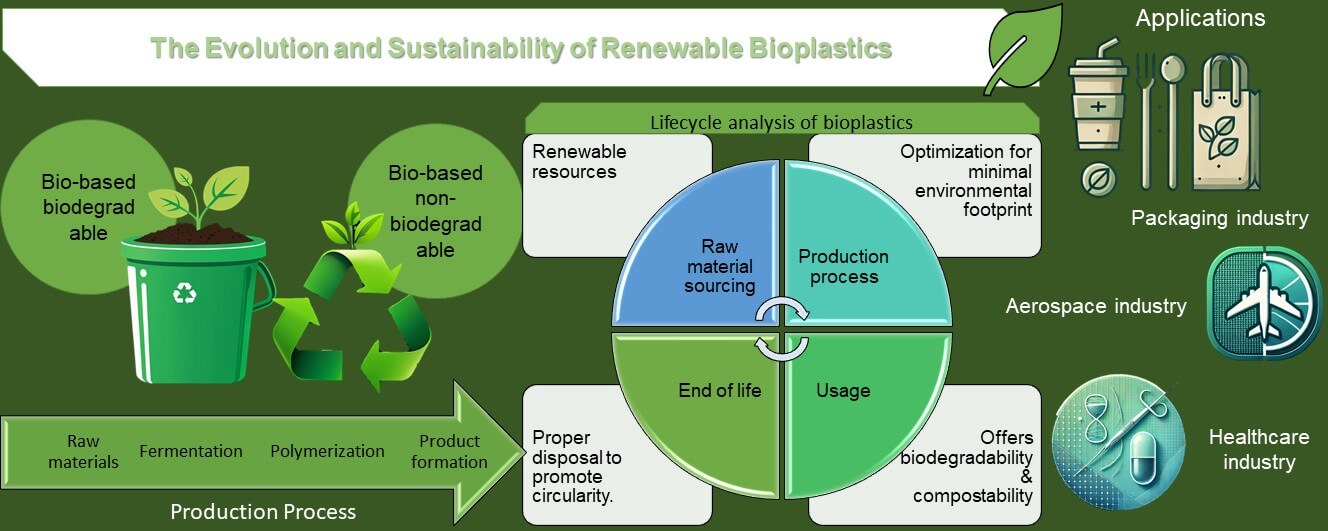
In this comprehensive review, the evolution and progress of bioplastics are examined, with an emphasis on their types, production methods, environmental impact, and biodegradability. In light of the increasing global efforts to address environmental degradation, bioplastics have emerged as a highly potential substitute for conventional petroleum-based plastics. This review classifies various categories of bioplastics, encompassing both biodegradable and bio-based variations, and assesses their environmental consequences using life cycle evaluations and biodegradability calculations. This paper analyzes the technological advancements that have enhanced the mechanical and thermal characteristics of bioplastics, hence increasing their feasibility for extensive commercial applications in diverse sectors. This review critically examines the possible uses of bioplastics in important industries including packaging, aerospace, and healthcare, emphasizing both achievements and current obstacles. In addition, the assessment addresses the economic and technical obstacles to expanding bioplastic manufacturing, namely concerns about cost, material efficiency, and waste disposal. Moreover, the article forecasts the future potential of bioplastics in furthering a sustainable circular economy and suggests methods to address existing constraints, such as improvements in recycling technology and the establishment of more economically efficient manufacturing methods. The findings are intended to educate policymakers, industry stakeholders, and researchers on the crucial contribution of bioplastics in attaining sustainability objectives and promoting innovation in the field of material science.Graphic Abstract
Keywords
Cite This Article
 Copyright © 2025 The Author(s). Published by Tech Science Press.
This work is licensed under a Creative Commons Attribution 4.0 International License , which permits unrestricted use, distribution, and reproduction in any medium, provided the original work is properly cited.
 Downloads
 Citation Tools
