
 Login
Login Register
 Submit a Paper
 Propose a Special lssue
 Open Access
ARTICLE

Sustainable Biopolymer Packaging Utilizing Non-Food-Competing Starches Derived from Rubber Cassava and Banana Wastes
1 Master’s Program in Nanotechnology, Graduate School, Institut Teknologi Bandung, Bandung, 40132, Indonesia
2 Research Center for Electronics, National Research and Innovation Agency, Bandung, 40135, Indonesia
3 Research Center for Environmental and Clean Technology, National Research and Innovation Agency, Bandung, 40135, Indonesia
4 Research Center for Nanoscience and Nanotechnology, Institut Teknologi Bandung, Bandung, 40132, Indonesia
5 School of Pharmacy, Institut Teknologi Bandung, Bandung, 40132, Indonesia
6 Research Center for Food Technology and Processing, National Research and Innovation Agency, Yogyakarta, 55861, Indonesia
7 Research Collaboration Center for Electrochemistry, BRIN-UNDIP, Semarang, 50275, Indonesia
* Corresponding Author: Athanasia Amanda Septevani. Email:
(This article belongs to the Special Issue: Biomass-based Thermoset and Thermoplastic Polymers for Biomass-based Composites)
Journal of Renewable Materials 2026, 14(2), 5 https://doi.org/10.32604/jrm.2025.02025-0118
Received 23 July 2025; Accepted 30 October 2025; Issue published 25 February 2026
 View Full Text
 Download PDF
Abstract
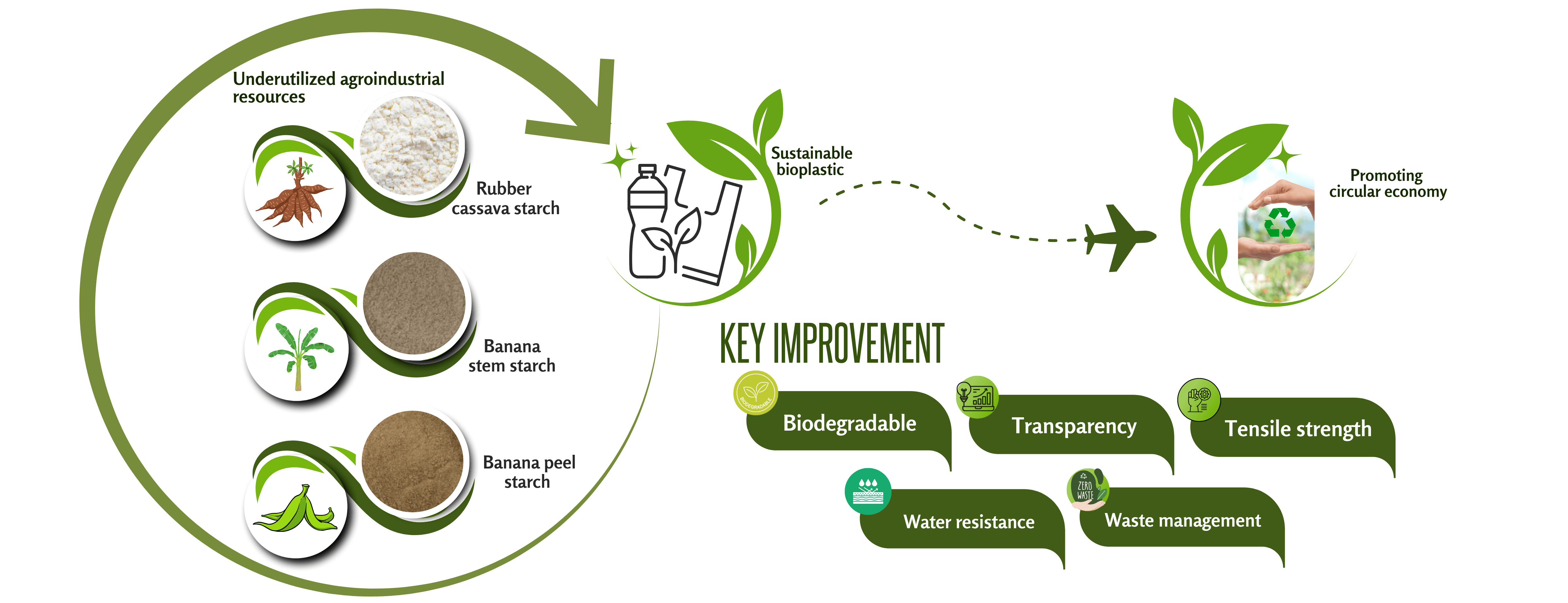
This study investigates the potential of starch extracted from underutilized agro-industrial resources as non-food-competing raw materials for the development of flexible bioplastics for food packaging applications. Starch was extracted from three biomass sources: rubber cassava (Manihot glaziovii), banana stem, and banana peel from Ambonese banana (Musa acuminata L.). Rubber cassava starch (SRC) exhibited the highest starch yield (50.68 ± 0.28%), significantly surpassing banana stem (SBS, 14.20 ± 0.25%) and banana peel (SBP, 3.07 ± 0.15%). The amylose contents of SRC, SBS, and SBP were 28.18%, 52.80%, and 56.57%, respectively, while their amylopectin contents were 71.83%, 47.20%, and 43.43%. FTIR spectra confirmed the absence of cyanogenic groups in SRC, indicating its safety for packaging applications. XRD analysis revealed that PSRC films were predominantly amorphous, while PSBS and PSBP showed higher crystallinity. The enhancement of mechanical properties, specifically PSBS, showed the highest tensile strength at 16.04 ± 0.56 MPa, whereas PSRC demonstrated the highest elongation at break at 23.57 ± 0.40%, which could be attributed to the inherent characteristics of the starch sources. Additionally, PSRC film exhibited the highest transparency at 60.2%, the greatest water solubility at 34.92%, and the lowest water contact angle at 41.58°, confirming its more hydrophilic nature compared to other films. This work highlights the potential of low-cost, sustainable, and non-food agro-industrial starch sources as promising candidates for the development of flexible, eco-friendly bioplastics.Graphic Abstract
Keywords
Cite This Article
 Copyright © 2026 The Author(s). Published by Tech Science Press.
This work is licensed under a Creative Commons Attribution 4.0 International License , which permits unrestricted use, distribution, and reproduction in any medium, provided the original work is properly cited.
 Downloads
 Citation Tools
