
 Login
Login Register
 Submit a Paper
 Propose a Special lssue
 Open Access
REVIEW

Bacterial Biorefineries: Transforming Agro-Industrial Waste into Sustainable Solutions for a Circular Bioeconomy
1 Institute of Climate Adaptation and Marine Biotechnology (ICAMB), Universiti Malaysia Terengganu, Kuala Nerus, 21030, Terengganu, Malaysia
2 Ocular Infections and Antimicrobials Research Group, Singapore Eye Research Institute, The Academia, 20 College Road, Discovery Tower, Singapore, 169856, Singapore
3 Faculty of Science and Marine Environment, Universiti Malaysia Terengganu, Kuala Nerus, 21030, Terengganu, Malaysia
4 BioSES Research Interest Group, Faculty of Science and Marine Environment, Universiti Malaysia Terengganu, Kuala Nerus, 21030, Terengganu, Malaysia
5 Biomaterials and Product Development laboratory, Department of Biotechnology, Kalasalingam Academy of Research and Education, Anand Nagar, Krishnankoil, 626126, Tamil Nadu, India
6 School of Applied Science, Faculty of Integrated Life Sciences, Quest International University, Ipoh, 34020, Perak, Malaysia
* Corresponding Author: Sevakumaran Vigneswari. Email:
(This article belongs to the Special Issue: Valorization of Lignocellulosic Biomass for Functional Materials)
Journal of Renewable Materials 2026, 14(3), 6 https://doi.org/10.32604/jrm.2025.02025-0148
Received 27 July 2025; Accepted 09 October 2025; Issue published 25 March 2026
 View Full Text
 Download PDF
Abstract
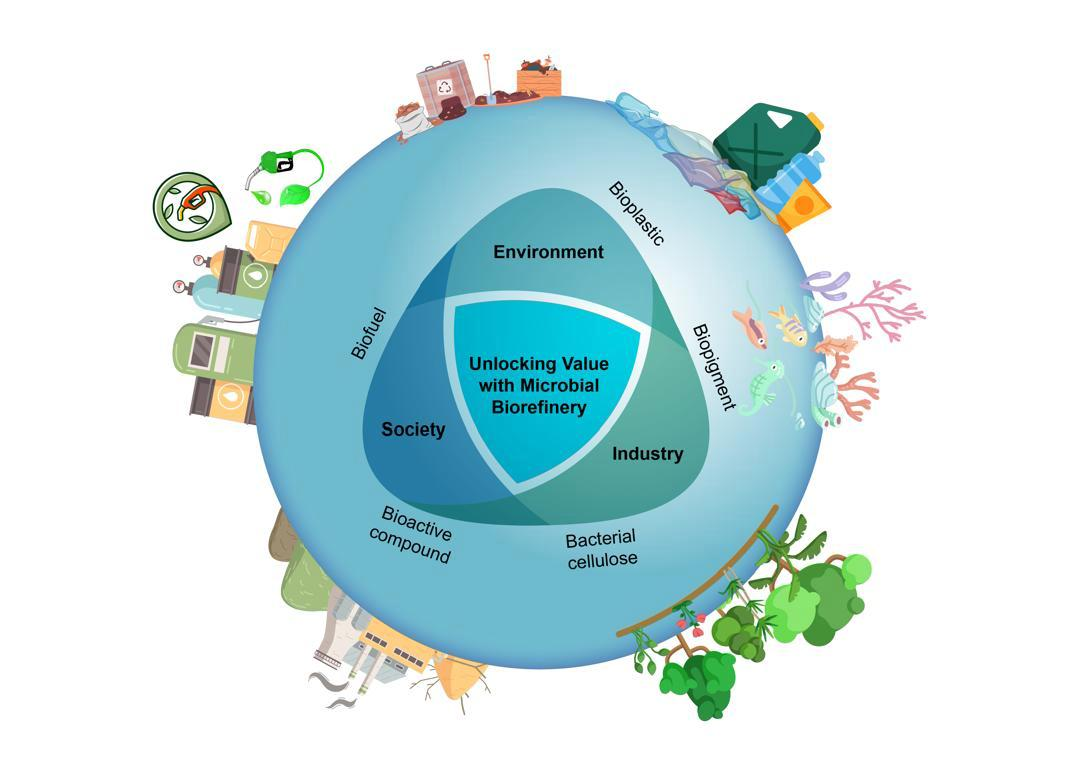
The escalating accumulation of agro-industrial waste—exceeding 350 million tons annually from post-harvest residues, food processing, and aquaculture—poses serious environmental threats, including greenhouse gas emissions, groundwater contamination, and excessive landfill usage. Although conventional treatment methods such as composting, incineration, and recycling offer partial mitigation, they often fall short of delivering scalable, circular solutions. Microbial biorefineries have emerged as a transformative approach, enabling the conversion of diverse biomass streams into high-value renewable materials. Through microbial fermentation, agricultural and municipal waste can be repurposed into functional outputs such as nanocellulose, biochar, and biocompatible compounds with applications in packaging, pharmaceuticals, and cosmetics. This review critically examines the role of microbial systems in agro-waste valorization, highlighting recent advances in strain engineering, process integration, and bioproduct development. It also explores the regulatory and techno-economic frameworks required to scale these innovations within a biomass-driven circular economy, positioning microbial biorefineries as key enablers of sustainable material transitions.Graphic Abstract
Keywords
Cite This Article
 Copyright © 2026 The Author(s). Published by Tech Science Press.
This work is licensed under a Creative Commons Attribution 4.0 International License , which permits unrestricted use, distribution, and reproduction in any medium, provided the original work is properly cited.
 Downloads
 Citation Tools
