
 Login
Login Register
 Submit a Paper
 Propose a Special lssue
 Open Access
ARTICLE

Bio-Based Foams from Agricultural Waste: Optimizing Corn Starch-Corn Husk Composites with Xanthan Gum for Cushioning Applications
Department of Tool and Materials Engineering, Faculty of Engineering, King Mongkut’s University of Technology Thonburi, Bangkok, Thailand
* Corresponding Author: Manisara Phiriyawirut. Email:
Journal of Renewable Materials 2026, 14(3), 8 https://doi.org/10.32604/jrm.2026.02025-0227
Received 10 December 2025; Accepted 13 January 2026; Issue published 25 March 2026
 View Full Text
 Download PDF
Abstract
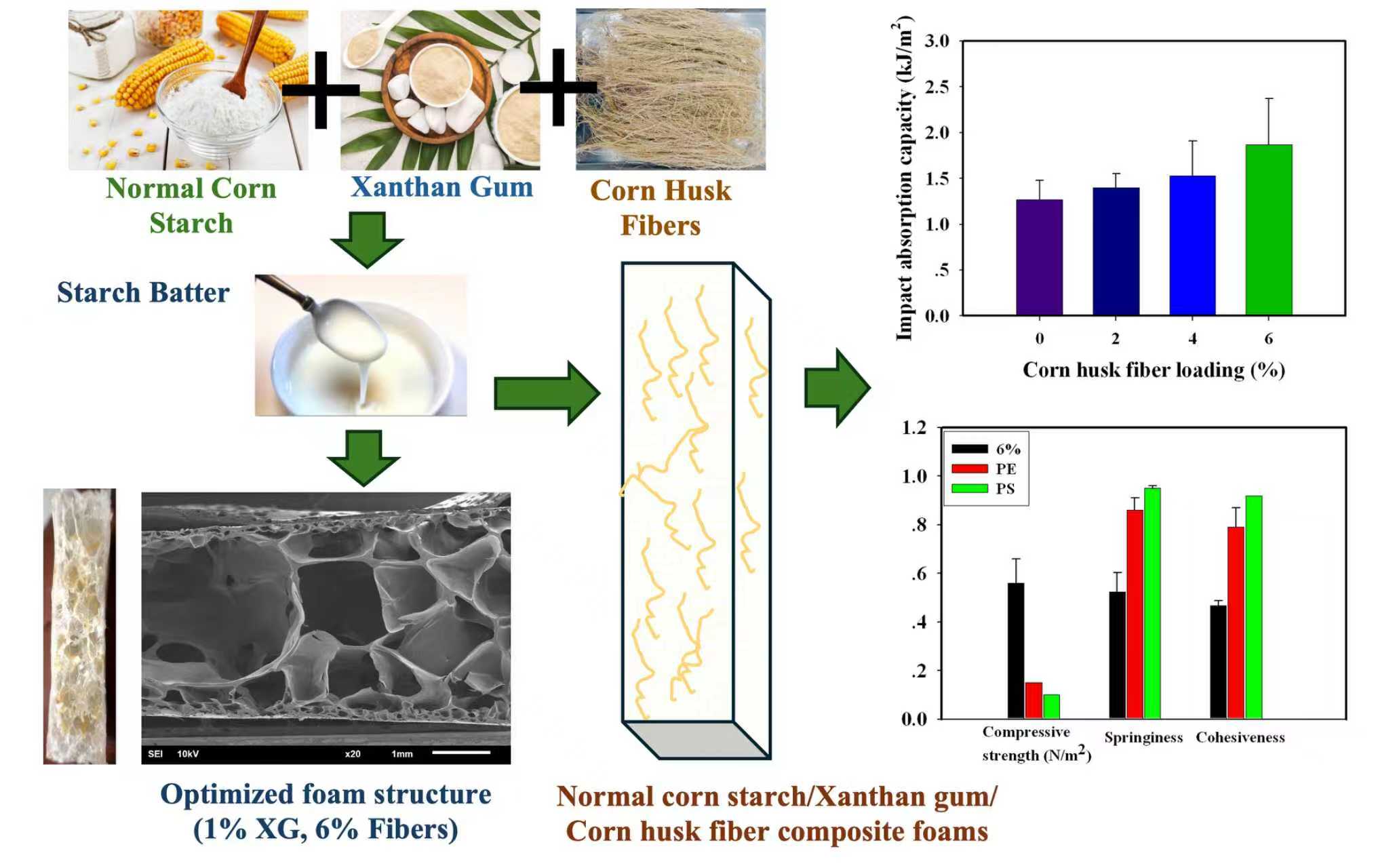
With the escalating environmental impact of petrochemical-based packaging, the development of biodegradable alternatives from agricultural waste has become imperative. This study describes the fabrication and optimization of a sustainable, bio-based cushioning material derived from a corn starch foam matrix and corn husk fibers via compression molding. The investigation of starch ratios revealed that 100% normal corn starch (NCS) provided superior expansion and structural integrity compared to waxy starch, which exhibited significant cell wall collapse under SEM analysis. To enhance formability, xanthan gum (XG) was incorporated as a stabilizer; a 1.0% (w/w) concentration was found to be the morphological inflection point, yielding a refined closed-cell structure and a bulk density of 0.43 g/cm3. The stabilized matrix was reinforced with 2.0% to 6.0% (w/w) corn husk fibers pre-treated with tetraethoxy silane (TEOS) to improve interfacial adhesion. The addition of 6.0% fibers significantly augmented the material’s energy absorption capacity, achieving a peak impact strength of 1.87 ± 0.50 kJ/m2 and a compressive strength of 0.56 N/mm2. These results demonstrate that the optimized agricultural waste-derived composite effectively surpasses the load-bearing capabilities of traditional commercial foams, offering a viable, eco-friendly solution for high-load protective packaging.Graphic Abstract
Keywords
Starch foam; corn starch; corn husk fiber; xanthan gum; waxy corn starch
Cite This Article
APA Style
Phiriyawirut, M., Wachararuangroong, K., Wongsaroj, M., Arompijit, N. (2026). Bio-Based Foams from Agricultural Waste: Optimizing Corn Starch-Corn Husk Composites with Xanthan Gum for Cushioning Applications. Journal of Renewable Materials, 14(3), 8. https://doi.org/10.32604/jrm.2026.02025-0227
Vancouver Style
Phiriyawirut M, Wachararuangroong K, Wongsaroj M, Arompijit N. Bio-Based Foams from Agricultural Waste: Optimizing Corn Starch-Corn Husk Composites with Xanthan Gum for Cushioning Applications. J Renew Mater. 2026;14(3):8. https://doi.org/10.32604/jrm.2026.02025-0227
IEEE Style
M. Phiriyawirut, K. Wachararuangroong, M. Wongsaroj, and N. Arompijit, “Bio-Based Foams from Agricultural Waste: Optimizing Corn Starch-Corn Husk Composites with Xanthan Gum for Cushioning Applications,” J. Renew. Mater., vol. 14, no. 3, pp. 8, 2026. https://doi.org/10.32604/jrm.2026.02025-0227
 Copyright © 2026 The Author(s). Published by Tech Science Press.
This work is licensed under a Creative Commons Attribution 4.0 International License , which permits unrestricted use, distribution, and reproduction in any medium, provided the original work is properly cited.
 Downloads
 Citation Tools
