
 Login
Login Register
 Submit a Paper
 Propose a Special lssue
 Open Access
ARTICLE
Effect of Fiber Content on the Mechanical Performance of Bamboo Microfiber Reinforced PLA Composites
1 Department of Forest Engineering, Faculty of Technology, University of Brasília (UnB), Brasília, Brazil
2 Federal Institute of Education, Science and Technology of Brasília (IFB), Brasília, Brazil
* Corresponding Author: Cláudio Del Menezzi. Email:
Journal of Renewable Materials 2026, 14(9), 6 https://doi.org/10.32604/jrm.2026.02026-0052
Received 26 March 2026; Accepted 30 July 2026; Issue published 23 September 2026
 View Full Text
 Download PDF
Abstract
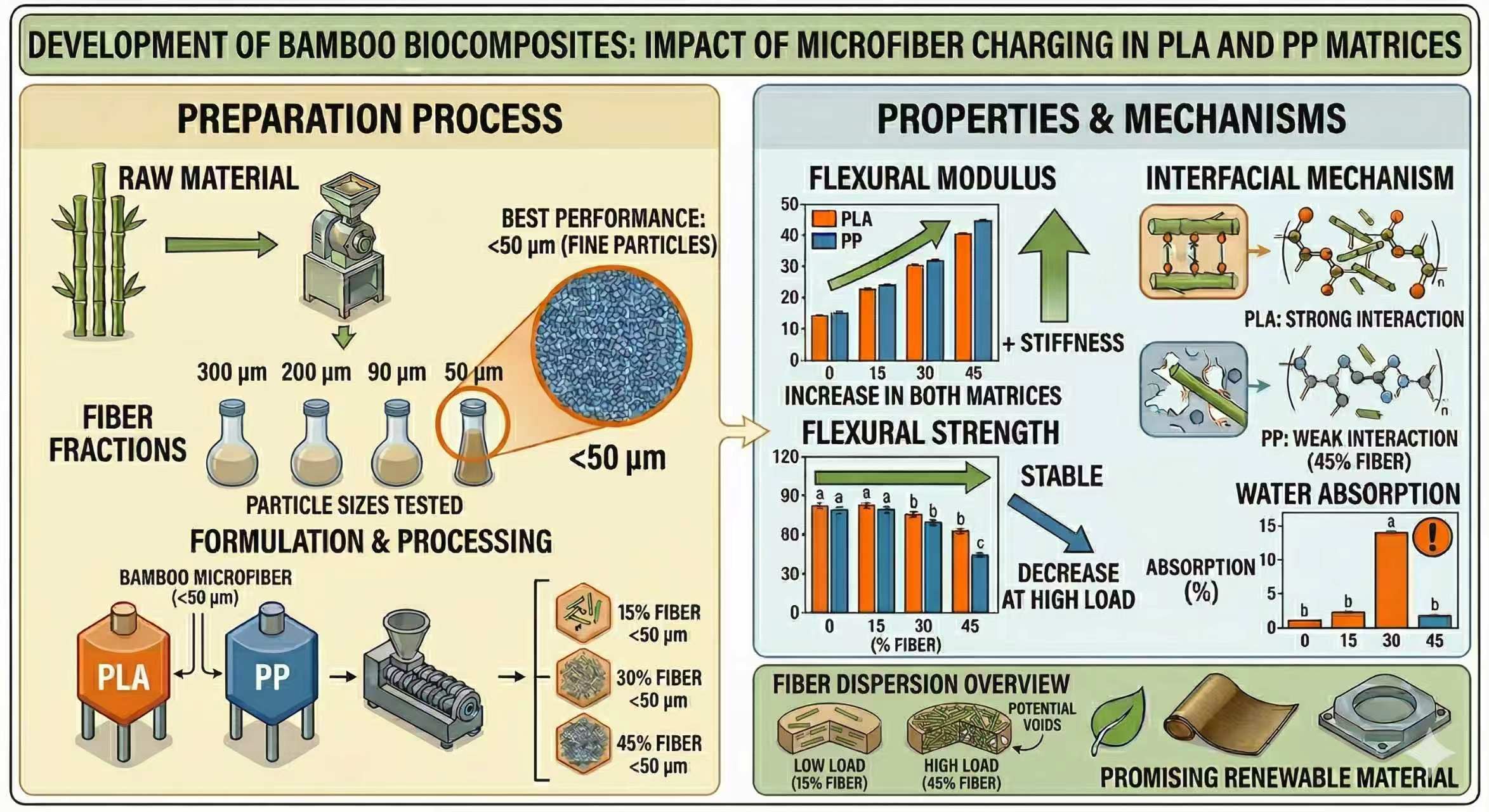
This study investigated the effect of bamboo fiber (BF) content on properties of polylactic acid (PLA) composites, using polypropylene (PP) as a control for comparative purposes. Initially, the BF was evaluated in four particle sizes (300, 200, 90, and 50 μm) through dynamic mechanical analysis to identify the most suitable particle size regarding viscoelastic behavior. The 50 μm fiber was selected based on a multi-criteria approach balancing interfacial restriction, structural stiffness, and microstructural homogeneity. Subsequently, the 50 μm fibers were combined with PLA and PP polymers in different polymer/fiber ratios, corresponding to 85%/15%, 70%/30%, and 55%/45% by weight (wt%). The results showed that the incorporation of microfibers promoted an increase in the storage modulus in both matrices. A statistically significant increase in the flexural modulus was observed at 30% and 45% fiber loading for both matrices. At 45% loading, the flexural modulus of PLA increased by approximately 43% (reaching ~5900 MPa) and nearly doubled in PP (reaching ~2658 MPa). Meanwhile, flexural strength remained stable in PLA but significantly decreased in PP (dropping to ~45 MPa) at 45% fiber content. Regarding surface hardness, both composites exhibited a non-significant upward trend with fiber addition, reaching maximum mean values of ~4481 N/mm for PLA and ~2334 N/mm for PP. 24 h-water absorption remained low and stable in PP but increased sharply in PLA at 45% reinforcement. The composites showed similar behavior with increasing fiber content, regardless of matrix type, for flexural modulus and hardness, while statistically significant differences were observed for flexural strength.Graphic Abstract
Keywords
Vegetable fibers; biocomposites; bamboo; PLA; PP; fiber content; particle size
Cite This Article
APA Style
Silva, L., Menezzi, C.D., Dornelles, P. (2026). Effect of Fiber Content on the Mechanical Performance of Bamboo Microfiber Reinforced PLA Composites. Journal of Renewable Materials, 14(9), 6. https://doi.org/10.32604/jrm.2026.02026-0052
Vancouver Style
Silva L, Menezzi CD, Dornelles P. Effect of Fiber Content on the Mechanical Performance of Bamboo Microfiber Reinforced PLA Composites. J Renew Mater. 2026;14(9):6. https://doi.org/10.32604/jrm.2026.02026-0052
IEEE Style
L. Silva, C. D. Menezzi, and P. Dornelles, “Effect of Fiber Content on the Mechanical Performance of Bamboo Microfiber Reinforced PLA Composites,” J. Renew. Mater., vol. 14, no. 9, pp. 6, 2026. https://doi.org/10.32604/jrm.2026.02026-0052
 Copyright © 2026 The Author(s). Published by Tech Science Press.
This work is licensed under a Creative Commons Attribution 4.0 International License , which permits unrestricted use, distribution, and reproduction in any medium, provided the original work is properly cited.
 Downloads
 Citation Tools
