Home / Journals / JRM / Vol.14, No.9, 2026
Special Issues
Table of Content
cover

On the Cover

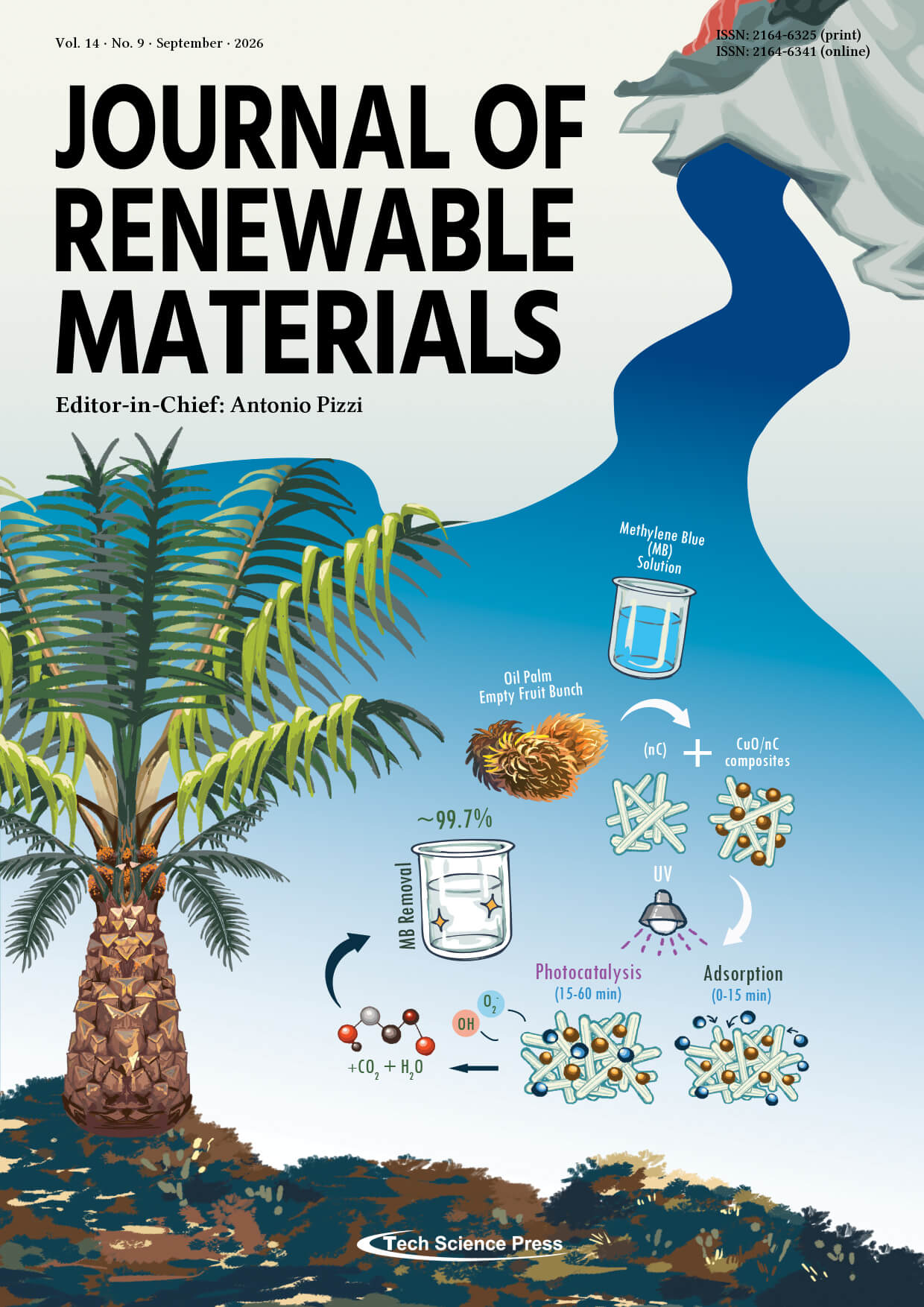
Schematic illustration of methylene blue (MB) wastewater treatment using a CuO/nanocellulose photocatalyst derived from oil palm empty fruit bunch (OPEFB) biomass. OPEFB is converted into nanocellulose and integrated with CuO to remove MB. Nanocellulose primarily enhances adsorption during the first 15 min, followed by dominant photocatalytic degradation by the CuO/nanocellulose composite under UV light irradiation.

View this paper

  • Open AccessOpen Access

    ARTICLE

    Experimental Investigation of Morphological, Physical, and Thermo-Mechanical Properties of Flax/Epoxy Composites for Automotive Applications

    Matilde Oliveira1, Vítor Neves2, Mariana Banea1,*
    Journal of Renewable Materials, Vol.14, No.9, 2026, DOI:10.32604/jrm.2026.02026-0063 - 23 September 2026
    Abstract Natural fibre-reinforced composites are increasingly being considered as sustainable alternatives to synthetic composites for lightweight automotive applications. The aim of this study was to evaluate the influence of flax fibre architecture and areal weight on the mechanical, morphological, and thermal performance of epoxy-based composites. Laminates were manufactured by vacuum bagging using twill 2/2 and biaxial flax fabrics with areal weights of 200, 250, 350, and 400 g/m2. Mechanical properties were assessed through tensile, flexural, and Charpy impact tests, while fracture mechanisms were analysed by scanning electron microscopy (SEM). Thermal behaviour was evaluated using thermogravimetric analysis (TGA)… More >

    Graphic Abstract

    Experimental Investigation of Morphological, Physical, and Thermo-Mechanical Properties of Flax/Epoxy Composites for Automotive Applications

  • Open AccessOpen Access

    ARTICLE

    Oil Palm Empty Fruit Bunch-Derived Nanocellulose Boosts Methylene Blue Removal in CuO-Based Photocatalysts

    Haniffudin Nurdiansah1,*, Joko Setyo Wibowo1, Retno Asih2,*, Diah Susanti1, Rindang Fajarin1, Azzah Dyah Pramata1, Amaliya Rasyida1, Lukman Noerochim1, Isao Watanabe3, Darminto2
    Journal of Renewable Materials, Vol.14, No.9, 2026, DOI:10.32604/jrm.2026.02026-0031 - 23 September 2026
    (This article belongs to the Special Issue: Nanocellulose for Sustainable Material Applications: Emerging Biodegradable Materials and Nanocomposites)
    Abstract A synergistic effect of adsorption and photocatalysis provides a key role ensuring high degradation efficiency. In this study, nanocellulose (nC) derived from oil palm empty fruit bunch (OPEFB) via delignification followed by acid hydrolysis was combined with CuO for methylene blue (MB) removal through a two-stage process: adsorption followed by photocatalysis. The nC content varied at 5%, 15%, and 25% by mass. Structural analyses revealed successful extraction of nC from OPEFB, with particle sizes of 260–310 nm, a surface area of 2.3 m2/g, and a pore diameter of 9.5 nm. The incorporation of nC improves CuO More >

  • Open AccessOpen Access

    REVIEW

    Kenaf Fibre–Based Composites as Sustainable Materials for Marine Applications: A Short Review

    Harmiansyah1,2,3, Muhammad Asyraf Muhammad Rizal1,2,4,5,*, Mohd Yazid Yahya1,2,5, Rushdan Ahmad Ilyas1,4,5,6, Melbi Mahardika5,7
    Journal of Renewable Materials, Vol.14, No.9, 2026, DOI:10.32604/jrm.2026.02025-0207 - 23 September 2026
    (This article belongs to the Special Issue: Biomass-based Thermoset and Thermoplastic Polymers for Biomass-based Composites)
    Abstract Kenaf fibre has attracted increasing attention as a sustainable reinforcement material for polymer composites, particularly for applications in marine environments where lightweight structures, corrosion resistance, and environmental compatibility are essential. This review critically examines the current state of research on kenaf fibre–reinforced composites for marine applications, focusing on their mechanical performance, environmental durability, processing methods, and sustainability potential. Existing studies consistently indicate that kenaf fibres offer favourable strength-to-weight ratios, low density, and renewable characteristics, making them promising alternatives to conventional synthetic reinforcements. Surface modification techniques, including alkaline and silane treatments, have been widely reported to… More >

  • Open AccessOpen Access

    ARTICLE

    Nano-Silica Synthesis from Rice Husk Waste and Its Use as a Paper Sheet Anti-Aging Coating with Density Functional Theory (DFT) Insights

    Mona A. El-Sabour, Mohamed El-Sakhawy*, Hebat-Allah S. Tohamy
    Journal of Renewable Materials, Vol.14, No.9, 2026, DOI:10.32604/jrm.2026.02026-0030 - 23 September 2026
    Abstract Paper ages naturally by heat, oxidation, and hydrolysis, which cause a progressive loss of mechanical strength. This study achieved a high yield of 93% amorphous SiO2 from rice husk waste through controlled calcination at 450°C (3 h) and 800°C (2 h), alkaline extraction with 2.5 N NaOH, acid precipitation with 1 N HCl and freeze-drying. The resulting nano-silica particles were incorporated into a 3% w/v hydroxyethyl cellulose (HEC) binder to prepare a 2% w/v impregnation solution, which was applied to paper sheets by soaking for 0–20 min. Structural analyses (FTIR, XRD, SEM) confirmed the successful preparation… More >

  • Open AccessOpen Access

    ARTICLE

    Valorization of Agricultural Lignocellulosic Residues into Mycelium-Based Biofoams: Processing-Structure–Property Relationships and Cushioning Performance

    Supachai Pisuchpen1,*, Tanyawan Suwandecha1, Ponusa Jitphuthi1, Somporn Nilmanee1, Wirongrong Tongdeesoontorn2, Thatsanee Luangharn3
    Journal of Renewable Materials, Vol.14, No.9, 2026, DOI:10.32604/jrm.2026.02026-0036 - 23 September 2026
    Abstract The environmental burden of petroleum-based cushioning materials has driven the search for sustainable, bioderived alternatives. This study developed mycelium-based biofoams from locally available agro-industrial residues, rubberwood sawdust, and grass jelly pulp using Pleurotus ostreatus, Lentinus squarrosulus, and Ganoderma lucidum. The effects of nutritional supplementation, substrate morphology, and processing conditions on growth behavior and material performance were systematically investigated. Nutritional supplementation significantly enhanced fungal colonization, with bran increasing the growth rate of L. squarrosulus to 17.0 mm/day and promoting dense, interconnected hyphal networks. Substrate morphology governed the resulting foam structure and properties: surface wood sawdust (SW) produced compact biofoams with… More >

    Graphic Abstract

    Valorization of Agricultural Lignocellulosic Residues into Mycelium-Based Biofoams: Processing-Structure–Property Relationships and Cushioning Performance

  • Open AccessOpen Access

    ARTICLE

    Effect of Fiber Content on the Mechanical Performance of Bamboo Microfiber Reinforced PLA Composites

    Laura Silva1, Cláudio Del Menezzi1,*, Paula Dornelles1,2
    Journal of Renewable Materials, Vol.14, No.9, 2026, DOI:10.32604/jrm.2026.02026-0052 - 23 September 2026
    Abstract This study investigated the effect of bamboo fiber (BF) content on properties of polylactic acid (PLA) composites, using polypropylene (PP) as a control for comparative purposes. Initially, the BF was evaluated in four particle sizes (300, 200, 90, and 50 μm) through dynamic mechanical analysis to identify the most suitable particle size regarding viscoelastic behavior. The 50 μm fiber was selected based on a multi-criteria approach balancing interfacial restriction, structural stiffness, and microstructural homogeneity. Subsequently, the 50 μm fibers were combined with PLA and PP polymers in different polymer/fiber ratios, corresponding to 85%/15%, 70%/30%, and… More >

    Graphic Abstract

    Effect of Fiber Content on the Mechanical Performance of Bamboo Microfiber Reinforced PLA Composites

Per Page:

Share Link