
 Login
Login Register
 Submit a Paper
 Propose a Special lssue
 Open Access
REVIEW
Neurotransmitter-Mediated Signaling in Glioblastoma and Glial Tumors: Biology and Therapeutic Opportunities
1 Department of Biomedical, Dental, Morphological and Functional Imaging Sciences, University of Messina, Messina, Italy
2 Department of Human Pathology of Adults and Developmental Age “Gaetano Barresi”, Division of Pathology, University of Messina, Messina, Italy
3 Department of Chemical, Biological, Pharmaceutical and Environmental Sciences, University of Messina, Messina, Italy
4 School of Medicine and Surgery, University of Roma Tor Vergata, Rome, Italy
5 Department of Biomedical and Dental Sciences and Morphofunctional Imaging, Unit of Neurosurgery, University of Messina, Messina, Italy
* Corresponding Author: Pietro Tralongo. Email:
# These authors contributed equally to this work as the first author
§ These authors contributed equally to this work
Oncology Research 2026, 34(6), 1 https://doi.org/10.32604/or.2026.076088
Received 13 November 2025; Accepted 10 March 2026; Issue published 21 May 2026
 View Full Text
 Download PDF
Abstract
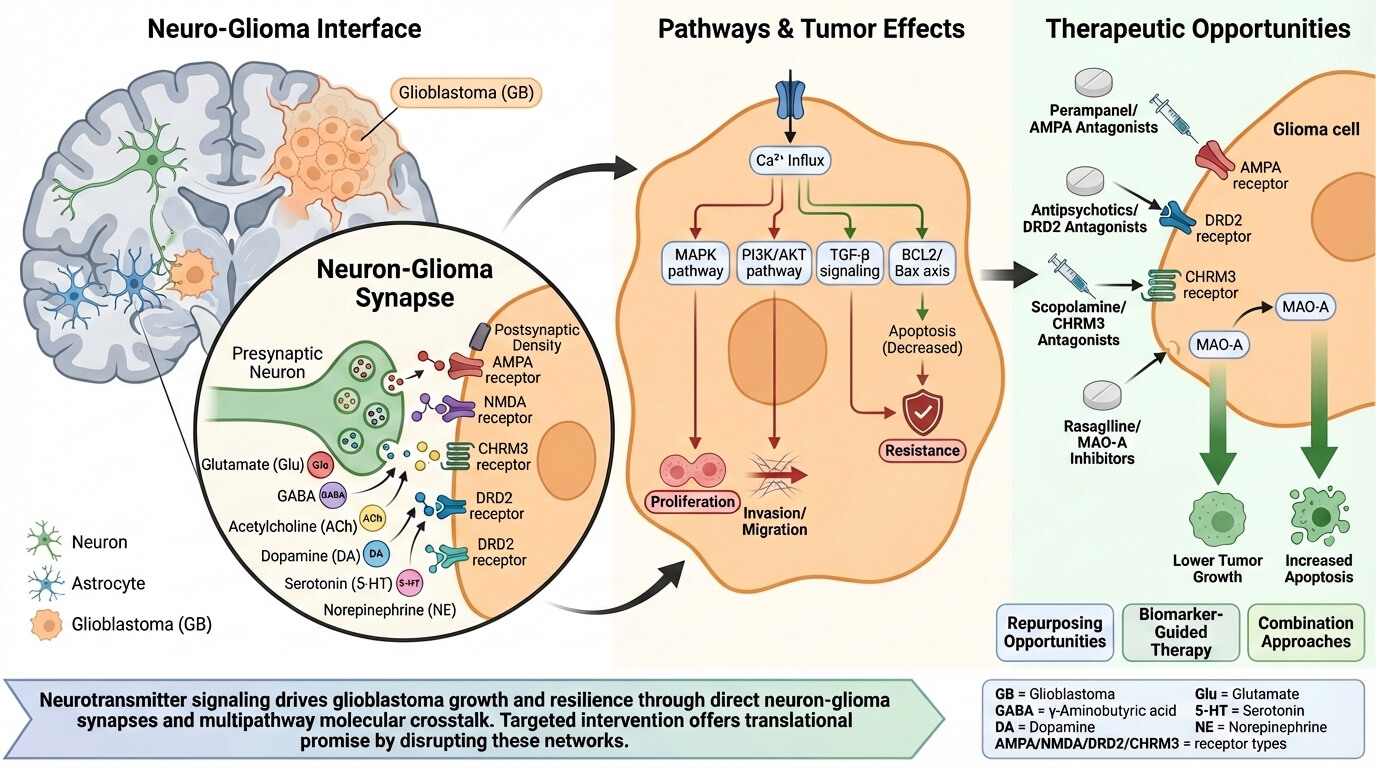
Glioblastoma (GB) is the most common primary malignant brain tumor of adulthood, and despite optimal safe resection and chemoradiation, it is still lethal. Neuroscience of cancer has shown that neuronal activities, as well as neurotransmitters, play an active role in the glioma microenvironment. This article aims to integrate the existing literature on the role of neurotransmitters and their receptors in glioblastoma, as well as other gliomas, highlighting areas of therapeutic intervention in the neuron-tumor interface. We will describe the neuro–glioma interface, including functional neuron–glioma synapses and activity-dependent tumor growth. We will also discuss major neurotransmitter systems involved in glioma pathobiology: glutamate, gamma aminobutyric acid, acetylcholine, dopamine, serotonin, norepinephrine, and other neurotransmitters. We will highlight that these neurotransmitter systems activate common intracellular signaling pathways that control tumor proliferation, invasion, metabolic reprogramming, immune suppression, therapy resistance, etc. In addition, some reports have found tumor-suppressing effects depending on the context. The involvement of neurotransmitter-driven signaling pathways represents a promising area of clinical potential in glioma pathobiology. In particular, focusing on key neurotransmitter systems with blood–brain barrier-permeable agents like alpha-amino-3-hydroxy-5-methyl-4-isoxazolepropionic acid (AMPA/Xc−) system, Muscarinic acetylcholine receptor M3 (CHRM3), dopamine receptor D2, monoamine oxidase A, etc., may enhance drug-repurposing research as well as development of novel anti–neuron–glioma agents.Graphic Abstract
Keywords
Cite This Article
 Copyright © 2026 The Author(s). Published by Tech Science Press.
This work is licensed under a Creative Commons Attribution 4.0 International License , which permits unrestricted use, distribution, and reproduction in any medium, provided the original work is properly cited.
 Downloads
 Citation Tools
