
 Login
Login Register
 Submit a Paper
 Propose a Special lssue
 Open Access
ARTICLE
FSCN1 Modulates Fatty Acid Metabolism and the Coordinated Activation of AKT/mTOR and p38 MAPK Pathways in Colorectal Cancer Cells
1 Bengbu Medical University Key Laboratory of Cancer Research and Clinical Laboratory Diagnosis, School of Laboratory Medicine, Bengbu Medical University, Bengbu, China
2 Department of Blood Transfusion, The Affiliated Wuxi People’s Hospital of Nanjing Medical University, Wuxi People’s Hospital, Wuxi Medical Center, Nanjing Medical University, Wuxi, China
3 Department of Biology, Hefei No.1 Middle School, Hefei, China
4 State Key Laboratory of Oncology in South China, Collaborative Innovation Center for Cancer Medicine, Sun Yat-Sen University Cancer Center, Guangzhou, China
5 Metabolic Innovation Center, Sun Yat-Sen University, Guangzhou, China
6 School of Pharmacy, Bengbu Medical University, Bengbu, China
7 Department of Biochemistry and Molecular Biology, School of Laboratory Medicine, Bengbu Medical University, Bengbu, China
8 Anhui Provincial Key Laboratory of Tumor Evolution and Intelligent Diagnosis and Treatment, Bengbu Medical University, Bengbu, China
* Corresponding Authors: Peng Huang. Email: ; Qi Ding. Email:
; Yupeng Wu. Email:
Oncology Research 2026, 34(10), 24 https://doi.org/10.32604/or.2026.084987
Received 03 May 2026; Accepted 24 July 2026; Issue published 14 September 2026
 View Full Text
 Download PDF
Abstract
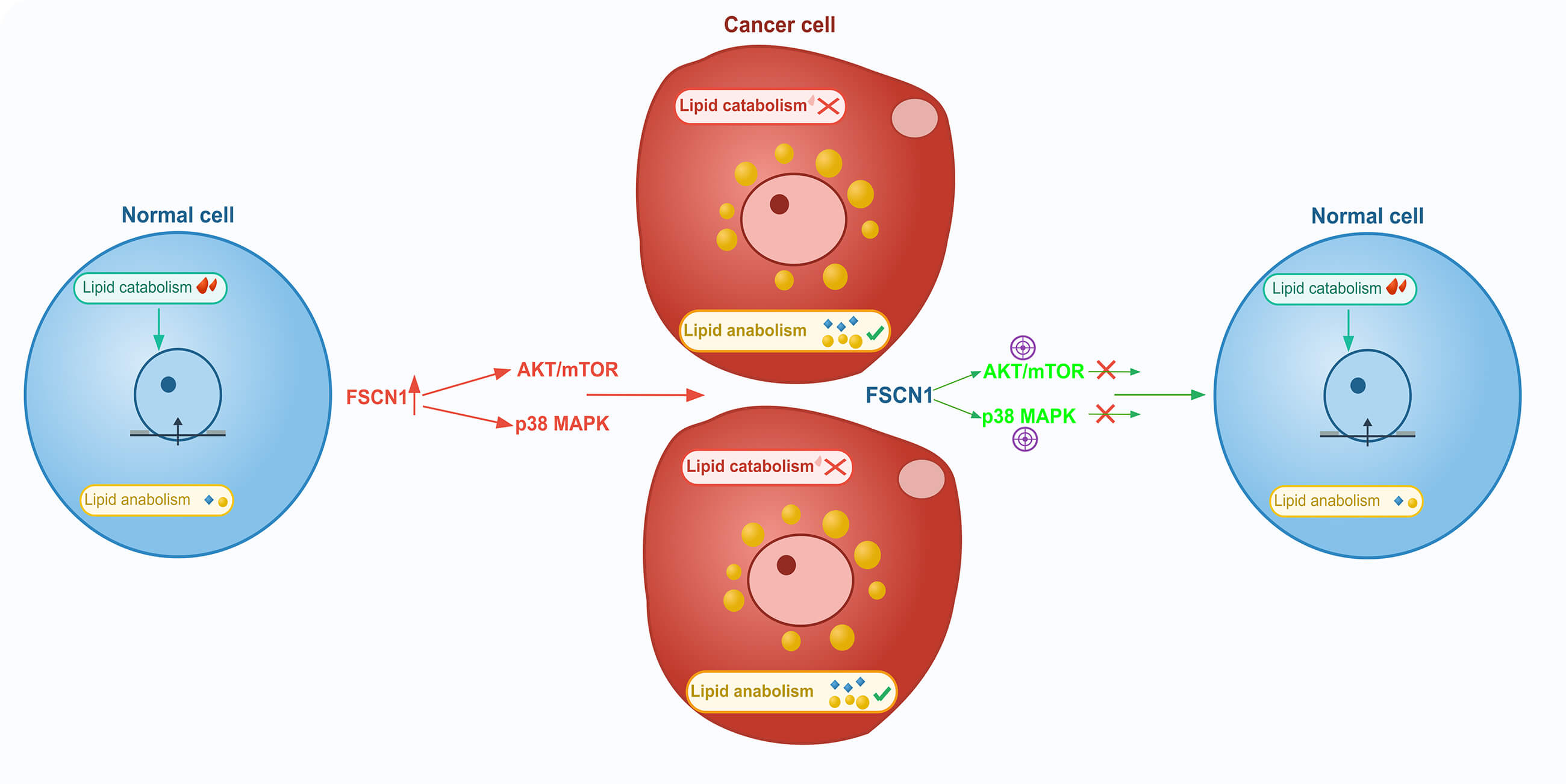
Background: Fascin actin-bundling protein 1 (FSCN1) modulates the expression of key lipogenic enzymes fatty acid synthase (FASN) and stearoyl-CoA desaturase (SCD1) in colorectal cancer (CRC), but the underlying mechanisms remain elusive. Methods: Bioinformatics analyses were performed to evaluate FSCN1 expression and its prognostic value in CRC. Intracellular lipid levels following FSCN1 knockdown were assessed by Nile Red/DAPI co-staining and triglyceride quantification, and further validated by Oil Red O staining of xenograft tumors. Expression levels of key metabolic enzymes were measured by qRT-PCR and Western blotting. RNA sequencing identified FSCN1-associated pathways, which were functionally investigated using pharmacological inhibitors. Results: FSCN1 was significantly upregulated in CRC (p < 0.001; AUC = 0.796) and was correlated with poorer overall survival (p = 0.018). FSCN1 depletion reduced intracellular lipid accumulation, accompanied by downregulation of lipogenic mediators—sterol regulatory element-binding transcription factor 1 (SREBF1; protein product: SREBP1), FASN, and SCD1—and upregulation of peroxisomal fatty acid oxidation (FAO)-related factors—peroxisome proliferator-activated receptor alpha (PPARA; protein product: PPARα) and acyl-CoA oxidase 1 (ACOX1). Mechanistically, FSCN1 was associated with activation of the protein kinase B/mammalian target of rapamycin (AKT/mTOR) and p38 mitogen-activated protein kinase (p38 MAPK) pathways; pharmacological inhibition with LY294002 or SB203580 phenocopied the lipid-lowering effects of FSCN1 knockdown. Conclusion: Collectively, these findings link FSCN1 to the AKT/mTOR/SREBP1/(FASN/SCD1) lipogenic axis and the p38 MAPK/PPARα/ACOX1 peroxisomal FAO pathway, implicating FSCN1 in lipid metabolic regulation and CRC progression, while suggesting a putative functional regulatory axis and a promising candidate therapeutic target for CRC.Graphic Abstract
Keywords
Supplementary Material
Supplementary Material FileCite This Article
 Copyright © 2026 The Author(s). Published by Tech Science Press.
This work is licensed under a Creative Commons Attribution 4.0 International License , which permits unrestricted use, distribution, and reproduction in any medium, provided the original work is properly cited.
 Downloads
 Citation Tools
