
 Login
Login Register
 Submit a Paper
 Propose a Special lssue
 Open Access
ARTICLE
The Impact of Combretastatin A-4 on Cancer Cells and Circulating Tumor Cells (CTCs): A Multi-Assay Approach
1 Laboratory of Biochemistry/Metastatic Signaling, Section of Genetics, Cell Biology and Development, Department of Biology, University of Patras, University Campus, Patras, Greece
2 Synthetic Organic Chemistry Laboratory, Department of Chemistry, University of Patras, University Campus, Patras, Greece
3 Department of Pharmacology and Physiology, University of Maryland School of Medicine, Baltimore, MD, USA
4 Laboratory of Rare Human Circulating Cells and Liquid Biopsy (LCCRH), University Medical Centre of Montpellier, Montpellier, France
5 CREEC, MIVEGEC, University of Montpellier, CNRS, IRD, Montpellier, France
6 European Liquid Biopsy Society (ELBS), Hamburg, Germany
* Corresponding Author: Galatea Kallergi. Email:
Oncology Research 2026, 34(10), 1 https://doi.org/10.32604/or.2026.085665
Received 15 May 2026; Accepted 27 July 2026; Issue published 14 September 2026
 View Full Text
 Download PDF
Abstract
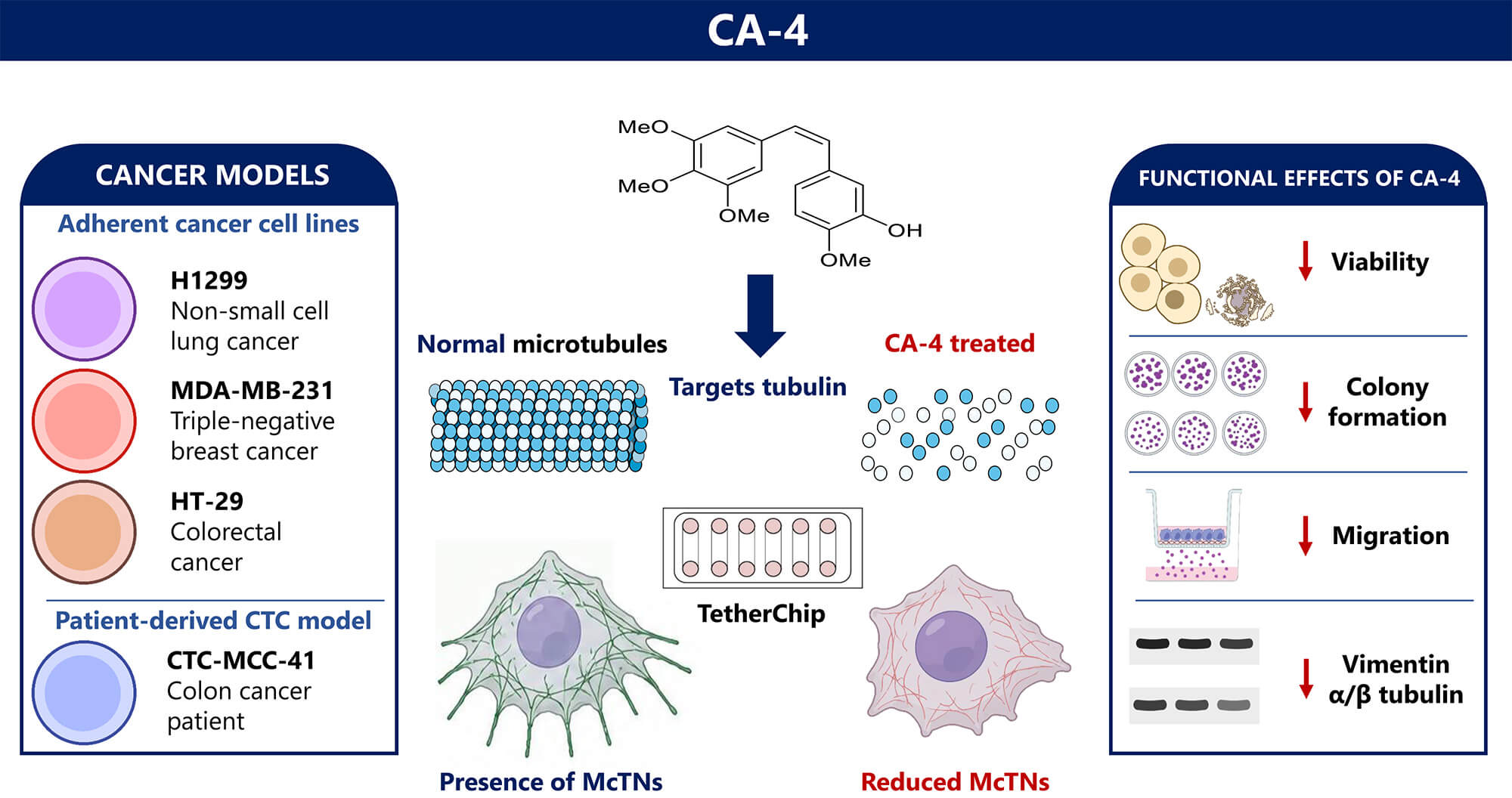
Objectives: Combretastatin A-4 (CA-4) is a microtubule-disrupting agent with established anti-tumor properties. This study aimed to evaluate the effects of CA-4 on key metastatic traits of cancer cells, including migration, clonogenic potential, cytoskeletal protein expression, and microtentacle (McTN) formation, using multiple cancer cell models, including the colon patient-derived circulating tumor cell line CTC-MCC-41. Methods: H1299 (non-small cell lung cancer), MDA-MB-231 (triple-negative breast cancer), HT-29 (colorectal cancer), and CTC-MCC-41 (derived from the blood of a colon cancer patient) cells were treated with CA-4 (10 μM) for 24 and 48 h. Colony formation was assessed with a clonogenic assay. Migration assays (Boyden chamber) evaluated cell motility, while cell viability was determined via MTT assay. Western blot analysis examined vimentin and α/β-tubulin expression. TetherChip assay analyzed McTN formation using wheat germ agglutinin (WGA) staining. Results: CA-4 treatment significantly reduced cell viability, colony formation, and migration across all tested cancer cell lines. Western blot analysis revealed a marked reduction in vimentin and α/β-tubulin expression after 48 h of treatment, indicating disruption of cytoskeletal integrity. In addition, TetherChip analysis demonstrated a pronounced decrease in McTN formation following CA-4 exposure, suggesting inhibition of cytoskeletal protrusions associated with metastatic dissemination. Conclusions: CA-4 effectively impairs multiple cancer cell functions related to metastatic progression, including proliferation, migration, cytoskeletal organization, and McTN formation. These findings highlight the potential of CA-4 as a microtubule-targeting agent with anti-metastatic activity, particularly in circulating tumor cells.Graphic Abstract
Keywords
Supplementary Material
Supplementary Material FileCite This Article
 Copyright © 2026 The Author(s). Published by Tech Science Press.
This work is licensed under a Creative Commons Attribution 4.0 International License , which permits unrestricted use, distribution, and reproduction in any medium, provided the original work is properly cited.
 Downloads
 Citation Tools
