
 Login
Login Register
 Submit a Paper
 Propose a Special lssue
 Open Access
REVIEW
Parasitic Infections and Carcinogenesis: Molecular Mechanisms, Immune Modulation, and Emerging Therapeutic Strategies
1 Department of Medical Biology and Biochemistry, Faculty of Medicine, Ludwik Rydygier Collegium Medicum in Bydgoszcz, Nicolaus Copernicus University in Toruń, 24 Karłowicza St., Bydgoszcz, 85-092, Poland
2 Student Research Club of Medical Biology and Biochemistry, Department of Medical Biology and Biochemistry, Faculty of Medicine, Ludwik Rydygier Collegium Medicum in Bydgoszcz, Nicolaus Copernicus University in Toruń, 24 Karłowicza St., Bydgoszcz, 85-092, Poland
* Corresponding Author: Marta Pawłowska. Email:
Oncology Research 2026, 34(2), 8 https://doi.org/10.32604/or.2025.071891
Received 14 August 2025; Accepted 12 December 2025; Issue published 19 January 2026
 View Full Text
 Download PDF
Abstract
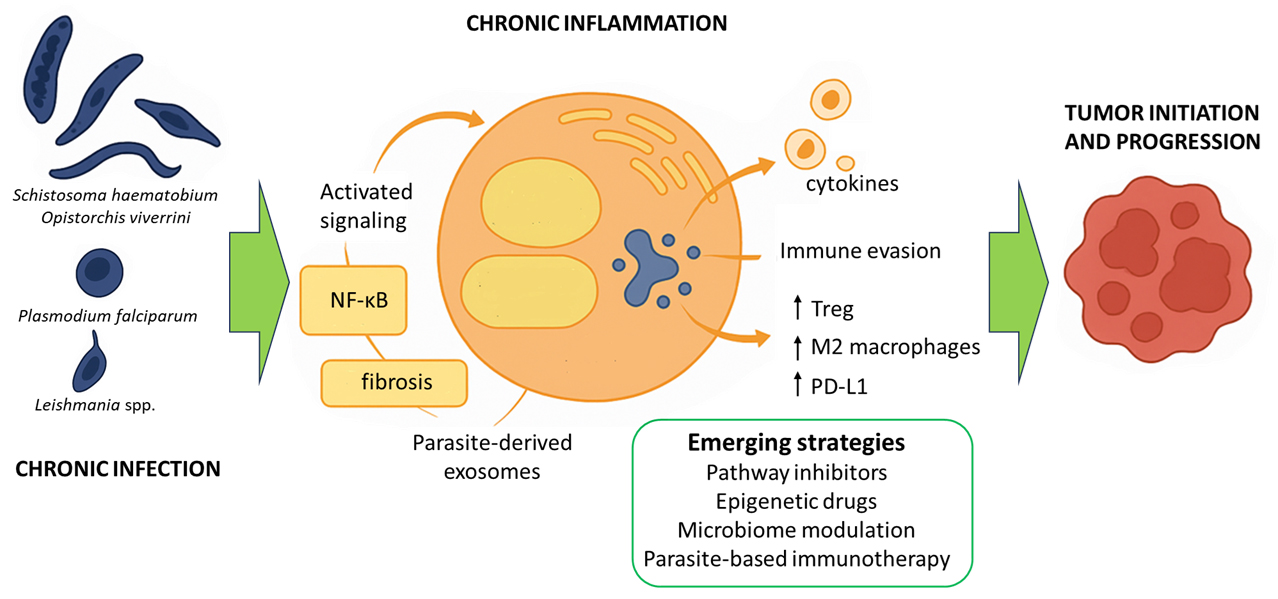
Parasitic infections are increasingly recognized as contributors to cancer development, yet the underlying oncogenic mechanisms remain insufficiently understood. Growing evidence from molecular oncology, immunology, and microbiome research suggests that chronic parasitic infections may drive tumorigenesis through sustained inflammation, deregulated signaling pathways, genomic instability, and the release of parasite-derived exosomes that reshape the tumor microenvironment. These insights underscore the need to integrate parasitology with cancer biology to understand infection-associated malignancies better. The aim of this narrative review is to synthesize current knowledge on how selected parasites contribute to cancer development and to highlight emerging therapeutic and diagnostic opportunities. We examine pathogens such as Schistosoma haematobium, Opisthorchis viverrini, Toxoplasma gondii, Plasmodium falciparum, and Leishmania spp., detailing their roles in chronic inflammation, immune modulation, and interactions with tumor-associated immune cells. The review further discusses parasite-induced immunosuppression, coinfections, and their cumulative impact on cancer risk. Additionally, we explore novel therapeutic approaches, including pathway inhibitors, epigenetic drugs, microbiome modulation, and engineered parasites. Future perspectives emphasize parasite-based immunotherapies, long-term epigenetic consequences of infection, and AI-driven multi-omics strategies for identifying oncogenic signatures. This review integrates advances from parasitology and oncology to provide new insights into biomarkers, targeted therapies, and mechanisms of infection-induced tumorigenesis. The literature search covered studies indexed in PubMed, Scopus, and Web of Science up to July 2025.Graphic Abstract
Keywords
Cite This Article
 Copyright © 2026 The Author(s). Published by Tech Science Press.
This work is licensed under a Creative Commons Attribution 4.0 International License , which permits unrestricted use, distribution, and reproduction in any medium, provided the original work is properly cited.
 Downloads
 Citation Tools
