Home / Journals / OR / Vol.34, No.2, 2026
Special Issues
Table of Content
cover

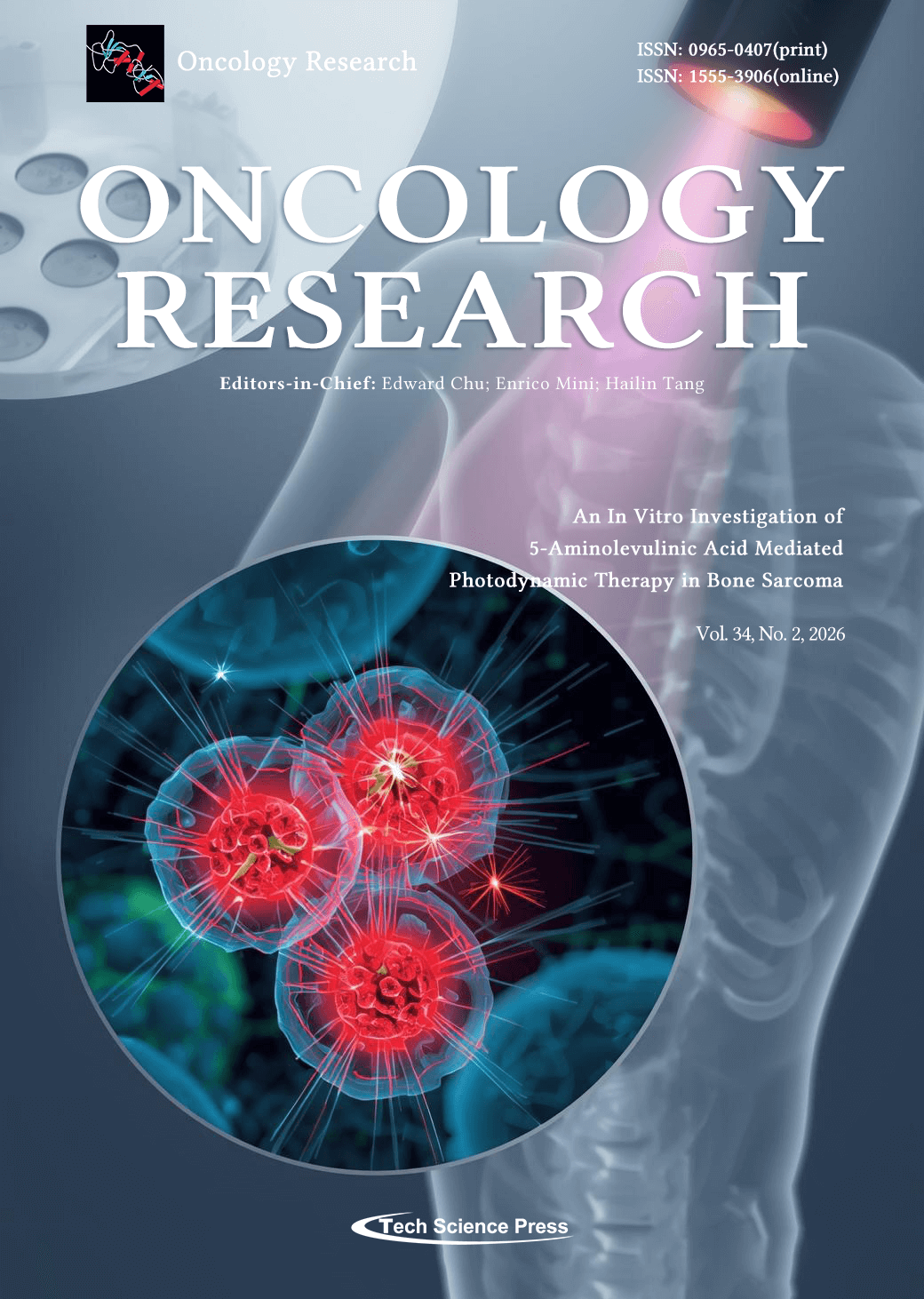
On the Cover

Bone sarcomas are rare, aggressive solid cancers that arise mainly in the limbs and affect children and people of working age. Surgery is the mainstay of curative treatment with the aim of achieving complete clearance of the tumour. There are minimal intra-operative options to optimise tumour eradication.  5-Aminolevulinic Acid (5-ALA) mediated photodynamic therapy has been effective for various cancer types, and therefore this paper has explored the potential for bone cancer as demonstrated in this cover depicting bone sarcoma cells that have internalised the 5-ALA and are subsequently destroyed following administration of red light.

View this paper

  • Open AccessOpen Access

    ARTICLE

    An In Vitro Investigation of 5-Aminolevulinic Acid Mediated Photodynamic Therapy in Bone Sarcoma

    Rebecca H. Maggs*, Marcus J. Brookes, Kenneth S. Rankin
    Oncology Research, Vol.34, No.2, 2026, DOI:10.32604/or.2025.069781 - 19 January 2026
    (This article belongs to the Special Issue: Sarcoma Crossroads: Osteosarcoma, Bone Sarcoma, and Soft Tissue Sarcoma)
    Abstract Background: Photodynamic therapy (PDT) may eradicate residual malignant cells following sarcoma resection, through reactive oxygen species (ROS) mediated cytotoxicity, thus improve clinical outcomes. This study aims to assess the efficacy of 5-aminolevulinic acid (5-ALA) as a photosensitizer in combination with red light (RL) for PDT of bone sarcoma cells in vitro. Methods: Three bone sarcoma cell lines underwent treatment with 5-ALA and RL or sham-RL (SL). 5-ALA uptake was assessed using flow cytometry. Production of ROS was measured using CellROX Green staining and fluorescence microscopy. Cell viability was assessed using Cell Counting Kit-8 assays. Results: All cell… More >

  • Open AccessOpen Access

    REVIEW

    Evolution or Revolution in Colorectal Cancer Treatment: Present and Future of New Therapeutic Options. A Narrative Review

    Urszula Częścik1,2,#, Martyna Gryglas3, Arkadiusz Szterk4, Sylwia Flis3,#,*
    Oncology Research, Vol.34, No.2, 2026, DOI:10.32604/or.2025.067449 - 19 January 2026
    (This article belongs to the Special Issue: Advances and Innovations in Colorectal Cancer Research and Treatment)
    Abstract Colorectal cancer (CRC) is the third most common malignancy worldwide and the second leading cause of cancer-related deaths, accounting for approximately 10% of all cancer cases. By 2050, CRC incidence is expected to rise substantially, driven by population aging and greater exposure to risk factors in developing countries. Despite advances in medicine and pharmacy, the effectiveness of available treatments remains limited, underscoring the urgent need for innovative therapeutic strategies. This review summarizes and critically evaluates currently available CRC therapies and explores new emerging directions. Particular attention is given to the role of immunotherapy, targeted therapies,… More >

  • Open AccessOpen Access

    REVIEW

    Unveiling the Anticancer Potential of Urolithin A in Colorectal Cancer: A Systematic Review

    Mariana Francisco1, Fernando Mendes1,2,3,4,5,*, Diana Martins1,2,3,4, Joana Liberal1,2
    Oncology Research, Vol.34, No.2, 2026, DOI:10.32604/or.2025.070276 - 19 January 2026
    (This article belongs to the Special Issue: Advances and Innovations in Colorectal Cancer Research and Treatment)
    Abstract Objectives: Colorectal cancer (CRC) is a major global health burden, and Urolithin A (Uro-A) has emerged as a promising anticancer agent. This systematic review aims to synthesize current in vitro evidence on the anticancer effects of Uro-A in CRC, highlighting effective concentration ranges, exposure times, relevant outcomes, and underlying molecular mechanisms. Methods: Following PRISMA 2020 guidelines, a systematic search was conducted in PubMed, Scopus, and Web of Science using the following strategy: (colorectal cancer) AND (urolithin a) OR (3,8-dihydroxy-6H-dibenzo(b,d)pyran-6-one). Eligibility criteria were defined by the PICO framework: (P) in vitro CRC cell models; (I) Uro-A alone or… More >

    Graphic Abstract

    Unveiling the Anticancer Potential of Urolithin A in Colorectal Cancer: A Systematic Review

  • Open AccessOpen Access

    REVIEW

    The Frontier of Melanoma Treatment: Defeating Immunotherapy Resistance—A Systematic Review

    Kamila Mozga1, Olga Synowiecka1, Igor Rydzyk1, Anna Marek1, Ewelina Wieczorek1, Alicja Petniak2,*, Paulina Gil-Kulik2
    Oncology Research, Vol.34, No.2, 2026, DOI:10.32604/or.2025.070505 - 19 January 2026
    Abstract Objectives: Immunotherapy based on immune checkpoint blockade (ICB) has become a key treatment for melanoma. However, the increasing number of cases of melanoma resistant to immunotherapy highlights the need to develop methods to overcome this resistance. This study aims to collect the most recent information on melanoma immunotherapy, discuss potential strategies to overcome resistance to immunotherapy, and identify areas that require further analysis. Methods: To achieve this goal, scientific publications from 2021–2024 available in PubMed and Google Scholar databases were analyzed. The databases were searched using the following terms: “melanoma”, “immunotherapy”, “Immune Checkpoint Blockade”, and More >

  • Open AccessOpen Access

    REVIEW

    A Holistic Review of Oncological Drug Targets and Trajectories of Resistance in Cancer Therapy

    Harpreet Kaur1,*, Dhrubalochan Rana2, Sowvik Bag2, Paramjeet Singh3
    Oncology Research, Vol.34, No.2, 2026, DOI:10.32604/or.2025.071209 - 19 January 2026
    (This article belongs to the Special Issue: Drug Targets in Oncology: Mechanisms, Challenges, and Innovations)
    Abstract The prolonged and intricate history of oncological treatments has transitioned significantly since the introduction of chemotherapy. Substantial therapeutic benefits in cancer therapy have been achieved by the integration of conventional treatments with molecular biosciences and omics technologies. Human epidermal growth factor receptor, hormone receptors, and angiogenesis factors are among the established therapies in tumor reduction and managing side effects. Novel targeted therapies like KRAS G12C, Claudin-18 isoform 2 (CLDN18.2), Trophoblast cell-surface antigen 2 (TROP2), and epigenetic regulators emphasize their promise in advancing precision medicine. However, in many cases, the resistance mechanisms associated with these interventions… More >

    Graphic Abstract

    A Holistic Review of Oncological Drug Targets and Trajectories of Resistance in Cancer Therapy

  • Open AccessOpen Access

    REVIEW

    Targeting Sphingolipids in Breast Cancer: From Tumor Biology to Therapeutic Strategies

    Min Hee Kim1, Boyoon Huh1, Joo-Won Park1,*, Woo-Jae Park2,*
    Oncology Research, Vol.34, No.2, 2026, DOI:10.32604/or.2025.071523 - 19 January 2026
    (This article belongs to the Special Issue: Advances in Pathology, Early Diagnosis and Therapeutic Strategies for Breast Cancer)
    Abstract Breast cancer is one of the most prevalent malignancies among women and comprises a heterogeneous spectrum of molecular subtypes with distinct biological behaviors. Among various regulatory molecules, sphingolipids play pivotal roles in dynamically modulating fundamental cellular processes such as proliferation, apoptosis, and metastasis through metabolic interconversions, including phosphorylation, glycosylation, and the generation of sphingosine-1-phosphate. This review aims to elucidate the mechanisms through which sphingolipid metabolism orchestrates cancer cell fate and drives breast cancer progression. Particular emphasis is placed on the balance between proapoptotic ceramides and pro-survival metabolites, such as sphingosine-1-phosphate, which collectively influence tumor growth More >

  • Open AccessOpen Access

    REVIEW

    Clinical Molecular Pathology and Treatment Developments in Advanced Uveal Melanoma: State of the Art

    Stefano Dore1, Matteo Sacchi1, Antonio Pinna1, Giuseppe Palmieri2,3, Panagiotis Paliogiannis4,*
    Oncology Research, Vol.34, No.2, 2026, DOI:10.32604/or.2025.071831 - 19 January 2026
    Abstract Uveal melanoma (UM) is the most common intraocular cancer, with approximately 5.2 individuals per million affected annually in the United States. It represents approximately 3% of the global malignant melanoma cases, accounting for 80% of the overall noncutaneous melanomas. Clinically, it remains silent in about 30% of the cases; when symptomatic, it generally causes metamorphopsia (painless loss or distortion of vision) and/or photopsia (flashing or flickering of light in the visual field). Discoloration of the iris, astigmatism, glaucoma, and even blindness are other, less common clinical manifestations. Several pathophysiological mechanisms underlie the development of UM.… More >

  • Open AccessOpen Access

    REVIEW

    Parasitic Infections and Carcinogenesis: Molecular Mechanisms, Immune Modulation, and Emerging Therapeutic Strategies

    Marta Pawłowska1,*, Dorian Jarek2, Jan Milanowski2, Karolina Szewczyk-Golec1
    Oncology Research, Vol.34, No.2, 2026, DOI:10.32604/or.2025.071891 - 19 January 2026
    Abstract Parasitic infections are increasingly recognized as contributors to cancer development, yet the underlying oncogenic mechanisms remain insufficiently understood. Growing evidence from molecular oncology, immunology, and microbiome research suggests that chronic parasitic infections may drive tumorigenesis through sustained inflammation, deregulated signaling pathways, genomic instability, and the release of parasite-derived exosomes that reshape the tumor microenvironment. These insights underscore the need to integrate parasitology with cancer biology to understand infection-associated malignancies better. The aim of this narrative review is to synthesize current knowledge on how selected parasites contribute to cancer development and to highlight emerging therapeutic and… More >

    Graphic Abstract

    Parasitic Infections and Carcinogenesis: Molecular Mechanisms, Immune Modulation, and Emerging Therapeutic Strategies

  • Open AccessOpen Access

    REVIEW

    Progression on Mechanism and Therapeutic Implications of Neddylation in Lung Cancer

    Jiayu Zou1,2,3, Yajie Lu3, Jiaqi Li3, Zhaokai Zhou4,5, Fu Peng3, Pu Qiu2,*, Hailin Tang6, Cheng Peng1,*
    Oncology Research, Vol.34, No.2, 2026, DOI:10.32604/or.2025.071940 - 19 January 2026
    Abstract Lung cancer is the most common but fatal malignant tumor worldwide. Patients with lung cancer experienced a relatively low 5-year overall survival rate, and issues such as metastasis and drug resistance remain prominent challenges in its clinical management. Neddylation, a novel type of post-translational modification, was overactivated in lung cancer and was closely associated with its occurrence, development, metastasis, and drug resistance. This review systematically summarizes the biological process of neddylation and deeply explores the latest research progress on how neddylation affects lung cancer cell proliferation, metastasis, and drug resistance mechanisms, with a focus on More >

  • Open AccessOpen Access

    REVIEW

    Cancer-Associated Fibroblasts in Prostate Cancer: Unraveling Mechanisms and Therapeutic Implications

    Yang Wu1,#,*, Dong Xu1,#, Run Shi1, Mingwei Zhan2, Shaohui Xu3, Xin Wang4, Jianpeng Zhang5, Zhaokai Zhou6, Weizhuo Wang7, Yongjie Wang8, Minglun Li9, Zihao Xu10,*, Kaifeng Su11,*
    Oncology Research, Vol.34, No.2, 2026, DOI:10.32604/or.2025.073265 - 19 January 2026
    Abstract Prostate cancer (PCa) remains a major cause of cancer-related mortality in men, largely due to therapy resistance and metastatic progression. Increasing evidence highlights the tumor microenvironment (TME), particularly cancer-associated fibroblasts (CAFs), as a critical determinant of disease behavior. CAFs constitute a heterogeneous population originating from fibroblasts, mesenchymal stem cells, endothelial cells, epithelial cells undergoing epithelial–mesenchymal transition (EMT), and adipose tissue. Through dynamic crosstalk with tumor, immune, endothelial, and adipocyte compartments, CAFs orchestrate oncogenic processes including tumor proliferation, invasion, immune evasion, extracellular matrix remodeling, angiogenesis, and metabolic reprogramming. This review comprehensively summarizes the cellular origins, phenotypic More >

  • Open AccessOpen Access

    ARTICLE

    Prognostic Value of Circulating Tumor Cells and Cancer Associated Macrophage-Like Cells in Metastatic Non-Small Cell Lung Cancer Patients: A Retrospective Exploratory Analysis

    Marco Siringo1,2,#,*, Michela De Meo1,#, Alain Jonathan Gelibter3, Chiara Nicolazzo4,5,§, Paola Gazzaniga5,§
    Oncology Research, Vol.34, No.2, 2026, DOI:10.32604/or.2025.069832 - 19 January 2026
    (This article belongs to the Special Issue: Liquid Biopsy: A Powerful Tool for Exploring Tumor Biology)
    Abstract Objectives: Although immune checkpoint inhibitors (ICIs) and targeted therapies have reshaped treatment non-small cell lung cancer (NSCLC) paradigms, prognosis remains poor for many patients due to delayed diagnosis and resistance mechanisms. Liquid biopsy offers a minimally invasive approach to monitoring tumor evolution. Among circulating biomarkers, circulating tumor cells (CTCs) and cancer-associated macrophage-like cells (CAM-Ls) may provide complementary prognostic insights. The study aimed to evaluate the prognostic role of CTC and CAM-Ls dynamic in metastatic NSCLC patients. Methods: We retrospectively analyzed 77 patients with metastatic NSCLC who underwent CTC and CAM-L evaluation via the CellSearch® system… More >

  • Open AccessOpen Access

    ARTICLE

    Detection of KRAS, NRAS and BRAF Mutations in Liquid Biopsy from Patients with Colorectal Cancer

    Katerina Ondraskova1,2, Matous Cwik3, Ondrej Horky4, Jitka Berkovcova4, Jitka Holcakova1, Martin Bartosik1, Tomas Kazda5, Klara Mrazova1,6, Michal Uher7, Igor Kiss3, Roman Hrstka1,3,*
    Oncology Research, Vol.34, No.2, 2026, DOI:10.32604/or.2025.070116 - 19 January 2026
    Abstract Objectives: Cancer treatment relies heavily on accurate diagnosis and effective monitoring of the disease. These processes often involve invasive procedures, such as colonoscopy, to detect malignant tissues, followed by molecular analyses to determine relevant biomarkers. This study aimed to evaluate the clinical performance of droplet digital PCR (ddPCR) for detecting Kirsten Rat Sarcoma Viral Proto-Oncogene (KRAS), Neuroblastoma RAS Viral Oncogene Homolog (NRAS), and B-Raf Murine Sarcoma Viral Oncogene Homolog B (BRAF) mutations in circulating tumor DNA (ctDNA) from colorectal cancer patients using liquid biopsy. Methods: ctDNA was isolated from colorectal cancer (CRC) patients (n = 110) and analyzed for KRAS, BRAF,… More >

  • Open AccessOpen Access

    ARTICLE

    Serum Extracellular Vesicle-Associated GULP1 Is a Key Indicator of Hepatocellular Carcinoma

    Hyung Seok Kim1,#, Ju A Son2,#, Minji Kang3,4,#, Soon Sun Kim3, Geum Ok Baek3, Moon Gyeong Yoon3, Se Ha Jang3,4, Dokyung Jung5, Ji Eun Han3, Jae Youn Cheong3,*, Jung Woo Eun3,*
    Oncology Research, Vol.34, No.2, 2026, DOI:10.32604/or.2025.070392 - 19 January 2026
    Abstract Objectives: Early detection of hepatocellular carcinoma (HCC) is a significant challenge due to the limited sensitivity of alpha-fetoprotein (AFP). This study aimed to assess serum-derived extracellular vesicle-encapsulated GULP PTB domain-containing engulfment adaptor 1 (EV-GULP1) as a novel, noninvasive biomarker for HCC detection and prognosis, leveraging the potential of tumor-specific molecules carried by small extracellular vesicles (EVs). Methods: The study utilized both internal and external cohorts of HCC patients and controls. Small EVs were isolated from serum samples, then characterized and validated to confirm their identity. The expression levels of EV-GULP1 were quantified using quantitative reverse transcription… More >

  • Open AccessOpen Access

    ARTICLE

    BHLHE40 Is a Transcriptional Regulatory Target of NFE2L3 in Triple-Negative Breast Cancer

    Shail Rakesh Modi, Terrick Andey*, George Acquaah-Mensah*
    Oncology Research, Vol.34, No.2, 2026, DOI:10.32604/or.2025.070793 - 19 January 2026
    (This article belongs to the Special Issue: Identification of potential targets and biomarkers for cancers and the exploration of novel molecular mechanisms of tumorigenesis and metastasis)
    Abstract Objectives: The current treatment options and therapeutic targets for triple-negative breast cancer (TNBC), an aggressive subtype of breast cancer (BrCA), are limited. This study aimed to identify novel biomarkers and transcriptional regulatory networks (TRN) inherent in TNBC samples. Methods: We analyzed pan-cancer BrCA datasets from The Cancer Genome Atlas (TCGA) to compare triple-positive breast cancer (TPBC) with TNBC. TRN algorithms and virtual inference of protein-enriched regulon (VIPER) were used to identify master regulators and their target genes. Utilizing TNBC cells (MDA-MB-231 and MDA-MB-468), we validated the relationship of nuclear factor erythroid 2-like 3 (NFE2L3) and… More >

    Graphic Abstract

    <i>BHLHE40</i> Is a Transcriptional Regulatory Target of <i>NFE2L3</i> in Triple-Negative Breast Cancer

  • Open AccessOpen Access

    ARTICLE

    Revealing the Roles of the SH3GLB1-Hydrogen Peroxide Axis in Glioblastoma Multiforme Cells

    Wei-Ting Hsueh1,#, Kwang-Yu Chang1,2,3,#, Chin-Chuan Tsai4,5, Kuan-Tso Chen5,6, Kuen-Jang Tsai7, Zi-Xuan Hong8, Chan-Chuan Liu2, Jui-Mei Chu2, Li-Ying Qiu2, Yu-Yan Lan8, Chia-Hung Chien8,*
    Oncology Research, Vol.34, No.2, 2026, DOI:10.32604/or.2025.071258 - 19 January 2026
    Abstract Objectives: Glioblastoma (GBM) is a prevalent malignant brain tumor prone to drug resistance. We previously found a strong correlation between SH3 domain GRB2-like endophilin B1 (SH3GLB1) and superoxide dismutase 2 (SOD2), which converts O2 to hydrogen peroxide (H2O2). Prior studies show that H2O2 redox signaling is vital for physiological processes and can drive tumor progression. Therefore, we aim to define how H2O2 signaling regulates SH3GLB1 and AKT (protein kinase B) pathways in GBM and to assess whether modulating H2O2 reverses temozolomide (TMZ) resistance. Methods: We used cultured cells and pharmacological inhibitors and activators to confirm the significance of… More >

    Graphic Abstract

    Revealing the Roles of the SH3GLB1-Hydrogen Peroxide Axis in Glioblastoma Multiforme Cells

  • Open AccessOpen Access

    ARTICLE

    Utilization of a UPLC-MS/MS Approach to Elucidate the Role of ABCB1-Mediated Paclitaxel Resistance in Non-Small Cell Lung Cancer Cells

    Sha Hu1,2,#, Wenjing Wang1,#, Qianfang Hu3,#, Rujuan Zheng1,2, Qinghe Huang1,2, Hui Shi1,2, Xinyuan Ding3,*, Wenjuan Wang1,2,*, Zengyan Zhu1,2,*
    Oncology Research, Vol.34, No.2, 2026, DOI:10.32604/or.2025.068967 - 19 January 2026
    (This article belongs to the Special Issue: Advances in Cancer Pharmacology)
    Abstract Objectives: Acquired resistance to paclitaxel represents a critical barrier to the effective chemotherapy of non-small cell lung cancer (NSCLC). The present study aimed to elucidate the molecular and pharmacological mechanisms promoting paclitaxel resistance in NSCLC and to explore potential strategies for overcoming this resistance. Methods: Here, we report an integrated pharmacological and analytical approach to quantify paclitaxel disposition and overcome resistance in a A549/TAX cell model (paclitaxel-resistant A549 cells). Results: Cell counting kit-8 (CCK-8) assay, colony formation, and apoptosis assays confirmed that A549/TAX cells exhibited marked resistance to paclitaxel relative to parental A549 cells. Based on… More >

  • Open AccessOpen Access

    ARTICLE

    PIK3R1 as a Gastric Cancer Biomarker Linked to CD73+ Treg-Mediated Immunosuppression

    Bu Zou1,#, Yi-En Xu2,#, Hui-Chan He3, Zu-Lu Ye2, Da-Lei Zhou2, Cai-Yun He2,*, Chan Huang4,*
    Oncology Research, Vol.34, No.2, 2026, DOI:10.32604/or.2025.069453 - 19 January 2026
    (This article belongs to the Special Issue: Novel Targets and Biomarkers in Solid Tumors)
    Abstract Objectives: Gastric cancer (GC) remains a major global health concern, and Phosphoinositide-3-Kinase Regulatory Subunit 1 (PIK3R1), a regulatory subunit of the PI3K signaling pathway, may play a critical yet underexplored role in GC progression. This study aimed to investigate the prognostic significance of PIK3R1 in GC and its association with the tumor immune microenvironment. Methods: PIK3R1 expression and its clinical relevance were analyzed using datasets from GC patients who underwent gastrectomy, including cohorts from The Cancer Genome Atlas (TCGA) and the Sun Yat-sen University Cancer Center (SYSUCC). Prognostic models integrating PIK3R1 expression with clinical parameters… More >

  • Open AccessOpen Access

    ARTICLE

    Development and Assessment of a Novel Palmitoylation-Related lncRNA Signature for Prognosis and Immune Landscape in Hepatocellular Carcinoma

    Zhilong He1,#, Jing Qin1,#, Sixuan Wu2,#, Xian Liang1, Yu Liu1, Jinfeng Qiu1, Zhimin Li2,*, Kai Hu1,*
    Oncology Research, Vol.34, No.2, 2026, DOI:10.32604/or.2025.070567 - 19 January 2026
    (This article belongs to the Special Issue: Long noncoding RNAs as Tumorigenic Drivers and Therapeutic Targets)
    Abstract Objective: The contribution of long non-coding RNAs (lncRNAs) associated with protein palmitoylation to the progression of hepatocellular carcinoma (HCC) remains largely unclear. This study sought to establish a prognostic signature based on palmitoylation-related lncRNAs and explore their functional implications in HCC. Methods: RNA sequencing and clinical data for HCC and normal tissues were sourced from the Cancer Genome Atlas (TCGA). Pearson correlation analysis was used to identify lncRNAs that were co-expressed with palmitoylation-related genes. Univariate Cox regression was applied to select lncRNAs with prognostic value, followed by the construction of a predictive model using the… More >

  • Open AccessOpen Access

    ARTICLE

    A Retrospective Real-World Study: The Efficacy and Safety of Immune Checkpoint Inhibitors Combined with Chemoradiotherapy in Limited-Stage Small Cell Lung Cancer

    Ruoxue Cai1,#, Shuyi Hu2,#, Feiyang Li2, Huanhuan Sha3,*, Guoren Zhou2,*, Ying Fang3
    Oncology Research, Vol.34, No.2, 2026, DOI:10.32604/or.2025.070893 - 19 January 2026
    (This article belongs to the Special Issue: Advances in Cancer Therapeutics)
    Abstract Objective: To determine whether immunotherapy can bring new hope for patients with limited-stage small-cell lung cancer (LS-SCLC). We conducted this retrospective study to evaluate whether immunotherapy can achieve better efficacy in LS-SCLC patients. Methods: We evaluated 122 LS-SCLC patients who received concurrent chemoradiotherapy (CCRT) or sequential chemoradiotherapy (SCRT) (Group A) and immunotherapy combined with CCRT/SCRT followed by immunotherapy (Group B), to assess the objective response rate (ORR), disease control rate (DCR), and progression-free survival (PFS). Factors affecting prognosis were also explored using Cox analysis. The prognosis of patients with type 2 diabetes and patients with… More >

  • Open AccessOpen Access

    ARTICLE

    Thimerosal Inhibits Tumor Malignant Progression through Direct Action and Enhancing the Efficacy of PD-1-Based Immunotherapy

    Ping Wang1,2,#, Yan-Han Chen1,2,#, Ze-Tao Zhan1,2, Jun-Xiang Zeng1,2, Yu Chen3,4, Yuan Lin1,2, Tao Chen1,5,*, Wei-Jie Zhou1,2,5,*
    Oncology Research, Vol.34, No.2, 2026, DOI:10.32604/or.2025.071902 - 19 January 2026
    (This article belongs to the Special Issue: Advances and Innovations in Colorectal Cancer Research and Treatment)
    Abstract Background: Thimerosal is a mercury-containing preservative widely used in vaccines. This study aimed to investigate its potential antitumor effects and mechanisms in solid malignancies, particularly colorectal cancer (CRC) and melanoma. Methods: A combination of in vitro and in vivo approaches was employed. Cell proliferation, apoptosis, migration, and invasion were assessed using Cell Counting Kit-8 (CCK-8), colony formation, ATP viability, Western blotting, flow cytometry, wound-healing and Transwell assays. Subcutaneous, lung metastases, and Azoxymethane/Dextran Sulfate Sodium Salt (AOM/DSS)-induced colitis-associated CRC models were established to examine antitumor efficacy and safety. The functional role of mercury ions was validated using structural… More >

  • Open AccessOpen Access

    ARTICLE

    The FN1-ITGB4 Axis Drives Acquired Chemoresistance in Bladder Cancer by Activating FAK Signaling

    Xiaoyu Zhang1,#, RenFei Zong1,#, Yan Sun1, Nan Chen2, Kunyao Zhu1, Hang Tong1, Tinghao Li1, Junlong Zhu1, Zijia Qin1, Linfeng Wu1, Aimin Wang1, Weiyang He1,*
    Oncology Research, Vol.34, No.2, 2026, DOI:10.32604/or.2025.072084 - 19 January 2026
    (This article belongs to the Special Issue: Signaling Pathway Crosstalk in Malignant Tumors: Molecular Targets and Combinatorial Therapeutics)
    Abstract Objective: While cisplatin-based chemotherapy is pivotal for advanced bladder cancer, acquired resistance remains a major obstacle. This study investigates key molecular drivers of this resistance and potential reversal strategies. Methods: We established GC (Gemcitabine and Cisplatin)-resistant T24-R and UC3-R cell lines from T24 and UM-UC-3 (UC3) cells. Transcriptomic and proteomic analyses identified differentially expressed molecules. Apoptosis and cell viability were assessed by flow cytometry and CCK-8 (Cell Counting Kit-8) assays, while RT-qPCR (Reverse Transcription Quantitative Polymerase Chain Reaction) and Western blot analyzed gene and protein expression. Immunofluorescence evaluated FAK (Focal Adhesion Kinase) phosphorylation, and a… More >

  • Open AccessOpen Access

    ARTICLE

    Esketamine Enhances the Chemosensitivity of Colorectal Adenocarcinoma Cells to 5-Fluorouracil via AMPK/mTOR/HMMR Signaling Pathway

    Yuerou Feng, Panpan Tong, Shuwen Fu, Xiaofan Lu, Liquan Zheng, Jielan Lai*, Renchun Lai*
    Oncology Research, Vol.34, No.2, 2026, DOI:10.32604/or.2025.072563 - 19 January 2026
    (This article belongs to the Special Issue: Advances and Innovations in Colorectal Cancer Research and Treatment)
    Abstract Background: The efficacy of standard 5-fluorouracil (5-FU) chemotherapy for colorectal cancer is limited by drug resistance and adverse effects, prompting research into esketamine, a potent ketamine variant with analgesic, antidepressant, and recently discovered anti-tumor properties, to determine if it can enhance 5-FU’s chemosensitivity. This study investigates whether esketamine synergizes with 5-FU to enhance therapeutic efficacy in colorectal adenocarcinoma cell models. Methods: We performed functional assays to evaluate proliferation (CCK-8), migration (wound healing), invasion (Transwell), and apoptosis (flow cytometry) in colorectal adenocarcinoma cell lines treated with 5-FU alone or in combination with esketamine. Transcriptomic profiling was… More >

  • Open AccessOpen Access

    ARTICLE

    Gut Associated Metabolites Enhance PD-L1 Blockade Efficacy in Prostate Cancer

    Ke Liu1,2,3,#, Xia Xue1,2,3,#, Haiming Qin4,5,#, Jiaying Zhu6,#, Meng Jin1,6, Die Dai6, Youcai Tang1, Ihtisham Bukhari1, Hangfan Liu1, Chunjing Qiu1, Feifei Ren1, Pengyuan Zheng1,2,3, Yang Mi1,2,3,*, Weihua Chen6,7,*
    Oncology Research, Vol.34, No.2, 2026, DOI:10.32604/or.2025.072661 - 19 January 2026
    (This article belongs to the Special Issue: Advancing Cellular Therapeutics in Oncology: Innovations, Challenges, and Clinical Translation)
    Abstract Background: The gut microbiome has emerged as a critical modulator of cancer immunotherapy response. However, the mechanisms by which gut-associated metabolites influence checkpoint blockade efficacy in prostate cancer (PC) remain not fully explored. The study aimed to explore how gut metabolites regulate death-ligand 1 (PD-L1) blockade via exosomes and boost immune checkpoint inhibitors (ICIs) in PC. Methods: We recruited 70 PC patients to set up into five subgroups. The integrated multi-omics analysis was performed. In parallel, we validated the function of gut microbiome-associated metabolites on PD-L1 production and immunotherapy treatment efficacy in PC cell lines… More >

  • Open AccessOpen Access

    ARTICLE

    RNF145 Promotes Hepatocellular Carcinoma Metastasis through Ubiquitination and Degradation of PCDH9

    Huan Zhang1,#, Zhangwendi Xu1,#, Yien Xu1,#, Mao Li2, Lingrui Liu1, Caiyun He1,*, Wenhuan Zhong1,*, Jiliang Qiu1,*
    Oncology Research, Vol.34, No.2, 2026, DOI:10.32604/or.2025.073079 - 19 January 2026
    Abstract Objective: Ring finger protein 145 (RNF145), an E3 ubiquitin ligase, is significantly upregulated in hepatocellular carcinoma (HCC). However, its role in HCC remains unknown. The study aimed to investigate the functions and underlying mechanisms of RNF145 in HCC. Methods: The role of RNF145 in HCC was investigated using data from The Cancer Genome Atlas (TCGA) and in vitro experimental assays. Its oncogenic functions were assessed using the transwell migration assay and the wound-healing assay. The molecular mechanism was explored through protein immunoprecipitation and western blot analyses. Data from public databases were analyzed to correlate RNF145 expression… More >

  • Open AccessOpen Access

    ARTICLE

    SDHA Deficiency in Hepatocellular Carcinoma Promotes Tumor Progression through Succinate-Induced M2 Macrophage Polarization

    Xinyang Li1,2,3,#, Luyuan Ma1,2,3,#, Chuan Shen1,2,3, Ruolan Gu1,2,3, Shilong Dong1,2,3, Mingjie Liu1,2,3, Ying Xiao1,2,3, Wenpeng Liu1,2,3, Yuexia Liu1,2,3, Caiyan Zhao1,2,3,*
    Oncology Research, Vol.34, No.2, 2026, DOI:10.32604/or.2025.073179 - 19 January 2026
    (This article belongs to the Special Issue: Targeting the Tumor Microenvironment: Emerging Insights into Cancer Progression and Therapeutics)
    Abstract Background: Hepatocellular carcinoma (HCC) is an aggressive and lethal malignancy. Metabolic reprogramming dynamically remodels the tumor microenvironment (TME) and drives HCC progression. This study investigated the mechanism through which metabolic reprogramming remodels the TME in HCC. Methods: HCC patient transcriptome data were subjected to bioinformatics analysis to identify differentially expressed genes and immune infiltration status. Immunohistochemical analysis was performed to determine the correlation between succinate dehydrogenase complex subunit A (SDHA) expression and M2 macrophage infiltration. SDHA-knockdown or SDHA-overexpressing HCC cells were used for in vitro experiments, including co-culturing, flow cytometry, and enzyme-linked immunosorbent assay. Western blotting… More >

  • Open AccessOpen Access

    CASE REPORT

    Detection of Prostate Carcinoma in an Asymptomatic Individual Initiated by an Immunological Biopsy—A Case Report

    Simon Burg1, Audrey Laure Céline Grust1,2,*
    Oncology Research, Vol.34, No.2, 2026, DOI:10.32604/or.2025.068555 - 19 January 2026
    (This article belongs to the Special Issue: Novel Targets and Biomarkers in Solid Tumors)
    Abstract Background: With a total of 1.46 million new cases and 396,792 deaths in 2022, prostate cancer is a major medical challenge around the world. Detecting and treating cancer at earlier, preferably localized stages can significantly increase survival rates. Here, a novel blood-based cancer screening as a pre-test in combination with targeted MRI imaging enabled the early diagnosis of prostate cancer. Case Description: We present the case of a 64-year-old man who participated in a prospective, interventional, multicenter cancer screening study where an immunological biopsy-based technique served as a part of a novel screening technique. This immunology… More >

  • Open AccessOpen Access

    CASE REPORT

    Rare Multiple Brain Metastases Following Debulking Surgery and Androgen Deprivation Therapy in Aggressive Prostate Cancer-Case Report

    Andong Cheng1,2,#, Yiding Chen1,#, Hao Li1, Feixiang Yang1, Junlan Jiang3, Sheng Tai1, Weiwei Chen4, Yu Guan1, Shuiping Yin1,*, Jialin Meng1,2,*
    Oncology Research, Vol.34, No.2, 2026, DOI:10.32604/or.2025.066478 - 19 January 2026
    (This article belongs to the Special Issue: Unraveling cell death in solid tumors: single-cell & spatial transcriptomics illuminate therapeutic target)
    Abstract Background: In clinical practice, approximately 80% of prostate cancer (PC) cases are localized and can achieve favorable outcomes with appropriate treatment. Conversely, some remaining cases exhibit an aggressive phenotype or develop resistance to therapeutic interventions, leading to tumor metastasis and a poorer prognosis. When PC metastasizes to distant sites, the bone remains the predominant location, and brain metastases are regarded as exceedingly rare. Case Description: The current study focused on a rare clinical PC case that presented multiple brain metastases after prostate surgery. The patient was initially diagnosed with PC through prostate biopsy and subsequently underwent More >

  • Open AccessOpen Access

    RETRACTION

    Retraction: ABCB5–ZEB1 Axis Promotes Invasion and Metastasis in Breast Cancer Cells

    Oncology Research Editorial Office
    Oncology Research, Vol.34, No.2, 2026, DOI:10.32604/or.2025.078459 - 19 January 2026
    Abstract This article has no abstract. More >

  • Open AccessOpen Access

    RETRACTION

    Retraction: miR-202 Promotes Cell Apoptosis in Esophageal Squamous Cell Carcinoma by Targeting HSF2

    Oncology Research Editorial Office
    Oncology Research, Vol.34, No.2, 2026, DOI:10.32604/or.2025.078460 - 19 January 2026
    Abstract This article has no abstract. More >

  • Open AccessOpen Access

    RETRACTION

    Retraction: miR-126-5p Restoration Promotes Cell Apoptosis in Cervical Cancer by Targeting Bcl2l2

    Oncology Research Editorial Office
    Oncology Research, Vol.34, No.2, 2026, DOI:10.32604/or.2025.078461 - 19 January 2026
    Abstract This article has no abstract. More >

Per Page:

Share Link

