
 Login
Login Register
 Submit a Paper
 Propose a Special lssue
 Open Access
ARTICLE
BHLHE40 Is a Transcriptional Regulatory Target of NFE2L3 in Triple-Negative Breast Cancer
Department of Pharmaceutical Sciences, Massachusetts College of Pharmacy and Health Sciences, Worcester, MA 01608, USA
* Corresponding Authors: Terrick Andey. Email: ; George Acquaah-Mensah. Email:
(This article belongs to the Special Issue: Identification of potential targets and biomarkers for cancers and the exploration of novel molecular mechanisms of tumorigenesis and metastasis)
Oncology Research 2026, 34(2), 14 https://doi.org/10.32604/or.2025.070793
Received 24 July 2025; Accepted 19 December 2025; Issue published 19 January 2026
 View Full Text
 Download PDF
Abstract
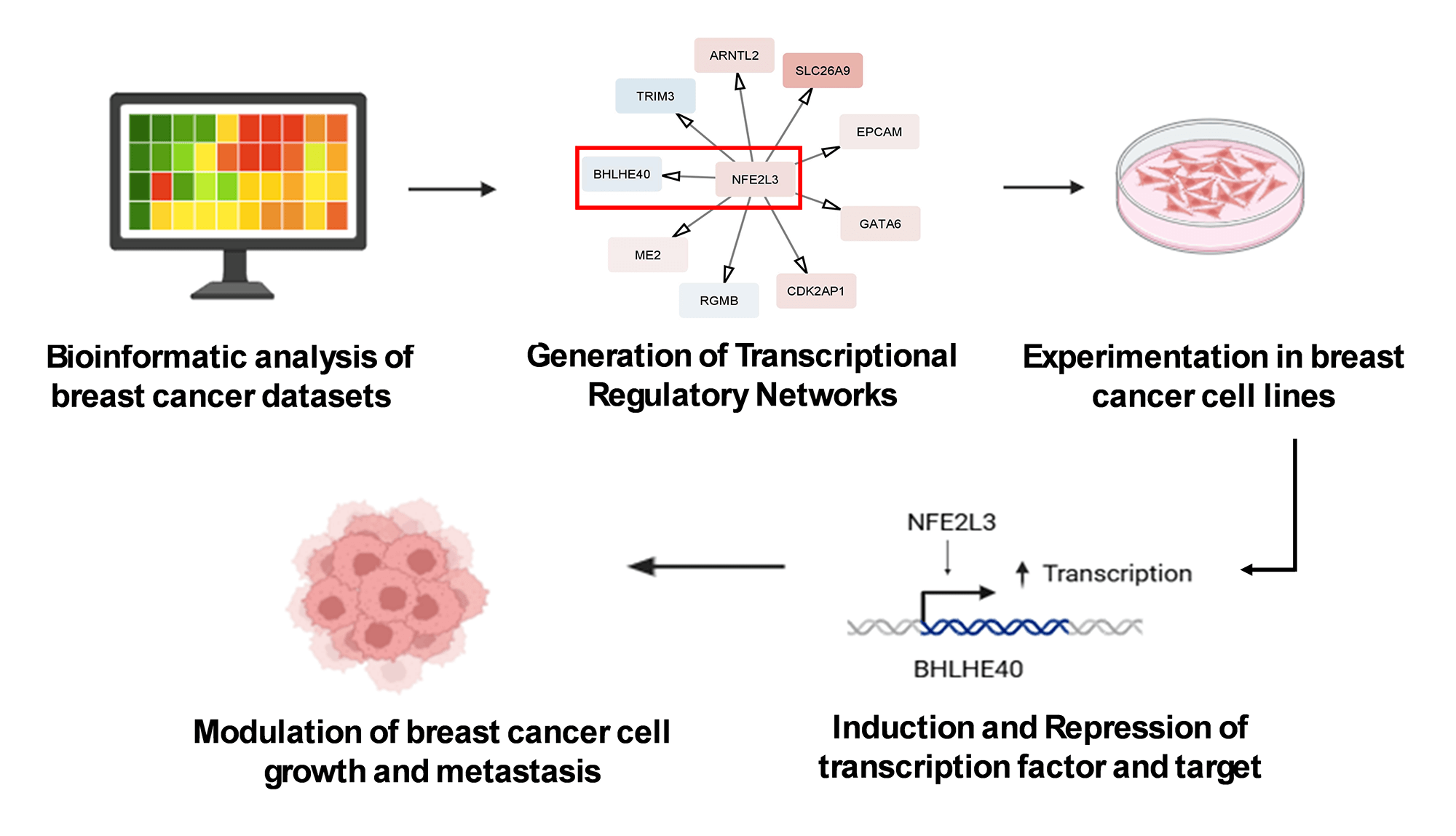
Objectives: The current treatment options and therapeutic targets for triple-negative breast cancer (TNBC), an aggressive subtype of breast cancer (BrCA), are limited. This study aimed to identify novel biomarkers and transcriptional regulatory networks (TRN) inherent in TNBC samples. Methods: We analyzed pan-cancer BrCA datasets from The Cancer Genome Atlas (TCGA) to compare triple-positive breast cancer (TPBC) with TNBC. TRN algorithms and virtual inference of protein-enriched regulon (VIPER) were used to identify master regulators and their target genes. Utilizing TNBC cells (MDA-MB-231 and MDA-MB-468), we validated the relationship of nuclear factor erythroid 2-like 3 (NFE2L3) and basic helix-loop-helix family member E 40 (BHLHE40) by performing a luciferase assay. The expression levels of these targets were measured after transfections with plasmid and siRNA via qRT-PCR and western blots. The effect of these genes on cell proliferation and migration was studied using phenotypic assays. Results: Using computational approaches, we identified NFE2L3 as a master regulator with BHLHE40 as its target gene. NFE2L3 protein binds to the promoter region of BHLHE40 and regulates its transcriptional activity. Additionally, silencing and overexpressing NFE2L3 and BHLHE40 in TNBC cell lines MDA-MB-231 and MDA-MB-468 showed that NFE2L3 directly regulates BHLHE40 at both transcriptional and translational levels. We found that BHLHE40 requires NFE2L3 for cell proliferation and migration in TNBC. Conclusion: These findings underscore the significance of NFE2L3 and BHLHE40 in TNBC, highlighting NFE2L3’s role in regulating the oncogenic activity of BHLHE40 in TNBC cells.Graphic Abstract
Keywords
Cite This Article
 Copyright © 2026 The Author(s). Published by Tech Science Press.
This work is licensed under a Creative Commons Attribution 4.0 International License , which permits unrestricted use, distribution, and reproduction in any medium, provided the original work is properly cited.
 Downloads
 Citation Tools
