
 Login
Login Register
 Submit a Paper
 Propose a Special lssue
 Open Access
REVIEW
Efficacy and Mechanisms of CDK4/6 Inhibitors in Breast Cancer: Advancing Targeted Therapeutic Strategies
1 Department of Agriculture Science, Faculty of Agro-Based Industry, Universiti Malaysia Kelantan, Jeli, Kelantan, Malaysia
2 Department of Pharmacology, Luqman College of Pharmacy, PB 86, Old Jewargi Road, Gulbarga, Karnataka, India
3 Department of Pharmacognosy, Luqman College of Pharmacy, PB 86, Old Jewargi Road, Gulbarga, Karnataka, India
4 Advanced Livestock and Aquaculture Research Group, Faculty of Agro-Based Industry, Universiti Malaysia Kelantan, Jeli Campus, Jeli, Malaysia
5 Department of Orthopaedics, School of Medical Sciences, Universiti Sains Malaysia, Kubang Kerian, Kelantan, Malaysia
6 Department of Biotechnology, Koneru Lakshmaiah University (KLEF), Vaddeswaram Campus, Guntur, Andhra Pradesh, India
7 Department of Rasa Shastra and Bhaishajya Kalpana, Faculty of Ayurveda, Institute of Medical Sciences, Banaras Hindu University, Varanasi, Uttar Pradesh, India
* Corresponding Authors: Zulhisyam Abdul Kari. Email: ; Muhammad Rajaei Ahmad Mohd Zain. Email:
; Rohit Sharma. Email:
(This article belongs to the Special Issue: The Evolving Landscape of Cancer Treatment: Molecular Insights and Immunotherapeutic Breakthroughs)
Oncology Research 2026, 34(4), 13 https://doi.org/10.32604/or.2026.073601
Received 22 September 2025; Accepted 29 December 2025; Issue published 23 March 2026
 View Full Text
 Download PDF
Abstract
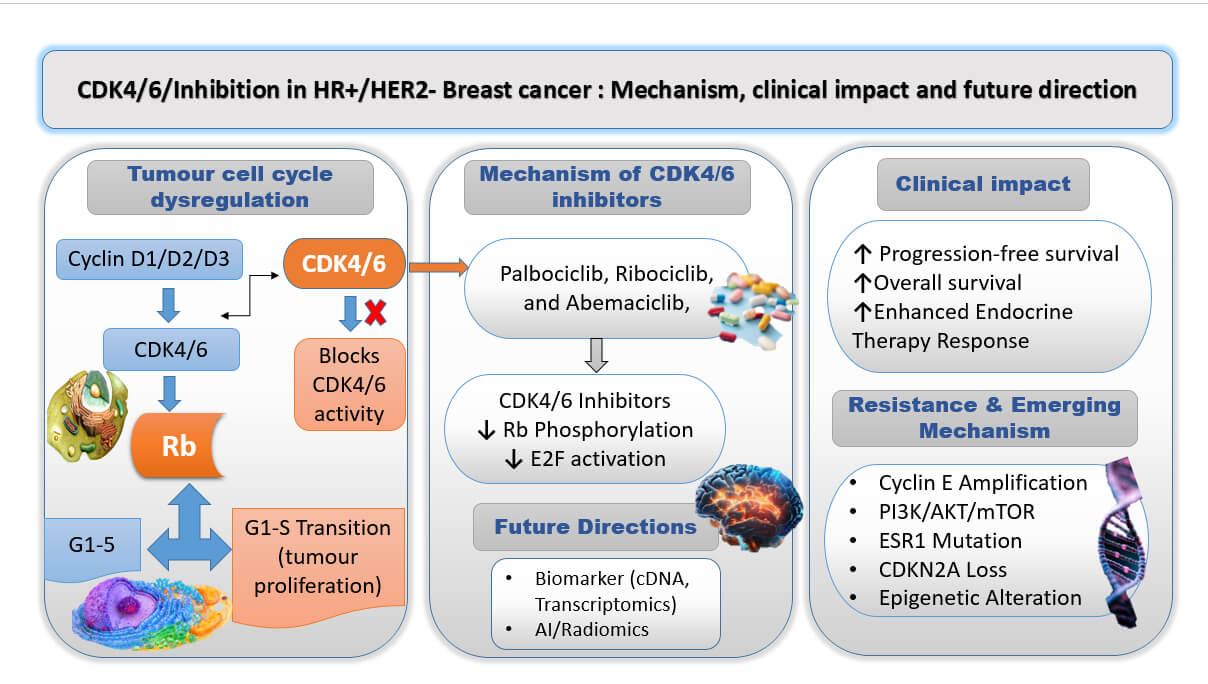
Breast cancer remains the primary cause of cancer-related mortality for women globally; therefore, further breakthroughs in treatment approaches are crucial. Palbociclib, ribociclib, and abemaciclib are among the Cyclin-dependent kinase 4 and 6 (CDK4/6) inhibitors that have become an innovative family of targeted therapy for hormone receptor-positive, Human Epidermal Growth factor receptor 2 (HR+/HER2−) breast cancer. These inhibitors work by preventing the action of CDK4/6, which are crucial in the regulation of the cell cycle. Leading cancer cells to cell cycle arrest and undergo apoptosis. When these inhibitors are used with endocrine medicines like letrozole and fulvestrant, clinical trials lead positive impact in progression-free survival and, in a few cases, complete survival. However, despite their effectiveness, resistance mechanisms are primary and current acquired problems, requiring combined approaches with additional targeted medicines and continuous investigation into innovative therapeutic plans. To maintain patient compliance and quality of life, common side effects such as tiredness, gastrointestinal problems, and neutropenia need to be effectively managed. There is hopefulness for wider oncological applications as next-generation CDK inhibitor development and adaptive clinical trials continue to test their potential beyond breast cancer. CDK4/6 inhibitors continue to be a key part of breast cancer treatment as cancer biology advances, marking a major advancement towards more potent and customized cancer medicines. This review aims to provide current evidence on CDK4/6 inhibitors in HR+/HER2− breast cancer, highlighting their mechanisms, interaction with endocrine resistance, combination strategies, and emerging biomarkers guiding personalized therapy.Graphic Abstract
Keywords
Cite This Article
 Copyright © 2026 The Author(s). Published by Tech Science Press.
This work is licensed under a Creative Commons Attribution 4.0 International License , which permits unrestricted use, distribution, and reproduction in any medium, provided the original work is properly cited.
 Downloads
 Citation Tools
