
 Login
Login Register
 Submit a Paper
 Propose a Special lssue
 Open Access
ARTICLE

Optimizing Nitrogen Rate and Biostimulant Application to Improve Onion (Allium cepa L.) Yield and Nutrient Use Efficiency
1 Faculty of Agriculture, University of Novi Sad, Dositej Obradović Square 8, Novi Sad, 21000, Serbia
2 Department of Vegetable Sciences and Floriculture, Mendel University in Brno, Lednice, 69144, Czech Republic
3 Institute of Field and Vegetable Crops, National Institute of the Republic of Serbia, Novi Sad, 21000, Serbia
4 Faculty of Agriculture, University of Belgrade, Belgrade, 11080, Serbia
* Corresponding Author: Jelena Popović-Đorđević. Email:
Phyton-International Journal of Experimental Botany 2025, 94(7), 1997-2013. https://doi.org/10.32604/phyton.2025.065535
Received 15 March 2025; Accepted 05 June 2025; Issue published 31 July 2025
 View Full Text
 Download PDF
Abstract
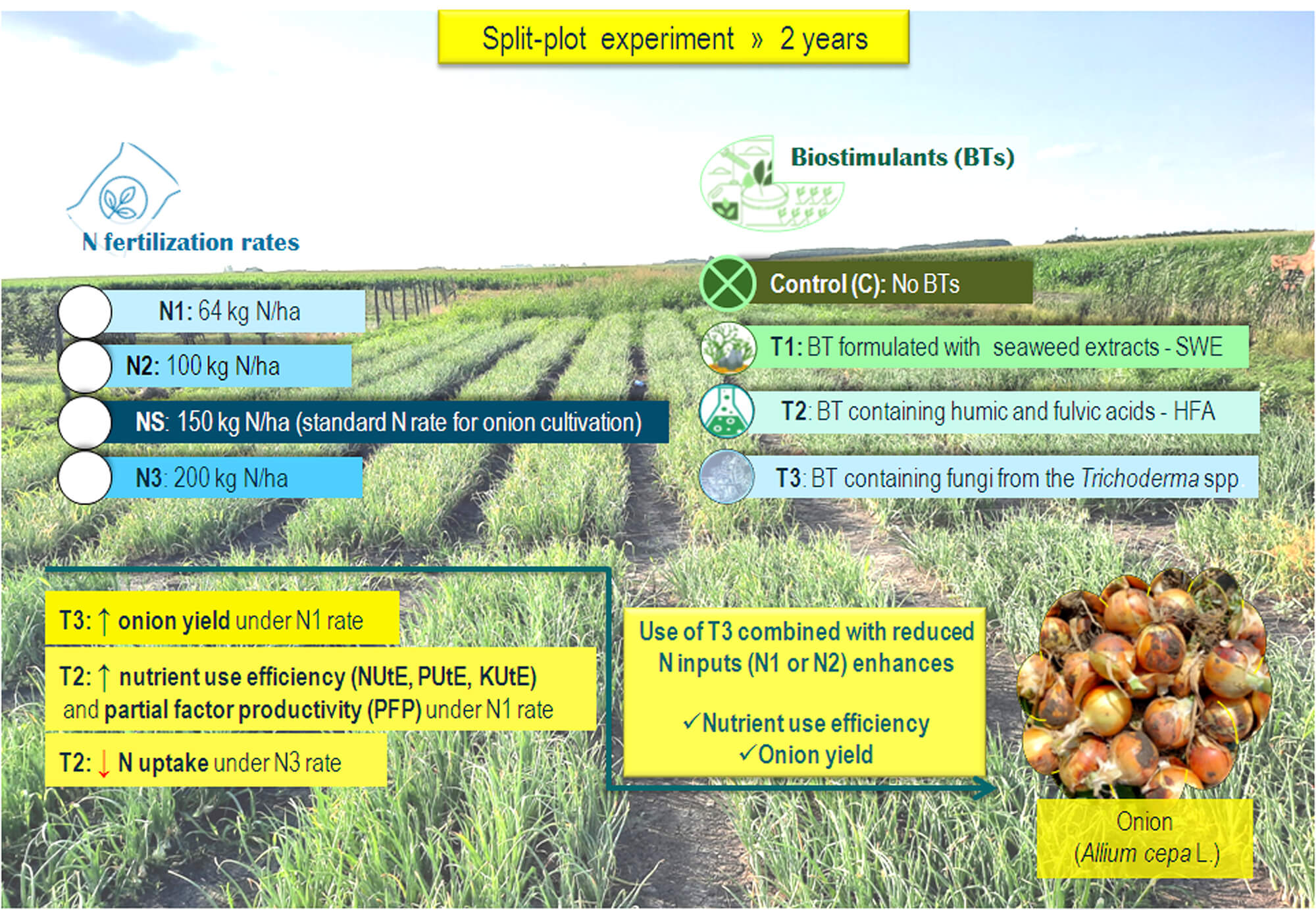
Onion (Allium cepa L.) is a widely cultivated vegetable valued for its taste, aroma, and nutritional content. Biostimulants (BTs) are substances that stimulate plant growth and development. This study explores the impact of BTs and nitrogen (N) fertilization on the yield and nutrient use efficiency of directly seeded onions, addressing the challenges of excessive N application and promoting sustainable practices. A two-year field experiment was conducted using a split-plot design with three replications. Treatments included a control (C), a seaweed extract-based BT (T1), humic and fulvic acids (T2), and Trichoderma spp. (T3). N rates applied were 64 kg N/ha (N1), 100 kg N/ha (N2), 150 kg N/ha as the standard (NS), and 200 kg N/ha (N3). Compared to the C × NS treatment, T1 × N1 increased yield by 7.6% with a saving of 50 kg N/ha; T2 × N3 increased yield by 19.4%; and T3 × N1 increased yield by 11.7% with a saving of 86 kg N/ha. The T2 treatment reduced N uptake under excessive N rate (T2 × N3), indicating a potential protective effect against stress induced by high N levels. Treatment with T1 improved nutrient use efficiency (NUtE, PUtE, KUtE) and partial factor productivity (PFP) under reduced N conditions (T1 × N1). The study advises farmers to apply T3 under reduced N rates (N1 and N2) to improve yield and highlights that all three BTs enhance nutrient use efficiency, providing promising strategies to boost onion productivity while minimizing nutrient losses in direct seeding cultivation.Graphic Abstract
Keywords
Cite This Article
 Copyright © 2025 The Author(s). Published by Tech Science Press.
This work is licensed under a Creative Commons Attribution 4.0 International License , which permits unrestricted use, distribution, and reproduction in any medium, provided the original work is properly cited.
 Downloads
 Citation Tools
