Home / Journals / PHYTON / Vol.94, No.7, 2025
Special Issues
Table of Content
cover

On the Cover

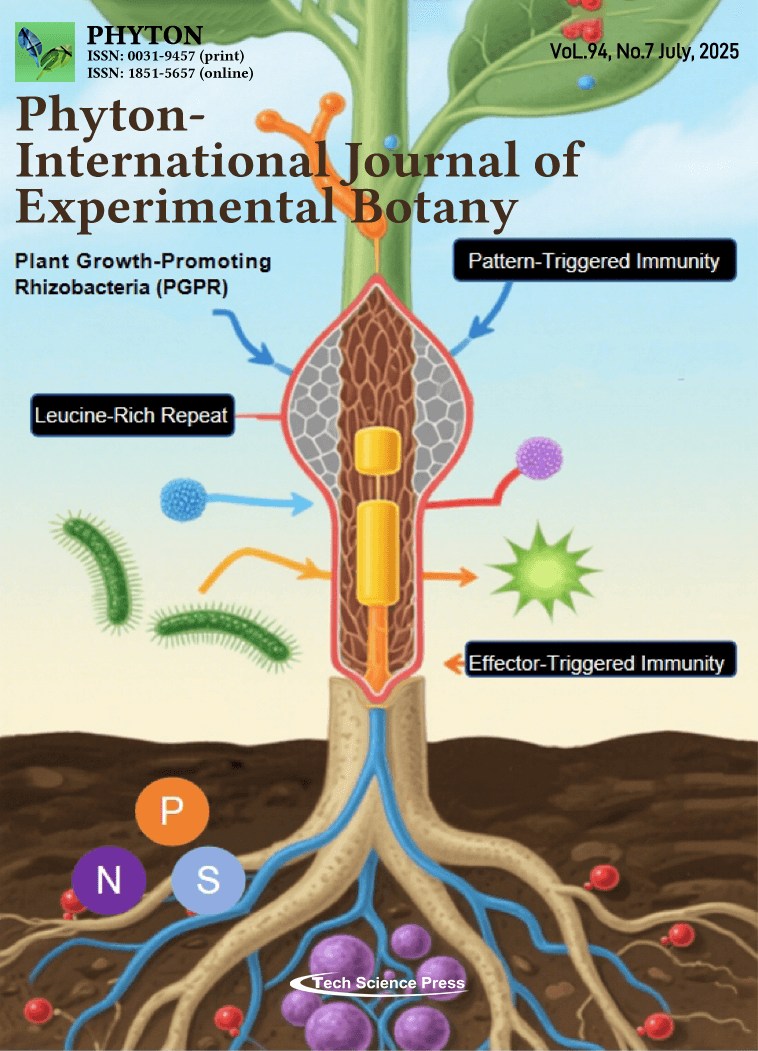
Plant-pathogen interactions involve complex biological processes that operate across molecular, cellular, microbiome, and ecological levels, significantly influencing plant health and agricultural productivity. In response to pathogenic threats, plants have developed sophisticated defense mechanisms, such as pattern-triggered immunity (PTI) and effector-triggered immunity (ETI), which rely on specialized recognition systems such as pattern recognition receptors (PRRs) and nucleotide-binding leucine-rich repeat (NLR) proteins. Furthermore, structural barriers such as callose deposition and lignification, along with the synthesis of secondary metabolites and antimicrobial enzymes, play crucial roles in inhibiting pathogen invasion and proliferation. The plant microbiome further enhances host immunity through beneficial associations with plant growth-promoting rhizobacteria (PGPR) and mycorrhizal fungi, which facilitate induced systemic resistance (ISR) and improve nutrient acquisition. As climate change exacerbates the impact of pathogens, these molecular and microbiome-driven defenses influence disease distribution and plant resilience, highlighting the importance of integrating ecological insights for sustainable disease management Advancements in microbiome engineering, including the application of synthetic microbial communities and commercial bio-inoculants, offer promising strategies for sustainable disease management. However, the impacts of climate change on pathogen virulence, host susceptibility, and disease distribution complicate these interactions, emphasizing the need for resilient and adaptive agricultural practices. The Cover image explains a generalized overview of plant microbe interaction. This cover image was created using AI-generated content from "doubao AI". The authorsconfirm that no human likenesses, copyrighted elements, or misleading representationsare included in the image.
View this paper

  • Open AccessOpen Access

    REVIEW

    Phytochemicals as Multi-Target Therapeutic Agents for Oxidative Stress-Driven Pathologies: Mechanisms, Synergies, and Clinical Prospects

    Bismillah Mubeen1,2,#, Ammarah Hasnain2,3,#,*, Syed Atif Hasan Naqvi4, Fahad Hakim5, Syed Sheharyar Hassan Naqvi6, Muhammad Zeeshan Hassan4, Muhammad Umer Iqbal7, Mahmoud Moustafa8, Mohammed O. Alshaharni8, Mingzheng Duan1,*
    Phyton-International Journal of Experimental Botany, Vol.94, No.7, pp. 1941-1971, 2025, DOI:10.32604/phyton.2025.064056 - 31 July 2025
    (This article belongs to the Special Issue: Advances in Molecular Insights of Plant Secondary Metabolites: Biosynthesis, Regulation, and Applications)
    Abstract Plants have long served as a cornerstone for drug discovery, offering a vast repertoire of bioactive compounds with proven efficacy in combating oxidative stress, a pivotal driver of chronic diseases such as cancer, diabetes, cardiovascular disorders, and neurodegenerative conditions. This review synthesizes current knowledge on plant-derived antioxidants, emphasizing their mechanisms, therapeutic potential, and quantitative efficacy validated through standardized assays. Key phytochemicals, including polyphenols, carotenoids, flavonoids, and terpenoids, neutralize reactive oxygen species (ROS) through radical scavenging, enzyme modulation, and gene regulation. For instance, lutein, a carotenoid found in leafy greens, demonstrates potent antioxidant activity with IC50 values… More >

  • Open AccessOpen Access

    REVIEW

    Integrative Perspectives on Multi-Level Mechanisms in Plant-Pathogen Interactions: From Molecular Defense to Ecological Resilience

    Adnan Amin, Wajid Zaman*
    Phyton-International Journal of Experimental Botany, Vol.94, No.7, pp. 1973-1996, 2025, DOI:10.32604/phyton.2025.067885 - 31 July 2025
    (This article belongs to the Special Issue: Multi-Level Mechanisms in Plant-Pathogen Interactions)
    Abstract Plant-pathogen interactions involve complex biological processes that operate across molecular, cellular, microbiome, and ecological levels, significantly influencing plant health and agricultural productivity. In response to pathogenic threats, plants have developed sophisticated defense mechanisms, such as pattern-triggered immunity (PTI) and effector-triggered immunity (ETI), which rely on specialized recognition systems such as pattern recognition receptors (PRRs) and nucleotide-binding leucine-rich repeat (NLR) proteins. These immune responses activate intricate signaling pathways involving mitogen-activated protein kinase cascades, calcium fluxes, reactive oxygen species production, and hormonal cross-talk among salicylic acid, jasmonic acid, and ethylene. Furthermore, structural barriers such as callose deposition… More >

  • Open AccessOpen Access

    ARTICLE

    Optimizing Nitrogen Rate and Biostimulant Application to Improve Onion (Allium cepa L.) Yield and Nutrient Use Efficiency

    Đorđe Vojnović1, Robert Pokluda2, Ivana Maksimović1, Janko Červenski3, Sonja Ilin3, Boris Adamović1, Jelena Popović-Đorđević4,*
    Phyton-International Journal of Experimental Botany, Vol.94, No.7, pp. 1997-2013, 2025, DOI:10.32604/phyton.2025.065535 - 31 July 2025
    (This article belongs to the Special Issue: Optimizing Crops Production: Agronomic, Chemical and AI-assisted Approaches)
    Abstract Onion (Allium cepa L.) is a widely cultivated vegetable valued for its taste, aroma, and nutritional content. Biostimulants (BTs) are substances that stimulate plant growth and development. This study explores the impact of BTs and nitrogen (N) fertilization on the yield and nutrient use efficiency of directly seeded onions, addressing the challenges of excessive N application and promoting sustainable practices. A two-year field experiment was conducted using a split-plot design with three replications. Treatments included a control (C), a seaweed extract-based BT (T1), humic and fulvic acids (T2), and Trichoderma spp. (T3). N rates applied were 64… More >

    Graphic Abstract

    Optimizing Nitrogen Rate and Biostimulant Application to Improve Onion (<i>Allium cepa</i> L.) Yield and Nutrient Use Efficiency

  • Open AccessOpen Access

    ARTICLE

    Mitochondrial Genomic Characterization and Phylogenetic Analysis of Wild Rapeseed Rorippa indica

    Wentao Sheng1,2,*
    Phyton-International Journal of Experimental Botany, Vol.94, No.7, pp. 2015-2031, 2025, DOI:10.32604/phyton.2025.066232 - 31 July 2025
    (This article belongs to the Special Issue: Plant Organelles Comparative Genomics and DNA Systematics)
    Abstract Rorippa indica is a wild oilseed crop of Brassicaceae with good environmental adaptability and strong stress resistance. This plant has become an important wild relative species for rapeseed (Brassica napus L.) and is used to improve its agronomic traits, with important development and utilization value. However, the research of R. indica genetics is still lacking. And no mitochondrial genome (mitogenome) in the genus Rorippa has been expounded. To analyze the structural characteristics of the R. indica mitogenome, second-generation and third-generation sequencing techniques were made to assemble its mitogenome. The results showed that its mitogenome is composed of a single master… More >

  • Open AccessOpen Access

    ARTICLE

    Detection of Rice Bacterial Leaf Blight Using Hyperspectral Technology and Continuous Wavelet Analysis

    Kaihao Shi1,2, Lin Yuan1,2,*, Qimeng Yu3, Zhongting Shen2, Yingtan Yu2, Chenwei Nie1, Xingjian Zhou3, Jingcheng Zhang3
    Phyton-International Journal of Experimental Botany, Vol.94, No.7, pp. 2033-2054, 2025, DOI:10.32604/phyton.2025.066286 - 31 July 2025
    Abstract Plant diseases are a major threat that can severely impact the production of agriculture and forestry. This can lead to the disruption of ecosystem functions and health. With its ability to capture continuous narrow-band spectra, hyperspectral technology has become a crucial tool to monitor crop diseases using remote sensing. However, existing continuous wavelet analysis (CWA) methods suffer from feature redundancy issues, while the continuous wavelet projection algorithm (CWPA), an optimization approach for feature selection, has not been fully validated to monitor plant diseases. This study utilized rice bacterial leaf blight (BLB) as an example by… More >

  • Open AccessOpen Access

    ARTICLE

    Participatory Rice Breeding in Rainfed Land to Sustainable Agriculture

    Vina Eka Aristya1, Sri Minarsih1, Kristamtini1, I Gusti Komang Dana Arsana1, Samijan1, Setyorini Widyayanti1, Sodiq Jauhari1, Arif Susila1, Ni Wayan Trisnawati1, I Ketut Mahaputra1, I Nyoman Suyasa1, Opik Mahendra2, Supriyanta3, Gilang Wirakusuma3, Taufan Alam3, Taryono3,*
    Phyton-International Journal of Experimental Botany, Vol.94, No.7, pp. 2055-2073, 2025, DOI:10.32604/phyton.2025.065227 - 31 July 2025
    (This article belongs to the Special Issue: Crop Managements and Crop Adversity: Strategies, Mechanisms, and Implements)
    Abstract Rice, as a primary commodity, needs to be increased in production while facing the sustainability challenges of limited land, water resources, and climate change. The demand for rice productivity was not enough to rely only on the fertile fields’ ability; it is necessary to consider the rainfed land potential. Cultivation in rainfed land involves biophysical pressure, low production, and limited access to superior varieties. Participatory rice breeding aimed to identify farmers’ trait preferences and develop acceptable lines. A bottom-up approach involved 203 farmers from four rainfed fields in Indonesia, i.e., Semarang-Central Java, Kulon Progo-Yogyakarta, Tabanan-Bali,… More >

  • Open AccessOpen Access

    ARTICLE

    Leaf Position on the Sunflower Stem Determines Physiological Condition during Flowering

    Antonela Markulj Kulundžić1,*, Daniela Horvat2, Marija Kovačević Babić2, Anto Mijić1, Aleksandra Sudarić1, Maja Matoša Kočar1, Tomislav Duvnjak1, Ivica Liović1, Ivana Varga3, Marija Viljevac Vuletić2,*
    Phyton-International Journal of Experimental Botany, Vol.94, No.7, pp. 2075-2095, 2025, DOI:10.32604/phyton.2025.065961 - 31 July 2025
    (This article belongs to the Special Issue: Influence of Biotic and Abiotic Stresses Signals on Plants and their Performance at Different Environments)
    Abstract Sunflower leaf photosynthesis strongly depends on the leaf position in the plant stem conditioning, which directly affects other physiological processes. Therefore, a study of the leaf’s physiological status regarding the leaf position in the stem was performed on sunflowers in the flowering stage. Eight differently positioned leaves were investigated, starting with the youngest leaf on the top of the stem to the leaves of the stem bottom, assigned as the oldest senescent leaves. According to chlorophyll fluorescence (ChlF) parameters connected to photosystem II (PSII) processes, significant changes in PSII functioning occurred only in the senescent… More >

  • Open AccessOpen Access

    ARTICLE

    Synergistic Effect of Zinc Oxide, Magnesium Oxide and Graphene Nanomaterials on Fusarium oxysporum-Inoculated Tomato Plants

    Alejandra Sánchez-Reyna1, Yolanda González-García2, Ángel Gabriel Alpuche-Solís3, Gregorio Cadenas-Pliego4, Adalberto Benavides-Mendoza5,6, Antonio Juárez-Maldonado6,7,*
    Phyton-International Journal of Experimental Botany, Vol.94, No.7, pp. 2097-2116, 2025, DOI:10.32604/phyton.2025.067092 - 31 July 2025
    (This article belongs to the Special Issue: Plant Metabolism Changes to Abiotic and Biotic Stresses: Plant Physiology and Biochemistry Responses and Possible Adaptations Strategies)
    Abstract Tomato is an economically important crop that is susceptible to biotic and abiotic stresses, situations that negatively affect the crop cycle. Biotic stress is caused by phytopathogens such as Fusarium oxysporum f. sp. lycopersici (FOL), responsible for vascular wilt, a disease that causes economic losses of up to 100% in crops of interest. Nanomaterials represent an area of opportunity for pathogen control through stimulations that modify the plant development program, achieving greater adaptation and tolerance to stress. The aim of this study was to evaluate the antimicrobial capacity of the nanoparticles and the concentrations used in tomato… More >

  • Open AccessOpen Access

    ARTICLE

    Differential Responses of Common Bean (Phaseolus vulgaris) Cultivars to Exogenous Indole-3-Butyric Acid Application

    Gülay Zulkadir*
    Phyton-International Journal of Experimental Botany, Vol.94, No.7, pp. 2117-2129, 2025, DOI:10.32604/phyton.2025.066762 - 31 July 2025
    (This article belongs to the Special Issue: Integrated Nutrient Management in Cereal Crops)
    Abstract Bean (Phaseolus vulgaris) is a globally important legume crop valued for its nutritional content and adaptability. Establishing a robust root system during early growth is critical for optimal nutrient uptake, shoot development, and increased resistance to biotic stress. This study evaluated the effects of exogenous indole-3-butyric acid (IBA) on root and shoot development in two bean cultivars, Onceler-98 and Topcu, during the seedling stage. IBA was applied at four concentrations: 0 (control), 50, 100, and 150 μM. Morphological parameters measured included root length (RL), root fresh weight (RFW), root dry weight (RDW), root nodule number (RNN), More >

  • Open AccessOpen Access

    ARTICLE

    Effects of Seed Priming and Foliar Application of Selenite, Nanoselenium, and Microselenium on Growth, Biomolecules, and Nutrients in Cucumber Seedlings

    Oscar Sariñana-Aldaco1, Carmen Alicia Ayala-Contreras1, Susana González-Morales2, Gregorio Cadenas-Pliego3, Marissa Pérez-Alvarez3, América Berenice Morales-Díaz4, Dámaris Leopoldina Ojeda-Barrios5, José Gerardo Uresti-Porras6, Adalberto Benavides-Mendoza7,*
    Phyton-International Journal of Experimental Botany, Vol.94, No.7, pp. 2131-2153, 2025, DOI:10.32604/phyton.2025.067577 - 31 July 2025
    (This article belongs to the Special Issue: Application of Nanomaterials in Plants)
    Abstract Selenium (Se) is a nutrient that is considered beneficial for plants, because its improvement in growth, yield and quality helps plants to mitigate stress. The objective of this research was to evaluate the application of sodium selenite (Na2SeO3), nanoparticles (SeNPs) and microparticles (SeMPs) of Se in cucumber seedlings, via two experiments: one with seed priming and the other with foliar application of Se materials. The doses used were: 0, 0.1, 0.5, 1.0, 1.5 and 3.0 mg · L−1, for each form of Se and for each form of application. Treatment 0 consisted of the application of… More >

  • Open AccessOpen Access

    ARTICLE

    Grain Photosynthesis and Filling Characteristics of Rice Varieties with Different Grain Weights

    Jinge Li1,2, Chuyao Wang1,2, Fangbo Cao1,2, Min Huang1,2,*, Jiana Chen1,2,*
    Phyton-International Journal of Experimental Botany, Vol.94, No.7, pp. 2155-2165, 2025, DOI:10.32604/phyton.2025.066940 - 31 July 2025
    Abstract Grain filling is a critical determinant of yield and quality in rice. This study aims to clarify the association between grain photosynthesis and the filling rate of rice varieties with different grain weights, providing a theoretical foundation for optimizing grain-filling processes. Two rice varieties with similar growth duration but different grain weights were selected: a large-grain variety, Lingliangyou 268 (L268), and a small-grain variety, Ruiliangyou 1053 (R1053). Differences in grain filling, grain photosynthetic rate, and grain chlorophyll content were systematically examined during the filling stage. Results showed significant differences in grain-filling, grain photosynthetic rate, and… More >

  • Open AccessOpen Access

    ARTICLE

    Sandalwood Essential Oil (SEO) Readily Inhibits Colletotrichum gloeosporioides-Mediated Anthracnose in Post-Harvest Stored Mango (Mangifera indica L. cv. ‘Keitt’)

    Muhammad Shahzaib1,2, Shenzhen Wang1,3, Rundong Yao1, Sezai Ercisli4, Rongxiang Wang1, Xiaona Fu1, Hanqing Cong1, Pingyin Guan3, Xuefei Jiang2, Mahmoud F. Seleiman5, Yuandi Zhu3, Muhammad Mubashar Zafar1,2,6,7,*, Fei Qiao1,6,*
    Phyton-International Journal of Experimental Botany, Vol.94, No.7, pp. 2167-2181, 2025, DOI:10.32604/phyton.2025.065068 - 31 July 2025
    (This article belongs to the Special Issue: Innovations in Post-Harvest Disease Control and Quality Preservation of Horticultural Crops)
    Abstract Mango (Mangifera indica L. cv. ‘Keitt’) is one of the core fruit delicacies produced by China. During the post-harvest storage span, the fungal pathogen colletotrichum gloeosporioides readily invades the fruits and leads to a significant overall yield loss. In recent years of development, the exploitation of naturally occurring fungitoxic compounds such as Sandalwood Essential Oil (SEO) has been useful in tackling various fungal species. This study demonstrates the potential of SEO as part of a storage protection strategy against C. gloeosporioides-induced post-harvest anthracnose. SEO displayed a relatively higher mycelial growth inhibition rate when compared to various other essential More >

  • Open AccessOpen Access

    ARTICLE

    Moderate Grazing Disturbance Can Promote the Leymus chinensis Grasslands’ Recovery through the Existing Bud Banks in Northern China

    Qun Ma1, Zhimin Liu1, Quanlai Zhou1, Wei Liang1,*, Jing Wu2,*
    Phyton-International Journal of Experimental Botany, Vol.94, No.7, pp. 2183-2194, 2025, DOI:10.32604/phyton.2025.067807 - 31 July 2025
    (This article belongs to the Special Issue: Plant and Environments)
    Abstract The Leymus chinensis grassland is one of the most widely distributed associations in the warm temperate grassland and due to overgrazing in recent years, it has experienced varying degrees of degradation. Vegetative regeneration via bud banks serves as the primary way of vegetation reproduction in the L. chinensis grassland ecosystem. However, the role of the bud bank in the vegetation regeneration of grazing grassland remains unclear. Based on the relationship between the under-ground bud bank and above-ground vegetation of L. chinensis grassland under different grazing stages, this study aimed to explore whether the grazing grassland could self-recover through… More >

  • Open AccessOpen Access

    ARTICLE

    Adaptive Responses of Secale Cereale to Moderate Soil Drought: Role of Phytohormones, Free Amino Acids, and Phenolic Compounds

    Lesya Voytenko1,*, Mykola Shcherbatiuk1, Valentyna Vasyuk1, Kateryna Romanenko1, Lidiya Babenko1, Oleksandr Smirnov2,3, Iryna Kosakivska1
    Phyton-International Journal of Experimental Botany, Vol.94, No.7, pp. 2195-2214, 2025, DOI:10.32604/phyton.2025.067772 - 31 July 2025
    (This article belongs to the Special Issue: Stress Metabolites of Plants: Protective and Regulatory Functions)
    Abstract Prolonged lack of rain and high-temperature lead to soil water deficits, inhibiting cereal crop growth in early ontogenesis and reducing grain quality and yield. Rye (Secale cereale L.) is a key grain crop, particularly in regions where wheat cultivation is challenging or unfeasible. To clarify its drought adaptation mechanisms, we analyzed the effects of moderate soil drought on growth, hormonal homeostasis, and the dynamics and distribution of free amino acids and phenolic compounds in rye at early vegetative stages and post-recovery. Drought triggered both general and organ-specific changes in endogenous phytohormones. A nonspecific response involved the… More >

  • Open AccessOpen Access

    ARTICLE

    Limitation of RGB-Derived Vegetation Indices Using UAV Imagery for Biomass Estimation during Buckwheat Flowering

    E. M. B. M. Karunathilake1,#, Thanh Tuan Thai1,2,3,#, Sheikh Mansoor1, Anh Tuan Le3,4, Faheem Shehzad Baloch1,5, Yong Suk Chung1,*, Dong-Wook Kim6,*
    Phyton-International Journal of Experimental Botany, Vol.94, No.7, pp. 2215-2228, 2025, DOI:10.32604/phyton.2025.067439 - 31 July 2025
    (This article belongs to the Special Issue: Application of Digital Agriculture and Machine Learning Technologies in Crop Production)
    Abstract Accurate and timely estimation of above-ground biomass is crucial for understanding crop growth dynamics, optimizing agricultural input management, and assessing productivity in sustainable farming practices. However, conventional biomass assessments are destructive and resource-intensive. In contrast, remote sensing techniques, particularly those utilizing low-altitude unmanned aerial vehicles, provide a non-destructive approach to collect imagery data on plant canopy features, including spectral reflectance and structural details at any stage of the crop life cycle. This study explores the potential visible-light-derived vegetative indices to improve biomass prediction during the flowering period of buckwheat (Fagopyrum tataricum). Red, green, and blue (RGB)… More >

Per Page:

Share Link
