Home / Journals / PHYTON / Vol.94, No.9, 2025
Special Issues
Table of Content
cover

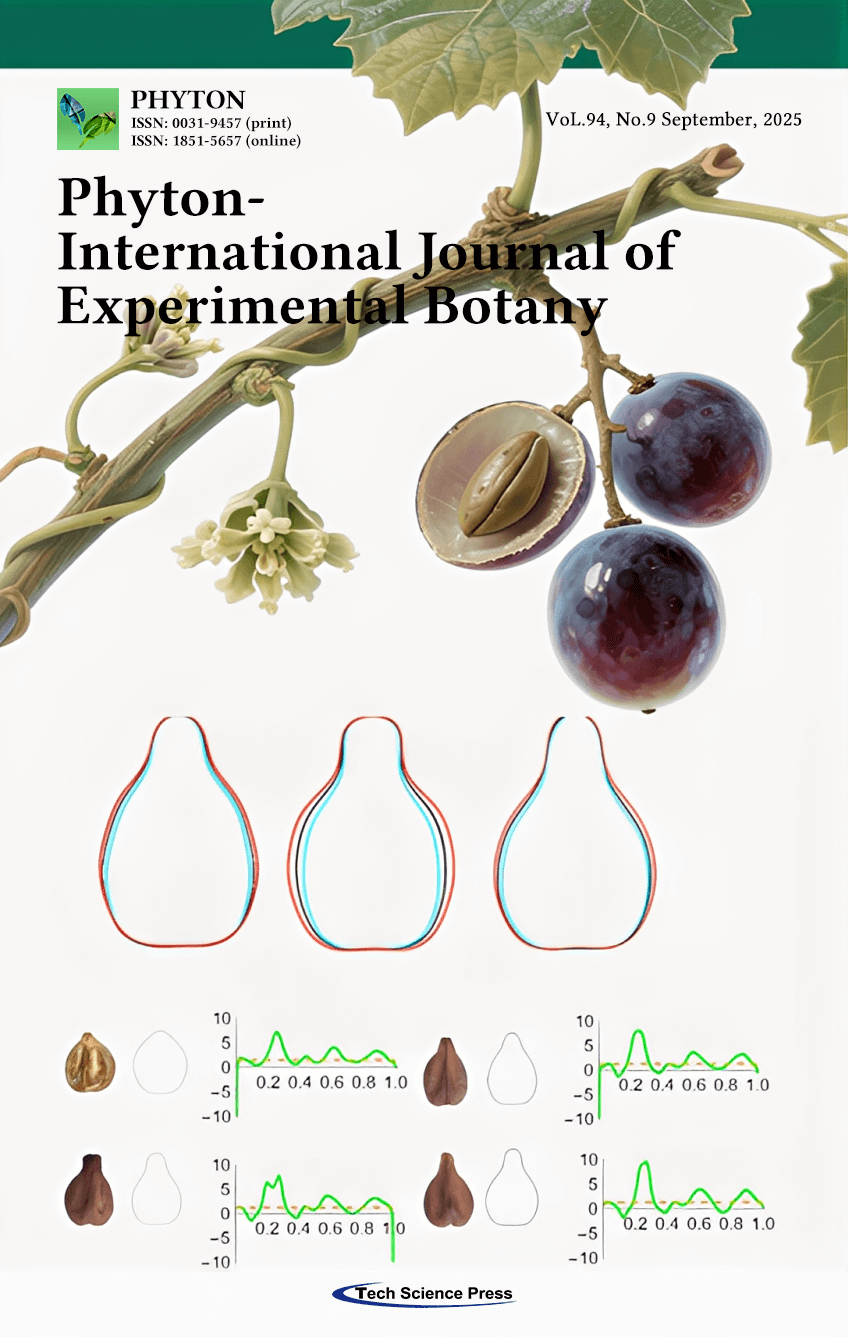
On the Cover

Seed shape is a characteristic of the maternal plant due to seed structure. However, cultivated Vitis is maintained vegetatively, so the shape of the seed remains stable over generations. The lack of cross-pollination keeps a high degree of heterozygosity. As a result, seed shape is a stable property of cultivars. Geometric models may be defined to link seeds with cultivars and confirm pedigrees established by molecular techniques.
Above: Geometric models were created for Hebén, Chenin, and Regina types. The Hebén model is the average silhouette of Hebén seeds harvested in 2020 and 2025. The Chenin model averages the seeds of Chenin and Gewürtztraminer. The Regina model averages Regina dei Vigneti and Muscat Hamburg. These three types correspond to three of six haplotypes recently described as the origin of Vitis cultivars. Below, left to right: Curvature analysis in seeds of Vitis amurensis, Hebén, Tempranillo, and Regina dei Vigneti.
View this paper

  • Open AccessOpen Access

    REVIEW

    Recent Advances and Emerging Trends in Chlorophyll Fluorescence Parameter Fv/Fm

    Qingsong Jiao, Xueyun Hu*
    Phyton-International Journal of Experimental Botany, Vol.94, No.9, pp. 2615-2630, 2025, DOI:10.32604/phyton.2025.069246 - 30 September 2025
    Abstract Chlorophyll fluorescence, particularly the parameter Fv/Fm, has emerged as a reliable, non-invasive indicator of the maximum quantum efficiency of Photosystem II (PSII) in plants. Over the past decade, significant research has leveraged Fv/Fm to evaluate plant responses to a wide range of biotic and abiotic stresses, as well as to support crop improvement and ecological monitoring. This review synthesizes recent progress in understanding the physiological basis, measurement techniques, and applied significance of Fv/Fm across diverse plant systems. We highlight methodological advancements in fluorescence imaging and remote sensing, identify consistent patterns and contrasting findings in stress-response studies, and More >

  • Open AccessOpen Access

    REVIEW

    Nanoparticles and Phytohormonal Synergy in Plants: Sustainable Agriculture Approach

    Hafiza Muniba Din Muhammad1, Safina Naz1, Zarina Bibi2, Mohamed A. A. Ahmed3, Alina-Stefania Stanciu4, Riaz Ahmad5,*
    Phyton-International Journal of Experimental Botany, Vol.94, No.9, pp. 2631-2648, 2025, DOI:10.32604/phyton.2025.069474 - 30 September 2025
    (This article belongs to the Special Issue: Emerging Insights into Phytohormonal Crosstalk in Plant Stress Tolerance)
    Abstract The production of crops is badly affected by climate change globally. Mitigation of adverse effects of climate change is in need of time through different management practices such as developing tolerant genetic resources, hormonal applications to boost defense systems, nanoparticles, and balanced fertilization. The nano-hormonal synergy had the potential to mitigate the adverse effects of climate change by modulation of morpho-physiological and biochemical activities. Plant growth, yield, and quality can be enhanced with the supplementation of nano-hormonal interactions. Therefore, the current study explores the synergy between nanoparticles and phytohormonal use. The nanoparticles, even in low… More >

  • Open AccessOpen Access

    REVIEW

    Viticulture: History, Breeding Systems and Recent Developments

    José Luis Rodríguez-Lorenzo1, Bohuslav Janoušek1, Emilio Cervantes2,*
    Phyton-International Journal of Experimental Botany, Vol.94, No.9, pp. 2649-2667, 2025, DOI:10.32604/phyton.2025.068936 - 30 September 2025
    (This article belongs to the Special Issue: Adaptation Mechanisms of Grapevines to Growing Environments and Agricultural Strategies)
    Abstract Grapevine is unique among crops because its domestication resulted not only in new morphological characteristics, but also in altered reproductive mechanisms. Viticulture involves a change from a dioecious to a hermaphroditic mating system, which makes the reproductive system more efficient. In consequence and the fact that it is one of the oldest and most economically important cultivated plants, Vitis vinifera could be defined as an over-domesticated species. Here we review some key aspects in viticulture. The main areas of interest have remained consistent throughout history, including the origin and characterisation of cultivars, resistance to environmental conditions,… More >

  • Open AccessOpen Access

    REVIEW

    From Nature to Innovation: Exploring the Functional Properties and Multifaceted Applications of Seed Mucilage

    Livanshee Gupta1, Nouha Haoudi2,3,*, Lanjelina Oinam1, Ananya Mahajan1, Sonia Morya1,*
    Phyton-International Journal of Experimental Botany, Vol.94, No.9, pp. 2669-2700, 2025, DOI:10.32604/phyton.2025.065058 - 30 September 2025
    (This article belongs to the Special Issue: Vegetable Resources, Sustainable Plant Protection and Adaptation Strategies to Climate Change)
    Abstract The trends of consuming or using eco-friendly, biodegradable products due to the change in the lifestyle of the people have led to the exploration of new sources from plants or animals. Seed mucilage (SeM) is an underexplored component of plants that can be brought into play to deal with such problems. Mucilage, a viscous polysaccharide that can be obtained when seeds like chia, flax, garden cress, and tomato get hydrated and form a slimy, gel-like substance around the seed coat, can be utilized due to its unique characteristics. It has been used in developing many… More >

  • Open AccessOpen Access

    ARTICLE

    Transcriptomics Provides New Insights into Resistance Mechanisms in Wheat Infected with Puccinia striiformis f. sp. tritici

    Jing Zhang1,#, Huifen Qiao1,#, Shenglong Wang1,#, Jiawei Yuan1, Qingsong Ba1, Gensheng Zhang1,2,*, Guiping Li1,*
    Phyton-International Journal of Experimental Botany, Vol.94, No.9, pp. 2701-2718, 2025, DOI:10.32604/phyton.2025.070017 - 30 September 2025
    (This article belongs to the Special Issue: Advances in Plant Breeding and Genetic Improvement: Leveraging Molecular Markers and Novel Genetic Strategies)
    Abstract Wheat stripe rust, a devastating disease caused by the fungal pathogen Puccinia striiformis f. sp. tritici (Pst), poses a significant threat to global wheat production. Growing resistant cultivars is a crucial strategy for wheat stripe rust management. However, the underlying molecular mechanisms of wheat resistance to Pst remain incompletely understood. To unravel these mechanisms, we employed high-throughput RNA sequencing (RNA-Seq) to analyze the transcriptome of the resistant wheat cultivar Mianmai 46 (MM46) at different time points (24, 48, and 96 h) post-inoculation with the Pst race CYR33. The analysis revealed that Pst infection significantly altered the expression of genes… More >

  • Open AccessOpen Access

    ARTICLE

    Optimizing Silver Nanoparticle Concentrations to Improve the In Vitro Regeneration and Growth of Phalaenopsis Orchids

    Hay Mon Aung1, Aung Htay Naing2,*, Chang Kil Kim2, Kyeung II Park1,*
    Phyton-International Journal of Experimental Botany, Vol.94, No.9, pp. 2719-2727, 2025, DOI:10.32604/phyton.2025.068713 - 30 September 2025
    (This article belongs to the Special Issue: Advances in Ornamental Plants: Micropropagation, Plant Biotechnology, Chromosome Doubling, Mutagenesis, Plant Breeding, Environmental Stress Tolerance, and Postharvest Physiology)
    Abstract Phalaenopsis orchids are economically important ornamental crops; however, their commercial micropropagation is often limited by poor rooting efficiency and inconsistent growth. In this study, we investigated the effects of silver nanoparticles (Ag-NPs) on the in vitro regeneration and growth of Phalaenopsis cultivar 611B to determine the optimal concentration of Ag-NPs for improved micropropagation outcomes. Shoot tip explants (2–3 mm)—derived from protocorm-like bodies were cultured on a regeneration medium containing Hyponex (20:20:20 and 6.5:6.5:19), 18 g/L sugar, 2 g/L peptone, 0.8 g/L activated charcoal, 12.5 g/L potato extract, 50 mL/L apple juice, and 10 mg/L 6-benzylaminopurine (6-BA), with… More >

  • Open AccessOpen Access

    ARTICLE

    Genomic and Functional Characterization of Thermophilic Paenibacillus sp. VCA1: A Biocontrol Agent Isolated from El Chichón Volcano Crater Lake

    Nancy Abril Martínez-López1, Betsy Anaid Peña-Ocaña2, Rodolfo García-Contreras3, Toshinari Maeda4, Reiner Rincón-Rosales1, Federico Antonio Gutiérrez-Miceli1, Víctor Manuel Ruíz-Valdiviezo1,*
    Phyton-International Journal of Experimental Botany, Vol.94, No.9, pp. 2729-2743, 2025, DOI:10.32604/phyton.2025.068176 - 30 September 2025
    (This article belongs to the Special Issue: Advances in Enhancing Grain Yield: From Molecular Mechanisms to Sustainable Agriculture)
    Abstract Species of the genus Paenibacillus, especially those from extreme environments that have been reported, are known for producing bioactive compounds with agricultural and biotechnological applications. In this study, we investigated the genomic and biochemical potential of Paenibacillus sp. VCA1 strain isolated from a thermophilic environment. Taxonomic identification was performed using whole genome similarity analysis, TETRA four-nucleotide frequency of occurrence analysis, ANI average nucleotide identity analysis, and gene distance analysis using digital DNA-DNA hybridization (dDDH). Functional analysis of the strain VCA1 was performed by detecting genes, enzymes, and genome subsystems involved in biocontrol and plant growth promotion,… More >

  • Open AccessOpen Access

    ARTICLE

    Modeling and Estimating Soybean Leaf Area Index and Biomass Using Machine Learning Based on Unmanned Aerial Vehicle-Captured Multispectral Images

    Sadia Alam Shammi1,2, Yanbo Huang1,*, Weiwei Xie1,2, Gary Feng1, Haile Tewolde1, Xin Zhang3, Johnie Jenkins1, Mark Shankle4
    Phyton-International Journal of Experimental Botany, Vol.94, No.9, pp. 2745-2766, 2025, DOI:10.32604/phyton.2025.068955 - 30 September 2025
    (This article belongs to the Special Issue: Application of Digital Agriculture and Machine Learning Technologies in Crop Production)
    Abstract Crop leaf area index (LAI) and biomass are two major biophysical parameters to measure crop growth and health condition. Measuring LAI and biomass in field experiments is a destructive method. Therefore, we focused on the application of unmanned aerial vehicles (UAVs) in agriculture, which is a cost and labor-efficient method. Hence, UAV-captured multispectral images were applied to monitor crop growth, identify plant bio-physical conditions, and so on. In this study, we monitored soybean crops using UAV and field experiments. This experiment was conducted at the MAFES (Mississippi Agricultural and Forestry Experiment Station) Pontotoc Ridge-Flatwoods Branch… More >

  • Open AccessOpen Access

    ARTICLE

    Impact of Fertilizer Types on the Physicochemical Parameters of Culture Substrate and the Growth of Pelargonium zonale

    Andreea Moldovan1, Ioana Moldovan2,*, Lukács Lehel2, Antonia Odagiu3, Lucia Draghia4, Maria Cantor1,*
    Phyton-International Journal of Experimental Botany, Vol.94, No.9, pp. 2767-2779, 2025, DOI:10.32604/phyton.2025.069324 - 30 September 2025
    (This article belongs to the Special Issue: Flowering Plants: Their History, Cultivation Methods, Biology, and Impact on Well-being)
    Abstract Pelargonium zonale is an important ornamental and medicinal plant. The purpose of this investigation was to evaluate the effects of conventional and unconventional fertilization on variations in the physicochemical parameters of the culture substrate (temperature, pH, and electrical conductivity) in two cultivars of Pelargonium zonale (L.) L’Hér., grown in pots. This study was conducted under greenhouse conditions, using Pindstrup peat as the culture substrate. The analysis focused on how these physicochemical indicators of peat influenced plant height and development under fertilization conditions. Results revealed that in the ‘Tango Salmon’ cultivar, both fertilization regimes significantly modified substrate temperature… More >

  • Open AccessOpen Access

    ARTICLE

    Evaluation of Floral Phenotypic Diversity of Kiwifruit Male Germplasm Resources

    Yuqing Wan1, Lihua Wang2, Qian Zhang2, Qian Gao1, Xin Liu2, Gaomin Fan2, Yan Wan1, Xiaoqin Zheng1,*
    Phyton-International Journal of Experimental Botany, Vol.94, No.9, pp. 2781-2796, 2025, DOI:10.32604/phyton.2025.071151 - 30 September 2025
    Abstract Exploring the phenotypic trait variation and diversity of kiwifruit male plant resources can support selection, breeding, and genetic improvement, ultimately enhancing agricultural production. In this study, 50 kiwifruit male plants were collected from the resource nursery of Sichuan Provincial Natural Resources Bureau. The phenotypic variation of the germplasm was analyzed using 16 quantitative traits. The analysis involved coefficient of variation (CV), Shannon-Wiener index (H), principal component analysis, correlation analysis, cluster analysis, and comprehensive evaluation. The results showed that the variation range of 16 phenotypic traits in kiwifruit male germplasm resources was 1.55% to 83.71%, with… More >

  • Open AccessOpen Access

    ARTICLE

    Tolerance of Sweet Sorghum (Sorghum bicolor) to Water Deficit and Irrigation Water Salinity: Water Relations and Production

    Rodrigo Rafael da Silva1,*, Gabriela Carvalho Maia de Queiroz1, Amanda Cibele da Paz Sousa1, Antônio Gustavo de Luna Souto1, Francisco Hélio Alves de Andrade 2, Francimar Maik da Silva Morais1, Rita Magally Oliveira da Silva Marcelino1, Fagner Nogueira Ferreira1, Alex Alvares da Silva3, Maria Isabela Batista Clemente1, Baltazar Cirino Junior1, Wedson Aleff Oliveira da Silva1, Mateus de Freitas Almeida dos Santos1, José Francismar de Medeiros1,*
    Phyton-International Journal of Experimental Botany, Vol.94, No.9, pp. 2797-2814, 2025, DOI:10.32604/phyton.2025.068089 - 30 September 2025
    (This article belongs to the Special Issue: Abiotic Stress in Agricultural Crops)
    Abstract Due to its tolerance to water deficit and salinity, sorghum is considered a suitable crop for cultivation in regions affected by these stress conditions, enabling the efficient use of limited water resources. This study evaluated the resilience of the sweet sorghum cultivar BRS 506 under water deficit and salinity stress, focusing on water relations and yield performance in semiarid conditions. A randomized complete block design was employed in a 3 × 3 factorial arrangement with four replicates. Treatments consisted of three levels of irrigation water salinity (1.50, 3.75, and 6.00 dS m−1) and three irrigation levels… More >

  • Open AccessOpen Access

    ARTICLE

    Planting Years Drive Structural and Functional Shifts in the Rhizosphere Bacterial Microbiome of Zanthoxylum bungeanum

    De Zhang1,2, Yuan-Zu Ji1, Tong Zhao1, Jun-Ying Zhao1,*
    Phyton-International Journal of Experimental Botany, Vol.94, No.9, pp. 2815-2838, 2025, DOI:10.32604/phyton.2025.069196 - 30 September 2025
    (This article belongs to the Special Issue: Plant Biodiversity (Cultivated and Wild Flora) and Its Utility in Plant Breeding)
    Abstract This study investigated the effects of planting duration (1, 5, 10 and 15 years) on soil properties, bacterial community diversity, and function in the rhizosphere of Zanthoxylum bungeanum. We employed Illumina high-throughput sequencing and PICRUSt2 functional prediction to analyze the structure and functional potential of rhizosphere soil bacterial communities. The Mantel test and redundancy analysis were used to identify physicochemical factors influencing bacterial community structure and function. The results indicated significant differences in rhizosphere soil physicochemical properties across planting years: the content of organic matter, alkaline hydrolyzable nitrogen in the soil, as well as the activity… More >

  • Open AccessOpen Access

    ARTICLE

    Acalypha gaumeri: Antifungal Activity of Three Populations under Edaphic and Seasonal Variations and Ex-Situ Propagation

    Arely A. Vargas-Díaz1, Daisy Pérez-Brito2, Beatriz Hernández-Carlos3, Jairo Cristóbal-Alejo4,*, Silvia Andrade-Canto2, Marcela Gamboa-Angulo2,*
    Phyton-International Journal of Experimental Botany, Vol.94, No.9, pp. 2839-2853, 2025, DOI:10.32604/phyton.2025.066682 - 30 September 2025
    (This article belongs to the Special Issue: Functional Plant Extracts and Bioactive Metabolites)
    Abstract In the search for new alternatives to control tropical fungal pathogens, the ethanol extracts (EEs) from Acalypha gaumeri (Euphorbiaceae) roots showed antifungal properties against several tropical fungal phytopathogens. A. gaumeri is classified as endemic to the Yucatan Peninsula, Mexico, an area with distinct rainy, drought and northern seasons. The present study evaluated the antifungal activity of three wild populations of A. gaumeri collected quarterly in different seasons during one year against Alternaria chrysanthemi, Colletotrichum gloeosporioides, and Pseudocercospora fijiensis and explored their ex-situ propagation. The highest activity was shown by the EE from the Tinum wild population during the rainy season against A. chrysanthemi,… More >

  • Open AccessOpen Access

    ARTICLE

    Effects of Microplastics on Growth Pattern of Pinus massoniana and Schima uperba

    Keke Zhang1,2,3, Yong Cui1,2,3, Changchang Shao1,2,3, Liqing Yang1,2,3, Yuxin Wang1,2,3, Yao Fang1,2,3, Hua Zhou4, Jie Wang1,2,3, Honglang Duan1,2,3,*
    Phyton-International Journal of Experimental Botany, Vol.94, No.9, pp. 2855-2871, 2025, DOI:10.32604/phyton.2025.065683 - 30 September 2025
    (This article belongs to the Special Issue: Plant Responses to Abiotic Stress Mechanisms)
    Abstract As ubiquitous environmental contaminants, microplastics (MPs) have garnered global concern due to their persistence, bioaccumulation potential, and multifaceted threats to ecosystem health. These particles threaten terrestrial ecosystems via soil contamination; however, research on their phytotoxicity remains predominantly focused on herbaceous plants. The responses of woody plants to MPs and their interspecific differences are severely unexplored. Here, two important ecological and economical tree species in southern China, Pinus massoniana (P. massoniana) and Schima superba (S. superba), were selected to explore the ecotoxicity effects of polyethylene (PE) and polypropylene (PP) MPs (the two most abundant species in the soil) on… More >

  • Open AccessOpen Access

    ARTICLE

    Species Number of Invasive Plants Negatively Regulates Carbon Contents, Enzyme Activities, and Bacterial Alpha Diversity in Soil

    Qi Chen1,2, Yizhuo Du1, Yingsheng Liu1, Yue Li1, Chuang Li1, Zhelun Xu1,3, Congyan Wang1,4,5,*
    Phyton-International Journal of Experimental Botany, Vol.94, No.9, pp. 2873-2891, 2025, DOI:10.32604/phyton.2025.065970 - 30 September 2025
    (This article belongs to the Special Issue: Plant Responses and Adaptations to Environmental Stresses)
    Abstract The leaves of multiple invasive plants can coexist and intermingle within the same environment. As species number of invasive plants increases, variations may occur in decomposition processes of invasive plants, soil nutrient contents, soil enzyme activities, and soil microbial community structure. Existing progress have predominantly focused on the ecological effects of one species of invasive plant compared to native species, with limited attention paid to the ecological effects of multiple invasive plants compared to one species of invasive plant. This study aimed to determine the differences in the effects of mono- and co-decomposition of four… More >

  • Open AccessOpen Access

    ARTICLE

    Citric Acid Optimizes Lead (Pb) Phytoextraction in Mung Bean (Vigna radiata (L.) Wilczek) by Regulating Nutrient Uptake and Photosynthesis

    Hafiza Saima Gul1,2,*, Mumtaz Hussain1, Tayyaba Sanaullah3, Habib-ur-Rehman Athar2, Ibrahim Al-Ashkar4, Muhammad Kamran5, Mohammed Antar6, Ayman El Sabagh7,*
    Phyton-International Journal of Experimental Botany, Vol.94, No.9, pp. 2893-2909, 2025, DOI:10.32604/phyton.2025.058816 - 30 September 2025
    (This article belongs to the Special Issue: Abiotic Stress Tolerance in Crop Plants: Physio-biochemical and Molecular Mechanisms)
    Abstract The low efficiency of phytoextraction of lead (Pb) from agricultural fields poses a significant agricultural challenge. Organic chelating agents can influence Pb bioavailability in soil, affecting its uptake, transport, and toxicity in plants. This study aimed to assess the impact of citric acid (CA) and diethylenetriaminepentaacetic acid (DTPA) on chelate-assisted phytoextraction of Pb and its effect on growth and physiology of two cultivars (07001; 07002) of mung bean (Vigna radiata). The cultivars of mung bean were exposed to 60 mg·L−1 lead chloride (PbCl2) solution, with or without the addition of 300 mg·L−1 CA or 500 mg·L−1 DTPA, until… More >

  • Open AccessOpen Access

    ARTICLE

    Soil Temperature and Moisture as Key Determinants of SPAD Values in Greenhouse-Grown Cucumber in Qatar

    Farhat Abbas1, Fahim Ullah Khan1,2,*, Salem Al-Naemi3, Awni Al-Otoom1, Ahmed T. Moustafa4, Khaled Shami1
    Phyton-International Journal of Experimental Botany, Vol.94, No.9, pp. 2911-2925, 2025, DOI:10.32604/phyton.2025.064239 - 30 September 2025
    (This article belongs to the Special Issue: Influence of Biotic and Abiotic Stresses Signals on Plants and their Performance at Different Environments)
    Abstract This study aimed to explore the relationship between Soil-Plant Analysis Development (SPAD) values and key environmental factors in cucumber (Cucumis sativus L.) cultivation in a greenhouse. SPAD values, indicative of chlorophyll content, reflect plant health and productivity. The analysis revealed strong positive correlations between SPAD values and both indoor light intensity (ILI, r = 0.59, p < 0.001) and outdoor light intensity (OLI, r = 0.62, p < 0.001), suggesting that higher light intensities were associated with enhanced SPAD values. In contrast, significant negative correlations were found between SPAD values and soil temperature at 15–30 cm depth… More >

  • Open AccessOpen Access

    ARTICLE

    Genome-Wide Identification of the APETALA2/Ethylene-Responsive Factor (AP2/ERF) Gene Family in Acer paxii and Transcriptional Expression Analysis at Different Leaf Coloration Stages

    Zhong Ren1,2,3,#, Shuiming Zhang1,#, Yuzhi Fei1, Zhu Chen3, Yue Zhao3, Xin Meng3, Hongfei Zhao2,*, Jie Ren3,*
    Phyton-International Journal of Experimental Botany, Vol.94, No.9, pp. 2927-2947, 2025, DOI:10.32604/phyton.2025.067310 - 30 September 2025
    (This article belongs to the Special Issue: Ornamental Plants: Traits, Flowering, Aroma, Molecular Mechanisms, Postharvest Handling, and Application)
    Abstract Acer paxii belongs to the evergreen species of Acer, but it exhibits a unique feature of reddish leaves in fall in subtropical regions. Although the association of AP2/ERF transcription factors with color change has been well-documented in prior research, molecular investigations focusing on AP2/ERF remain notably lacking in Acer paxii. This research focuses on performing an extensive genome-wide investigation to identify and characterize the AP2/ERF gene family in Acer paxii. As a result, 123 ApAP2/ERFs were obtained. Phylogenetic analyses categorized the ApAP2/ERF family members into 15 subfamilies. The evolutionary traits of the ApAP2/ERFs were investigated by analyzing their… More >

  • Open AccessOpen Access

    EDITORIAL

    Plant Secondary Metabolism and Functional Biology

    Cheng Song1,*, Muhammad Abdullah2, Muhammad Aamir Manzoor3,*
    Phyton-International Journal of Experimental Botany, Vol.94, No.9, pp. 2949-2955, 2025, DOI:10.32604/phyton.2025.070974 - 30 September 2025
    (This article belongs to the Special Issue: Plant Secondary Metabolism and Functional Biology)
    Abstract This article has no abstract. More >

Per Page:

Share Link
