
 Login
Login Register
 Submit a Paper
 Propose a Special lssue
 Open Access
REVIEW
A Mini Review on Plant Immune System Dynamics: Modern Insights into Biotic and Abiotic Stress
1 School of Agriculture, Lovely Professional University, Phagwara, 144411, India
2 Institute of Agricultural Science, Banaras Hindu University, Varanasi, 221005, India
* Corresponding Author: Shweta Meshram. Email:
(This article belongs to the Special Issue: Plants Abiotic and Biotic Stresses: from Characterization to Development of Sustainable Control Strategies)
Phyton-International Journal of Experimental Botany 2025, 94(8), 2285-2312. https://doi.org/10.32604/phyton.2025.067814
Received 13 May 2025; Accepted 15 August 2025; Issue published 29 August 2025
 View Full Text
 Download PDF
Abstract
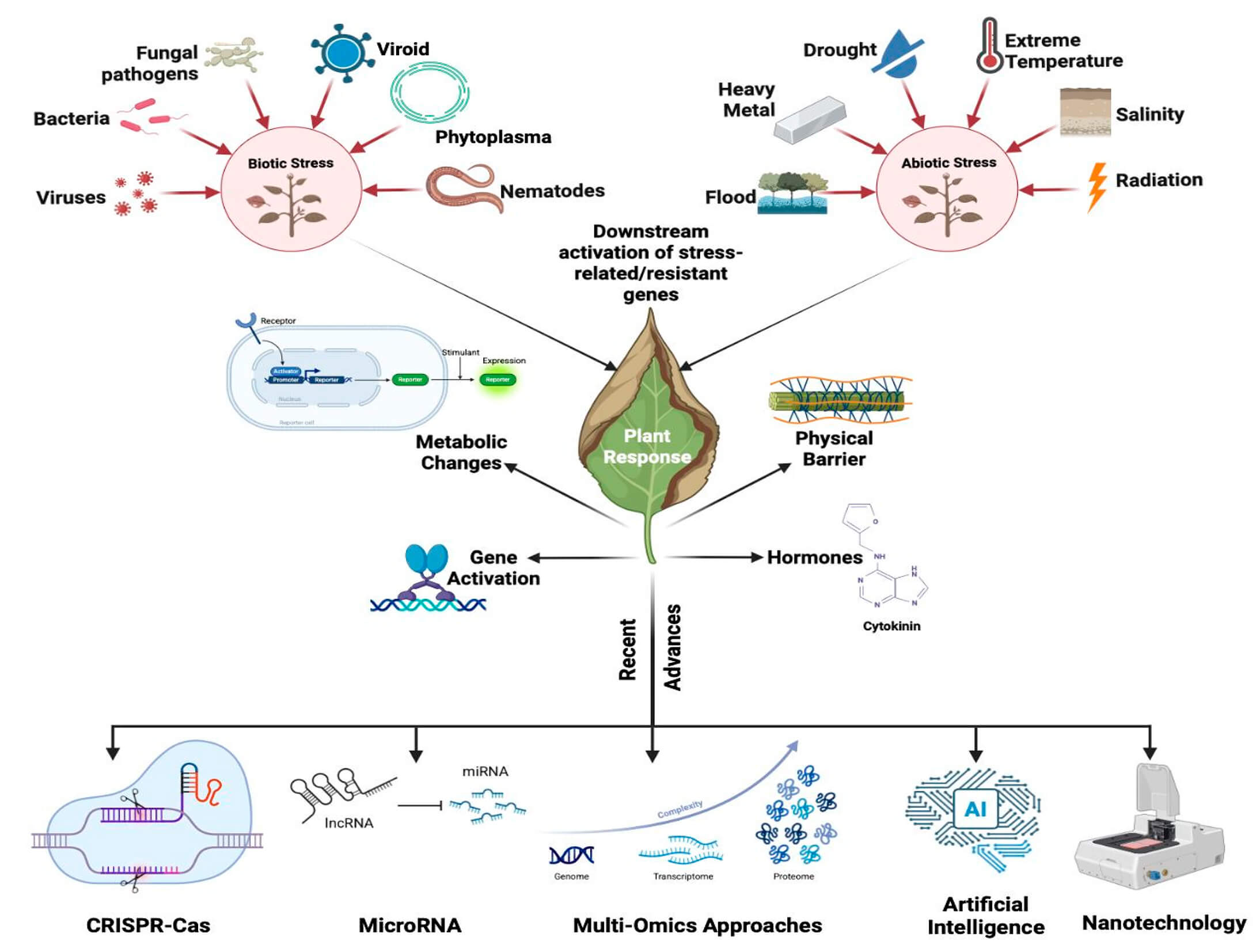
Plants are under constant exposure to varied biotic and abiotic stresses, which significantly affect their growth, productivity, and survival. Biotic stress, caused by pathogens, and abiotic stress, including drought, salinity, extreme temperatures, and heavy metals, activate overlapping yet distinct immune pathways. These are comprised of morphological barriers, hormonal signaling, and the induction of stress-responsive genes through complex pathways mediated by reactive oxygen species (ROS), phytohormones, and secondary metabolites. Abiotic stress triggers organelle-mediated retrograde signaling from organelles like chloroplasts and mitochondria, which causes unfolded protein responses and the regulation of cellular homeostasis. Simultaneously, biotic stress activates both PAMP-triggered immunity (PTI) and effector-triggered immunity (ETI), mediated by salicylic acid (SA), jasmonic acid (JA), and ethylene (ET). This review aims to provide an integrated overview of plant immune responses to multiple stressors, with emphasis on molecular crosstalk and recent technological interventions. A systematic literature search was conducted using the Scopus database, covering studies published between 2010 and 2025. Advances in CRISPR-Cas genome editing, RNA interference, omics technologies, nanotechnology, and artificial intelligence have improved our knowledge of plant stress physiology and facilitated the design of resilient crop varieties. Despite these advances, the integration of immune signals under simultaneous biotic and abiotic stress remains poorly understood, particularly at tissue-specific and cellular levels. Additionally, practical challenges persist in delivery methods, regulatory hurdles, and long-term field validation. With the escalation of climate change, understanding the complex crosstalk between stress signalling pathways is essential for maintaining sustainable agriculture and global food security. Future directions point toward real-time monitoring tools, such as single-cell omics and spatial transcriptomics, to fine-tune immune responses and support precision crop improvement.Graphic Abstract
Keywords
Cite This Article
 Copyright © 2025 The Author(s). Published by Tech Science Press.
This work is licensed under a Creative Commons Attribution 4.0 International License , which permits unrestricted use, distribution, and reproduction in any medium, provided the original work is properly cited.
 Downloads
 Citation Tools
