
 Login
Login Register
 Submit a Paper
 Propose a Special lssue
 Open Access
ARTICLE
The Impact of Major Meteorological Factors in Tobacco Growing Areas on Key Chemical Constituents of Tobacco Leaves
1 Agronomic Research and Development Center, Guizhou Academy of Tobacco Science, Guiyang, 550081, China
2 College of Agriculture, Yangtze University, Jingzhou, 434025, China
3 School of Geography and Resources, Guizhou Education University, Guiyang, 550018, China
4 Tobacco Management Office, China National Tobacco Corporation Guizhou Company, Guiyang, 550000, China
* Corresponding Authors: Benbo Xu. Email: ; Kesu Wei. Email:
# These authors contributed equally to this work
(This article belongs to the Special Issue: Advances in Enhancing Grain Yield: From Molecular Mechanisms to Sustainable Agriculture)
Phyton-International Journal of Experimental Botany 2025, 94(8), 2385-2398. https://doi.org/10.32604/phyton.2025.068213
Received 23 May 2025; Accepted 14 July 2025; Issue published 29 August 2025
 View Full Text
 Download PDF
Abstract
To clarify the relationships between the main chemical components in flue-cured tobacco in Guizhou and field meteorological factors during the tobacco growing period, the contributions of meteorological factors to the chemical composition of flue-cured tobacco and related components were explored in this study. The flue-cured tobacco variety Y87 was used as the experimental material, and tobacco samples and meteorological data were collected from seven typical tobacco-growing areas in Guizhou Province. Using a random forest model and canonical correlation analysis, the impact and contribution of the monthly mean temperature, precipitation, and sunshine duration during the field growing period to the chemical indicators of tobacco leaves were investigated. During the growing period of flue-cured tobacco in Guizhou, meteorological factors showed considerable variation, with the magnitude of change decreasing in the order of precipitation, sunshine duration, and mean temperature. Precipitation in April, mean temperature in June and August, and sunshine duration in April and May had the most significant impacts on the main chemical components of tobacco leaves, particularly nicotine, total sugar, and starch, with coefficients of variation reaching 14.93%, 14.59%, and 24.27%, respectively. The precipitation in May and June, mean temperature in August, and sunshine duration in June played key roles in influencing the nitrogen–nicotine ratio and total–reducing sugar ratio. Moreover, the mean temperature in May, precipitation in July, and mean temperature in July substantially contributed to the nicotine and total nitrogen contents, with contribution rates of 19.17%, 12.19%, and 17.36%, respectively, to the nicotine content. Sunshine duration in May, mean temperature in August, and sunshine duration in July significantly contributed to starch content, with rates of 17.45%, 15.34%, and 13.27%. During the root extension stage, vigorous growth stage, and maturation stage, meteorological factors primarily affected the accumulation of nitrogenous compounds such as nicotine and total nitrogen. The mean temperatures in May and July contributed 19.17% and 17.36% respectively to nicotine accumulation; whereas during the maturation stage and harvest stage, these factors mainly impacted the accumulation of carbohydrates such as starch and total sugars, The mean temperature in August and sunshine duration in July contributed 15.34% and 13.27% respectively to starch accumulation. Therefore, ensuring tobacco seedling transplantation is completed before May and appropriately extending the maturation period can promote the accumulation of carbon-nitrogen compounds in tobacco leaves and improve leaf quality.Keywords
Supplementary Material
Supplementary Material FileDespite the harmful effects of smoking on health, tobacco (Nicotiana tabacum L.) remains one of the most important economic crops in the world [1–3]. It is widely used in various consumable products designed for smoking, chewing, and snuffing because of its sensory attributes, including aroma, flavour, and odour [4,5]. Moreover, due to its fast growth cycle, high genetic transformation efficiency, and well-annotated genome, tobacco has emerged as a vital model organism in plant biotechnology [6]. Tobacco can adapt to a wide range of conditions, but its yield and quality are very sensitive to environmental conditions, including the climate, crop rotation patterns, soil properties, soil microbes, and topography during the field tobacco growing period [7–9].
The growth, yield, and quality of tobacco are affected by the genetic properties of cultivars; meteorological factors (including temperature, light, and precipitation); and ecological conditions (such as soil physical and chemical properties, soil types, and growing practices) [10–12]. Temperature plays a predominant role in tobacco production by affecting the rate of soil carbon mineralisation and directly affecting the growth of tobacco [13]. Tobacco is very sensitive to the water supply. The production of tobacco requires suitable amounts of soil nutrients such as nitrogen, phosphorus, and potassium for normal growth [14,15]. Under high soil nitrogen levels, the fresh and dry weights and total nitrogen and nicotine contents of tobacco leaves usually increase, but the reducing sugar content decreases [16]. In the Honghe tobacco zone in China, the yield and chemical composition of flue-cured tobacco are significantly correlated with climatic factors [8]. More than 2500 chemical compounds affecting tobacco quality have been identified; in particular, nicotine is the most important factor affecting tobacco leaf quality. The total sugar and reducing sugar levels in tobacco leaves determine sweetness and flavour, whereas the total nitrogen and nicotine contents determine the physical intensity and concentration of smoke [17]. Leaf quality is also affected by many factors, including cultivation practices, environmental conditions, and genotypes [15]. Owing to environmental destruction around the world and intensified climate change, environmental conditions, including climatic conditions, have become more variable and difficult to predict. The intensification of climate change strongly affects the production of tobacco, leading to a decrease in tobacco yield, a decrease in quality, and an increase in production costs [18]. Moreover, the interaction between genotype and the environment exacerbates difficulties in tobacco production. To improve the yield and quality potential of tobacco varieties, it is necessary to understand the environmental adaptability of different varieties and the influence of major meteorological factors in planting areas on the chemical composition of tobacco leaves.
Research indicates region-specific impacts of meteorological factors on tobacco chemical composition. In Hubei, precipitation during the maturity stage predominantly governs nicotine, total sugar content, and ratio indices, while humidity, precipitation, and sunshine duration during the fast-growing stage regulate reducing sugar, total nitrogen, and potassium content, respectively [19]. In Baoshan (Yunnan), temperature exerts the most significant influence, followed by rainfall, humidity, and sunshine duration [20]. The Changsha region demonstrates a contribution hierarchy of temperature > cumulative rainfall > cumulative sunshine hours [21]. For flue-cured tobacco sensory quality, field-growth temperature is the primary controlling factor, with rainfall and sunshine being secondary influences [22]. Chemical components in Guizhou tobacco are significantly affected by June sunshine duration, July precipitation, and temperature [23]. In Nanping, mean temperature and precipitation modulate sugar and starch accumulation, whereas sunshine duration dominates the potassium-chlorine ratio [24].
However, existing research predominantly focuses on analyzing linear relationships using methods such as correlation analysis, path analysis, and canonical correlation analysis. Although these analytical approaches can effectively quantify direct or indirect effects between variables, their application efficacy is constrained by stringent requirements for data distribution patterns, and they struggle to reveal complex nonlinear interactions. In contrast, random forest models based on ensemble learning theory demonstrate significant advantages. By constructing multi-dimensional decision tree systems, they can further clarify the specific contributions of meteorological factors to the accumulation of chemical components in tobacco leaves, offering more comprehensive insights into the association mechanisms between meteorological factors and chemical components. In this work, the correlation and contribution of meteorological factors to the main chemical constituents in tobacco and their relationships in Guizhou tobacco-growing areas are investigated by means of canonical correlation analyses and random forest models. This study aims to reveal the mechanism by which meteorological factors influence the accumulation and contents of chemical components in tobacco leaves and to provide a scientific basis and reference for the optimisation of tobacco cultivation.
The test material was Nicotiana tabacum Y87. Middle leaves (defined as positions 9–11 from the apex after topping) were harvested during a centralized harvesting period from 12 to 15 August 2021 in seven tobacco-growing regions in Guizhou Province: Changshun (22°55′53″N, 106°19′15″E), Weining (26°45′43″N, 103°59′00″E), Anlong (25°10′52″N, 105°27′43″E), Pingba (26°25′36″N, 106°13′20″E), Jinsha (27°24′05″N, 106°02′11″E), Yinjiang (28°01′10″N, 108°30′09″E), and Bozhou (27°30′50″N, 107°09′36″E). These regions are characterized by mountainous and hilly topography with a subtropical humid monsoon climate. All sampling sites were situated within contiguous tobacco cultivation zones with yellow-brown earth soils (Detailed physicochemical properties are presented in Table S1), where non-target vegetation interference was rigorously maintained beyond a 100-m radius. The spatial distribution of sampling points is detailed in Fig. S1. At each sampling site, three biological replicates were established, with each replicate comprising 20 tobacco leaves meeting the specified positional and dimensional standards. All target leaves were tagged prior to harvest, then subjected to standard curing processes post-harvest. The processed leaves were ground and sieved through a 60-mesh sieve, with the resulting powder stored under controlled conditions for subsequent analysis. Y87 was cultivated using local technical specifications for high-quality tobacco plantation management and treated using the three-stage curing method, and the sampled tobacco was cured, destemmed, crushed, and sifted to test its chemical composition.
2.2.1 Chemical Composition Testing
The reducing sugar, total sugar, total nitrogen, nicotine, potassium, starch, and chlorine contents were tested via previously reported methods [16,25]. Chemical composition analysis was conducted using the AUTOAnalyzer 3 continuous flow analyzer (AA3, Germany, Bran+Luebbe). The specific procedures are as follows: Starch was ultrasonically purified with an 80% ethanol-saturated NaCl solution, extracted via thermal ultrasonication with 90% DMSO-HCl, and its content was determined after a color reaction. Total nitrogen was converted into ammonia through sulfuric acid-catalyzed digestion, oxidized to chloramine under strongly alkaline conditions by sodium hypochlorite, and reacted with sodium salicylate to form an indigo dye, which was then detected by the equipment. Total sugar, reducing sugar, nicotine, potassium, and chlorine were all extracted in one step with 5% acetic acid, and their contents were determined after color reactions, with potassium content measured via flame photometry.
2.2.2 Meteorological Data Collection
In 2021, meteorological data (precipitation, mean temperature, sunshine duration, etc.) during the growth period (April–August) of cured tobacco in seven tobacco planting areas were obtained from Guizhou Meteorological Bureau monitoring data, and latitudinal and longitudinal data were obtained from the GPS positions of the sampling points.
2.3 Data Processing and Analysis
Data organisation was conducted using Microsoft Excel 2021, and a random forest model was constructed using the random forest function in an R language package to calculate contributions and generate plots. Canonical correlation analysis and significant difference analysis (Duncan’s method) were performed using SPSS 25.0.
The importance of features was assessed by calculating the IncNodePurity value [26]. The random forest model was implemented with the following parameters: number of trees (ntree) = 500, node splitting criterion = variance reduction, and mtry = 5 (approximately 1/3 of 16 total features). Model robustness was ensured through 10-fold cross-validation with a random seed set to 123.
(1) Node Impurity Calculation: In the construction of the decision tree, the impurity of each node was measured by the Gini index. The Gini index is calculated as
(2) Split Node Comparison: The algorithm uses different features for node splitting when constructing the decision tree and selects the feature that maximises impurity reduction (or increases in information gain).
(3) Cumulative Impurity Reduction Calculation: For each candidate feature, its postsplit impurity was calculated and compared to its presplit impurity. In all trees of a random forest, for each feature, the reduction in impurity due to node splitting was accrued. This cumulative value was the IncNodePurity of the feature, which reflected the overall degree of enhancement of the feature’s model purity at the split nodes.
(4) Relative Contribution Calculation: To more intuitively represent the degree of influence of each meteorological factor on individual chemical indicators, the IncNodePurity values of all meteorological factors were converted into percentages to obtain the relative contributions of meteorological factors to chemical indicators.
2.3.2 Canonical Correlation Analysis
Canonical correlation analysis was performed by extracting representative composite variables U1 and V1 (linear combinations of two variable groups) to reflect overall inter-group correlations through their mutual correlation [27]. The analysis incorporated 21 experimental units (7 regions × 3 biological replicates) with chemical composition data linked to corresponding regional climatic factors. Three variable groups were defined: (1) Meteorological factors (April–August precipitation, sunshine duration, and monthly mean temperature); (2) Chemical constituents (nicotine, total sugar, reducing sugars, total nitrogen, and starch content in cured tobacco); and (3) Compositional ratios (sugar-nicotine ratio, nitrogen-nicotine ratio, total-reducing sugar ratio, and potassium-chlorine ratio). This framework enabled exploration of canonical correlations between meteorological factors and tobacco chemical composition, as well as their interrelationships, derived through eigenvalue decomposition to maximize ρ(U1,V1).
3.1 Analysis of the Main Chemical Composition Indicators in Guizhou Tobacco-Growing Areas
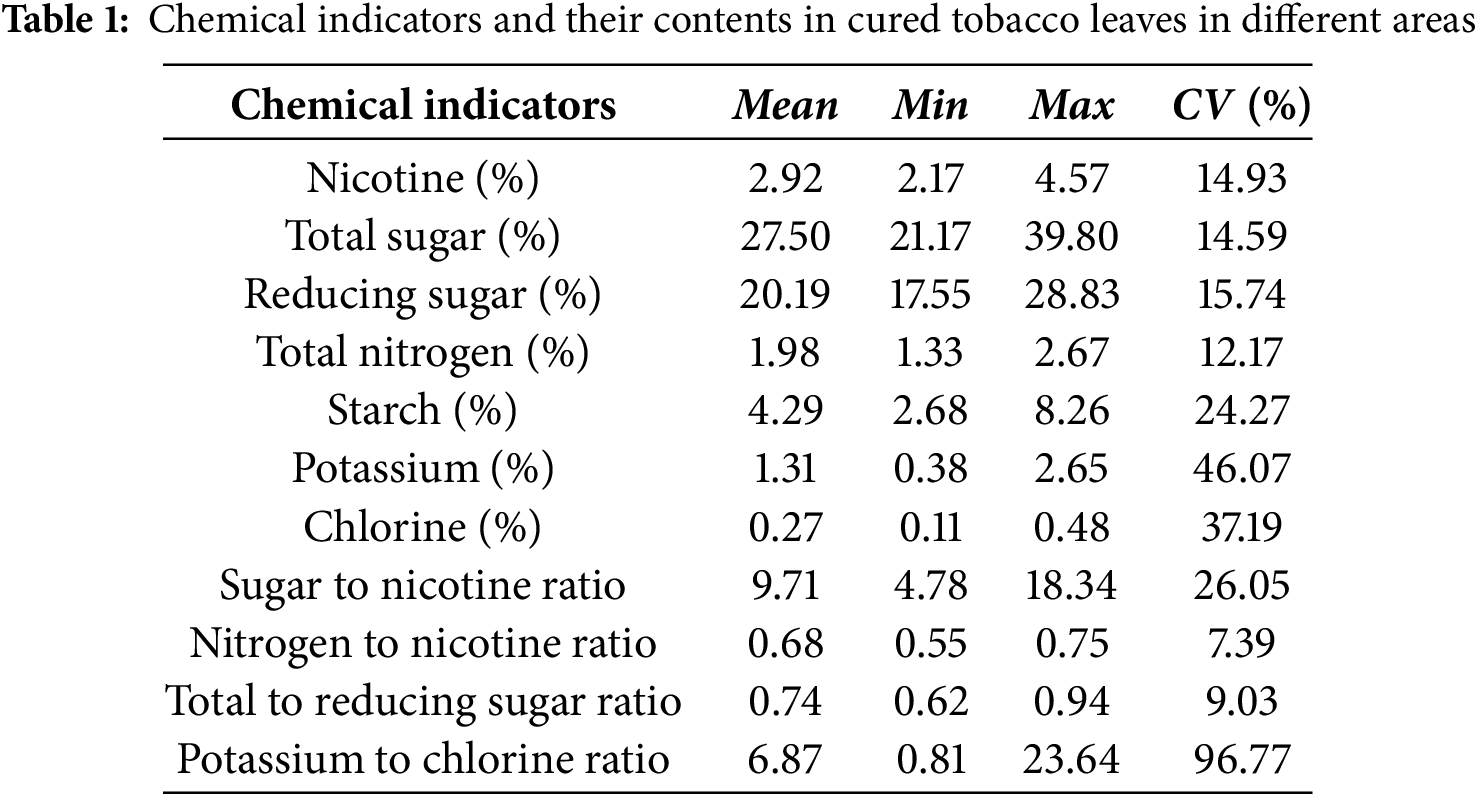
Table 1 shows the statistical data for chemical indicators and their contents in cured tobacco leaves in the Guizhou tobacco-growing areas. There were differences in the contents of various chemical components among different samples. The mean value of nicotine was 2.92%, and the content ranged from 2.17% to 4.57%, with a coefficient of variation of 14.93%, Among these regions, Jinsha and Yinjiang exhibited higher mean nicotine values (3.49% and 3.06%, respectively), while Weining and Bozhou showed lower values (2.76% and 2.63%, respectively). Notably, the nicotine content in Jinsha was significantly higher than in Bozhou (Table S2). The mean total sugar content was 27.50%, and the content ranged from 21.17% to 39.80%, with a coefficient of variation of 14.59%, Bozhou exhibited a relatively high mean value (30.48%), whereas Anlong and Jinsha showed lower values (24.93% and 24.74%, respectively). No significant differences in total sugar content were observed among regions (Table S2). The mean value of starch was 4.29%, and the content ranged from 2.68% to 8.26%, with a coefficient of variation of 24.27%, which varied widely among the samples. Bozhou exhibited a relatively higher starch content (5.56%), whereas Weining showed the lowest value (3.54%). Starch content in Bozhou was significantly higher than in Weining (Table S2).
3.2 Basic Analysis of Meteorological Factors in Guizhou Tobacco-Growing Areas
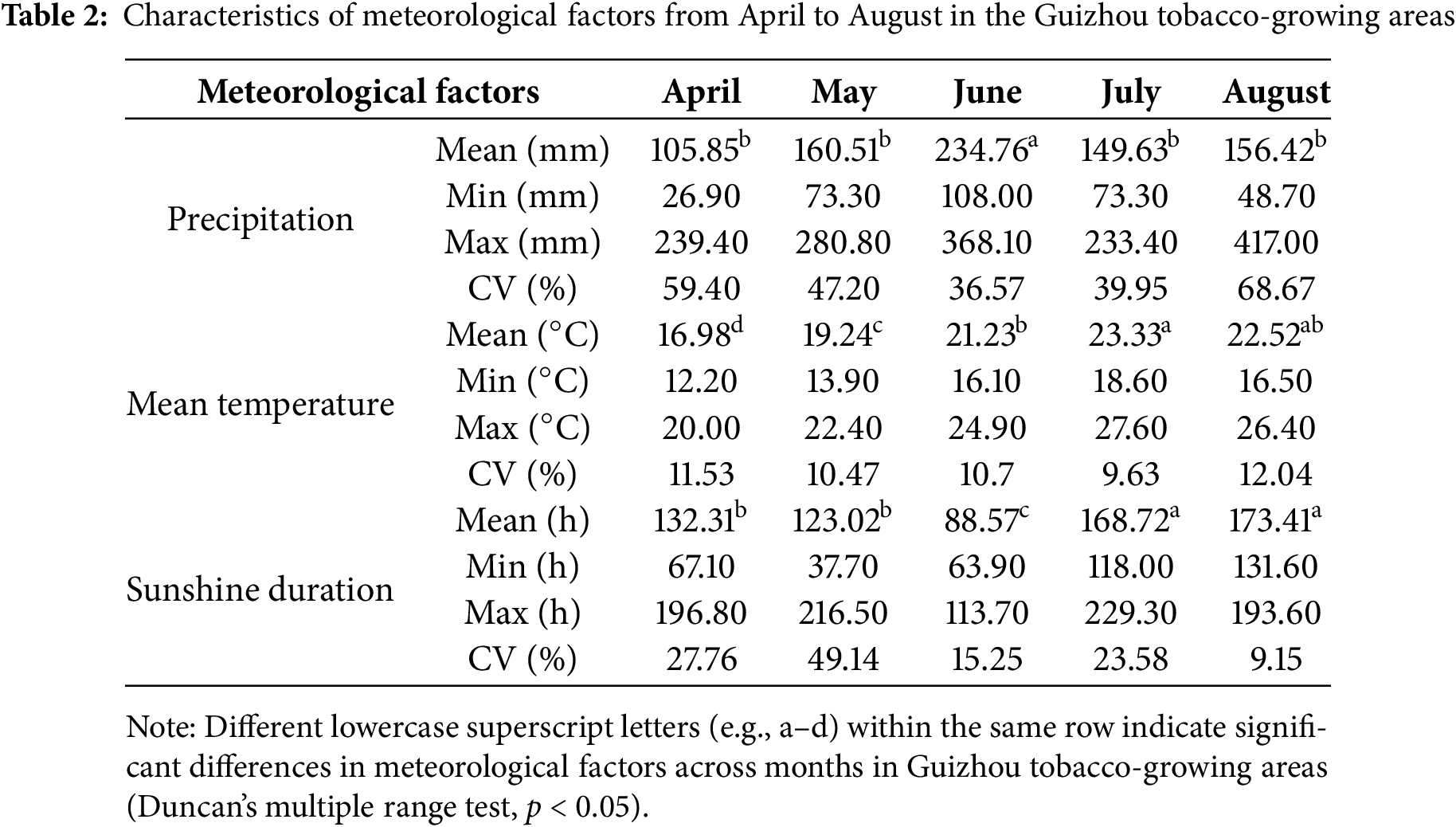
The changes in the characteristics of major meteorological factors from April to August in Guizhou tobacco-growing areas are shown in Table 2. The meteorological factor data for each sampling area are provided in Table S3. The monthly mean precipitation during the field growing period of tobacco in Guizhou Province ranged from 105.85 to 234.76 mm, in which the precipitation in June was significantly greater than that in other months, but the differences in precipitation at different sampling points were large, with coefficients of variation greater than 36.57%. The mean temperature of Guizhou tobacco-growing areas from April to August showed a gradual increasing trend, the mean temperature in July was significantly higher than that in April to June, and there was no significant difference between June and August. The differences in the monthly mean temperature at different sampling points were small, with the coefficient of variation ranging from 9.63% to 12.04%. The mean sunshine duration in different months varied significantly, ranging from 88.57 to 173.41 h, and the sunshine duration in June was significantly lower than that in other months, at only 88.57 h. Overall, during the growth period of tobacco leaves in Guizhou, there were significant differences in mean precipitation and sunshine duration across different months and tobacco regions, while the mean temperature was relatively stable.
3.3 Correlation Analysis between Major Chemical Components and Meteorological Factors in Guizhou Tobacco Leaves
3.3.1 Simple Correlation Analysis
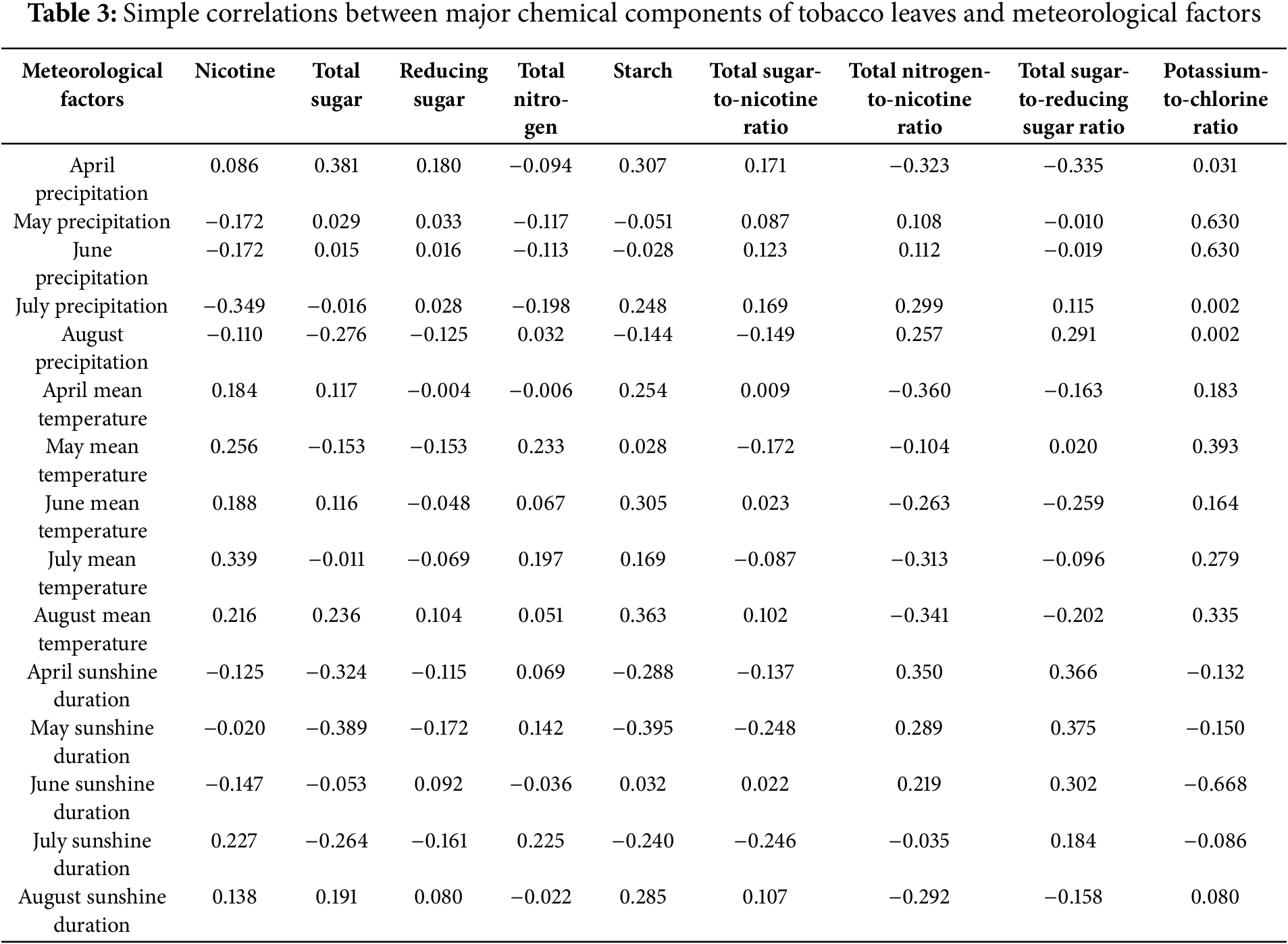
The simple correlation coefficients between the main chemical components of Guizhou tobacco and meteorological factors are shown in Table 3. The strength and direction of the linear relationships between the main chemical components of tobacco and individual meteorological factors were weak and not significant. Simple correlation analysis cannot be used to adequately reveal overall correlations between variables when multiple variables are involved, and complex, multidimensional interactions may occur among these variables, which may be beyond the scope of simple linear relationships.
3.3.2 Canonical Correlation Analysis between the Contents of Major Chemical Components and Meteorological Factors
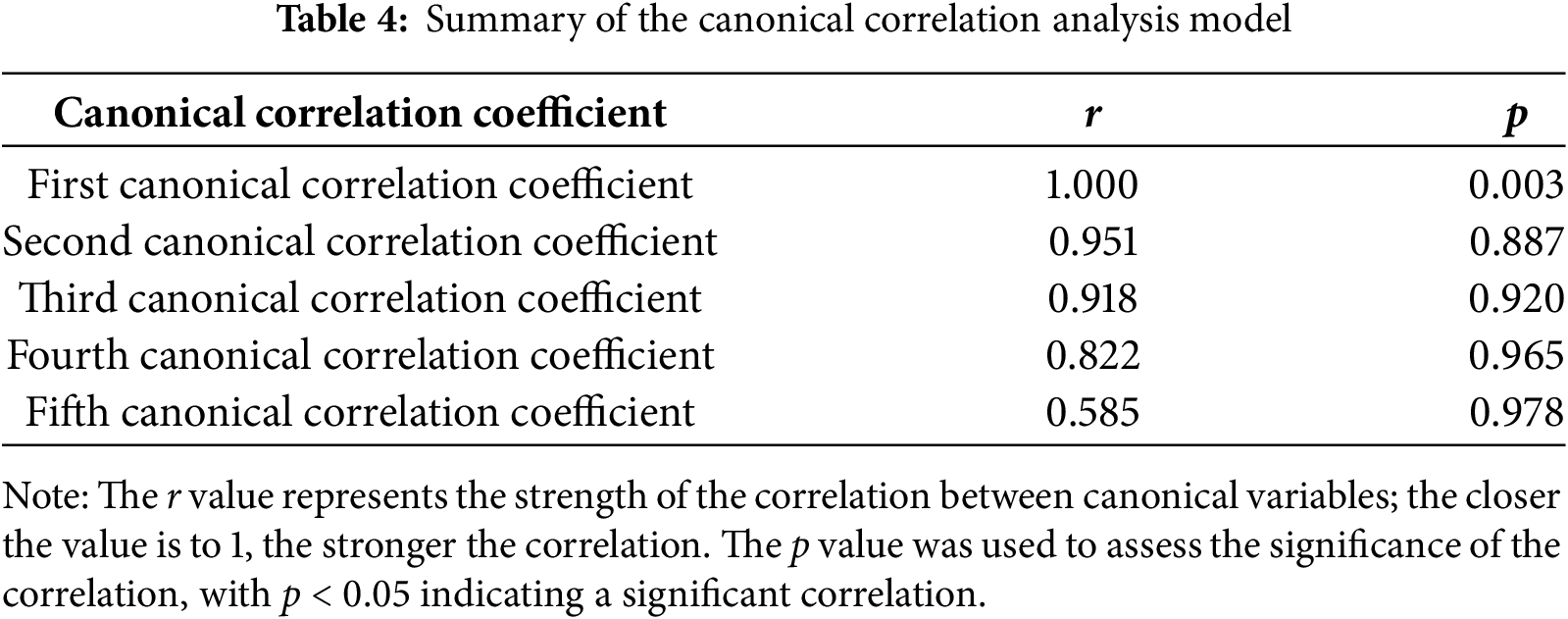
A summary of the canonical correlation analysis models between major chemical components and meteorological factors in Guizhou tobacco is shown in Table 4. The first canonical correlation coefficient was 1.000, and its significance level was 0.003, indicating that there was a very strong correlation between the canonical variables of Group 1 and that this association was statistically significant. The subsequent canonical correlation coefficients (from the second to the fifth) also showed high correlations, but p > 0.05, indicating that none of them were significant. Therefore, only the first pair of canonical correlation variables was selected.
The canonical variable model for chemical components is expressed as: U1 = 0.335 × (nicotine) + 0.411 × (total sugar) + 0.134 × (reducing sugar) − 0.128 × (total nitrogen) + 0.513 × (starch).
The canonical variable model for the meteorological factors is given by: V1 = 0.549 × (April precipitation) − 0.154 × (May precipitation) − 0.147 × (June precipitation) − 0.237 × (July precipitation) − 0.407 × (August precipitation) + 0.455 × (April mean temperature) + 0.155 × (May mean temperature) + 0.492 × (June mean temperature) + 0.408 × (July mean temperature) + 0.548 × (August mean temperature) − 0.567 × (April sunshine duration) − 0.552 × (May sunshine duration) − 0.284 × (June sunshine duration) − 0.114 × (July sunshine duration) + 0.432 × (August sunshine duration).
The coefficients indicate the direction and strength of each original variable’s contribution to the canonical variables (U1 and V1). A positive coefficient means an increase in that variable elevates the canonical variable value, while a negative coefficient means a decrease; the larger the absolute value, the stronger the influence. U1 and V1 capture the overall relationship between chemical and meteorological factors by maximizing correlation, but the coefficients do not directly imply causation—rather, they reflect weights in the canonical space. Taking April precipitation as an example, its coefficient in V1 is +0.549. If April precipitation increases, the value of V1 rises. Since V1 is positively correlated with U1, the value of U1 also increases. The coefficients of chemical components in U1 show that nicotine (+0.335), total sugar (+0.411), reducing sugar (+0.134), and starch (+0.513) increase, while total nitrogen (−0.128) decreases. Thus, increased April precipitation may lead to the accumulation of sugars and starch in tobacco leaves but reduce nitrogen content. According to the above model of correlated variables, among the main chemical components, nicotine, total sugar, and starch were most affected by meteorological factors. Among the meteorological factors in different months, precipitation in April, mean temperature in June, mean temperature in August, sunshine duration in April, and sunshine duration in May had the greatest effects on the main chemical composition of tobacco. Specifically, an increase in precipitation in April, the mean temperature in June, and the mean temperature in August regulated the synthesis of tobacco nicotine and total sugar and starch; and an increase in sunshine duration in April and May was not conducive to the synthesis and accumulation of nicotine in tobacco. The influence of meteorological factors on the main chemical components of Guizhou cured tobacco at different growth stages varied in degree depending on the stage and the meteorological factors.
3.3.3 Canonical Correlation Analysis for the Relationships between Major Chemical Components and Meteorological Factors
A summary of the canonical correlation analysis models for the relationships between major chemical components and meteorological factors is shown in Table 5. The first canonical correlation coefficient was 0.997, and its significance level was 0.019, indicating that there was a very strong correlation between the canonical variables of Group 1 and that this association was statistically significant. The subsequent canonical correlation coefficients (from second to fourth) also showed high correlations, but p > 0.05, indicating that none of them were significant. Therefore, only the first pair of canonical correlation variables was selected.
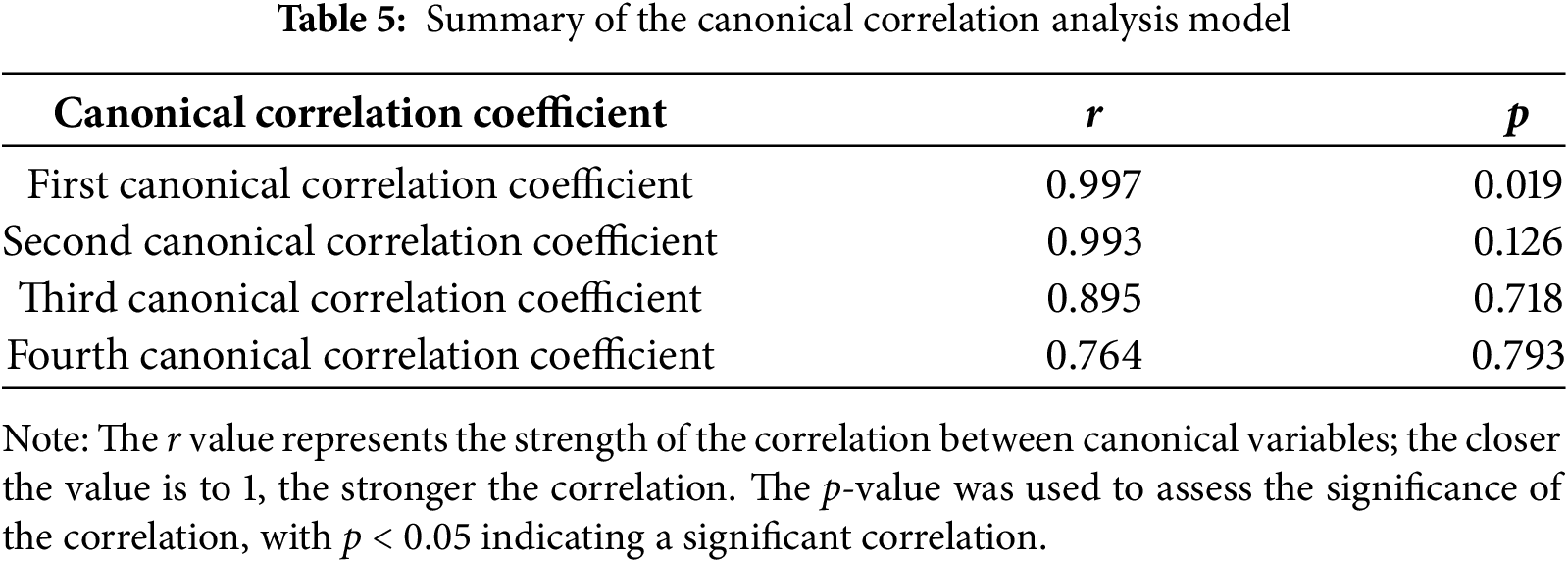
In the canonical variable model for chemical relationships, U1 is expressed as: U1 = 0.120 × (sugar–nicotine ratio) − 0.263 × (total nitrogen–nicotine ratio) − 0.332 × (total sugar–reducing sugar ratio) + 0.957 × (potassium–chlorine ratio)
In the canonical variable model for meteorological factors, V1 is defined as:V1 = 0.154 × (April precipitation) + 0.579 × (May precipitation) + 0.585 × (June precipitation) − 0.052 × (July precipitation) − 0.102 × (August precipitation) + 0.266 × (April mean temperature) + 0.367 × (May mean temperature) + 0.239 × (June mean temperature) + 0.327 × (July mean temperature) + 0.420 × (August mean temperature) − 0.253 × (April sunshine duration) − 0.272 × (May sunshine duration) − 0.701 × (June sunshine duration) − 0.123 × (July sunshine duration) + 0.167 × (August sunshine duration)
The typical correlation variable model presented above revealed that the total nitrogen–nicotine ratio, total sugar–reducing sugar ratio, and potassium–chlorine ratio were most affected by meteorological factors, and among the different meteorological factors, the precipitation in May, the precipitation in June, the mean temperature in August, and the sunshine duration in June were found to play major roles in regulating the chemical composition of Guizhou tobacco leaves. Specifically, an increase in precipitation in May, an increase in precipitation in June, an increase in mean temperature in August, and a decrease in sunshine duration in June caused a decrease in the nitrogen–nicotine ratio and total-reducing sugar ratio. Precipitation and sunshine duration in June had a significant effect on the regulation of the chemical composition of tobacco.
3.4 Analysis of the Relative Contributions of Meteorological Factors to the Major Chemical Indices of Tobacco in Guizhou
The impacts of meteorological factors in Guizhou on the relative contributions of major chemical indicators of tobacco are shown in Fig. 1. The 10-fold cross-validation results are presented in Table S4. The contribution rates of meteorological factors to the contents of major chemical components and their regulation varied by month and meteorological factor. Specifically, June sunshine duration and May and June precipitation contributed more to the potassium–chlorine ratio of tobacco, and May mean temperature and July precipitation and mean temperature contributed more to the nicotine and total nitrogen contents, with their contributions to nicotine content reaching 19.17%, 12.19% and 17.36%, respectively. The sunshine duration in May, the mean temperature in August and the sunshine duration in July contributed more to starch, with contributions of 17.45%, 15.34% and 13.27%, respectively; the sunshine durations in June and May contributed most to the total-reducing sugar ratio, with contributions of 15.98% and 16.05%, respectively. In addition, the sunshine duration in May and precipitation in April contributed more to the total sugar content, and sunshine duration in August and precipitation in May contributed more to reducing sugars.
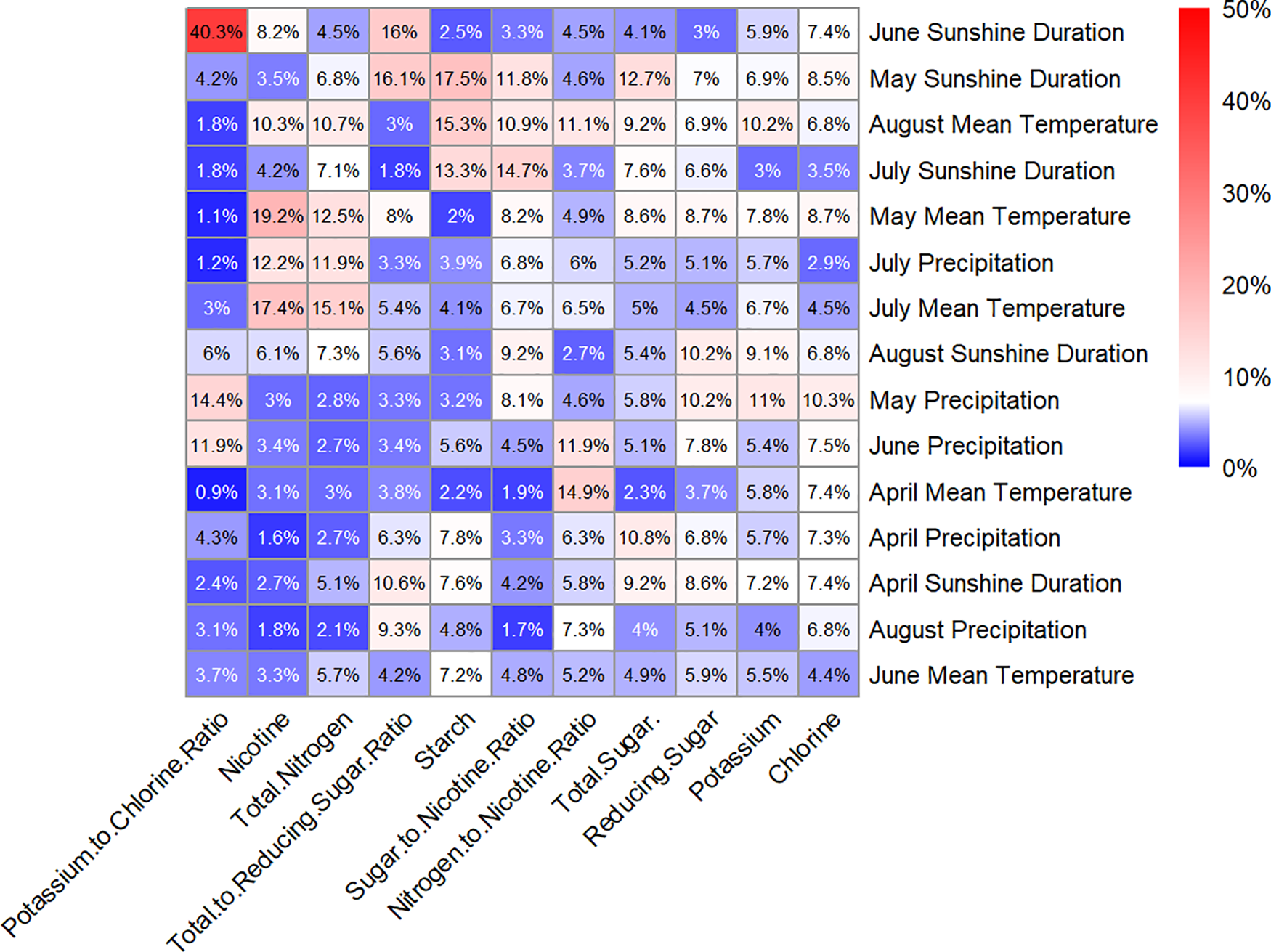
Figure 1: Analysis of the relative contribution of meteorological factors to major chemical indicators of tobacco leaves. Note: In the figure, color represents the relative contribution of meteorological factors to the content and balance of chemical components in cured tobacco leaves, with a gradient from blue to red, where blue denotes a lower contribution and red denotes a higher contribution; the numbers denote the specific relative contributions of meteorological factors by month to the chemical components in cured tobacco leaves
Note: In the table, the colour represents the relative contribution of meteorological factors to the content and regulation of chemical components in cured tobacco leaves, with a gradient from blue to red, where red denotes a greater contribution; the numbers indicate specific contribution values.
Cured tobacco is very sensitive to the environmental conditions under which it grows, including soil properties, solar radiation, precipitation, and temperature. Stress from temperature, sunshine duration, and drought can cause early flowering of tobacco, reducing its economic value [8,28]. Precipitation significantly influences biomass, sugar, and nicotine contents [29]. Excessive rainfall, high temperature, and high humidity can also exacerbate disease in tobacco [8]. Our findings indicate that precipitation, mean temperature, and sunshine duration varied greatly between the eastern and western parts of Guizhou tobacco-growing areas, with coefficients of variation ranging from 36.57% to 68.67%, 9.63% to 12.04% and 9.15% to 49.14%, respectively. In tobacco, the range of nicotine content is 1.17%–3.04%, that of the reducing sugar content is 1.17%–22.25%, that of the nitrogen content is 1.36%–2.31%, and that of the chlorine content is 0.18%–0.62% [8,30]. The average contents of nicotine and reducing sugars are 2.92% and 15.74%, respectively, which are within the reported ranges. The mountainous agricultural environment and the climate of Guizhou tobacco-growing areas constitute the ecological basis for the formation of the honey-sweetness flavour and fresh-sweetness flavour in Guizhou tobacco. In this study, the contents of nicotine and total sugar were most significantly and positively affected by mean temperature from the maturation stage to the harvest stage (June–August) and were most significantly and negatively affected by the duration of sunshine during the root extension stage and vigorous growth stage (April–May). These results are consistent with the fact that the total sugar and reducing sugar contents are positively correlated, whereas the contents of nicotine, protein, and chlorine are negatively related to precipitation in Guizhou Province [8]. The findings of Bu are consistent with our study [31], indicating that July rainfall is significantly negatively correlated with total sugar content in middle leaves, nicotine content decreases with increasing total sunshine duration, and August mean temperature is significantly positively correlated with total sugar content and the sugar-to-nicotine ratio. Similarly, Ji found that humidity during the root extension stage (April) is significantly positively correlated with reducing sugar content, and rainfall during the vigorous growth stage (May) is significantly negatively correlated with nicotine content, which aligns with our results [21]. However, Ji also reported that the mean temperature during the root extension stage and the field growth period is significantly negatively correlated with reducing sugar content [21], which differs from our findings. This discrepancy may be due to the fact that the temperatures during the root extension and vigorous growth stages of flue-cured tobacco in Guizhou are slightly lower than those in Baoshan, Yunnan. In regions with relatively lower temperatures, an increase in mean temperature may favor the accumulation of reducing sugars [32]. Sunshine duration ranging from 500–700 h is suitable for tobacco [33], but sunshine duration ranges from 418–913 h in Guizhou Province. Therefore, tobacco cultivation must be performed according to the characteristics of the local climate.
Tobacco requires optimum temperature (20°C–30°C), humidity (80%–85%), and sunshine duration (500–700 h) in its growth phase [8,34]. The results of the relative contribution analysis indicated that in the Guizhou tobacco-growing areas, the sunshine duration in June and the precipitation in May and June contributed strongly to the potassium–chlorine ratio of tobacco leaves. Moreover, the mean temperature in May and the precipitation and mean temperature in July significantly contributed to the contents of nicotine and total nitrogen, with contributions to nicotine reaching 19.17%, 12.19%, and 17.36%, respectively. These findings suggested that the mean temperature and precipitation during the vigorous growth stage and the early maturation stage were favourable for the accumulation of total nitrogen and nicotine. Biglouei conducted water treatment experiments at different growth stages and found that water management significantly affects the leaf area index, sugar and nicotine content, as well as the yield and quality of tobacco leaves. Appropriate water supplementation was shown to improve yield, average price, and output value [29]. Similarly, Wang suggested that total alkaloids are closely associated with temperature in the late maturity stage and rainfall during the vigorous growth and early maturity stages [35]. Similarly, in the present study, May sunshine duration, August mean temperature, and July sunshine duration contributed more to starch, with contributions of 17.45%, 15.34%, and 13.27%, respectively, indicating that longer sunshine duration and higher temperatures in the vigorously growing stage and late maturation stage were favourable for the accumulation of starch in tobacco leaves. The maximum contribution of sunshine duration to the total-reducing sugar ratio was observed in June and May, and the sunshine duration in the vigorous growth stage and early maturation stage regulated the total-reducing sugar ratio of tobacco. The research findings are consistent with those reported by Liu et al. [19].
In summary, this study conducted a relatively systematic investigation and discussion on the impacts of meteorological factors in different tobacco-growing regions of Guizhou on the main chemical quality and its coordination in tobacco leaves. It has been clarified that meteorological factors during the rooting stage, vigorous growth stage, and maturity stage primarily influence the accumulation of nitrogen-containing compounds such as nicotine and total nitrogen. According to local requirements for high-quality tobacco growth and processing, it is recommended to ensure tobacco seedling transplantation is completed before May and to appropriately extend the tobacco leaf maturation period. These measures can promote the accumulation of carbon-nitrogen compounds in tobacco leaves, effectively improving tobacco yield and quality. However, since meteorological factors significantly influence tobacco quality in cultivation, and this study only includes one year of experimental data and analysis results, the relevant conclusions still require more multi-year trials and comprehensive research. Such further studies would help explore the effects of region-specific meteorological factors on tobacco yield and quality indicators, facilitating the adjustment and optimization of production techniques.
The magnitude and coefficient of variation of meteorological factors during the growth period of tobacco in Guizhou were large and, in descending order, were precipitation, sunshine duration, and mean temperature, which all had a significant effect on the accumulation of carbohydrates and nitrogenous compounds in tobacco leaves. Overall, the precipitation, sunshine duration and mean temperature from April–June (root extension stage and vigorous growth stage) had major effects on the accumulation of nitrogenous compounds such as nicotine and total nitrogen, whereas the mean temperature and sunshine duration from July–August (maturation stage and harvest stage) had major effects on the accumulation of carbohydrates such as starch and total sugars. In the mountainous areas of Guizhou, areas with abundant precipitation from April to June, suitable sunshine duration from April to May, and slightly higher mean temperature from June to August are recommended as high-quality tobacco areas. Additionally, the transplanting period and cultivation techniques should be adjusted according to the patterns of precipitation, sunshine duration, and mean temperature in tobacco-growing areas.
Acknowledgement: We gratefully acknowledge the Guizhou Meteorological Bureau for providing meteorological factor data, and the Joint Laboratory of Smart Tobacco Agriculture (China Tobacco Hunan Industrial Co., Ltd. & Guizhou Academy of Tobacco Science) for instrumentation support in chemical constituent analysis.
Funding Statement: This work was supported by National Natural Science Foundation of China (32160648), Science and Technology Project of China Tobacco Company [110202202016], Science and Technology Project of Guizhou Tobacco Company 2022XM17, Science and Technology Program of Science and Technology Department of Guizhou Province (QKHJC-ZK [2022] YB288).
Author Contributions: The authors confirm contribution to the paper as follows: Study conception and design: Kesu Wei, Benbo Xu; Data collection: Guanhui Li, Zeyu Zhao, Jiati Tang; Supplied the materials: Qifang Zhang; Analysis and interpretation of results: Guanhui Li, Zeyu Zhao, Jiati Tang; Draft manuscript preparation: Guilin Ou, Yingchao Lin, Liping Chen, Benbo Xu, Xiang Li, Xun Liu, Shengjiang Wu, Zhu Ren, Xuekun Zhang, Kesu Wei. All authors reviewed the results and approved the final version of the manuscript.
Availability of Data and Materials: The data sets supporting the results of this article are included within the article.
Ethics Approval: Not applicable.
Conflicts of Interest: Kesu Wei is the grant recipient for the listed project. The authors declare that the research was conducted in the absence of any additional commercial or financial relationships that could be construed as potential conflicts of interest.
Supplementary Materials: The supplementary material is available online at https://www.techscience.com/doi/10.32604/phyton.2025.068213/s1.
References
1. Lecours N, Almeida GEG, Abdallah JM, Novotny TE. Environmental health impacts of tobacco farming: a review of the literature. Tob Control. 2012;21(2):191–6. doi:10.1136/tobaccocontrol-2011-050318. [Google Scholar] [PubMed] [CrossRef]
2. Ozturk M, Metin M, Altay V, Kawano T, Gul A, Unal BT, et al. Aluminum toxicity: a case study on tobacco (Nicotiana tabacum L.). Phyton-Int J Exp Bot. 2023;92(1):165–92. doi:10.32604/phyton.2022.022038. [Google Scholar] [CrossRef]
3. Yang J, Pu T, Wan K, Wang L, Shi Y, Luo X, et al. Transcriptome and metabolome revealed the mechanism of NtBRL3 overexpression tobacco (Nicotiana tabacum L. K326) in response to drought stress. Phyton-Int J Exp Bot. 2023;92(9):2555–76. doi:10.32604/phyton.2023.030301. [Google Scholar] [CrossRef]
4. Chen XF, Long T, Huang SX, Chen YQ, Lu HL, Jiang ZK, et al. Metabolomics-based study of chemical compositions in cellulase additives derived from a tobacco-origin and their impact on tobacco sensory attributes. Arch Microbiol. 2024;206(4):163. doi:10.1007/s00203-024-03876-x. [Google Scholar] [PubMed] [CrossRef]
5. Romanini E, Colangelo D, Lucini L, Lambri M. Identifying chemical parameters and discriminant phenolic compounds from metabolomics to gain insight into the oxidation status of bottled white wines. Food Chem. 2019;288(24):78–85. doi:10.1016/j.foodchem.2019.02.073. [Google Scholar] [PubMed] [CrossRef]
6. Fei J, Liu Z, Wang P, Qu J, Liu S, Guan S, et al. The maize WRKY transcription factor ZmWRKY25 respond drought stress in transgenic tobacco. Phyton-Int J Exp Bot. 2024;93(12):3617–35. doi:10.32604/phyton.2024.052704. [Google Scholar] [CrossRef]
7. Zhou GS, Yin XH, Li YM, Zhao ZX, Xu LZ, Ding JL. Optimal planting timing for corn relay intercropped with flue-cured tobacco. Crop Sci. 2015;55(6):2852–62. doi:10.2135/cropsci2014.05.0396. [Google Scholar] [CrossRef]
8. Tang ZX, Chen LL, Chen ZB, Fu YL, Sun XL, Wang BB, et al. Climatic factors determine the yield and quality of Honghe flue-cured tobacco. Sci Rep. 2020;10(1):19868. doi:10.1038/s41598-020-76919-0. [Google Scholar] [PubMed] [CrossRef]
9. Henry JB, Vann M, McCall I, Cockson P, Whipker BE. Nutrient disorders of burley and flue-cured tobacco: part 2-micronutrient disorders. Crop Forage Turfgrass Manag. 2018;4(1):1–7. doi:10.2134/cftm201711.0077. [Google Scholar] [CrossRef]
10. Zhu RX, He SJ, Ling HR, Liang YJ, Wei BL, Yuan XM, et al. Optimizing tobacco quality and yield through the scientific application of organic-inorganic fertilizer in China: a meta-analysis. Front Plant Sci. 2024;15:1500544. doi:10.3389/Fpls.2024.1500544. [Google Scholar] [PubMed] [CrossRef]
11. Zhao XL, Cheng Q, Luan MB, Zhang YH. Effects of environmental factors on the growth and quality of the tobacco variety Zhusha 2: a case study in Yunan, China. Pak J Agr Sci. 2024;61(3):733–41. doi:10.21162/Pakjas/24.143. [Google Scholar] [CrossRef]
12. Wei K, Liu G, Wei B, Zhang Q, Wu S, Li Z. Effects of drought stress on the physiological characteristics of flue-cured tobacco during the vigorous growing period. Phyton-Int J Exp Bot. 2025;94(4):1287–98. doi:10.32604/phyton.2025.062385. [Google Scholar] [CrossRef]
13. Tang ZX, Sun XL, Luo ZK, He NP, Sun OJ. Effects of temperature, soil substrate, and microbial community on carbon mineralization across three climatically contrasting forest sites. Ecol Evol. 2018;8(2):879–91. doi:10.1002/ece3.3708. [Google Scholar] [PubMed] [CrossRef]
14. Machanoff CA, Vann MC, Woodley AL, Suchoff D. Evaluation of the use of polyethylene mulches in the production of organic flue-cured tobacco. Agron J. 2022;114(4):2501–17. doi:10.1002/agj2.21100. [Google Scholar] [CrossRef]
15. Tiecher T, Pace CR, Gatiboni L, Vann M, Hardy D, Fisher L. Flue-cured tobacco and Cl rates: implications on yield, quality, and nutrient concentration. Agron J. 2023;115(2):896–908. doi:10.1002/agj2.21272. [Google Scholar] [CrossRef]
16. Chen YJ, Ren K, He X, Chen Y, Hu BB, Hu XD, et al. The response of flue-cured tobacco cultivar K326 to nitrogen fertilizer rate in China. J Agric Sci. 2020;158(5):371–82. doi:10.1017/S0021859620000738. [Google Scholar] [CrossRef]
17. Banozic M, Jokic S, Ackar D, Blazic M, Subaric D. Carbohydrates-key players in tobacco aroma formation and quality determination. Molecules. 2020;25(7):1734. doi:10.3390/Molecules25071734. [Google Scholar] [PubMed] [CrossRef]
18. Ali MY, Shahrier M, Kafy AA, Ara I, Javed A, Fattah MA, et al. Environmental impact assessment of tobacco farming in northern Bangladesh. Heliyon. 2023;9(3):e14505. doi:10.1016/j.heliyon.2023.e14505. [Google Scholar] [PubMed] [CrossRef]
19. Liu J, Ren YJ, Chen ZH, Liu Y, Zhang YZ, Deng PR. Relationship between chemical components and climatic factors of flue-cured tobacco in Hubei and analysis of differences in tobacco areas. Chin Agricult Sci Bullet. 2023;39(17):64–71. (In Chinese). [Google Scholar]
20. Ji SH, Zhao XB, Wang CC, Zhan RF, Lu P, Fang ZH. Correlation between main climatic factors and chemical components of tobacco leaves in Baoshan tobacco-growing area. Guizhou Agricult Sci. 2021;49(6):134–9. [Google Scholar]
21. Zhao AJ, Su JY, Ding CX, Liu DM. Correlation analysis between meteorological factors and conventional chemical components of tobacco leaves in Changsha tobacco area. Hunan Agricult Sci. 2018;10:44–7. (In Chinese). [Google Scholar]
22. Zhou FF, Zhan J, Hao YS, Cui FT, Zhou LJ, Jiang MH, et al. Effects of climatic factors and chemical components on sensory quality of flue-cured tobacco in Yunnan tobacco-growing areas. J Henan Agricult Univ. 2014;48(5):555–60. (In Chinese). doi:10.16445/j.cnki.1000-2340.2014.05.016. [Google Scholar] [CrossRef]
23. Shi JX, Chen X, Lei L. Effects of ecological factors on main chemical components of tobacco leaves in Guizhou. Chin Tobacco Sci. 2008;2:18–22. [Google Scholar]
24. Ding GS, Wang YB, Chen ZY, Zhang ZF, Qiu J, Liu XG, et al. Relationship between main climatic factors and chemical components of tobacco leaves in Nanping tobacco area. Chin Tobacco Sci. 2009;30(4):26–30. (In Chinese). [Google Scholar]
25. Zhang ZT, Tian H, Li JS, Wang D, Wu XW. Polyaspartic acid increases potassium content and reduces the ratio of total sugar to nicotine in tobacco leaves. Heliyon. 2024;10(4):e26383. doi:10.1016/j.heliyon.2024.e26383. [Google Scholar] [PubMed] [CrossRef]
26. Hyde R, Angelov P, MacKenzie AR. Fully online clustering of evolving data streams into arbitrarily shaped clusters. Inform Sci. 2017;382(6):96–114. doi:10.1016/j.ins.2016.12.004. [Google Scholar] [CrossRef]
27. Yang X, Liu W, Liu W, Tao D. A survey on canonical correlation analysis. IEEE Trans Knowl Data Eng. 2021;33(6):2349–68. doi:10.1109/TKDE.2019.2958342. [Google Scholar] [CrossRef]
28. Nghiem DT, Vu HTT, Nguyen NV, Le CTT. Growth, yield and quality variability of flue-cured tobacco in response to soil and climatic factors in Northern Vietnam. Ital J Agron. 2024;19(3):100016. doi:10.1016/J.Ijagro.2024.100016. [Google Scholar] [CrossRef]
29. Biglouei MH, Assimi MH, Akbarzadeh A. Effect of water stress at different growth stages on quantity and quality traits of Virginia (flue-cured) tobacco type. Plant Soil Environ. 2010;56(2):67–75. doi:10.17221/163/2009-PSE. [Google Scholar] [CrossRef]
30. White FH, Pandeya RS, Dirks VA. Correlation studies among and between agronomic, chemical, physical and smoke characteristics in flue-cured tobacco (Nicotiana tabacum L). Can J Plant Sci. 1979;59(1):111–20. doi:10.4141/cjps79-016. [Google Scholar] [CrossRef]
31. Bu GX, Qiao CY, Wang F, Jing YG, Feng XP, Su QH. Study on relationships between main climatic factors and chemical quality of flue-cured tobacco in fuxin area. Acta Agricult Jiangxi. 2013;26(2):95–8. doi:10.19386/j.cnki.jxnyxb.2014.02.025. [Google Scholar] [CrossRef]
32. Zhu YK, Peng ZL, Zhao YY, Yang QX, Duan WD, Yin GT, et al. Impacts of different transplanting and harvesting dates on upper leaf quality characteristics of flue-cured tobacco in southern Shaanxi. Jiangsu Agricult Sci. 2024;52(6):96–105. (In Chinese). [Google Scholar]
33. Akehurst BC. Effect of planting time on yield and quality of flue-cured tobacco in Iringa District Tanzania. Exp Agr. 1965;1(4):305–13. doi:10.1017/s0014479700021608. [Google Scholar] [CrossRef]
34. Li Y, Ren K, Hu MY, He X, Gu KY, Hu BB, et al. Cold stress in the harvest period: effects on tobacco leaf quality and curing characteristics. BMC Plant Biol. 2021;21(1):131. doi:10.1186/s12870-021-02895-w. [Google Scholar] [PubMed] [CrossRef]
35. Wang B, Li TF. Relevance analyses between different weather factors and tobacco chemical constitutions. J Yunnan Agric Univ. 2005;5:742–5. doi:10.16211/j.issn.1004-390x(n).2005.05.033. [Google Scholar] [CrossRef]
Cite This Article
 Copyright © 2025 The Author(s). Published by Tech Science Press.
This work is licensed under a Creative Commons Attribution 4.0 International License , which permits unrestricted use, distribution, and reproduction in any medium, provided the original work is properly cited.
 Downloads
 Citation Tools
