
 Login
Login Register
 Submit a Paper
 Propose a Special lssue
 Open Access
ARTICLE

Keystone Fungal Endophytes of Panax Plants Drive the Conversion of Ginsenoside Rb1 to Rd
1 Tianjin University of Traditional Chinese Medicine, Tianjin, China
2 Institute of Chinese Materia Medica, China Academy of Chinese Medical Sciences, State Key Laboratory for Quality Ensurance and Sustainable Use of Dao-di Herbs, Beijing, China
3 Wenshan Miaoxiang Notoginseng Technology, Co., Ltd., Wenshan, China
4 Institute of Sanqi Research, Wenshan University, Wenshan, China
* Corresponding Authors: Guozhuang Zhang. Email: ; Linlin Dong. Email:
Phyton-International Journal of Experimental Botany 2026, 95(2), 11 https://doi.org/10.32604/phyton.2026.075657
Received 05 November 2025; Accepted 26 January 2026; Issue published 28 February 2026
 View Full Text
 Download PDF
Abstract
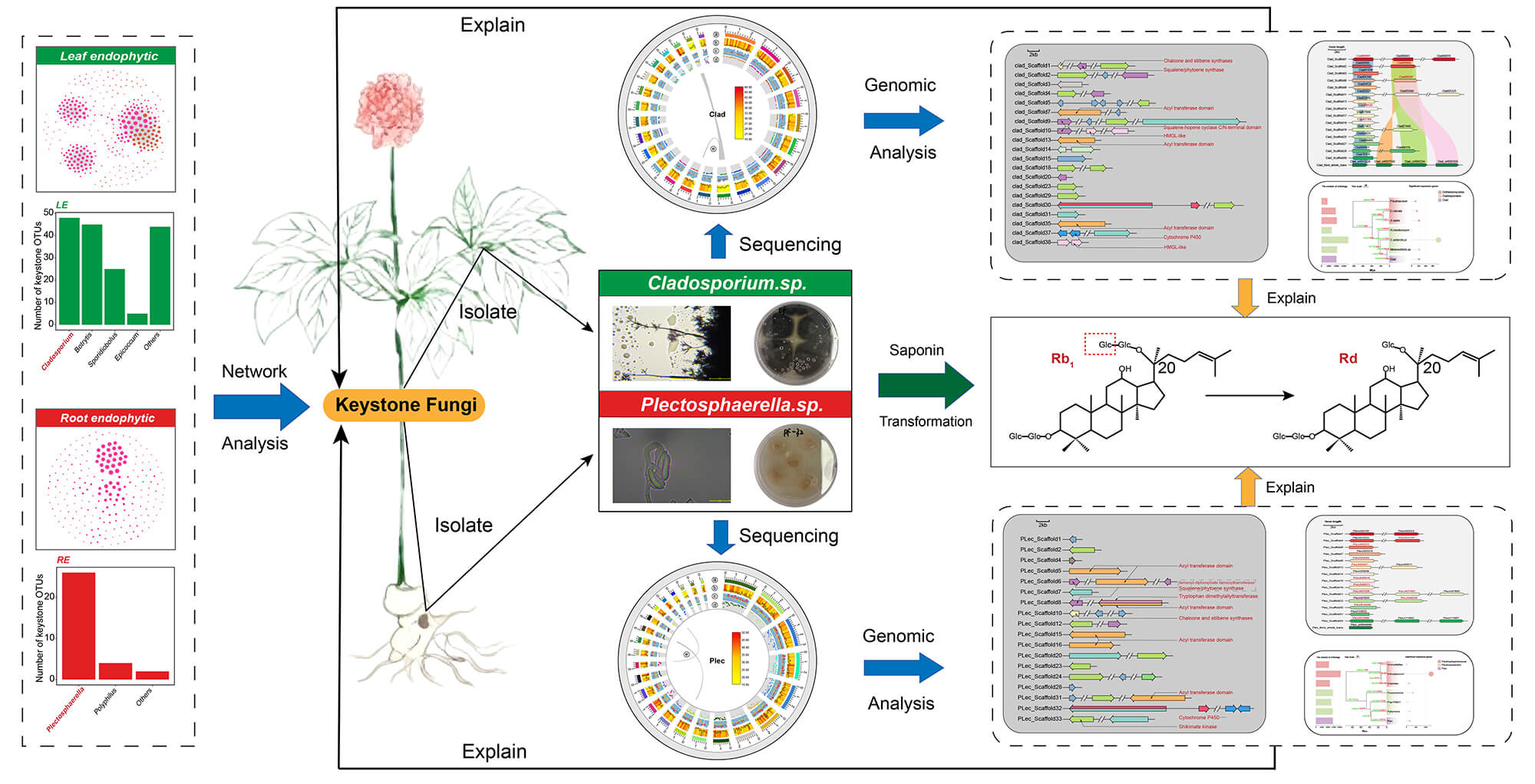
Keystone taxa are critical for microbial community homeostasis and ecological niche interactions. However, the functions and genomic traits of endophytic keystone fungi in plant tissues remain unclear. Via network analysis, this study identified keystone fungi Plectosphaerella (Plec) and Cladosporium (Clad) in roots/leaves of medicinal Panax plants (P. ginseng, P. quinquefolius, P. notoginseng). Both correlated strongly positively with ginsenoside Rd content in respective tissues (ρ > 0.6, p < 0.001). Co-cultivation confirmed their ability to convert ginsenoside Rb1 to Rd, linked to β-glucosidase activity. Whole-genome sequencing/assembly/evolutionary analysis of the two strains elucidated genomic features for their keystone roles and saponin biotransformation. Genome mining found multiple GH3 genes (potential saponin transformers) in both; 11 (Plec) and 5 (Clad) were upregulated by cellobiose. Gene family phylogenetic analysis showed expanded transmembrane transport and environmental response functions. Both also had abundant secondary metabolic gene clusters and secretome genes, linking biotic interaction functions to their keystone roles. In summary, this study shows Panax endophytic keystone fungi can participate in ginsenoside biotransformation and clarifies their genomic traits, offering insights for functional endophytic fungal resource development.Graphic Abstract
Keywords
Supplementary Material
Supplementary Material FileCite This Article
 Copyright © 2026 The Author(s). Published by Tech Science Press.
This work is licensed under a Creative Commons Attribution 4.0 International License , which permits unrestricted use, distribution, and reproduction in any medium, provided the original work is properly cited.
 Downloads
 Citation Tools
