
 Login
Login Register
 Submit a Paper
 Propose a Special lssue
 Open Access
ARTICLE

Exploring the Therapeutic Potential of Horwoodia dicksoniae through Phytochemical Profiling, Antioxidant Assessment, and Biological Activity Evaluation
Department of Zoology, College of Science, King Saud University, Riyadh, Saudi Arabia
* Corresponding Author: Aiman Ammari. Email:
(This article belongs to the Special Issue: Medicinal Plants: Phytochemical and Pharmacological Research)
Phyton-International Journal of Experimental Botany 2026, 95(8), 8 https://doi.org/10.32604/phyton.2026.087258
Received 13 June 2026; Accepted 10 July 2026; Issue published 28 August 2026
 View Full Text
 Download PDF
Abstract
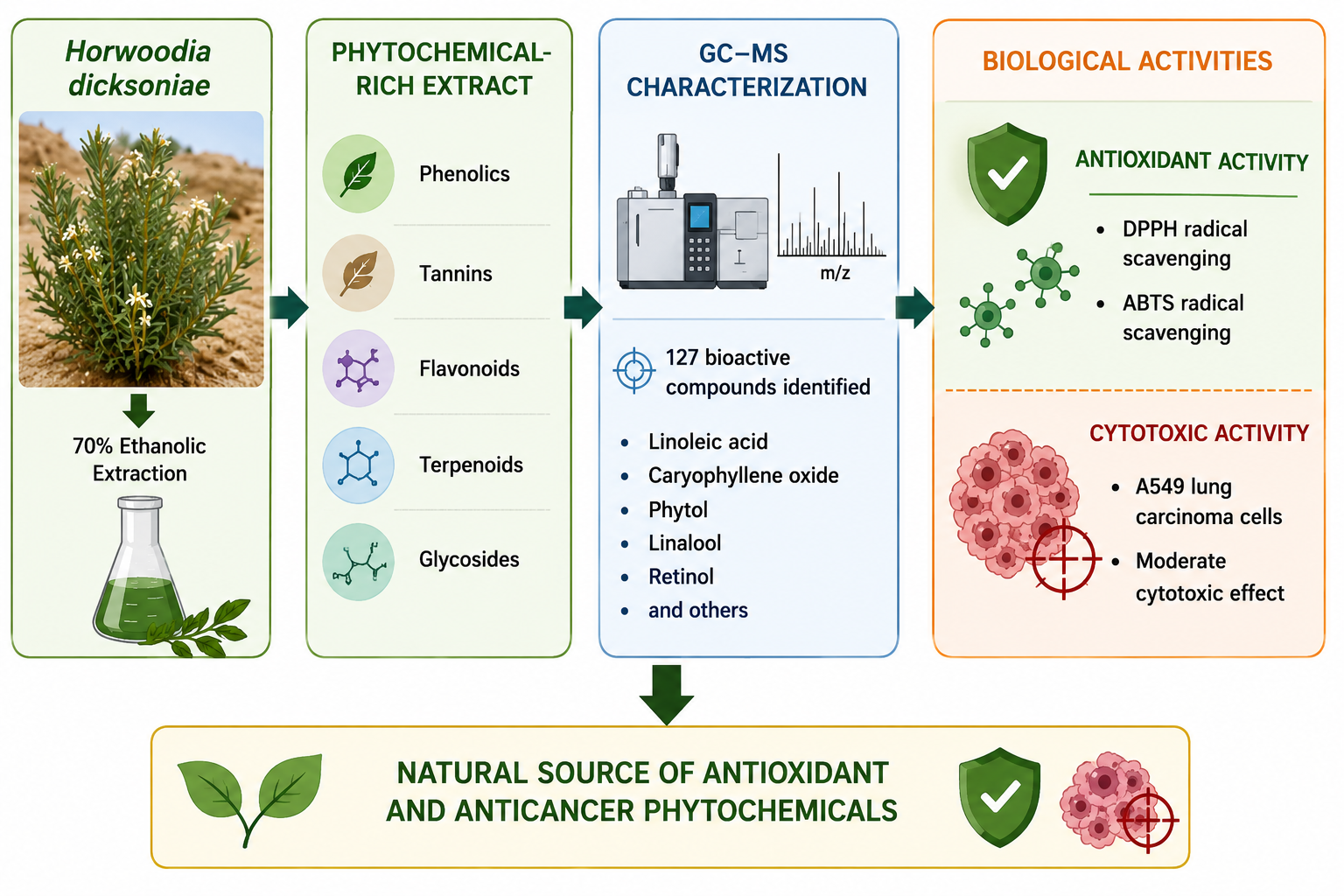
Medicinal plants are valuable sources of bioactive compounds with diverse pharmacological properties. However, the phytochemical composition and biological activities of Horwoodia dicksoniae remain insufficiently investigated. Therefore, this study evaluated the phytochemical composition, antioxidant activity, physicochemical characteristics, and in vitro cytotoxic potential of the ethanolic extract of H. dicksoniae collected from the Thumamah area, Riyadh, Saudi Arabia. The extract was subjected to phytochemical characterization, chemical profiling, physicochemical analysis, antioxidant activity assessment, and cytotoxicity evaluation. Qualitative screening confirmed the presence of phenolics, flavonoids, tannins, terpenoids, and glycosides, while quantitative analysis revealed high levels of phenolic and tannin constituents. The extract exhibited notable antioxidant activity, with half-maximal inhibitory concentration (IC50) values of 500.65 ± 2.54 and 227.52 ± 6.85 μg/mL. Chemical profiling identified 127 phytochemical constituents, predominantly fatty acids, terpenoids, esters, and oxygenated hydrocarbons, with 9,12-octadecadienoic acid (Z,Z)-, cis-(-)-1,2-epoxy-p-menth-8-ene, n-hexadecanoic acid, caryophyllene oxide, phytol, linalool, and retinol as the major compounds. Physicochemical analysis indicated satisfactory dispersion stability, while cytotoxicity testing against A549 cells demonstrated moderate growth inhibition, although the IC50 value was not reached within the tested concentration range. These findings suggest that H. dicksoniae is a promising source of bioactive phytochemicals with antioxidant potential and warrants further investigation for pharmaceutical applications.Graphic Abstract
Keywords
Supplementary Material
Supplementary Material FileCite This Article
 Copyright © 2026 The Author(s). Published by Tech Science Press.
This work is licensed under a Creative Commons Attribution 4.0 International License , which permits unrestricted use, distribution, and reproduction in any medium, provided the original work is properly cited.
 Downloads
 Citation Tools
