
 Login
Login Register
 Submit a Paper
 Propose a Special lssue
 Open Access
ARTICLE
Combining Meta-Analysis to Investigate the Role of Non-Target Metabolic Pathways in Maize Detoxification of Nicosulfuron
1 Hebei Key Laboratory of Crop Stress Biology, College of Agronomy and Biotechnology, Hebei Normal University of Science and Technology, Qinhuangdao, China
2 Hebei Key Laboratory of Crop Genetics and Breeding, Institute of Cereal and Oil Crops, Hebei Academy of Agriculture and Forestry Sciences, Shijiazhuang, China
* Corresponding Authors: Yanbing Wang. Email: ; Jian Wang. Email:
Phyton-International Journal of Experimental Botany 2026, 95(9), 17 https://doi.org/10.32604/phyton.2026.086921
Received 07 June 2026; Accepted 20 July 2026; Issue published 24 September 2026
 View Full Text
 Download PDF
Abstract
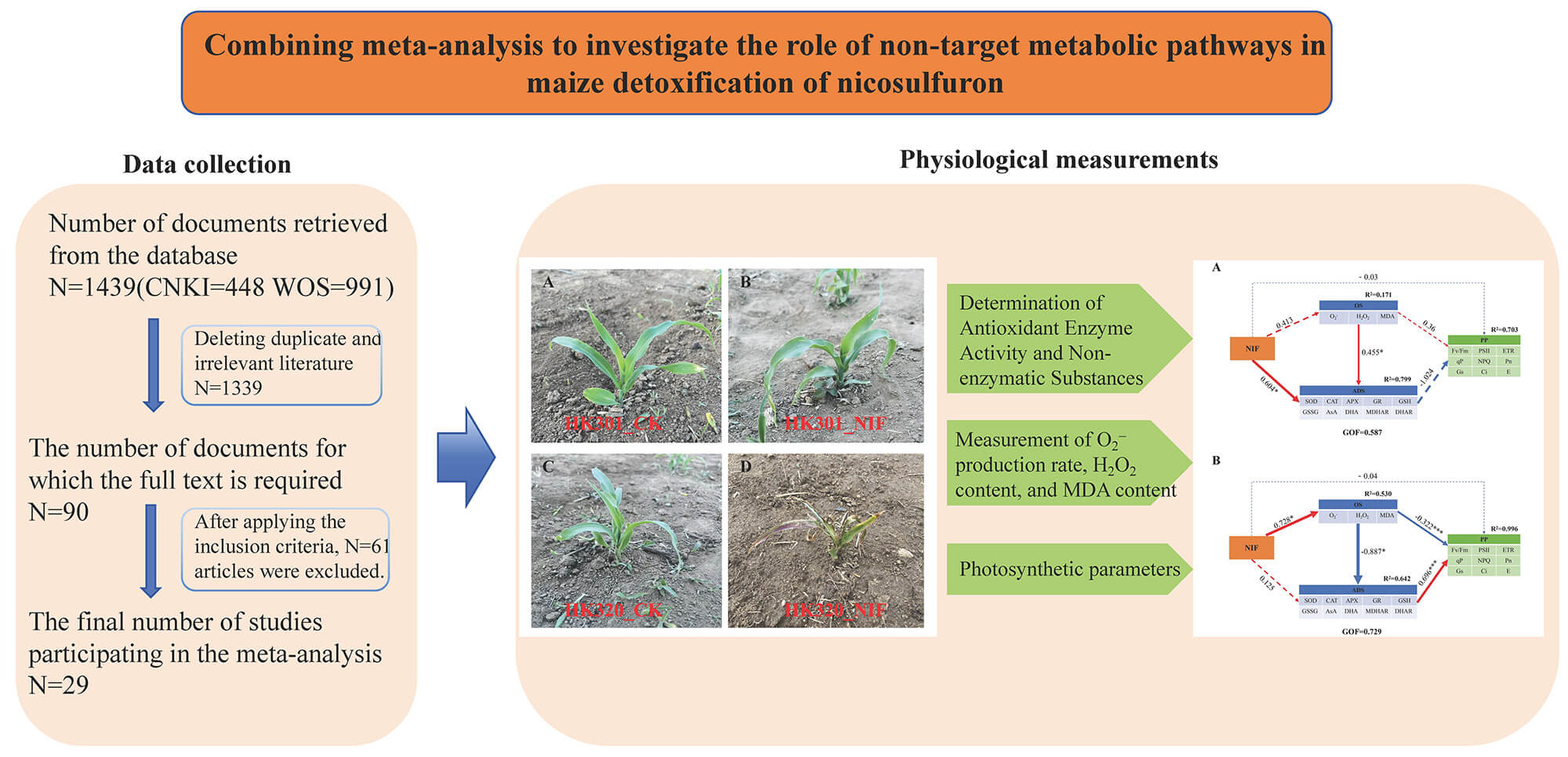
To clarify the effectiveness of nicosulfuron (NIF) in controlling weeds in cornfields and the physiological response mechanisms of corn, this study synthesized 29 relevant articles for a meta-analysis. A pair of sweet corn sister lines with different resistance to NIF (resistant HK301 and sensitive HK320) was selected as materials, and the responses of non-target metabolic pathways under NIF stress were analyzed using structural equation modeling. The results indicate that NIF is highly effective against weeds such as Eleusine indica and Amaranthus retroflexus, but less effective against weeds such as Cyperus difformis (13.20%) and Abutilon theophrasti (−4.10%). High concentrations (≥60 g hm−2) and prolonged application (more than 30 days) significantly enhance effectiveness (up to 170.60% and 155.50%, respectively). In terms of physiological mechanisms, the antioxidant capacity, photosynthetic performance and levels of non-enzymatic antioxidants in sensitive maize (Maize.G) were significantly lower than those in the resistant Maize.K, with higher accumulation of ROS and MDA. The structural equation model revealed that in HK301, NIF induced oxidative stress effectively activates the antioxidant defense system, inhibits ROS accumulation and membrane lipid peroxidation, reduces photosynthetic damage, and maintains physiological homeostasis. Conversely, in HK320, excessive oxidative stress leads to impaired antioxidant function and a decline in photosynthetic performance. This study demonstrates physiological differences in NIF responses between resistant and sensitive maize lines, providing practical guidance for the rational use of NIF in corn-fields and, theoretical insights into the non-target effects of herbicides and crop resistance mechanisms.Graphic Abstract
Keywords
Supplementary Material
Supplementary Material FileCite This Article
 Copyright © 2026 The Author(s). Published by Tech Science Press.
This work is licensed under a Creative Commons Attribution 4.0 International License , which permits unrestricted use, distribution, and reproduction in any medium, provided the original work is properly cited.
 Downloads
 Citation Tools
