
 Login
Login Register
 Submit a Paper
 Propose a Special lssue
 Open Access
ARTICLE
Canopy Microclimate Affect Vine Physiology, Bunch Sunburn, and Berry Amino Acid Content in East–West Oriented Chardonnay Vines
1 Instituto de Investigaciones Agropecuarias, INIA Cauquenes, Camino a Parral km 4, Región del Maule, Cauquenes, Chile
2 Centro de Investigación e Innovación VitiScience-CIA 250013, Facultad de Agronomía y Sistemas Naturales, Pontificia Universidad Católica, Santiago, Chile
3 Instituto de Investigaciones Agropecuarias, INIA Raihuen, Av. Esperanza s/n, Estación Villa Alegre, Región del Maule, Villa Alegre, Chile
4 Universidad Católica del Maule, Departamento de Ciencias Agrarias, Laboratorio de Agricultura Cuantitativa y Ecofisiología (LACE), km 6 Camino Los Niches, Curicó, Chile
5 Agriaquaculture Nutritional Genomic Center, CGNA, Temuco, Chile
6 Centro de Desarrollo del Secano Interior, Departamento de Ciencias Forestales, Facultad de Ciencias Agrarias y Forestales, Universidad Católica del Maule, Talca, Chile
* Corresponding Author: Miguel Araya-Alman. Email:
(This article belongs to the Special Issue: Molecular and Physiological Mechanisms of Berry Fruit Development and Quality Formation)
Phyton-International Journal of Experimental Botany 2026, 95(9), 19 https://doi.org/10.32604/phyton.2026.088464
Received 04 July 2026; Accepted 24 August 2026; Issue published 24 September 2026
 View Full Text
 Download PDF
Abstract
(1) Background: Increasing heat and radiation exposure in Mediterranean vineyards are intensifying the risk of berry sunburn and altering grape composition, particularly in white cultivars such as Chardonnay. Canopy management and shading nets are potential adaptation strategies, but their effects on microclimate, vine physiology, and nitrogen-related berry composition remain insufficiently understood. (2) Methods: This study evaluated the effects of photoselective and conventional shade nets, leaf removal, and an untreated control on Chardonnay grapevines grown in east–west-oriented rows during one growing season. (3) Results: The incident photosynthetically active radiation (PARi) was strongly increased by leaf removal, being 124.0% higher than under the conventional Raschel net, 112.6% higher than under the photoselective black-white net, and 80.9% higher than the control without intervention. The photoselective black-white net eliminated afternoon temperature events above 35°C, although it showed the highest sunburn severity. Leaf removal showed the highest stem water potential values, increasing proline concentration in grapes. The conventional Raschel net reduced berry arginine concentration compared with all other treatments and increased serine and histidine concentrations relative to the control and black–white photoselective net, although these amino acids did not differ from leaf removal. (4) Conclusions: Shading nets and leaf removal differentially modified light exposure, the frequency of extreme heat events, vine water status, and amino acid metabolism in Chardonnay vines trained in east–west-oriented rows. These findings highlighted the need to adjust canopy and shading strategies according to row orientation, as practices that mitigate heat exposure may also produce contrasting effects on berry sunburn and composition.Keywords
Grapevine (Vitis vinifera L.) is one of the world’s most important fruit crops. Global grape production reached approximately 75.9 million tonnes in 2024, with Chile contributing nearly 2.45 million tonnes [1]. Viticulture is increasingly exposed to the effects of climate change, particularly in Mediterranean-climate regions, where higher temperatures, more frequent heatwaves, and intensified solar radiation during the growing season threaten grape yield, berry composition, and wine quality [2,3]. Excessive heat and light exposure can induce physiological disorders such as berry sunburn, which damages epidermal and subepidermal tissues, reduces fruit marketability, and alters key metabolic pathways associated with ripening and composition [4]. These stresses are particularly relevant for white grape cultivars such as Chardonnay, whose berries lack the protective anthocyanin pigments present in red cultivars, thereby increasing their susceptibility to photo-oxidative injury, thermal stress, and the degradation of aroma-related compounds [5].
Canopy management practices play a central role in regulating the amount and spectral quality of light reaching the cluster zone, while also modifying local temperature, humidity, and airflow conditions within the fruiting area. Basal leaf removal, widely used in cool-climate viticulture, consists of removing leaves around the cluster zone to improve fruit exposure, air circulation, and spray penetration [6]. Although this practice can promote the accumulation of selected phenolic compounds and help reduce bunch rot incidence, its use in warm-climate regions may expose berries to supra-optimal temperatures and excessive ultraviolet radiation, thereby increasing the risk of sunburn and associated alterations in berry composition [7].
Shading nets have emerged as a promising canopy-based strategy to mitigate excessive radiation and thermal loads in the cluster zone without relying on severe foliage removal [8]. The effects of this technology depend largely on their optical properties, including shading intensity, spectral transmissivity, light scattering capacity, and color, all of which influence the microclimate beneath the net [9]. Black–white photoselective nets, for instance, are designed to reflect part of the incoming solar radiation while promoting the penetration of diffuse light, potentially reducing peak cluster temperatures without excessively limiting the photosynthetically active radiation (PAR) required for canopy carbon assimilation. By contrast, conventional black Raschel nets tend to produce a more uniform reduction in incoming radiation across the PAR and near-infrared (NIR) regions, generating a cooler but potentially darker microenvironment around the fruiting zone [10]. Despite these contrasting properties, the extent to which different net types modulate thermal stress, light exposure, ripening dynamics, and berry composition in white grape cultivars under Mediterranean-climate conditions remains insufficiently understood.
The role of nitrogen metabolism in grape composition and wine quality has received increasing attention, particularly because grape-derived nitrogen compounds strongly influence fermentation performance and aroma formation [11]. Amino acids in must constitute essential nitrogen sources for yeast during alcoholic fermentation, affecting fermentation kinetics as well as the production of higher alcohols, esters, and other volatile aroma compounds [12]. In grape berries, proline, arginine, alanine, and glutamine are commonly among the most abundant amino acids, although their relative concentrations are highly responsive to environmental conditions such as light exposure, temperature, and vine water status [12]. Previous studies have also shown that berry light exposure influences not only total amino acid accumulation but also the relative composition of individual amino acids, highlighting the importance of cluster-zone microclimate in determining grape nitrogen composition and its potential implications for wine aroma development [12]. Riesling berries exposed in a west-face orientation showed total amino acid content higher than the berries harvesting from east-facing orientation, while highly exposed canopy sides accumulated more proline, leucine, isoleucine, valine, serine, and tryptophan in berries [12]. Similarly, cluster shading altered berry nitrogen composition in Gamay Noir and Gamay Fréaux varieties by reducing the concentrations of most free amino acids in both the skin and pulp, including proline, with the magnitude of these responses depending on cultivar and berry tissue [13].
Heat and radiation stress can alter berry nitrogen metabolism by affecting nitrogen uptake, translocation, and amino acid partitioning, with potential consequences for yeast assimilable nitrogen availability, fermentation regularity, and wine sensory attributes [14]. Proline accumulation is particularly relevant in this context, as it is widely recognized as a stress-associated amino acid that increases under drought, salinity, high temperature, and excessive radiation [15]. Functionally, proline acts as an osmoprotectant and compatible solute, contributing to cellular protection under stress conditions [16]. In grape berries, higher proline concentrations have been associated with sun-exposed or heat-stressed tissues, where proline may contribute to osmotic adjustment and protection against photo-oxidative damage [17]. By contrast, arginine, one of the main nitrogen storage and transport-related amino acids in grapes, may decline under stress conditions as a result of impaired nitrogen uptake, altered source–sink relationships, or a metabolic shift toward stress-protective compounds such as proline [14]. Changes in the relative abundance of proline and arginine may provide useful insights into the nitrogen metabolic status of grape berries and their cumulative exposure to environmental stress during ripening.
This study evaluated the effects of conventional and photoselective nets on cluster-zone microclimate, bioclimatic and thermal risk indices, berry physicochemical parameters, bunch sunburn incidence and severity, and grape amino acid content in Chardonnay grapevines during one growing season.
2.1 Site Description and Vineyard Characteristics
The experiment was conducted during the 2023–2024 growing season at the Escuela Agrícola Superior de Molina, located in the Quechereguas sector, Molina commune, Maule Region, Chile (35°05′52″ S, 71°16′24″ W). According to the Köppen classification, the climate corresponds to a warm-summer Mediterranean type (Csb), characterized by warm, dry summers and mild, rainy winters, with most precipitation concentrated between April and September. The soil at the experimental site belongs to the Piedra Blanca Series. These soils are of alluvial origin, deep, and stratified, with a loam-textured surface horizon that transitions to fine sandy loam at depth.
The vineyard was planted in 1997 with own-rooted Vitis vinifera L. cv. Chardonnay, clone CH6, and trained to a vertical shoot-positioned trellis system. The rows were oriented approximately from east to west, with a slight southeast–northwest deviation and an azimuth of approximately 115.8° from north. The vine spacing was 2.3 m between rows and 1.0 m within rows, equivalent to approximately 4350 vines ha−1. The vines were drip-irrigated with a water supply of 2 L h−1 when reached 1.2 MPa and managed according to standard local practices, which were applied uniformly throughout the experimental vineyard.
2.2 Experimental Design and Arrangement of Treatments
Different canopy-management treatments were compared using a completely randomized design with three experimental replicates per treatment, which occupied independent sections of the vineyard, and treatment allocation was randomized among the experimental units. All treatments were imposed at the pea-size berry stage, using the general experimental approach previously reported by Gutiérrez-Gamboa et al. [18].
The treatments comprised an untreated control, basal leaf removal, conventional black Raschel netting, and black–white photoselective netting. Control vines received no additional modification of the fruit zone. For the leaf-removal treatment, six basal leaves were manually removed from the southern canopy face around the bunches to increase fruit exposure. The conventional net provided 35% nominal shade and had, according to the manufacturer, approximately 1.2–1.4 threads cm−2 in the weft (3 threads inch−1) and approximately 2.6 meshes cm−1. The black–white photoselective material provided 16% nominal shade and had a reported thread density of 2.6 × 3.0 threads cm−2.
Both netting materials were applied as sections approximately 7 m long and 1 m wide, extending between two adjacent trellis posts. They were positioned vertically along the south-facing side of the fruiting zone, covering the bunches and part of the surrounding vertically positioned canopy. Approximately five to six vines constituted each replicate. The net sections were secured directly to the trellis and canopy-support structure with plastic ties and staples.
2.3 Monitoring of Cluster-Zone Temperature, Derived Thermal Indices and Incident Photosynthetically Active Radiation (PARi)
Temperature conditions within the bunch zone were followed from the establishment of the treatments until harvest using Thermochron DS1921G-F5 iButton data loggers (Analog Devices, USA). A single logger was assigned to each treatment and programmed to collect one temperature measurement every hour. The sensors operate between −40 and 85°C, with a resolution of 0.5°C and an accuracy of ±1.0°C within the −30 to 70°C range.
Each logger was located near a representative bunch in the central portion of the corresponding treatment area. To minimize heating caused by direct solar exposure, sensors were held in DS9093F snap-in fobs and protected with perforated, ventilated radiation shields. At the end of the experiment, records were retrieved using a DS9490B USB adapter and the associated acquisition software.
The hourly series were examined for missing or anomalous observations before further processing; no records required removal or correction. Daily minimum, maximum, and mean temperatures were subsequently obtained for each treatment. These temperature series were also used to derive meteorological, bioclimatic, and heat-risk indicators according to Verdugo-Vásquez et al. [19], adapted to the monitoring period and fruit-zone scale used here.
Growing degree days were calculated with a base temperature of 10°C, and the Cool Night Index was also determined [19]. Heat exposure was characterized by counting hours exceeding 30 and 35°C and days in which afternoon temperature exceeded 35°C [19]. Calculations covered the period between treatment installation and harvest.
Light conditions in the fruiting zone were characterized one week after treatment installation with an AccuPAR LP-80 ceptometer (METER Group, Pullman, WA, USA). Incident photosynthetically active radiation (PARi) was recorded beneath the lower canopy near the bunch zone. Within each replicate, the probe was maintained horizontally without touching plant organs or the nets, and measurements were collected under stable radiation conditions.
2.4 Stem Water Potential and Leaf Chlorophyll Index
Vine water status was assessed through midday stem water potential (Ψstem) using a model 600 pressure chamber (PMS Instrument Co., Corvallis, OR, USA). Measurements were made on DOY 24 and 37 between 12:00 and 14:00 h under clear atmospheric conditions. Two healthy, fully expanded leaves located near the fruiting zone were selected from each replicate. Selected leaves were enclosed with plastic bags and aluminum foil for at least 2 h before excision to minimize transpiration and permit equilibration between leaf and stem xylem water potential. They were then detached and immediately placed in the pressure chamber for determination of Ψstem.
Leaf chlorophyll status was assessed non-destructively using a Soil Plant Analysis Development (SPAD) chlorophyll meter (SPAD-502Plus, Konica Minolta, Osaka, Japan). Healthy expanded leaves from the same general canopy position used for water-potential assessment were measured on the lamina while avoiding the midrib and major veins. Three SPAD readings were obtained from each replicate and averaged before statistical analysis.
2.5 Berry Physicochemical Parameters at Harvest
At approximately 22 °Brix, corresponding to technological maturity, 100 berries were sampled from each experimental replicate. Samples were weighed and subsequently crushed to obtain juice for maturity measurements. Soluble solids were determined with an HI96813 digital refractometer (Hanna Instruments, Woonsocket, RI, USA), and pH was measured using a Yalitector 1 OB-001 benchtop meter equipped with a glass electrode and temperature probe (YaliTech Instruments, Santiago, Chile). Bunch sunburn was evaluated visually on 10 randomly chosen clusters per replicate from the fruiting zone. Incidence represented the proportion of evaluated clusters displaying visible symptoms, whereas severity represented the estimated percentage of the cluster surface showing sunburn injury.
2.6 Amino Acid Content of Grapes at Harvest
The free amino acid profile of Chardonnay berries was analyzed by reversed-phase HPLC coupled to diode-array detection after derivatization with 9-fluorenylmethyl chloroformate (Fmoc-Cl). The analytical procedure was adapted from Kahsay et al. [20] with some modifications [18]. Briefly, freeze-dried and homogenized berry samples were extracted with 0.1 N HCl, sonicated, centrifuged, filtered, and subjected to Fmoc-Cl derivatization. Amino acids were separated on a C18 column and identified and quantified using external amino acid standards. Results were expressed as mg N kg−1 berry fresh weight. Total free amino acids, total free amino acids excluding proline, the proline-to-arginine ratio, and potential fermentative aroma precursor nitrogen were calculated from the concentrations of the corresponding amino acids.
Statistical analyses were performed considering treatment as the main experimental factor in a completely randomized design, with four treatments and three independent replicates per treatment. Determined variables were subjected to one-way analysis of variance after verification of residual normality and homogeneity of variances using the Shapiro–Wilk and Levene tests, respectively. When a significant treatment effect was detected, means were compared using Duncan’s multiple range test at p-value ≤ 0.05. All analyses were conducted using Statgraphics Centurion XVI.I.
Minimum temperature was relatively similar across treatments, ranging from 10.05°C in the black-white photoselective net to 10.52°C in the control (Table 1). Maximum temperature was highest under leaf removal, reaching 35.09°C, followed by the control and conventional Raschel nets, with 34.32 and 34.16°C, respectively. In contrast, the black-white photoselective net showed the lowest maximum temperature, at 32.35°C. Mean temperature varied only slightly among treatments, with values between 20.95°C in leaf removal and 21.65°C in the control.
Similar Cool Night Index (CI) values were found among treatments, ranging from 9.67°C under the photoselective net to 10.50°C under leaf removal (Table 1). However, accumulated thermal indices showed some treatment-related variation. The control accumulated the highest Growing Degree Days (GDD), with 618.72 thermal units, followed by the conventional Raschel net with 609.73 thermal units, while leaf removal and black-white photoselective net showed lower values, with 595.52 and 599.37 thermal units, respectively.
Table 1: Meteorological, bioclimatic, and heat-risk indices recorded under different canopy management and shading net treatments in Chardonnay vines.
| Control | Leaf Removal | Raschel | Black-White | |
|---|---|---|---|---|
| Average Minimum T° | 10.52 | 10.50 | 10.08 | 10.05 |
| Average Maximum T° | 34.32 | 35.09 | 34.16 | 32.35 |
| Mean T° | 21.65 | 20.95 | 21.44 | 21.31 |
| GDD | 618.72 | 595.52 | 609.73 | 599.37 |
| CI | 10.12 | 10.50 | 10.05 | 9.67 |
| Nº days with T° >30°C | 43 | 44 | 44 | 42 |
| Nº days with T° >35°C | 18 | 23 | 14 | 0 |
| Nº of h > 30°C | 271 | 220 | 251 | 264 |
| Nº of h > 35°C | 41 | 34 | 47 | 9 |
The heat-risk indices indicated that the most pronounced treatment effect was associated with the frequency and duration of high-temperature events. The number of days with temperatures above 30°C were frequent in all treatments, ranging from 42 to 44 days. However, the number of days with temperatures above 35°C was markedly reduced under the black-white photoselective net, with no events recorded above this threshold, compared with 18 days in the control, 23 days under leaf removal, and 14 days under conventional Rachel net.
A similar pattern was observed for accumulated hours above 35°C, which were much lower under black-white photoselective netting, with only 9 h, compared with 41 h in the control, 34 h under leaf removal, and 47 h under conventional Raschel net.
3.2 Canopy Light Environment Conditions and Leaf Chlorophyll Status
The leaf chlorophyll index was not affected by the treatments. SPAD index values ranged from 10.28 to 12.15 in the leaf removal and photoselective net treatments, respectively (Fig. 1).
The incident photosynthetically active radiation (PARi) differed among treatments. Leaf removal showed the highest PARi value, reaching 1125.5 μmol m−2 s−1, which reflects the greater exposure of the cluster zone. PARi was reduced by 44.7% in the control, 55.4% under the conventional Raschel net, and 53.0% under the photoselective black-white net compared to the vines subjected to basal leaf removal.
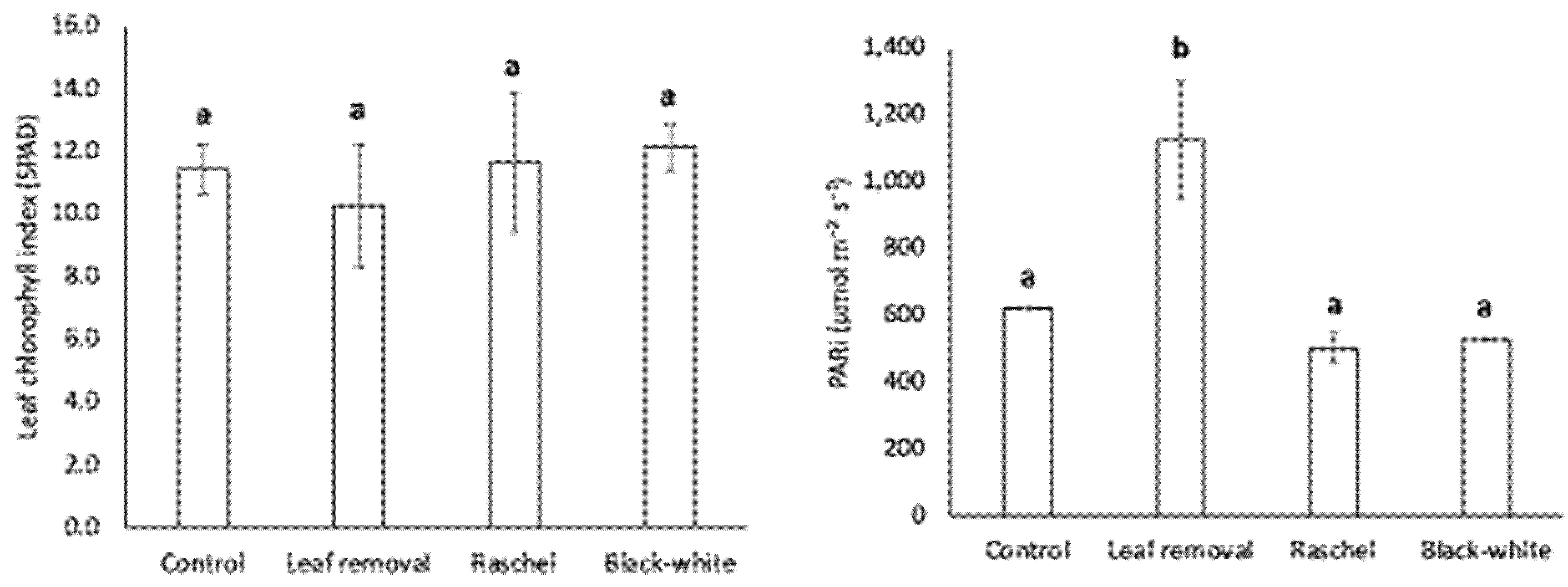
Figure 1: Leaf chlorophyll index (left) and incident photosynthetically active radiation (PARi) (right) recorded under different canopy management and shading net treatments in Chardonnay vines. Different lowercase letters indicate significant differences among treatments at each sampling date according to Duncan’s multiple range test (p-value ≤ 0.05).
Leaf removal showed the most negative stem water potential on 24 DOY reaching −1.1 MPa (Fig. 2). In this date, the black-white photoselective net decreased stem water potential of the vines than control vines. Similarly, leaf removal also showed the most negative stem water potential on 37 DOY, reaching nearly −1.47 MPa.
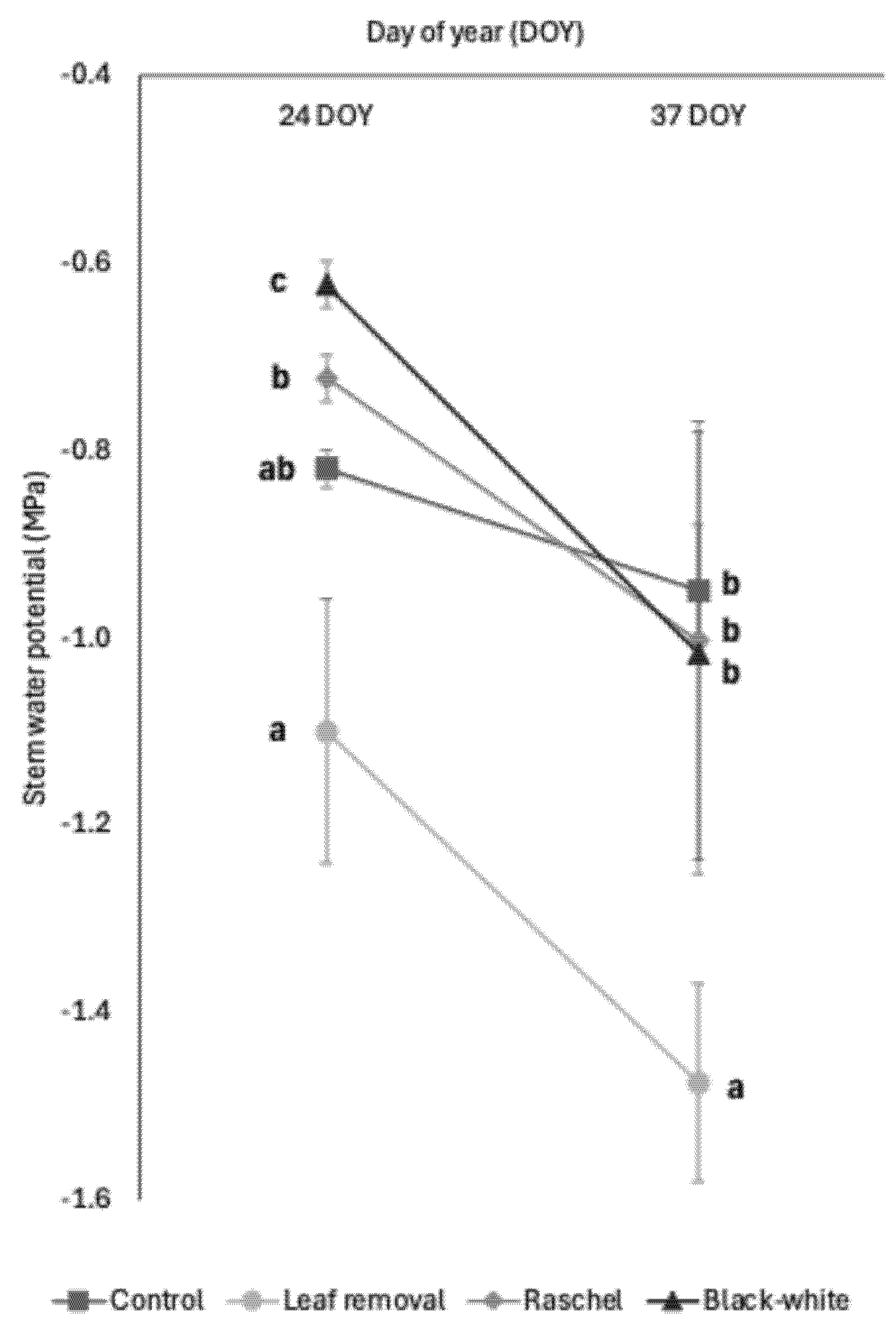
Figure 2: Stem water potential recorded at 24 and 37 day of the year (DOY) in vines subjected to different canopy management and shading net treatments in Chardonnay vines. Different lowercase letters indicate significant differences among treatments at each sampling date according to Duncan’s multiple range test (p-value ≤ 0.05).
3.4 Physicochemical Parameters of Berries
Berry weight, soluble solids, and must pH were not affected by the canopy management or shading treatments (Table 2).
Table 2: Berry weight, soluble solids, pH, and bunch sunburn incidence and severity in Chardonnay vines subjected to leaf removal and shade net treatments.
| Control | Leaf Removal | Raschel | Black-White | |
|---|---|---|---|---|
| Weight of 100 berries (g) | 114.34 ± 8.26a | 123.62 ± 17.66a | 117.41 ± 16.05a | 121.85 ± 15.21a |
| Soluble solids (ºBrix) | 22.27 ± 0.49a | 21.50 ± 0.82a | 21.57 ± 1.02a | 22.33 ± 1.72a |
| pH | 3.09 ± 0.09a | 3.09 ± 0.04a | 3.07 ± 0.05a | 3.09 ± 0.10a |
| Bunch sunburn incidence (%) | 36.67 ± 4.71a | 45.00 ± 11.79a | 53.33 ± 4.71a | 45.00 ± 2.36a |
| Bunch sunburn severity (%) | 2.42 ± 0.35a | 2.00 ± 0.47a | 3.92 ± 0.82a | 7.08 ± 1.53b |
Bunch sunburn incidence also did not differ among treatments. Bunch sunburn severity was affected by treatment (Fig. 3). The vines under the black-white photoselective net reached the highest severity value of sunburn, reaching 7.1%. This value represents approximately 2.9 times higher than the control.
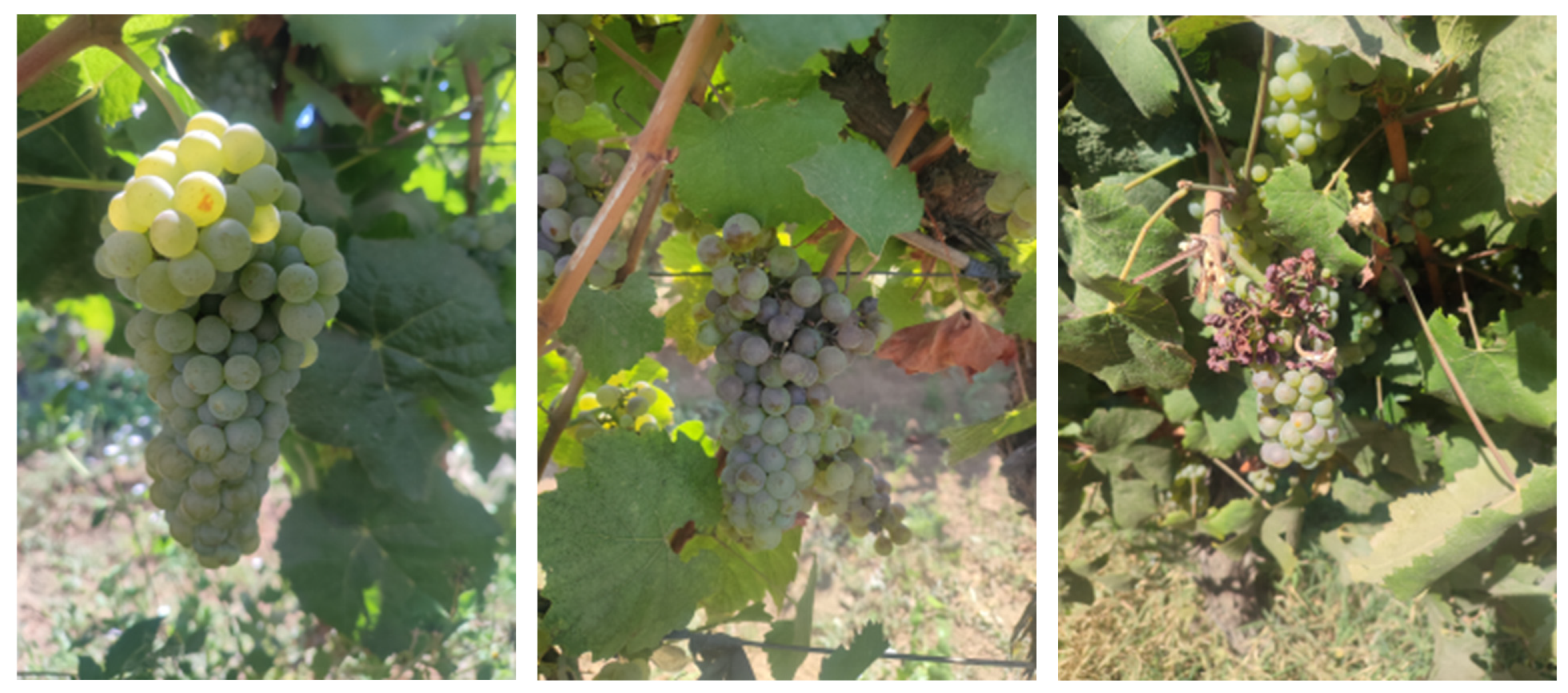
Figure 3: Representative bunch sunburn symptoms observed in Chardonnay grape clusters under the different canopy management treatments. From left to right: From left to right: low, moderate, and high levels of bunch sunburn severity.
3.5 Amino Acid Content in Grapes
The treatments did not modify total amino acids and total amino acids excluding proline, including the aromatic precursor nitrogen content (Table 3). However, changes were observed in the content of specific amino acids.
L-arginine was reduced under conventional Raschel netting, with values approximately 58% lower than the control. L-serine concentration was higher in berries from vines subjected to leaf removal and conventional Raschel netting than in those from the control and black–white photoselective net. L-proline concentration was higher under leaf removal than under the control and black–white photoselective net. This value was approximately 2.2 times higher than the control, equivalent to a 120% increase.
Table 3: Amino acid content (mg N kg−1) in Chardonnay grapes harvested from vines subjected to leaf removal and shade net treatments.
| Control | Leaf Removal | Raschel | Black-White | |
|---|---|---|---|---|
| L-Arginine | 3.79 ± 0.11b | 4.89 ± 0.82b | 1.59 ± 0.06a | 4.38 ± 0.07b |
| L-Glutamine | 14.35 ± 0.43a | 25.92 ± 9.14a | 23.12 ± 5.76a | 18.36 ± 5.94a |
| L-Serine | 4.17 ± 0.48a | 5.80 ± 0.55b | 5.77 ± 0.22b | 4.40 ± 1.07a |
| L-Aspartic acid | 0.86 ± 0.14a | 0.81 ± 0.08a | 0.90 ± 0.16a | 1.02 ± 0.33a |
| L-Glutamic acid | 2.08 ± 0.40a | 1.91 ± 0.06a | 1.72 ± 0.31a | 1.51 ± 0.11a |
| L-Threonine | 4.16 ± 0.45a | 5.41 ± 1.22a | 5.94 ± 0.21a | 4.45 ± 0.92a |
| L-Glycine | 7.52 ± 1.52a | 5.52 ± 0.32a | 7.41 ± 1.46a | 6.07 ± 0.97a |
| L-Alanine | 13.53 ± 0.39a | 14.03 ± 2.33a | 16.47 ± 2.13a | 14.70 ± 1.61a |
| L-Proline | 31.21 ± 3.14a | 68.67 ± 1.07b | 50.14 ± 11.25ab | 43.32 ± 16.33a |
| L-Histidine | 5.25 ± 0.90a | 6.83 ± 1.28ab | 8.76 ± 1.64b | 5.39 ± 0.10a |
| Proline to arginine ratio | 8.38 ± 0.85a | 25.22 ± 13.37a | 19.56 ± 4.47a | 9.87 ± 3.56a |
| Total amino acids | 90.06 ± 10.50a | 122.79 ± 24.07a | 125.13 ± 9.10a | 103.59 ± 27.45a |
| Total amino acids-proline | 58.84 ± 10.78a | 63.84 ± 15.15a | 75.00 ± 8.65a | 60.28 ± 11.13a |
| Aromatic precursor nitrogen | 5.03 ± 0.65a | 5.84 ± 0.72a | 6.82 ± 0.03a | 5.47 ± 1.25a |
The modification of the cluster-zone microclimate in Chardonnay through basal leaf removal and lateral shade nets produces different responses in vine water status and berry amino acid content. The east–west row orientation was probably a key condition for interpreting the response of the treatments. In vineyards with rows oriented approximately from east to west, the two canopy faces do not receive radiation in the same way throughout the day [21]. Depending on the side of installation and the seasonal solar trajectory, a lateral net may protect the fruiting zone during part of the day but may also create localized zones of heat accumulation or uneven radiation exposure [22]. This is especially important when the net is installed only on one side of the canopy, as occurred in the present experiment. Under these conditions, the net may create a partial microenvironment where radiation, air movement, and cluster exposure can vary strongly within a short distance [23,24]. A comparable response was recently reported in Cabernet Sauvignon, where conventional Raschel netting produced the greatest reduction in cluster-zone radiation but did not decrease bunch sunburn severity, whereas a photoselective net provided greater protection despite maintaining intermediate radiation levels [18]. This comparison suggests that sunburn protection depends not only on the magnitude of shading, but also on the optical properties of the net and the resulting pattern of berry exposure. However, the higher sunburn severity under this treatment indicates that air temperature measured near the cluster zone was probably not the only driver of berry injury. Sunburn in grape berries is controlled by the interaction between berry surface temperature, direct radiation, ultraviolet exposure, previous acclimation, berry developmental stage, and tissue antioxidant capacity [25]. Thus, even if the surrounding air temperature was lower, localized radiation on the berry surface or heat accumulation on the net material itself may have contributed to tissue damage.
These findings are particularly relevant for the black–white photoselective net used in this study because it had a lower nominal shading percentage than the conventional Raschel net. A low-shading photoselective material may reduce peak air temperature while still allowing enough radiation to reach the bunches, especially under lateral installation and east–west rows. In addition, the net surface itself may heat during periods of direct solar exposure, creating a warm boundary layer close to the protected canopy face [22]. This would not necessarily be fully captured by an air-temperature sensor placed near the bunch zone, but it could influence berry surface temperature and sunburn severity. Therefore, the response observed under the black–white net suggests that the protective capacity of shade nets depends not only on their ability to reduce air temperature but also on their shading density, spectral properties, distance from clusters, ventilation, and position relative to the sun-exposed canopy face [8]. The difference between sunburn incidence and severity also deserves attention since incidence indicates how many bunches were affected, whereas severity reflects the extent of damage within affected bunches. Despite that bunch sunburn incidence did not differ statistically among treatments, severity reached 7.08% under black–white photoselective netting, whereas the remaining treatments ranged from 2.00 to 3.92%. Thus, treatment effects were expressed more clearly in the extent of damage within affected bunches than in the proportion of bunches showing symptoms. In white grapevine cultivars, greater sunburn severity may compromise must quality through tissue oxidation, changes in aroma-related composition, and the inclusion of damaged berries during pressing [26]. The absence of statistically significant differences in the weight of 100 berries, soluble solids content and must pH indicates that the evaluated canopy strategies did not strongly affect basic technological maturity at harvest. Ghiglieno et al. [7] reported that combined natural and artificial shading delayed ripening in Chardonnay by 1 to 5 days across three growing seasons and maintained higher titratable acidity and malic acid concentrations than more exposed treatments. These contrasting responses indicate that the effects of shading on berry composition depend on shading intensity, treatment arrangement, canopy architecture, row orientation, and seasonal conditions. In the present study, the narrow ranges of soluble solids content and must pH suggest that lateral netting modified the cluster-zone environment without substantially delaying technological maturity. However, because titratable acidity and individual organic acids were not measured, a possible effect on acid preservation, which is particularly relevant for the freshness and balance of Chardonnay wines, cannot be excluded [17].
The amino acid response differed between leaf removal and conventional Raschel netting. Leaf removal increased berry proline from 31.21 to 68.67 mg N kg−1, representing a 2.2-fold increase relative to the control, without statistically affecting arginine, total amino acids, or total amino acids excluding proline. This response agrees with Canoura et al. [15], who reported elevated proline concentrations under water deficit in a study conducted with Chardonnay and Syrah, supporting an association between vine water status and berry proline accumulation. In contrast, conventional Raschel netting reduced arginine by 58% and increased serine and histidine by 38% and 67%, respectively, relative to the control. A comparable compound-specific response was observed in Cabernet Sauvignon, in which conventional Raschel netting increased berry histidine, whereas photoselective netting reduced arginine [18]. Thereby, canopy treatments modified individual amino acid rather than total amino acid content. These changes may be relevant from an enological point of view because individual amino acids differ in their availability to yeast. The increase in proline under leaf removal does not necessarily indicate improved fermentative nitrogen availability because proline is poorly assimilated by Saccharomyces cerevisiae under anaerobic conditions [27]. Conversely, the lower arginine concentration under Raschel netting could alter the relative contribution of readily assimilable nitrogen to the must. Nevertheless, total amino acids excluding proline and potential fermentative aroma precursor nitrogen remained unchanged. Moreover, because amino acids were quantified in whole berries rather than must, and ammonium, yeast-assimilable nitrogen, fermentation kinetics, volatile compounds, and sensory attributes were not determined, the implications for Chardonnay wine quality remain to be validated through microvinification.
These responses indicate that shade nets should be considered integrated modifiers of the cluster-zone microclimate rather than solely as tools for temperature reduction [22,24]. In Chardonnay vineyards with east–west-oriented rows, net selection and installation should account for canopy side and seasonal radiation patterns [12], as well as shading intensity, optical properties, distance from the bunches, and ventilation [8,22]. Under the lateral configuration evaluated in the present study, the black–white photoselective net was associated with fewer temperature events above 35°C but did not prevent sunburn damage, whereas conventional Raschel netting modified the relative composition of the berry amino acid pool. Similar treatment-dependent responses were previously reported in Cabernet Sauvignon [18]. Leaf removal may improve fruit-zone aeration, but under warm conditions it can also increase berry exposure and the risk of sunburn [2,18]. Alternative practices, including delayed leaf removal, shoot positioning, and kaolin application, may therefore be considered according to the cultivar, climatic conditions, and production objectives [24,28]. Management decisions should integrate thermal exposure, sunburn severity, vine water status, and berry nitrogen composition rather than rely on a single response variable.
Despite this, the findings obtained from this trial have some limitations. The study was conducted during a single growing season and at one site, which limits the extrapolation of the results to other seasons, locations, grapevine varieties, and edaphoclimatic conditions. Interannual differences in weather conditions, including the frequency of heatwaves, cloudiness, wind intensity, irrigation requirements, and seasonal solar angle, may strongly modify the performance of lateral shade nets [8,22]. The study did not include direct measurements of UV radiation, spectral distribution, net surface temperature, berry surface temperature, or airflow beneath the nets. These variables are essential to confirm whether the higher sunburn severity under the black–white net was caused by radiation quality, localized heating, reduced ventilation, or a combination of these factors. Nevertheless, the present results provide field-based evidence on the microclimatic dynamics generated by lateral shade-net installation in Chardonnay. In addition, amino acids were measured only at harvest, so the temporal dynamics of nitrogen metabolism during ripening were not studied. Future studies should evaluate multiple seasons, different shading percentages and materials, both canopy faces in east–west rows, and direct links between grape amino acid composition, yeast-assimilable nitrogen, fermentation kinetics, volatile compounds, and Chardonnay wine sensory quality.
The present findings demonstrate that lateral canopy management strategies differentially modify the cluster-zone microclimate and berry amino acid composition in Chardonnay. The contrasting responses observed among shading materials indicate that their effectiveness cannot be predicted solely by their shading intensity, emphasizing the importance of considering their optical properties and the resulting microenvironment around the clusters. Future studies should evaluate these responses across different cultivars, row orientations, climatic conditions, and growing seasons, while integrating berry surface temperature, radiation balance, and fruit composition to better optimize canopy management strategies under increasingly warm viticultural conditions.
Acknowledgement:
Funding Statement: This research was funded by the Agencia Nacional de Investigación y Desarrollo (ANID), FONDECYT de Iniciación grant No. 11240152; and ANID—VitiScience—CIA 250013.
Author Contributions: The authors confirm their contributions to the paper as follows: conceptualization, Gastón Gutiérrez-Gamboa, Nicolás Verdugo-Vásquez, and Miguel Araya-Alman; methodology, Gastón Gutiérrez-Gamboa, Nicolás Verdugo-Vásquez, Marisol Reyes Muñoz, Marcos Carrasco-Benavides, and Sebastián Romero-Bravo; software, Nicolás Verdugo-Vásquez, and Marcos Carrasco-Benavides; validation, Gastón Gutiérrez-Gamboa, Nicolás Verdugo-Vásquez, Marisol Reyes Muñoz, and Miguel Araya-Alman; formal analysis, Gastón Gutiérrez-Gamboa, Nicolás Verdugo-Vásquez, and Marcos Carrasco-Benavides; investigation, Gastón Gutiérrez-Gamboa, Marisol Reyes Muñoz, Sebastián Romero-Bravo, Manuel Chacón-Fuentes, and Miguel Araya-Alman; resources, Marisol Reyes Muñoz, Marcos Carrasco-Benavides, Sebastián Romero-Bravo, Manuel Chacón-Fuentes, and Miguel Araya-Alman; data curation, Gastón Gutiérrez-Gamboa, Nicolás Verdugo-Vásquez, and Marcos Carrasco-Benavides; writing—original draft preparation, Gastón Gutiérrez-Gamboa; writing—review and editing, Gastón Gutiérrez-Gamboa, Nicolás Verdugo-Vásquez, Marisol Reyes Muñoz, Marcos Carrasco-Benavides, Sebastián Romero-Bravo, Manuel Chacón-Fuentes, and Miguel Araya-Alman; visualization, Gastón Gutiérrez-Gamboa, Nicolás Verdugo-Vásquez, and Marcos Carrasco-Benavides; supervision, Gastón Gutiérrez-Gamboa, Marisol Reyes Muñoz, and Miguel Araya-Alman; project administration, Gastón Gutiérrez-Gamboa, and Miguel Araya-Alman; funding acquisition, Gastón Gutiérrez-Gamboa, and Miguel Araya-Alman. All authors reviewed and approved the final version of the manuscript.
Availability of Data and Materials: The original contributions presented in this study are included in the article. Further inquiries can be directed to the first and the corresponding authors.
Ethics Approval: Not applicable.
Conflicts of Interest: Given his role as Guest Editor of this journal, Gaston Gutiérrez-Gamboa was not involved in the peer review of this article and had no access to information regarding its peer review. Full responsibility for the editorial process for this article was delegated to another journal editor. The authors declare no other conflicts of interest.
References
1. FAOSTAT. Agricultural production statisticss—2010–2024. Rome, Italy: Food and Agriculture Organization of the United Nations (FAO); 2026. doi:10.4060/CD8035EN. [Google Scholar] [CrossRef]
2. Rustioni L , Altomare A , Shanshiashvili G , Greco F , Buccolieri R , Blanco I , et al. Microclimate of grape bunch and sunburn of white grape berries: effect on wine quality. Foods. 2023; 12( 3): 621. doi:10.3390/foods12030621. [Google Scholar] [CrossRef]
3. van Leeuwen C , Sgubin G , Bois B , Ollat N , Swingedouw D , Zito S , et al. Climate change impacts and adaptations of wine production. Nat Rev Earth Environ. 2024; 5( 4): 258– 75. doi:10.1038/s43017-024-00521-5. [Google Scholar] [CrossRef]
4. Hewitt S , Hernández-Montes E , Dhingra A , Keller M . Impact of heat stress, water stress, and their combined effects on the metabolism and transcriptome of grape berries. Sci Rep. 2023; 13( 1): 9907. doi:10.1038/s41598-023-36160-x. [Google Scholar] [CrossRef]
5. Gashu K , Verma PK , Acuña T , Agam N , Bustan A , Fait A . Temperature differences between sites lead to altered phenylpropanoid metabolism in a varietal dependent manner. Front Plant Sci. 2023; 14: 1239852. doi:10.3389/fpls.2023.1239852. [Google Scholar] [CrossRef]
6. Frioni T , Zhuang S , Palliotti A , Sivilotti P , Falchi R , Sabbatini P . Leaf removal and cluster thinning efficiencies are highly modulated by environmental conditions in cool climate viticulture. Am J Enol Vitic. 2017; 68( 3): 325– 35. doi:10.5344/ajev.2017.16098. [Google Scholar] [CrossRef]
7. Ghiglieno I , Mattivi F , Cola G , Trionfini D , Perenzoni D , Simonetto A , et al. The effects of leaf removal and artificial shading on the composition of Chardonnay and Pinot noir grapes. OENO One. 2020; 54( 4): 761– 77. doi:10.20870/oeno-one.2020.54.4.2556. [Google Scholar] [CrossRef]
8. Crouchett-Rojas R , Araya-Alman M , Verdugo-Vásquez N , Fourment M , Gutiérrez-Gamboa G . Shading nets: a current viticultural strategy to mitigate the negative impacts of global warming on grape and wine quality. Aust J Grape Wine Res. 2025; 2025: 9729885. doi:10.1155/ajgw/9729885. [Google Scholar] [CrossRef]
9. Pallotti L , Silvestroni O , Dottori E , Lattanzi T , Lanari V . Effects of shading nets as a form of adaptation to climate change on grapes production: a review. OENO One. 2023; 57( 2): 467– 76. doi:10.20870/oeno-one.2023.57.2.7414. [Google Scholar] [CrossRef]
10. Shahak Y , Ratner K , Giller YE , Zur N , Or E , Gussakovsky EE , et al. Improving solar energy utilization, productivity and fruit quality in orchards and vineyards by photoselective netting. Acta Hortic. 2008; 772: 65– 72. doi:10.17660/actahortic.2008.772.7. [Google Scholar] [CrossRef]
11. Verdenal T , Dienes-Nagy Á , Spangenberg JE , Zufferey V , Spring JL , Viret O , et al. Understanding and managing nitrogen nutrition in grapevine: a review. OENO One. 2021; 55( 1): 1– 43. doi:10.20870/oeno-one.2021.55.1.3866. [Google Scholar] [CrossRef]
12. Strack T , Stoll M . Implication of row orientation changes on fruit parameters of Vitis vinifera L. cv. Riesling in steep slope vineyards. Foods. 2021; 10( 11): 2682. doi:10.3390/foods10112682. [Google Scholar] [CrossRef]
13. Guan L , Wu B , Hilbert G , Li S , Gomès E , Delrot S , et al. Cluster shading modifies amino acids in grape (Vitis vinifera L.) berries in a genotype- and tissue-dependent manner. Food Res Int. 2017; 98: 2– 9. doi:10.1016/j.foodres.2017.01.008. [Google Scholar] [CrossRef]
14. Rienth M , Vigneron N , Darriet P , Sweetman C , Burbidge C , Bonghi C , et al. Grape berry secondary metabolites and their modulation by abiotic factors in a climate change scenario—a review. Front Plant Sci. 2021; 12: 643258. doi:10.3389/fpls.2021.643258. [Google Scholar] [CrossRef]
15. Canoura C , Kelly MT , Ojeda H . Effect of irrigation and timing and type of nitrogen application on the biochemical composition of Vitis vinifera L. cv. Chardonnay and Syrah grapeberries. Food Chem. 2018; 241: 171– 81. doi:10.1016/j.foodchem.2017.07.114. [Google Scholar] [CrossRef]
16. Ghosh UK , Islam MN , Siddiqui MN , Cao X , Khan MAR . Proline, a multifaceted signalling molecule in plant responses to abiotic stress: understanding the physiological mechanisms. Plant Biol. 2022; 24( 2): 227– 39. doi:10.1111/plb.13363. [Google Scholar] [CrossRef]
17. Gambetta GA , Kurtural SK . Global warming and wine quality: are we close to the tipping point? OENO One. 2021; 55( 3): 353– 61. doi:10.20870/oeno-one.2021.55.3.4774. [Google Scholar] [CrossRef]
18. Gutiérrez-Gamboa G , Araya-Alman M , Romero-Bravo S , Carrasco-Benavides M , Verdugo-Vásquez N , Chacón-Fuentes M . Shading nets modified cluster-zone radiation, bunch sunburn percentage and berry amino acid content in cabernet sauvignon: a preliminary study. Plants. 2026; 15( 14): 2183. doi:10.3390/plants15142183. [Google Scholar] [CrossRef]
19. Verdugo-Vásquez N , Orrego R , Gutiérrez-Gamboa G , Reyes M , Zurita Silva A , Balbontín C , et al. Trends and climatic variability in the Chilean viticultural production zones: three decades of climatic data (1985–2015). OENO One. 2022; 57( 1): 345– 62. doi:10.20870/oeno-one.2023.57.1.7151. [Google Scholar] [CrossRef]
20. Kahsay BN , Moeller L , Imming P , Neubert RHH , Gebre-Mariam T . Development and validation of a simple, selective, and accurate reversed-phase liquid chromatographic method with diode array detection (RP-HPLC/DAD) for the simultaneous analysis of 18 free amino acids in topical formulations. Chromatographia. 2022; 85( 7): 665– 76. doi:10.1007/s10337-022-04160-0. [Google Scholar] [CrossRef]
21. Hunter JK , Tarricone L , Volschenk C , Giacalone C , Melo MS , Zorer R . Grapevine physiological response to row orientation-induced spatial radiation and microclimate changes. OENO One. 2020; 54( 2): 411– 33. doi:10.20870/oeno-one.2020.54.2.3100. [Google Scholar] [CrossRef]
22. Abdel-Ghany AM , Al-Helal IM , Shady MR . On the emissivity and absorptivity of plastic shading nets under natural conditions. Adv Mech Eng. 2015; 7: 165605. doi:10.1155/2014/165605. [Google Scholar] [CrossRef]
23. Ponce de León MA , Bailey BN . Fruit zone shading to control grape berry temperature: a modeling study. Am J Enol Vitic. 2022; 73( 3): 183– 97. doi:10.5344/ajev.2022.21054. [Google Scholar] [CrossRef]
24. Pallotti L , Dottori E , Lattanzi T , Lanari V , Brillante L , Silvestroni O . Anti-hail shading net and Kaolin application: protecting grape production to ensure grape quality in Mediterranean vineyards. Horticulturae. 2025; 11( 2): 110. doi:10.3390/horticulturae11020110. [Google Scholar] [CrossRef]
25. Gambetta JM , Holzapfel BP , Stoll M , Friedel M . Sunburn in grapes: a review. Front Plant Sci. 2020; 11: 604691. doi:10.3389/fpls.2020.604691. [Google Scholar] [CrossRef]
26. Pascual GA , Serra I , Calderón-Orellana A , Laurie VF , Lopéz MD . Changes in concentration of volatile compounds in response to defoliation of Muscat of Alexandria grapevines grown under a traditional farming system. Chil J Agric Res. 2017; 77( 4): 373– 81. doi:10.4067/s0718-58392017000400373. [Google Scholar] [CrossRef]
27. Nishimura A , Ichikawa K , Nakazawa H , Tanahashi R , Morita F , Sitepu I , et al. The Cdc25/Ras/cAMP-dependent protein kinase A signaling pathway regulates proline utilization in wine yeast Saccharomyces cerevisiae under a wine fermentation model. Biosci Biotechnol Biochem. 2022; 86( 9): 1318– 26. doi:10.1093/bbb/zbac100. [Google Scholar] [CrossRef]
28. Cataldo E , Fucile M , Mattii GB . Effects of Kaolin and shading net on the ecophysiology and berry composition of Sauvignon Blanc grapevines. Agriculture. 2022; 12( 4): 491. doi:10.3390/agriculture12040491. [Google Scholar] [CrossRef]
Cite This Article
 Copyright © 2026 The Author(s). Published by Tech Science Press.
This work is licensed under a Creative Commons Attribution 4.0 International License , which permits unrestricted use, distribution, and reproduction in any medium, provided the original work is properly cited.
 Downloads
 Citation Tools
