
 Login
Login Register
 Submit a Paper
 Propose a Special lssue
 Open Access
ARTICLE

Pedestrian Collision Safety Performance Prediction Method Based on Deep Learning Models
1 School of Mechanical Engineering, Dalian University of Technology, Dalian, 116024, China
2Guangzhou Automobile Group Co., Ltd., Automotive Engineering Research Institute, Guangzhou, 511434, China
* Corresponding Author: Wenbin Hou. Email:
(This article belongs to the Special Issue: Data-Driven and Physics-Informed Machine Learning for Digital Twin, Surrogate Modeling, and Model Discovery, with An Emphasis on Industrial Applications)
Computer Modeling in Engineering & Sciences 2025, 144(1), 1-27. https://doi.org/10.32604/cmes.2025.065664
Received 19 March 2025; Accepted 30 May 2025; Issue published 31 July 2025
 View Full Text
 Download PDF
Abstract
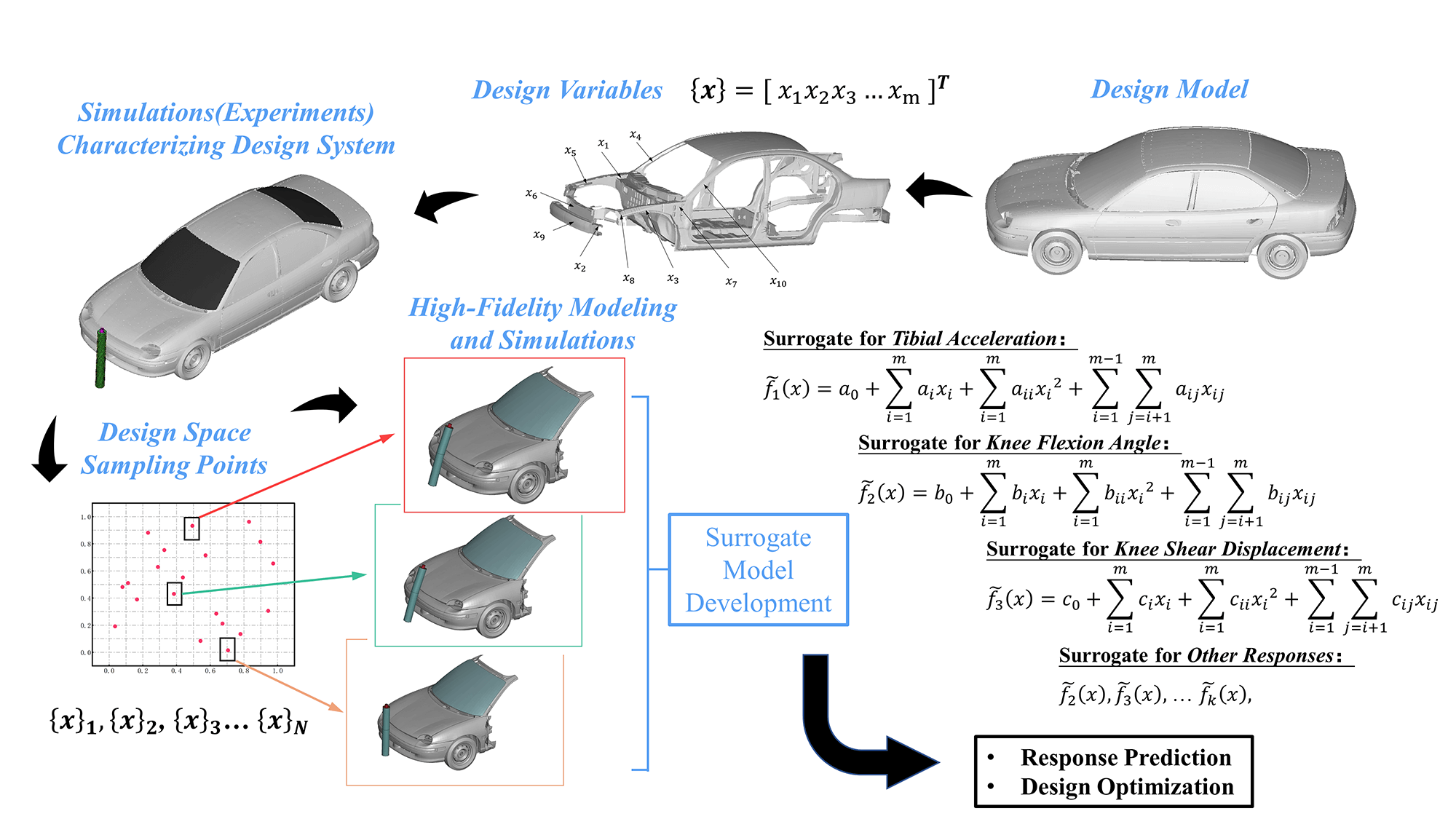
This study presents an interpretable surrogate framework for predicting pedestrian-leg injury severity that integrates high-fidelity finite-element (FE) simulations with a TabNet-based deep-learning model. We generated a parametric dataset of 3000 impact scenarios—covering ten vehicle types and various legform impactors—using automated FE runs configured via Latin hypercube sampling. After preprocessing and one-hot encoding of categorical features, we trained TabNet alongside Support-Vector Regression, Random Forest, and Decision-Tree ensembles. All models underwent hyperparameter tuning via Optuna’s Bayesian optimization coupled with repeated four-fold cross-validation (20 trials per model). TabNet achieved the best balance of explanatory power and predictive accuracy, with an average R2 = 0.94 ± 0.01 and RMSE = 0.14 ± 0.02. On an independent test set, 85%, 88%, and 90% of predictions for tibial acceleration, knee-flexion angle, and shear displacement, respectively, fell within ±20% of true peaks. SHAP-based analyses confirm that collision-point location and bumper geometry dominate injury outcomes. These results demonstrate TabNet’s capacity to deliver rapid, robust, and explainable injury predictions, offering actionable design insights for vehicle front-end optimization and regulatory assessment in early development stages.Graphic Abstract
Keywords
Cite This Article
 Copyright © 2025 The Author(s). Published by Tech Science Press.
This work is licensed under a Creative Commons Attribution 4.0 International License , which permits unrestricted use, distribution, and reproduction in any medium, provided the original work is properly cited.
 Downloads
 Citation Tools
