
 Login
Login Register
 Submit a Paper
 Propose a Special lssue
 Open Access
ARTICLE

Machine Learning Knowledge Driven Nonlinear Autoregressive Exogenous Networks for Fractional Order Proteasome-Fibril Interaction Model in Parkinson’s Disease Dynamics
1 Graduate School of Engineering Science and Technology, National Yunlin University of Science and Technology, Yunlin, Taiwan
2 Department of Computer Science and Information Engineering, National Yunlin University of Science and Technology, Yunlin, Taiwan
* Corresponding Author: Muhammad Asif Zahoor Raja. Email:
(This article belongs to the Special Issue: Recent Developments on Computational Biology-II)
Computer Modeling in Engineering & Sciences 2026, 147(2), 28 https://doi.org/10.32604/cmes.2026.079390
Received 20 January 2026; Accepted 30 March 2026; Issue published 27 May 2026
 View Full Text
 Download PDF
Abstract
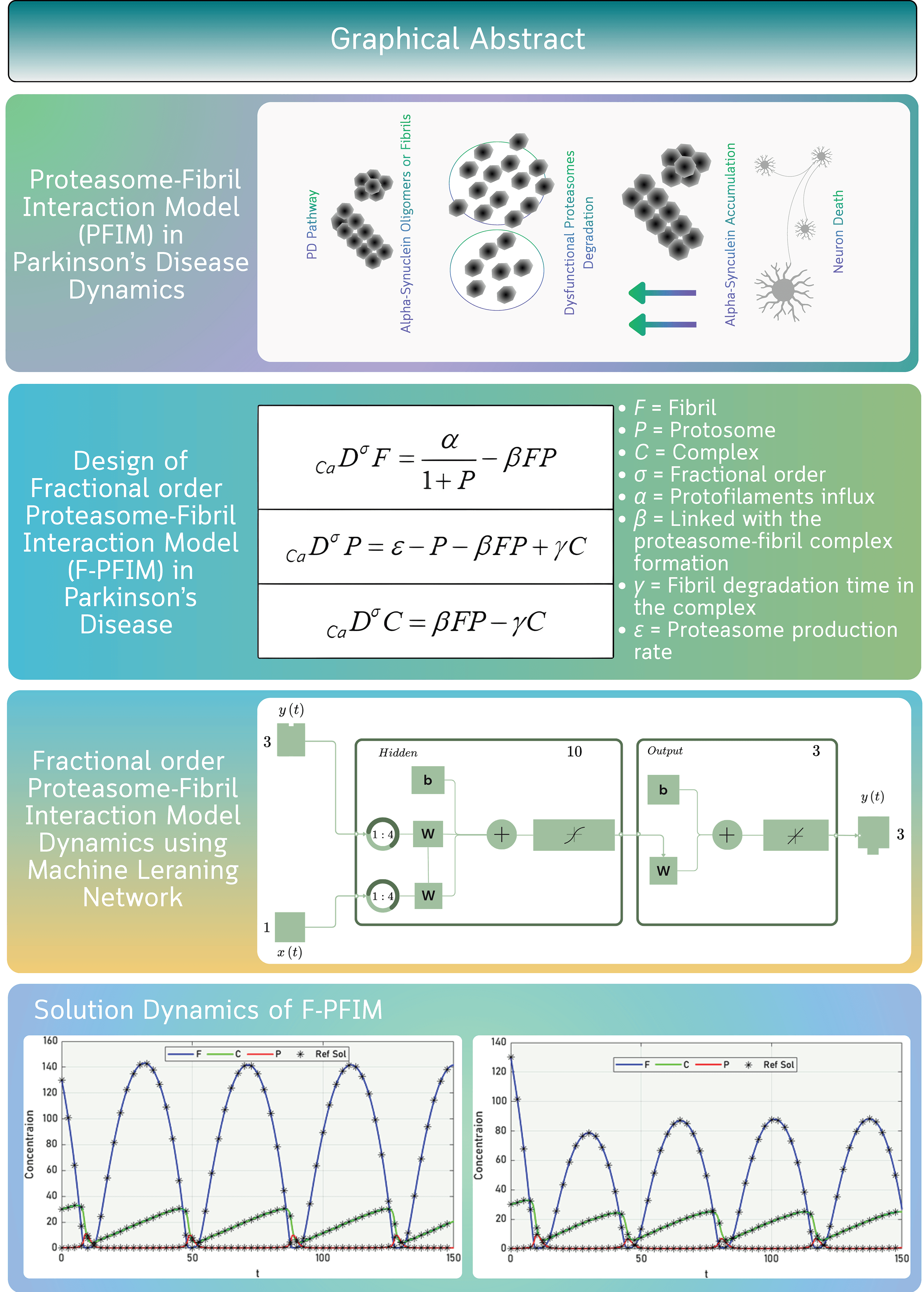
Parkinson’s disease (PD) is a complex neurodegenerative disease associated with the accumulation of α-synuclein, which is linked to the dysfunctional ubiquitin–proteasome system. Fractional calculus has emerged as a powerful tool for modeling complex disease dynamics due to its promising features that inherently capture memory and hereditary effects. This paper presents a fractional-order Proteasome-Fibril interaction model (F-PFIM) for the dynamics of PD, represented by three fractional differential classes, showing concentrations of fibrils (F), proteasomes (P), and proteasome fibril complex (C). The three classes of the F-PFIM collectively make a controlling system that works for the clearance of unnecessary protein from the cell to maintain cell hemostasis. When the P levels are very low, and F accumulation is high, the cell degradation machinery becomes overburdened. The prolonged instability of accumulated proteins leads to slow and progressive neurodegeneration associated with the onset of PD. Machine learning knowledge-driven nonlinear autoregressive exogenous networks backpropagated with Levenberg-Marquardt optimization (NAREN-LM) are presented to analyze the temporal evolution dynamics of F, C, and P in F-PFIM for different fractional orders varying from (0.89, 0.90, …, 1). The reference dataset is generated through the fractional Adams method (FAM) and is given to NAREN-LM in the form of training, testing, and validation sets. The performance of NAREN-LM is verified by analyzing the solution dynamics of F-PFIM in terms of mean square error-based convergence curves for training and testing, histogram plots, regression, and correlation results. Furthermore, the comparison of the NAREN-LM solution dynamics and corresponding absolute errors with those of the FAM endorses the accuracy of machine learning knowledge-driven predictive networks for F-PFIM.Graphic Abstract
Keywords
Cite This Article
 Copyright © 2026 The Author(s). Published by Tech Science Press.
This work is licensed under a Creative Commons Attribution 4.0 International License , which permits unrestricted use, distribution, and reproduction in any medium, provided the original work is properly cited.
 Downloads
 Citation Tools
