
 Login
Login Register
 Submit a Paper
 Propose a Special lssue
 Open Access
ARTICLE
Factors Facilitating the Uptake of Preventive Mental Health Support: An Exploratory Study of Primary Prevention among Workers
1 Department of Psychology and Counseling, Faculty of Education and Culture, Hokusho University, Ebetsu, Japan
2 Department of Sociology, School of Sociology, Kwansei Gakuin University, Nishinomiya, Japan
* Corresponding Author: Asaka Kawamura. Email:
(This article belongs to the Special Issue: Cognitive and Metacognitive Pathways to Mental Health Promotion: Prevention, Resilience, and Well-Being)
International Journal of Mental Health Promotion 2026, 28(9), 5 https://doi.org/10.32604/ijmhp.2026.081796
Received 09 March 2026; Accepted 24 July 2026; Issue published 22 September 2026
 View Full Text
 Download PDF
Abstract
Objective: Although many workers experience stress in daily life, psychological and practical barriers often prevent them from accessing mental health support before their difficulties become more severe. This exploratory study examined, among employed adults with no previous experience of using mental health services, whether self-stigma ratings differed according to the wording used to describe an interaction and the type of service provider. It also explored the service conditions that may facilitate initial access to preventive mental health support. Methods: An online survey was conducted with 349 workers in Japan. Participants reported their usual sources of consultation, rated self-stigma across six conditions combining two wording types (“consulting” and “chatting”) with three provider types, and provided free-text responses describing the services or conditions under which they might be willing to talk with a psychological counsellor. Results: Self-stigma ratings were significantly higher when the interaction was framed as “consulting” rather than “chatting” (p < 0.001). The main effect of provider type was also significant (p = 0.003), and the interaction between wording type and provider type was significant (p = 0.02). Although the effects of provider type and the interaction were small, post hoc comparisons showed that self-stigma ratings were higher for “consulting” than for “chatting” across all provider types. Age was significantly associated with self-stigma ratings (p = 0.01), whereas gender was not significant (p = 0.59). Free-text analysis identified six categories of preferred service conditions, among which low-intrusion and privacy-protective design and accessible design were most frequently reported. Higher self-stigma was associated with greater odds of selecting a non-counselling-oriented design rather than a low-intrusion and privacy-protective design. Conclusions: The findings suggest that preventive mental health support for workers may benefit from low-threshold entry points that reduce psychological and practical barriers, including careful attention to how support is labelled and introduced.Keywords
Supplementary Material
Supplementary Material File1.1 Workers’ Mental Health and the Importance of Primary Prevention
The World Health Organization has reported that 15% of working-age adults have a mental disorder and that mental health conditions among workers result in an estimated global economic loss of approximately US$1 trillion each year [1]. International epidemiological studies have also shown that mental disorders are common health problems: although lifetime prevalence varies considerably across countries, more than one in four people experience a mental disorder in many settings [2].
In Japan, the number of people receiving treatment for mental disorders has also increased over the past 15 years. According to the Ministry of Health, Labour and Welfare [3], approximately 302,000 inpatients and 3,891,000 outpatients received care in 2017, for a total of approximately 4,193,000 patients. Given the prevalence and economic burden of mental health difficulties among working-age adults, the primary prevention of mental disorders is an important public health issue [4,5].
Despite the number of workers who could benefit from primary prevention, a national survey in the United States found that only 21.8% of adults had received mental health treatment during the preceding 12 months [6]. Nishi et al. [7] similarly reported that, although 12-month use of mental health services has increased in Japan, it remains low compared with that in other high-income countries. Systems are therefore needed that enable workers to access mental health services earlier and more readily, including when they first notice stress in daily life.
1.2 Stigma as a Barrier to the Use of Mental Health Services
Stigma has consistently been identified as an important barrier to the use of counselling and psychological support services. It includes public stigma, or awareness of prejudice and discrimination from others, and self-stigma, in which individuals internalise these beliefs and perceive help-seeking as an indication of weakness [8]. Self-stigma refers to the perception that seeking mental health services will make a person socially unacceptable, and this perception can create substantial reluctance to use services [9].
A large review involving approximately 90,000 participants showed that stigma has a small-to-moderate but consistent negative association with help-seeking. Help-seeking is particularly likely to be inhibited when individuals believe that seeking support indicates weakness [10,11]. Such self-stigma is a substantial barrier to fostering a culture in which people feel able to seek support readily as a form of primary prevention.
1.3 Barriers to Mental Health Service Use in Japan
As noted above, the use of mental health services remains low in Japan compared with other high-income countries [7]. In Japan, self-stigma related to the shame of seeking help has also been reported to inhibit attitudes towards professional psychological help-seeking [12]. Mental-health-related stigma in Japan has characteristics rooted in its cultural context. Japanese society has traditionally placed considerable emphasis on shame and on sekentei, or concerns about how oneself and one’s family are viewed by others [13,14]. These concerns may extend to mental health: experiencing psychological difficulties may be viewed as a source of shame for the family, and people may worry that being known to attend psychiatric services will lower their social standing [13]. Maekawa and Kanai [13] reported that stronger concern about sekentei is associated with lower intention to seek professional psychological help. Thus, concern about social evaluation may amplify self-stigma and discourage professional help-seeking.
Large-scale research in Japan has also indicated that common reasons for not receiving professional support include perceiving no need for it and wanting to cope independently [15]. Cultural values that emphasise perseverance and self-reliance may contribute to reluctance to reveal psychological vulnerability [13,14]. Kanehara et al. [15] further reported a substantial treatment gap in Japan. These findings suggest that shame, sekentei, self-reliance, and family-oriented coping may interact in shaping mental-health-related stigma in Japan. Approaches to reducing barriers should therefore be sensitive to the Japanese cultural context rather than simply applying models developed in other settings without adaptation [8,14].
1.4 Existing Approaches to Promoting Help-Seeking
Several intervention studies have targeted people already experiencing psychological difficulties. For example, Stanley et al. [16] compared cognitive bias modification with psychoeducation among 32 undergraduates with psychological difficulties and reported significant reductions in stigma in both groups; at two-month follow-up, 25% of the participants had initiated professional support.
Mastrogiovanni and Nickerson [17] conducted an online narrative-sharing intervention for Arabic-speaking refugees with posttraumatic stress symptoms and found that service use at three-month follow-up was significantly higher than in the control group. Notably, self-stigma itself did not substantially decrease. This finding suggests that service use may increase even when stigma persists.
However, much previous research has focused on people who are already experiencing clinically meaningful distress or mental health problems. Such research is important for secondary and tertiary prevention but does not directly address how to promote the use of mental health services among non-clinical employed adults before difficulties escalate. Even when people recognise their symptoms, entering and remaining in support is not necessarily easy [8]. The psychological threshold may be even higher for those who do not yet perceive themselves as needing mental health care.
From a primary prevention perspective, an important question is how to create low-threshold, early, and routine pathways to support before stress develops into more serious psychological difficulties. This issue is particularly relevant for workers who experience stress, burden, or emotional strain in daily life but do not regard themselves as belonging to a clinical population. Research focusing specifically on the primary prevention stage remains limited [18], and little is known about how to facilitate initial access without elevating self-stigma ratings.
Recent research also highlights the need to distinguish preferences or intentions from actual service-use behaviour. A systematic review of digital mental health interventions showed that user engagement, including initial uptake and sustained use, is influenced by multiple contextual factors and that interest in an intervention does not necessarily translate into continued use [19]. Preferences regarding service use should therefore be interpreted cautiously as indicators of psychological barriers and readiness preceding behaviour, rather than as actual behaviour itself.
1.5 Mental Health Support in the Workplace
Mental health literacy and self-stigma have also been examined in workplace help-seeking research. Among healthcare workers, workplace mental health literacy was associated with stronger intentions both to seek help and to encourage others to seek help, whereas self-stigma and stigma towards others functioned as barriers to appropriate support [20]. A qualitative evidence synthesis has likewise emphasised the importance of considering contextual barriers and workers’ preferences when implementing workplace mental health interventions [18]. In addition, a systematic review of workplace stigma-reduction interventions concluded that such interventions may improve knowledge and supportive behaviour, although evidence for changes in help-seeking attitudes and actual behaviour remains limited [21]. Recent reviews of workplace mental health interventions have emphasised that implementation depends not only on the availability of programmes but also on organisational context, accessibility, leadership support, confidentiality, and stigma-related barriers [22]. Concerns about stigma may delay care until symptoms interfere substantially with daily functioning; similar patterns have also been described in high-risk occupational groups [22]. Accordingly, primary prevention for workers requires more than establishing a support desk: it also requires attention to the wording, format, and access conditions that may minimise psychological resistance.
1.6 Aim and Significance of the Present Study
Taken together, these findings indicate a need to develop ways for currently non-clinical workers to access mental health services through low-threshold pathways in workplaces and daily life. The goal in a primary prevention context is not simply to increase service use among people with evident symptoms, but to create early, routine routes to support before problems become severe. Anonymity and convenience may also be important in reducing psychological resistance to initial access [18].
At the primary prevention stage, people may have limited awareness that support is needed and may not be psychologically ready to seek it. Conventional interventions that assume a willingness to receive support may therefore fail to reach many people. Service designs that are less likely to elevate self-stigma ratings and that reduce resistance to initial access warrant investigation.
The present exploratory study therefore examined Japanese employed adults with no previous experience of using mental health services. It investigated whether self-stigma ratings differed according to wording used at the point of entry and according to provider type. It also explored the service conditions that may facilitate initial access to preventive mental health support. Clarifying these conditions from workers’ perspectives may inform future service design and dissemination strategies.
Participants were 349 workers in Japan: 192 men and 157 women. The mean age was 41.2 years (SD = 9.37). Eligibility criteria were being aged 18 years or older, not being a student, reporting no mental disorder, and having no previous experience of using mental health services such as counselling. Workers with previous experience of using mental health services were excluded because the study focused on factors that may facilitate initial access to preventive mental health support among people with no prior service-use experience. The absence of a mental disorder was presented as an eligibility criterion for participation and was based on participants’ self-report. Only age and gender were collected as demographic variables; detailed demographic information such as education level, marital status, employment type, and industry was not collected.
Regarding participant flow, the recruitment page was viewed by 5150 individuals, and the task was set to recruit 400 participants. According to the CloudWorks task records, 400 individuals completed the task. Of these, 349 questionnaire responses were available in Google Forms and were included in the final analysis. The remaining 51 task completions were not included in the analytic dataset because corresponding analysable questionnaire responses were not available in the Google Forms data. No additional respondents were excluded after the analytic dataset of 349 responses was established.
This study was conducted in accordance with the principles of the Declaration of Helsinki. The study protocol was reviewed and approved by the Research Ethics Committee of Hokusho University (Approval No. 2024-011). All participants were informed of the purpose and procedures of the study, the voluntary nature of participation, anonymity, and the handling of data before completing the questionnaire. Electronic informed consent was obtained from all participants before participation. Ethical approval was obtained before participant recruitment and data collection began.
Participants were recruited through CloudWorks (https://crowdworks.jp/), a Japanese crowdsourcing platform. The recruitment notice stated that the survey concerned the use of mental health services and took approximately 15 min to complete. It also stated that the purpose of the survey was to understand the extent to which people who did not perceive major problems with their mental health intended to use mental health support in daily life, with the aim of developing a system that would make preventive mental health support easier to access.
The eligibility criteria shown in the recruitment notice were as follows: being a worker in Japan, being aged 18 years or older, not being a student, self-reporting no diagnosis of mental illness, and having no previous experience of using counselling services. The notice also stated that each person should respond only once. After completing the Google Forms questionnaire, participants were asked to enter the password displayed at the end of the survey into CloudWorks to confirm task completion.
To support data quality, the recruitment notice asked participants to respond carefully and stated that responses judged to be incomplete or insufficiently careful could be rejected. Participants received 200 JPY, excluding tax, as compensation through CloudWorks after completing the survey.
The questionnaire first assessed demographic characteristics, including age and gender, followed by usual sources of consultation and self-stigma. Finally, participants provided free-text responses describing the services or conditions under which they might be willing to talk with a psychological counsellor. The free-text question was developed ad hoc for the present exploratory study and was not adapted from an existing survey or scale. The English translation of the question was as follows: “Under what kinds of services or conditions would you be willing to talk with a psychological counsellor?” The original Japanese wording of this question is provided in Section S1 of the Supplementary Material. This free-text question was administered once after all condition-specific items rather than separately for each wording-type and provider-type condition. All questionnaire items were presented in Japanese.
2.3 Measurement of Usual Sources of Consultation
Participants were asked whom they usually consulted in daily life. This item was developed ad hoc for the present exploratory study and was not adapted from an existing survey or scale. Multiple responses were permitted. Response options were friends, family members, partner, people at work, no one, and other sources.
2.4 Measurement of Self-Stigma
Previous research suggests that stigma towards mental health services may arise from multiple factors, including stigma towards psychological counsellors and stigma towards receiving services itself [23]. To examine the conditions under which self-stigma ratings related to the use of mental health services may be elevated, we adapted the referent and action described in items from the scale developed by Nagai et al. [24] and compared ratings across conditions. Three provider types were specified: a psychological counsellor, a career consultant, and non-professional listening-service provider. The third provider type did not refer to a licensed mental health professional, social worker, or career-support professional. Rather, it referred to a non-professional provider of a listening service, such as a service in Japan in which users can talk with someone about everyday experiences, concerns, or emotional burdens, often through online or other matching platforms. Such services are not intended to provide formal counselling or clinical intervention, but rather to offer conversation, listening, and informal emotional support. Two action wordings were specified: “consulting” and “chatting”. In Japanese, the term corresponding to “consulting” broadly refers to seeking advice about concerns in daily life and is not limited to professional mental health consultation.
Nagai et al.’s [24] self-stigma scale for seeking help from familiar others was developed and validated in Japanese and was considered suitable for measuring self-stigma related to help-seeking in the Japanese cultural context. The scale was developed with reference to items from the Self-Stigma of Seeking Help Scale by Vogel et al. [25], while allowing help-seeking targets other than mental health professionals to be assessed. This feature was appropriate for the present study because the provider conditions included not only a psychological counsellor, but also a career consultant and non-professional listening-service provider. Four items from Nagai et al.’s self-stigma scale were used for each condition, resulting in 24 items in total across the six conditions (three provider types × two wording types). The items were selected because they could be applied consistently across all provider types and wording conditions and because they reflected core aspects of self-stigma related to help-seeking, such as feeling weak, ashamed, or negatively evaluated when seeking support. An abbreviated item set was used to reduce participant burden, as participants were required to rate the same self-stigma content repeatedly across six conditions. Participants rated each item on a five-point scale ranging from 1 (do not agree) to 5 (agree).
First, the numbers and percentages of participants selecting each usual source of consultation were calculated.
For self-stigma, mean scale scores were calculated for each condition. A two-factor repeated-measures analysis of covariance was conducted with wording type (“consulting” vs. “chatting”) and provider type (psychological counsellor, career consultant, and non-professional listening-service provider) as within-participant factors. Gender was entered as a between-participant factor, and age was entered as a participant-level covariate. Participant ID was specified as the repeated-measures error term. Greenhouse–Geisser corrections were applied to within-participant effects where appropriate. Partial eta squared (ηp2) was reported as the effect size. Post hoc comparisons were conducted using estimated marginal means, with p-values adjusted using the Holm method.
Free-text responses were analysed using inductive content analysis based on an open-coding procedure. Two authors conducted the analysis: one specialised in clinical psychology and had experience in psychological counselling; the other specialised in social psychology and had no clinical experience. Responses included single words and sentences, and some described multiple services or conditions. Responses containing multiple services or conditions were segmented so that each meaning unit represented one service or condition. The units were coded at a comparable level of abstraction, avoiding overly specific expressions and case-dependent detail. Similar codes were then integrated to form category labels.
Because many codes were generated, the integration process was supported by natural language processing to reduce the risk of overlooking codes or over-integrating them into a particular label. Specifically, Python version 3.6.6 was used to transform codes and category labels into embedding vectors using Sentence-BERT [26], and cosine similarity was calculated. For each code, the categories with the highest and second-highest cosine similarity were identified. The analysts reviewed whether assignment to one of these candidate labels was appropriate. When neither label was appropriate, the code was manually reassigned. Category labels were then further integrated based on commonalities to generate the final categories of preferred service conditions. When the two analysts differed in their judgements, they returned to the original text and reached a decision through discussion. Thus, codes, labels, and categories were refined iteratively through a consensus-based process.
To examine whether the occurrence of service-condition categories differed by participant characteristics, a multinomial mixed model was estimated with category as the outcome and self-stigma, no usual source of consultation in daily life, gender, and age as explanatory variables. Because a participant could provide multiple meaning units, participant ID was included as a random intercept to account for within-participant correlation. The variable “no usual source of consultation in daily life” was derived from the item assessing usual sources of consultation. It indicated participants who selected “no one” when asked whom they usually consulted in daily life. In the primary analysis, self-stigma was treated as a continuous variable and standardised, together with age, to a mean of 0 and a standard deviation of 1. Penalised quasi-likelihood was used for estimation. Multicollinearity was examined using variance inflation factors calculated from the fixed-effects design matrix. For categorical predictors, female gender and having at least one usual source of consultation in daily life were used as the reference categories.
All quantitative analyses were conducted using R version 4.2.1 (R Foundation for Statistical Computing, Vienna, Austria). Data management and visualisation were performed using ‘tidyverse’ (version 2.0.0) and ‘ggplot2’ (version 3.4.4). Internal consistency was calculated using ‘psych’ (version 2.3.6), and tables were prepared using ‘gt’ (version 0.9.0). The repeated-measures analysis of covariance was conducted using ‘afex’ (version 1.3.0), estimated marginal means and post hoc comparisons were calculated using ‘emmeans’ (version 1.8.8), and partial eta squared was calculated using ‘effectsize’ (version 1.0.1). The multinomial mixed model was fitted using ‘mclogit’ (version 0.9.15), and variance inflation factors were calculated using ‘car’ (version 3.1.2). The threshold for statistical significance was set at α = 0.05, and all statistical tests were two-tailed.
3.1 Usual Sources of Consultation Reported by Participants
Among the 349 respondents, 170 (48.7%) reported friends as sources of consultation, 204 (58.5%) reported family members, 122 (35.0%) reported a partner, and 52 (14.9%) reported people at work. In addition, 59 participants (16.9%) reported that they had consulted no one.
3.2 Effects of Wording and Provider Type on Self-Stigma
Self-stigma scores were calculated for each of the six combinations of wording type and provider type (Table 1). A repeated-measures analysis of covariance was conducted with self-stigma score as the dependent variable; wording type (two levels) and provider type (three levels) as within-participant factors; gender as a between-participant factor; and age as a participant-level covariate. Greenhouse–Geisser corrections were applied where appropriate. Effect sizes for the F-tests are reported as partial eta squared (ηp2). The main effect of wording type (“consulting” vs. “chatting”) was significant, F(1, 346) = 158.28, p < 0.001, ηp2 = 0.314, indicating that self-stigma ratings were higher for “consulting” than for “chatting.” The main effect of provider type was also significant, F(1.82, 628.37) = 6.24, p = 0.003, ηp2 = 0.018. The interaction between wording type and provider type was significant, F(1.97, 680.96) = 4.19, p = 0.02, ηp2 = 0.012. Regarding participant-level variables, age was significantly associated with self-stigma ratings, F(1, 346) = 6.46, p = 0.01, ηp2 = 0.018, whereas gender was not significant, F(1, 346) = 0.29, p = 0.59, ηp2 < 0.001.
Table 1: Descriptive statistics and internal consistency of self-stigma scores across the six conditions.
| Provider Type | Wording Type | Mean | SD | Cronbach’s α |
|---|---|---|---|---|
| Psychological counsellor | Consult | 2.40 | 1.05 | 0.88 |
| Chat | 2.05 | 0.94 | 0.88 | |
| Career consultant | Consult | 2.39 | 1.06 | 0.88 |
| Chat | 2.11 | 0.99 | 0.88 | |
| Non-professional listening-service provider | Consult | 2.58 | 1.04 | 0.88 |
| Chat | 2.19 | 0.99 | 0.89 |
Post hoc comparisons showed that self-stigma ratings were significantly higher for “consulting” than for “chatting” in all provider-type conditions: psychological counsellor, estimate = 0.35, SE = 0.04, p < 0.001; career consultant, estimate = 0.29, SE = 0.03, p < 0.001; and non-professional listening-service provider, estimate = 0.39, SE = 0.03, p < 0.001. Comparisons among provider types showed that, in the “consulting” condition, ratings for the non-professional listening-service provider were higher than those for the psychological counsellor and career consultant, whereas the psychological counsellor and career consultant did not differ. In the “chatting” condition, ratings for the non-professional listening-service provider were higher than those for the psychological counsellor, but the other provider-type comparisons were not significant.
These results indicate that wording type was robustly associated with self-stigma ratings. Provider type and the interaction between wording type and provider type were also significant, although the effect sizes were small. Age, but not gender, was significantly associated with self-stigma ratings.
3.3 Free-Text Responses Regarding Conditions under Which Participants Might Be Willing to Talk with a Psychological Counsellor
After excluding seven invalid responses, such as “I do not know”, the free-text analysis included 342 participants: 189 men and 153 women, with a mean age of 41.3 years (SD = 9.4).
A total of 360 meaning units were extracted from the free-text responses, and six categories were identified: (1) low-intrusion and privacy-protective design (105 units, 29.2%); (2) accessible design (85 units, 23.6%); (3) high-quality counselling design (66 units, 18.3%); (4) assessment- and problem-solving-oriented design (49 units, 13.6%); (5) leisure- and food/drink-based design (44 units, 12.2%); and (6) non-counselling-oriented design (11 units, 3.1%). Definitions, decision rules, and examples are presented in Table 2.
Table 2: Definitions, decision rules, frequencies, and example responses for the six categories derived from free-text responses.
| Category | n (%) | Definition | Decision Rule | Example Responses |
|---|---|---|---|---|
| Low-intrusion and privacy-protective design | 105 (29.2%) | Service conditions that minimise interpersonal burden, psychological pressure, and concerns about confidentiality or privacy. | Responses were assigned to this category when they emphasised anonymity, confidentiality, non-face-to-face interaction, text-based communication, AI-based interaction, or being listened to without unsolicited advice. | “Privacy is protected.”/“I would prefer text-based communication.”/“I would feel more comfortable talking to AI.”/“I want someone to listen without giving advice.” |
| Accessible design | 85 (23.6%) | Service conditions that reduce practical barriers related to cost, location, time, and reservation procedures. | Responses were assigned to this category when they referred to affordability, online access, local availability, short duration, use during spare time, or access without an appointment. | “It should be affordable.”/“I would like to use it online.”/“I want to use it without making an appointment.” |
| High-quality counselling design | 66 (18.3%) | Service conditions that ensure counsellor competence, compatibility, and a comfortable counselling environment. | Responses were assigned to this category when they emphasised qualifications, reputation, counsellor competence, compatibility, the ability to change counsellors, or a supportive atmosphere. | “I want to talk to a qualified counsellor.”/“I would like to choose a counsellor who suits me.” |
| Assessment- and problem-solving-oriented design | 49 (13.6%) | Service conditions that help users understand their psychological state, record changes, and receive support for problem-solving. | Responses were assigned to this category when they referred to psychological assessment, feedback, recording changes, advice, information, or support for solving problems. | “I want someone to analyse my mental state.”/“I would like practical advice.” |
| Leisure- and food/drink-based design | 44 (12.2%) | Service conditions that allow conversation in a relaxed setting or alongside leisure activities. | Responses were assigned to this category when they referred to cafés, restaurants, bars, massage, relaxation settings, or group conversation. | “I would like to talk at a café.”/“I would prefer talking while receiving a massage.” |
| Non-counselling-oriented design | 11 (3.1%) | Service conditions that avoid explicitly identifying the service as counselling or that allow access through external prompts. | Responses were assigned to this category when they emphasised avoiding terms such as “counsellor” or “counselling”, or preferred access through prompts or recommendations from others. | “I would prefer not to use the word counselling.”/“I might use it if someone recommended it to me.” |
3.4 Differences in Category Selection According to Participant Characteristics
A multinomial mixed model was conducted with category as the outcome and self-stigma, no usual source of consultation in daily life, gender, and age as explanatory variables. The most frequent category, low-intrusion and privacy-protective design, was used as the reference category. No multicollinearity was observed (VIF = 1.013 − 1.044).
The results are shown in Table 3. Compared with the reference category, higher self-stigma was associated with a greater likelihood of selecting a non-counselling-oriented design (OR = 1.89, 95% CI [1.03, 3.49]). No other explanatory variables or category comparisons showed significant associations (ps > 0.05). Estimated probabilities for each category were calculated based on the multinomial mixed model and are shown in Fig. 1.
Table 3: Odds ratios for explanatory variables predicting category membership.
| Explanatory Variable | Accessible Design | High-Quality Counselling Design | Assessment- and Problem-Solving-Oriented Design | Leisure- and Food/Drink-Based Design | Non-Counselling-Oriented Design |
|---|---|---|---|---|---|
| Intercept | 0.72 [0.45, 1.14] | 0.52 [0.32, 0.86] | 0.40 [0.23, 0.70] | 0.41 [0.24, 0.71] | 0.04 [0.01, 0.15] |
| Self-stigma | 0.81 [0.58, 1.12] | 0.97 [0.70, 1.36] | 1.42 [0.99, 2.04] | 1.07 [0.74, 1.56] | 1.89 [1.03, 3.49] |
| No usual source of consultation in daily life | 0.78 [0.32, 1.89] | 1.16 [0.49, 2.73] | 0.31 [0.08, 1.16] | 0.81 [0.29, 2.31] | 2.33 [0.57, 9.60] |
| Gender | 1.15 [0.62, 2.14] | 1.39 [0.72, 2.69] | 1.55 [0.74, 3.26] | 1.17 [0.55, 2.45] | 2.33 [0.55, 9.95] |
| Age | 0.95 [0.69, 1.31] | 0.99 [0.71, 1.39] | 1.02 [0.70, 1.48] | 1.00 [0.68, 1.46] | 0.99 [0.50, 1.98] |
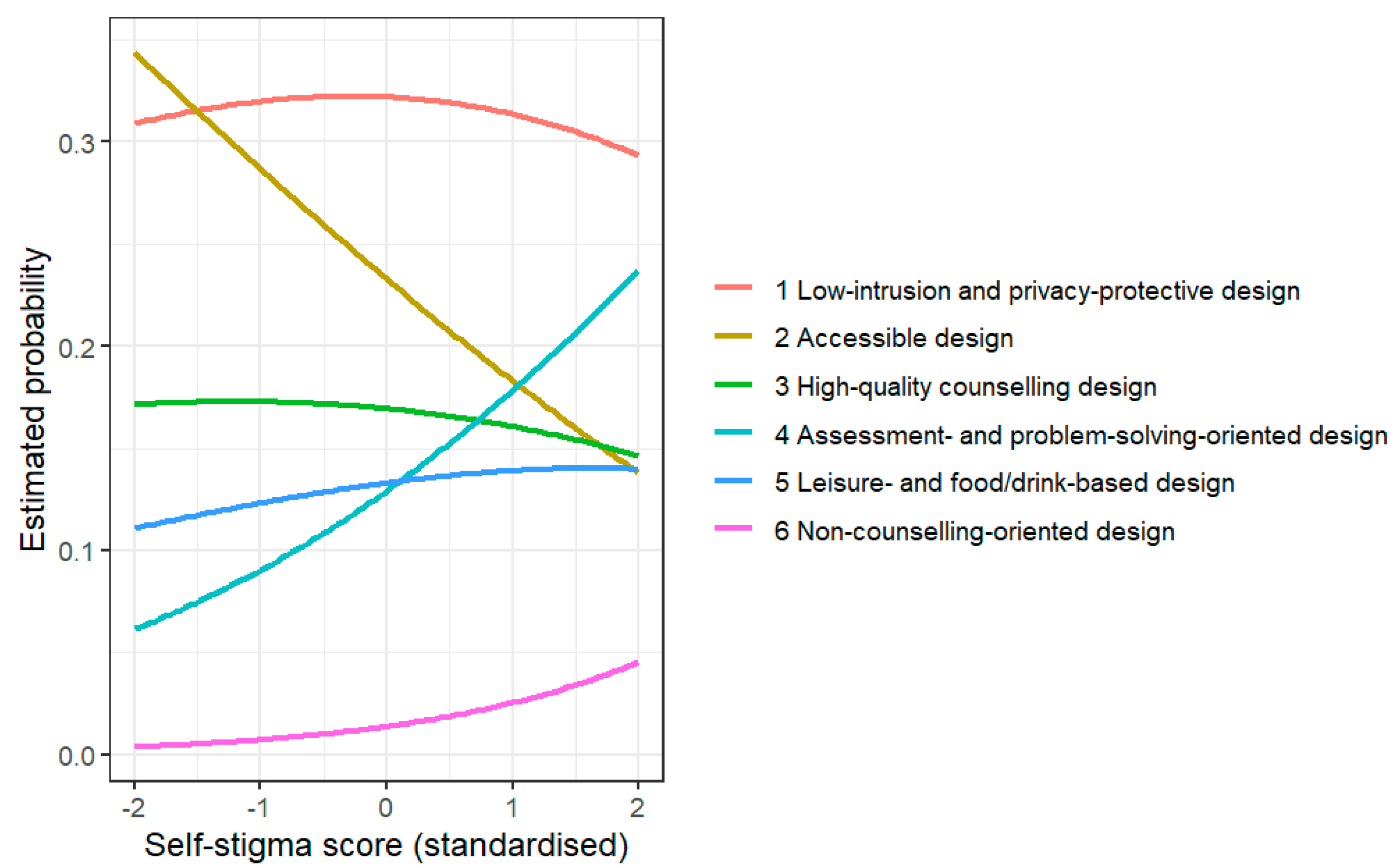
Figure 1: Estimated probabilities of selecting each service-design category according to standardised self-stigma score. Predicted probabilities were calculated with age fixed at its mean value, gender fixed at the reference category (female), and no usual source of consultation in daily life fixed at the reference category, that is, having at least one usual source of consultation in daily life.
The present exploratory study examined Japanese employed adults with no previous experience of using mental health services. It investigated whether self-stigma ratings differed according to wording and provider type, and explored conditions that may facilitate initial access to preventive mental health support. Family members and friends were the most common sources of consultation, whereas relatively few participants consulted people at work, and approximately 17% reported consulting no one. Self-stigma ratings were significantly higher when the interaction was framed as “consulting” rather than “chatting” across all provider types. Provider type and the interaction between wording type and provider type were also significant, although their effect sizes were small. Older participants showed higher self-stigma ratings, whereas gender was not significantly associated with self-stigma ratings. Regarding conditions under which participants might be willing to talk with a psychological counsellor, low-intrusion and privacy-protective design and accessible design were more frequently reported than conditions related to service quality. Higher self-stigma was associated with a preference for non-counselling-oriented design.
The present findings are based on a survey of Japanese workers and should not be generalised as culturally universal conclusions. Nevertheless, international studies consistently identify stigma, concerns about evaluation, privacy concerns, and access difficulties as barriers to help-seeking. The present study can be understood as examining how these general barriers may be expressed within the Japanese cultural context, including shame, sekentei, self-reliance, and concerns about burdening others.
The study also did not focus exclusively on workers who already recognised a clear need for mental health support. Rather, it examined non-clinical workers with no previous service-use experience in the context of primary prevention. Some participants may not have fully recognised their own difficulties or support needs at the time of the survey. In primary prevention, however, it is important to create entry points before problems become severe, so that support remains accessible when stress or difficulties increase.
4.1 Wording and Provider-Type Effects on Self-Stigma Ratings
First, self-stigma ratings were significantly higher when the interaction was framed as “consulting” rather than “chatting.” This wording effect was large in the repeated-measures analysis and was observed consistently across all provider types. This finding suggests that the label used to describe the act of talking with another person may be important at the point of entry to support. The term “consulting” may make help-seeking more explicit and evaluative, whereas “chatting” may frame the interaction as a more ordinary and less stigmatizing form of communication. This interpretation is consistent with previous research indicating that help-seeking labels and self-stigma can shape attitudes toward service use [25,27]. It may also be especially relevant in the Japanese cultural context, where help-seeking can be associated with shame, sekentei, and concerns about social evaluation [13,14].
At the same time, provider type and the interaction between wording type and provider type were also statistically significant, although their effect sizes were small. Ratings tended to be highest for the non-professional listening-service provider condition. This pattern was somewhat unexpected, because a non-professional listening service might appear to be a low-threshold option that allows users to talk more casually than in professional counselling.
One possible explanation is that the anonymity and low-threshold nature of the listener may have had mixed effects. Previous research on digital and low-threshold mental health support suggests that anonymity and easy access can reduce concerns about social evaluation and facilitate disclosure, but that these features may also make it more difficult for users to evaluate the listener’s trustworthiness and the confidentiality of the interaction [19]. Broader research on non-professional and peer support also indicates that clear arrangements around support roles, boundaries, training, and supervision are important for safe implementation [28]. In the present study, the non-professional listening-service provider may have been perceived as easy to access, but the listener’s identity, reliability, and confidentiality may have been less clear than in the psychological counsellor or career consultant conditions. This uncertainty may have contributed to higher self-stigma ratings in this condition. Because the present study did not directly assess participants’ perceptions of listener anonymity, trustworthiness, or confidentiality, this interpretation should be regarded as tentative.
However, the present study cannot determine whether differences in self-stigma ratings would translate into meaningful changes in actual service use. Wording should therefore be considered as one component of low-threshold service design, together with privacy protection, low intrusiveness, convenience, and access to appropriate professional support when needed.
Regarding participant characteristics, age was significantly associated with self-stigma ratings, whereas gender was not. The association with age is broadly consistent with previous research suggesting that older individuals may have less favourable attitudes toward professional psychological support [29]. Older workers may have had relatively fewer opportunities to encounter psychological support as a routine or preventive resource, which may have increased the psychological threshold for seeking support.
In contrast, gender was not significantly associated with self-stigma ratings. Although Mackenzie et al. [29] reported that women showed more favourable intentions to seek help from mental health professionals than men, and previous research has suggested that men may be less likely than women to seek professional psychological help [30], the present findings do not indicate that male participants had higher self-stigma ratings than female participants. This may be because the present study examined self-stigma ratings in response to specific wording conditions, rather than general attitudes toward help-seeking or actual help-seeking behaviour. In this context, whether the interaction was described as “consulting” or “chatting” may have had a stronger influence on self-stigma ratings than participant gender. Future research should examine gender-related mechanisms, such as psychological openness, disclosure concerns, masculine norms, workplace context, and actual service use, more directly.
Consultation was directed mainly towards close others. Family members (58.5%) and friends (48.7%) were common sources of consultation, whereas relatively few participants reported consulting people at work (14.9%). This pattern is broadly consistent with international findings indicating preferences for informal support in community and East Asian populations [31,32,33]. The workplace may be a particularly difficult environment in which to disclose psychological difficulties because of evaluation risks and role expectations. A recent scoping review found that workplace disclosure could be followed by negative or discriminatory responses from colleagues or managers, highlighting the evaluation risks associated with disclosure [34]. The low rate of consultation with people at work in the present study may therefore reflect structural and cultural factors, rather than simply a lack of motivation to seek support.
In addition, 16.9% of participants reported consulting no one. This proportion is broadly consistent with studies of young people in which approximately 15%–25% did not seek support [35,36]. Reported reasons for not seeking help include a preference to cope independently, concerns about stigma, underestimation of one’s difficulties, and low expectations regarding the usefulness of support [27,35]. Although not all non-consulters should be regarded as having unmet needs, international data indicate that many people with mental disorders do not receive treatment or experience substantial delays before first treatment contact [37,38]. Longer untreated periods have also been associated with poorer outcomes in depression and psychotic disorders [39,40].
Finally, the findings suggest that avoiding language and frameworks that explicitly evoke “consultation” may be particularly relevant for people with higher self-stigma ratings. In the multinomial model, higher self-stigma was associated with a greater likelihood of selecting a non-counselling-oriented design rather than a low-intrusion and privacy-protective design. Participants expressed preferences for avoiding terms such as “counsellor” or “counselling” and for being able to access support naturally following an external prompt. These preferences are consistent with evidence that labelling and self-stigma shape attitudes towards service use [25,27].
The free-text responses also emphasised privacy protection, text-based communication, AI-based support, listening without unsolicited advice, online access, local availability, low-cost or trial use, spare-time use, brief sessions, and access without appointments. These preferences are consistent with findings that evaluation concerns and practical barriers related to time, place, and cost can inhibit help-seeking [27,35]. Privacy concerns are also important: Clement et al. [10] reported that concerns about others finding out were associated with avoidance of help-seeking. This is consistent with Japanese findings concerning sekentei and social evaluation [13,14].
Taken together, people may not necessarily reject professional support itself; rather, they may avoid highly intrusive forms of contact. Because the present study did not measure actual service use, future intervention studies should test whether low-intrusion entry points combined with staged transitions to professional support increase uptake.
People who are generally healthy may nevertheless experience distress and conflict in daily life and often recover through self-help or support from close others. When stressors accumulate or coping resources become depleted, however, third-party support may become necessary. Paying for professional support can be associated with acknowledging weakness or an inability to cope independently. Service designs that do not depend excessively on individuals’ motivation or readiness may therefore be needed to make professional support more familiar and easier to access when necessary.
The low rate of consultation with workplace contacts in the present study suggests that workers may find it difficult to disclose psychological difficulties in workplace environments. Institutional arrangements alone may not automatically increase help-seeking. External support options separated from workplace evaluation risks should therefore be considered, such as routine access to external professional services through employee benefit programmes, online options, and brief sessions.
In Japan, the Ministry of Health, Labour and Welfare has promoted four types of mental health care, including line care and care by occupational health staff [41]. Nevertheless, the 2024 Survey on Industrial Safety and Health indicated that only 1.7% of workers consulted a professional about work-related stress [42]. Primary preventive support in workplaces may therefore need to offer external and routine sources of support that do not evoke evaluation risks. Regular opportunities for reflection could be embedded in institutional pathways so that workers do not need to declare that they are seeking “consultation”. Framing these opportunities as “reflection”, “organising one’s thoughts”, “self-checking”, “life design”, or “condition management” may reduce psychological resistance to initial access.
Low-intrusion entry points may include text-based communication, anonymity, access without reservations, brief sessions, and low-cost use. Depending on users’ circumstances and needs, such entry points could be linked to staged transitions to human support, including professional consultation. This hybrid approach, potentially including AI-based entry points, should be treated as a hypothesis for future intervention research rather than as an established model.
Luo et al. [43] examined the experiences of people who repeatedly used ChatGPT for emotional and mental health support. AI may offer anonymity, immediacy, and lower interpersonal evaluation risks, but rigorous assessment of safety and effectiveness remains necessary.
4.3 Limitations and Future Directions
This study has several limitations.
First, the study did not directly measure participants’ current psychological distress or need for mental health support. A lack of previous consultation cannot therefore be interpreted as an indicator of unmet mental health need. Some participants may not have recognised a need for support or may not have been experiencing psychological distress at the time of the survey. In addition, the study did not collect detailed demographic information such as education level, marital status, employment type, or industry; these factors may be relevant to mental health and help-seeking behaviour. Future studies should examine self-stigma, support needs, demographic and occupational context, and actual help-seeking behaviour among workers who are currently experiencing distress but have not sought support.
Second, the condition comparisons of self-stigma ratings did not include close others, such as family members or friends. It was therefore not possible to compare directly the self-stigma associated with consulting close others with that associated with consulting a psychological counsellor.
Third, responses concerning the conditions under which participants might be willing to talk were free-text preferences regarding service design rather than measures of actual service-use behaviour. Self-reported preferences and intentions may diverge from real-world behaviour [19]. Moreover, the free-text question was administered once after all condition-specific items and not separately for each wording-type and provider-type condition. The effects of these factors on preferred service-design categories could therefore not be examined directly.
Fourth, the order of items corresponding to the six conditions was not counterbalanced. Responses may therefore have been influenced by order effects in addition to wording and provider type. Future studies should randomise or counterbalance the presentation order.
Fifth, the study did not include independent manipulation-check items assessing how participants perceived the wording types or provider types. Although the Japanese terms corresponding to “consulting” and “chatting” are clearly distinct in everyday use, future studies should directly assess how participants interpret each condition.
Sixth, free-text responses were analysed using a consensus-based coding procedure supported by Sentence-BERT and cosine similarity, but formal inter-coder reliability was not calculated. Although the research team repeatedly returned to the original responses and resolved difficult classifications through discussion, future studies should include independent coding by multiple coders and report inter-coder reliability to strengthen reproducibility.
Seventh, because the study was based on cross-sectional data, it cannot establish the causal direction between self-stigma and service-design preferences or changes in help-seeking behaviour over time. Longitudinal and intervention research is needed.
Among Japanese workers with no previous experience of using mental health services, self-stigma ratings were higher when an interaction was framed as “consulting” rather than “chatting” across all provider types. Provider type and the interaction between wording type and provider type also showed statistically significant but small effects. Participants frequently preferred low-intrusion, privacy-protective, and accessible service designs. These findings suggest that preventive mental health support may benefit from low-threshold entry points that reduce psychological and practical barriers, including careful attention to how support is labelled and introduced. Because this study assessed self-reported ratings and preferences rather than actual service use, further longitudinal and intervention studies are needed to determine whether such approaches increase uptake.
Acknowledgement:
Funding Statement: This work was supported by JSPS KAKENHI Grant Number 24K16839, awarded to Asaka Kawamura. The sponsor’s website is https://www.jsps.go.jp/english/e-grants/. The funder had no role in the study design, data collection, data analysis, interpretation of the results, preparation of the manuscript, or decision to submit the manuscript for publication.
Author Contributions: The authors confirm contribution to the paper as follows: study conception and design: Asaka Kawamura and Tomoyuki Kobayashi; data collection: Asaka Kawamura; analysis and interpretation of results: Asaka Kawamura and Tomoyuki Kobayashi; draft manuscript preparation: Asaka Kawamura; review and editing of the manuscript: Asaka Kawamura and Tomoyuki Kobayashi. All authors reviewed and approved the final version of the manuscript.
Availability of Data and Materials: The data supporting the findings of this study are not publicly available due to privacy and ethical restrictions, as they include individual-level survey responses and free-text data. De-identified data may be available from the corresponding author upon reasonable request, subject to approval by the relevant ethics committee and compliance with the consent conditions under which the data were collected.
Ethics Approval: This study was conducted in accordance with the principles of the Declaration of Helsinki. The study protocol was reviewed and approved by the Research Ethics Committee of Hokusho University (Approval No. 2024-011). All participants were informed of the purpose and procedures of the study, the voluntary nature of participation, anonymity, and the handling of data before completing the questionnaire. Electronic informed consent was obtained from all participants before participation. Ethical approval was obtained before participant recruitment and data collection began.
Conflicts of Interest: The authors declare no conflicts of interest.
Supplementary Materials: The supplementary material is available online at https://www.techscience.com/doi/10.32604/ijmhp.2026.081796/s1.
References
1. World Health Organization . WHO guidelines on mental health at work [Internet]. 2022 [cited 2026 Jun 15]. Available from: https://iris.who.int/handle/10665/363843. [Google Scholar]
2. Kessler RC , Angermeyer M , Anthony JC , de Graaf R , Demyttenaere K , Gasquet I , et al. Lifetime prevalence and age-of-onset distributions of mental disorders in the World Health Organization’s World Mental Health Survey Initiative. World Psychiatry. 2007; 6( 3): 168– 76. [Google Scholar]
3. Ministry of Health, Labour and Welfare . Patient survey 2017 [Internet]. 2018 [cited 2026 Jun 15]. Available from: https://www.mhlw.go.jp/toukei/saikin/hw/kanja/17/index.html. [Google Scholar]
4. Tsutsumi A , Shimazu A , Yoshikawa T . Proposed guidelines for primary prevention for mental health at work: An update. Environ Occup Health Pract. 2019; 1( 1): 2– 12. doi:10.1539/eohp.2019-0007-ra. [Google Scholar] [CrossRef]
5. OECD . Health at a glance 2023: OECD indicators. Paris, France: OECD Publishing; 2023. doi:10.1787/7a7afb35-en. [Google Scholar] [CrossRef]
6. National Academies of Sciences, Engineering, Medicine . Behavioral health needs in the United States. In: Expanding behavioral health care workforce participation in medicare, medicaid, and marketplace plans. Washington, DC, USA: National Academies Press; 2024. [Google Scholar]
7. Nishi D , Ishikawa H , Kawakami N . Prevalence of mental disorders and mental health service use in Japan. Psychiatry Clin Neurosci. 2019; 73( 8): 458– 65. doi:10.1111/pcn.12894. [Google Scholar] [CrossRef]
8. Corrigan PW , Druss BG , Perlick DA . The impact of mental illness stigma on seeking and participating in mental health care. Psychol Sci Public Interest. 2014; 15( 2): 37– 70. doi:10.1177/1529100614531398. [Google Scholar] [CrossRef]
9. Vogel DL , Heimerdinger-Edwards SR , Hammer JH , Hubbard A . “Boys don’t cry”: Examination of the links between endorsement of masculine norms, self-stigma, and help-seeking attitudes for men from diverse backgrounds. J Couns Psychol. 2011; 58( 3): 368– 82. doi:10.1037/a0023688. [Google Scholar] [CrossRef]
10. Clement S , Schauman O , Graham T , Maggioni F , Evans-Lacko S , Bezborodovs N , et al. What is the impact of mental health-related stigma on help-seeking? A systematic review of quantitative and qualitative studies. Psychol Med. 2015; 45( 1): 11– 27. doi:10.1017/S0033291714000129. [Google Scholar] [CrossRef]
11. Schnyder N , Panczak R , Groth N , Schultze-Lutter F . Association between mental health-related stigma and active help-seeking: Systematic review and meta-analysis. Br J Psychiatry. 2017; 210( 4): 261– 8. doi:10.1192/bjp.bp.116.189464. [Google Scholar] [CrossRef]
12. Miyaji S . A study of restraining factors on the professional-psychological help seeking: Related to the degree of distress and self-stigma. Jpn Women’s Univ J. 2010; 16: 153– 72. (In Japanese). [Google Scholar]
13. Maekawa Y , Kanai A . A review of help-seeking toward mental health professionals: From the perspectives of help-seeking attitudes, intentions, and behaviors. Bull Grad Sch Educ Hum Dev Nagoya Univ. 2016; 63: 57– 72. (In Japanese). doi:10.18999/nupsych.63.1.5. [Google Scholar] [CrossRef]
14. Ando S , Yamaguchi S , Aoki Y , Thornicroft G . Review of mental-health-related stigma in Japan. Psychiatry Clin Neurosci. 2013; 67( 7): 471– 82. doi:10.1111/pcn.12086. [Google Scholar] [CrossRef]
15. Kanehara A , Umeda M , Kawakami N , World Mental Health Japan Survey Group . Barriers to mental health care in Japan: Results from the World Mental Health Japan Survey. Psychiatry Clin Neurosci. 2015; 69( 9): 523– 33. doi:10.1111/pcn.12267. [Google Scholar] [CrossRef]
16. Stanley IH , Hom MA , Joiner TE . Modifying mental health help-seeking stigma among undergraduates with untreated psychiatric disorders: A pilot randomized trial of a novel cognitive bias modification intervention. Behav Res Ther. 2018; 103: 33– 42. doi:10.1016/j.brat.2018.01.008. [Google Scholar] [CrossRef]
17. Mastrogiovanni N , Nickerson A . An online intervention designed to reduce self-stigma and increase help-seeking in Arabic-speaking refugees with posttraumatic stress symptoms: A randomized controlled trial. J Trauma Stress. 2025; 38( 5): 832– 43. doi:10.1002/jts.23168. [Google Scholar] [CrossRef]
18. Paterson C , Leduc C , Maxwell M , Aust B , Strachan H , O’Connor A , et al. Barriers and facilitators to implementing workplace interventions to promote mental health: Qualitative evidence synthesis. Syst Rev. 2024; 13( 1): 152. doi:10.1186/s13643-024-02569-2. [Google Scholar] [CrossRef]
19. Borghouts J , Eikey E , Mark G , De Leon C , Schueller SM , Schneider M , et al. Barriers to and facilitators of user engagement with digital mental health interventions: Systematic review. J Med Internet Res. 2021; 23( 3): e24387. doi:10.2196/24387. [Google Scholar] [CrossRef]
20. Wulf IC . Help-seeking and help-outreach intentions of healthcare workers—The role of mental health literacy and stigma in the workplace. Front Educ. 2022; 7: 856458. doi:10.3389/feduc.2022.856458. [Google Scholar] [CrossRef]
21. Hanisch SE , Twomey CD , Szeto AC , Birner UW , Nowak D , Sabariego C . The effectiveness of interventions targeting the stigma of mental illness at the workplace: A systematic review. BMC Psychiatry. 2016; 16: 1. doi:10.1186/s12888-015-0706-4. [Google Scholar] [CrossRef]
22. Greiner BA , Leduc C , O’Brien C , Cresswell-Smith J , Rugulies R , Wahlbeck K , et al. The effectiveness of organisational-level workplace mental health interventions on mental health and wellbeing in construction workers: A systematic review and recommended research agenda. PLoS One. 2022; 17( 11): e0277114. doi:10.1371/journal.pone.0277114. [Google Scholar] [CrossRef]
23. Kim PY , Thomas JL , Wilk JE , Castro CA , Hoge CW . Stigma, barriers to care, and use of mental health services among active duty and National Guard soldiers after combat. Psychiatr Serv. 2010; 61( 6): 582– 8. doi:10.1176/ps.2010.61.6.582. [Google Scholar] [CrossRef]
24. Nagai S , Kimura M , Iida T , Hiroi I . Development of a scale for measuring self-stigma of seeking help from informal source. Jpn J Sch Psychol. 2023; 22( 1): 19– 27. (In Japanese). doi:10.24583/jjspedit.22.1_19. [Google Scholar] [CrossRef]
25. Vogel DL , Wade NG , Haake S . Measuring the self-stigma associated with seeking psychological help. J Couns Psychol. 2006; 53( 3): 325– 37. doi:10.1037/0022-0167.53.3.325. [Google Scholar] [CrossRef]
26. Reimers N , Gurevych I . Sentence-BERT: Sentence embeddings using Siamese BERT-networks. In: Proceedings of the 2019 Conference on Empirical Methods in Natural Language Processing and the 9th International Joint Conference on Natural Language Processing (EMNLP-IJCNLP); 2019 Nov 3–7; Hong Kong, China. p. 3980– 90. doi:10.18653/v1/d19-1410. [Google Scholar] [CrossRef]
27. Corrigan P . How stigma interferes with mental health care. Am Psychologist. 2004; 59( 7): 614– 25. doi:10.1037/0003-066x.59.7.614. [Google Scholar] [CrossRef]
28. Cooper RE , Saunders KRK , Greenburgh A , Shah P , Appleton R , Machin K , et al. The effectiveness, implementation, and experiences of peer support approaches for mental health: A systematic umbrella review. BMC Med. 2024; 22( 1): 72. doi:10.1186/s12916-024-03260-y. [Google Scholar] [CrossRef]
29. Mackenzie CS , Gekoski WL , Knox VJ . Age, gender, and the underutilization of mental health services: The influence of help-seeking attitudes. Aging Ment Health. 2006; 10( 6): 574– 82. doi:10.1080/13607860600641200. [Google Scholar] [CrossRef]
30. Addis ME , Mahalik JR . Men, masculinity, and the contexts of help seeking. Am Psychologist. 2003; 58( 1): 5– 14. doi:10.1037/0003-066x.58.1.5. [Google Scholar] [CrossRef]
31. Brown J , Evans-Lacko S , Aschan L , Henderson MJ , Hatch SL , Hotopf M . Seeking informal and formal help for mental health problems in the community: A secondary analysis from a psychiatric morbidity survey in South London. BMC Psychiatry. 2014; 14( 1): 275. doi:10.1186/s12888-014-0275-y. [Google Scholar] [CrossRef]
32. Shumet S , Azale T , Angaw DA , Tesfaw G , Wondie M , Getinet Alemu W , et al. Help-seeking preferences to informal and formal source of care for depression: A community-based study in northwest Ethiopia. Patient Prefer Adherence. 2021; 15: 1505– 13. doi:10.2147/PPA.S311601. [Google Scholar] [CrossRef]
33. Park J , Lee S , Park G , Woodward S . Mental health help-seeking behaviours of East Asian immigrants: A scoping review. Eur J Psychotraumatol. 2025; 16( 1): 2514327. doi:10.1080/20008066.2025.2514327. [Google Scholar] [CrossRef]
34. Richard C , Corbière M , Fiset-Renaud H , Caiada M , Lamontagne J , Diotte F , et al. Disclosure impact of mental health conditions in the workplace: A scoping review and a thematic analysis. J Occup Rehabil. 2026; 36( 1): 131– 66. doi:10.1007/s10926-025-10288-1. [Google Scholar] [CrossRef]
35. Gulliver A , Griffiths KM , Christensen H . Perceived barriers and facilitators to mental health help-seeking in young people: A systematic review. BMC Psychiatry. 2010; 10: 113. doi:10.1186/1471-244X-10-113. [Google Scholar] [CrossRef]
36. Rickwood D , Deane FP , Wilson CJ , Ciarrochi J . Young people’s help-seeking for mental health problems. Aust E J Adv Ment Health. 2005; 4( 3): 218– 51. doi:10.5172/jamh.4.3.218. [Google Scholar] [CrossRef]
37. Wang PS , Angermeyer M , Borges G , Bruffaerts R , Chiu WT , de Girolamo G , et al. Delay and failure in treatment seeking after first onset of mental disorders in the World Health Organization’s World Mental Health Survey Initiative. World Psychiatry. 2007; 6( 3): 177– 85. [Google Scholar]
38. Alonso J , Liu Z , Evans-Lacko S , Sadikova E , Sampson N , Chatterji S , et al. Treatment gap for anxiety disorders is global: Results of the World Mental Health Surveys in 21 countries. Depress Anxiety. 2018; 35( 3): 195– 208. doi:10.1002/da.22711. [Google Scholar] [CrossRef]
39. Ghio L , Gotelli S , Marcenaro M , Amore M , Natta W . Duration of untreated illness and outcomes in unipolar depression: A systematic review and meta-analysis. J Affect Disord. 2014; 152–4: 45– 51. doi:10.1016/j.jad.2013.10.002. [Google Scholar] [CrossRef]
40. Penttilä M , Jääskeläinen E , Hirvonen N , Isohanni M , Miettunen J . Duration of untreated psychosis as predictor of long-term outcome in schizophrenia: Systematic review and meta-analysis. Br J Psychiatry. 2014; 205( 2): 88– 94. doi:10.1192/bjp.bp.113.127753. [Google Scholar] [CrossRef]
41. Ministry of Health, Labour and Welfare . Regarding the guidelines for the maintenance and promotion of workers’ mental health [Internet]. 2006 [cited 2026 Jun 15]. Available from: https://www.mhlw.go.jp/houdou/2006/03/h0331-1.html. [Google Scholar]
42. Ministry of Health, Labour and Welfare . Overview of the 2024 survey on industrial safety and health (actual conditions survey) [Internet]. 2025 [cited 2026 Jun 15]. Available from: https://www.mhlw.go.jp/toukei/list/dl/r06-46-50_gaikyo.pdf. [Google Scholar]
43. Luo X , Wang Z , Tilley JL , Balarajan S , Bassey UA , Cheang CI . Seeking emotional and mental health support from generative AI: Mixed-methods study of ChatGPT user experiences. JMIR Ment Health. 2025; 12: e77951. doi:10.2196/77951. [Google Scholar] [CrossRef]
Cite This Article
 Copyright © 2026 The Author(s). Published by Tech Science Press.
This work is licensed under a Creative Commons Attribution 4.0 International License , which permits unrestricted use, distribution, and reproduction in any medium, provided the original work is properly cited.
 Downloads
 Citation Tools
