
 Login
Login Register
 Submit a Paper
 Propose a Special lssue
 Open Access
ARTICLE
Trajectories of Functional Ability and Quality of Life among Older Adults after Hip Fracture with and without Cognition Impairment: A Three-Month Longitudinal Study
1 Institute of Allied Health Sciences, College of Medicine, National Cheng Kung University, Tainan, Taiwan
2 Department of Physiotherapy, Faculty of Health Science, Universitas ‘Aisyiyah Yogyakarta, Sleman, Indonesia
3 Department of Orthopedics, Wan Fang Hospital, Taipei Medical University, Taipei, Taiwan
4 Department of Orthopedics, School of Medicine, College of Medicine, Taipei Medical University, Taipei, Taiwan
5 School of Nursing, College of Nursing, Kaohsiung Medical University, Kaohsiung, Taiwan
6 Center for Long-Term Care Research, Kaohsiung Medical University, Kaohsiung, Taiwan
7 Department of Medical Research, Kaohsiung Medical University Hospital, Kaohsiung, Taiwan
8 Department of Family Medicine and Community Medicine, E-Da Hospital, I-Shou University, Kaohsiung, Taiwan
9 School of Medicine, College of Medicine, I-Shou University, Kaohsiung, Taiwan
10 College of Nursing, Kaohsiung Medical University, Kaohsiung, Taiwan
11 Graduate Institute of Biomedical Materials and Tissue Engineering, College of Biomedical Engineering, Taipei Medical University, Taipei, Taiwan
12 Psychology Department, Nottingham Trent University, Nottingham, UK
13 Biostatistics Consulting Center, National Cheng Kung University Hospital, College of Medicine, National Cheng Kung University, Tainan, Taiwan
14 Department of Occupational Therapy, College of Medicine, National Cheng Kung University, Tainan, Taiwan
15 Department of Occupational Therapy, College of Health Sciences, Kaohsiung Medical University, Kaohsiung, Taiwan
* Corresponding Authors: Chi Hsien Huang. Email: ,
; Chung-Ying Lin. Email:
International Journal of Mental Health Promotion 2026, 28(9), 2 https://doi.org/10.32604/ijmhp.2026.082706
Received 20 March 2026; Accepted 22 June 2026; Issue published 22 September 2026
 View Full Text
 Download PDF
Abstract
Background: Hip fractures among older adults lead to significant morbidity and mortality, often complicated by pre-existing cognitive impairment. Understanding the longitudinal trajectories of functional ability and quality of life (QoL) among this specific population is crucial for customized interventions development. The present study compared the three-month trajectories of functional ability and QoL among older adults after hip fracture, specifically differentiating between those with and without cognitive impairment. Methods: A three-month longitudinal comparison analysis was conducted with 647 older adults following hip fracture. Participants were stratified by cognitive status (intact [n = 377] vs. impaired [n = 270]). Repeated measures analysis of variance (RM-ANOVA) and generalized estimating equations (GEEs) were employed to compare the trajectories of the functional ability, functional mobility and QoL utility score. Results: RM-ANOVA showed significant changes over time for functional ability, functional mobility, and QoL. A significant interaction between time and cognitive status was found for functional ability (p < 0.001, ω2 = 0.011) and functional mobility (p < 0.001, ω2 = 0.013), suggesting differing recovery patterns based on cognitive status. GEE analyses confirmed that the cognition-intact group experienced a notable deterioration in QoL over time. However, the pace of QoL decrease was not statistically different between the two groups. Moreover, the group with cognitive impairment showed a significantly faster decline in both functional ability and mobility (p < 0.001) over three-month follow-up. Conclusions: Cognitive impairment among older adults after hip fracture is associated with a significantly poorer baseline condition and, critically, an accelerated decline in functional ability and mobility over the initial three-month recovery period. These findings underscore the need for early identification and tailored support strategies for cognitively impaired individuals to mitigate functional decline and improve post-fracture outcomes.Keywords
Hip fractures are a significant injury among older adults, with the global incidence and related disability increasing as populations age [1]. Recent worldwide epidemiological studies have showed that while age-standardized incidence has stabilized or decreased in specific contexts, demographic changes suggest that the absolute number of hip fractures is expected to nearly double by 2050 [2]. These fractures are significantly associated with increased mortality, with one-year all-cause mortality rates often reported between 15% and 30% reported in recent studies, surpassing those of numerous chronic diseases among older populations [3,4].
Hip fractures significantly impair mobility and daily activities among older individuals [5]. Longitudinal studies consistently demonstrate that a significant number of survivors have ongoing mobility impairments, are unable to ambulate independently, and necessitate assistance with fundamental activities of daily living (ADLs) at one-year post-event [4,6,7]. These functional impairments often lead to transitions from home to residential or nursing care, indicating both physical and cognitive disability following a fracture [8,9]. Following hip fracture, health-related quality of life (QoL) declines significantly and often remains below pre-fracture levels for prolonged periods, as reflected across key domains including mobility, self-care, usual activities, pain/discomfort, and anxiety/depression [7,10].
Functional independence and QoL measurements have emerged as essential goals in hip fracture research and clinical care to capture patient-centered outcomes [11,12]. The Barthel Index (BI) has been extensively utilized to evaluate fundamental ADL performance, has shown sensitivity to changes in hip fracture cohorts, and facilitates comparisons across different time intervals and clinical subgroups [11,12,13]. The EuroQol Five-Dimension Three-Level (EQ-5D-3L) instrument offers a preference-based assessment of health-related QoL and has been utilized in several hip fracture cohorts and deemed appropriate for cost-utility studies [14,15,16]. The joint evaluation of BI and EQ-5D-3L trajectories provides a comprehensive perspective on recovery, encompassing both clinician-assessed functionality and patient-reported health status [12,17,18].
Cognitive impairment is common among older adults with hip fractures and significantly complicates their clinical trajectory [19]. Cross-sectional and longitudinal studies indicate that a significant proportion of patients with hip fractures possess pre-existing dementia or mild cognitive impairment, with numerous others experiencing delirium or abrupt cognitive deterioration during hospitalization [20,21]. Cognitive impairment can negatively impact recovery through multiple mechanisms, such as challenges in comprehending and adhering to rehabilitation directives, compromised decision-making abilities, and diminished participation in therapeutic sessions [21,22]. Moreover, cognitive impairment correlates with an elevated risk of postoperative delirium, inadequate pain evaluation and treatment, and an increased incidence of medical problems, all of which may hinder early functional improvements [23,24].
Prior research has demonstrated that cognitive impairment correlates with poorer post–hip fracture outcomes, including reduced functional recovery, diminished mobility, and lower health-related quality of life [25]. However, a significant gap remains regarding understanding the longitudinal patterns of functional ability and QoL [25,26]. The extant literature has concentrated on isolated endpoints rather than the rate and pattern of change over time [27]. Therefore, it is crucial to determine whether cognitive impairment not only leads to inferior outcomes but also hastens decline or modifies the recovery trajectory in functional ability and QoL during the pivotal initial three-month period [7,28]. A comprehensive evaluation is essential to assess various domains, including overall function, mobility, and patient-reported QoL, while considering influential factors such as age, comorbidities, and social support that may impact these trajectories [16,29].
The extant literature is limited by a lack of prospective data investigating how short-term functional changes forecast long-term outcomes, especially among patients with cognitive impairment [7,30]. Given these gaps, the aim of the present study was to longitudinally examine the trajectories of functional ability and QoL over a three-month period among older adults following hip fractures, specifically comparing individuals with and without cognitive impairment. It was hypothesized that cognitive impairment would moderate longitudinal functional changes. More specifically, a significant interaction between time and cognitive status for objective functional outcomes was expected, such that individuals with cognitive impairment would demonstrate steeper declines over the follow-up period compared with cognitively intact individuals. Given the multidimensional and subjective nature of QoL—and prior inconsistencies regarding its temporal course after hip fracture—QoL trajectories were examined in an exploratory manner without specifying a directional hypothesis for group differences. This approach allowed for the possibility that perceived health status may not parallel objective functional change.
2.1 Study Design, Participants, and Procedure
The present study comprised a three-month prospective longitudinal comparative design to examine the trajectories of functional ability and QoL among older adults following hip fractures, categorized by cognitive status (i.e., impaired vs. intact). A total of 647 participants admitted for hip fractures were recruited from a medical center in Taipei (Taipei Municipal Wanfang Hospital) and followed up for three months. Participants were recruited between November 2017 and November 2024. Follow-up data were collected three months after surgery. Therefore, the follow-up assessment period occurred between February 2018 and February 2025.
Eligible participants were those who had sustained a hip fracture, received operative management, completed baseline assessment during the peri-discharge period, and had available data on cognitive status, functional ability, functional mobility, and health-related quality of life. Participants were excluded if they had incomplete baseline or follow-up outcome data, missing cognitive classification, major concurrent trauma, severe medical instability, or pre-existing conditions that substantially limited valid assessment of postoperative functional recovery.
Because the study was designed to investigate recovery trajectories after hip fracture, no healthy control group was included. Potential participants were approached by trained research assistants during their hospital stay when feeling better after their operation. Potential participants were approached for interview on the first or second day after their operation. However, if a patient was not in a suitable condition to participate (e.g., admission to the intensive care unit or other personal or clinical factors), the interview was postponed. In such cases, the interview was conducted once the patient’s condition had sufficiently stabilized and they were able to participate. In such cases, the interview was conducted once the patient’s condition had sufficiently stabilized and they were able to participate. However, all postponed interviews were completed within the index hospitalization and before discharge.
All interviews were completed during the same hospitalization period. The research assistants asked the participants to complete a survey (see Section 2.2 below for details) in person to evaluate their pre-injury (i.e., before hip fracture) conditions. Three months after discharge, the research assistants contacted the participants again via telephone interview to evaluate their functional ability and QoL at that moment. For participants with moderate or severe cognitive impairment who were unable to provide reliable responses independently, data were obtained with assistance from proxy respondents, primarily family members or primary caregivers who were familiar with the participant’s pre-fracture functional status, daily activities, and general health condition.
Participants were classified into two groups according to their cognitive status: individuals with intact cognitive abilities (n = 377) and those with cognitive impairment (n = 270). Cognitive status was assessed using the Short Portable Mental Status Questionnaire (SPMSQ), a concise evaluative instrument created by Pfeiffer (1975) to assess intellectual and cognitive functions (memory, orientation, and mathematical ability) in older adults [31]. This instrument comprises 10 straightforward questions to identify early cognitive decline. The scoring outcomes are categorized as follows: 0–2 errors = normal cognitive performance, 3–4 errors = mild cognitive impairment: 5–7 errors = moderate cognitive impairment; 8 or more errors = severe cognitive impairment. As aforementioned, the present study categorized the participants into two groups: those without cognitive impairment (0–2 errors) and those with cognitive impairment (3 or more errors).
Informed consent was obtained from each participant in strict conformity with the Declaration of Helsinki throughout the entire study procedure, and the study was approved by the Institutional Review Boards in Taipei Medical University (approval no.: TMU-JIRB N201709053) on 23 October 2017. For participants with moderate or severe cognitive impairment who lacked the capacity to provide independent informed consent, surrogate consent was obtained from a legally authorized representative or an appropriate family proxy, such as next of kin or a primary family caregiver, in accordance with the institutional review board-approved protocol.
2.2.1 Demographics and Clinical Characteristics at Baseline
Baseline data included demographic information, including age, sex, education level, marital status, living arrangement, and primary caregiver. The clinical variables assessed included body mass index (BMI) and the American Society of Anesthesiologists (ASA) Physical Status Classification Grading (I–V), a widely used framework for assessing and communicating a patient’s preoperative health status [32]. It categorizes patients based on their overall physical condition and the severity of systemic disease, ranging from ASA I (indicating a healthy patient with no systemic illness) to ASA V (indicating a moribund patient who is not expected to survive without the operation) [32].
2.2.2 Functional Ability at Baseline and Three-Month Follow-Up
Functional ability was assessed using the BI. The BI comprises 10 components that evaluate an individual’s capacity to execute fundamental activities of daily living (ADLs), including feeding, bathing, grooming, dressing, bowel control, bladder control, toilet use, transfers (between bed and chair), mobility (on flat surfaces), and stair climbing. Each item is evaluated on an ordinal scale (typically 0, 5, 10, or 15 points), with the aggregate of item scores producing a total score between 0 and 100. A superior total score indicates enhanced functional independence [33]. The BI Mobility sub-score, a segment of the BI, specifically assesses mobility function. Higher scores indicate enhanced mobility. Functional mobility was assessed using the “mobility on flat surfaces” item of the BI, which has a theoretical scoring range from 0 to 15, with higher scores indicating greater independence in mobility on flat surfaces.
2.2.3 Quality of Life at Baseline and Three-Month Follow-Up
QoL was evaluated using the European Quality of Life Five-Dimension Three-Level Version (EQ-5D-3L). The EQ-5D-3L is a commonly used, general, preference-based tool for evaluating health-related quality of life. It consists of five individual dimensions—mobility, self-care, usual activities, pain/discomfort, and anxiety/depression—each evaluated on a three-tier scale (1 = no problems, 2 = moderate problems, 3 = significant problems). This results in 243 potential health states, which are transformed into a singular utility index (0 = deceased to 1 = optimal health) by population-derived preference weights. The EQ-5D-3L health states were converted into utility index scores using the Taiwan EQ-5D-3L value set. Elevated utility values signify improved self-reported health state, enabling both cross-sectional comparisons and longitudinal monitoring of health outcomes following hip fracture surgery [34].
Descriptive statistics were used to characterize the participants. Categorical variables are presented as frequencies and percentages, and continuous variables are presented as means and standard deviations (Mean ± SD). Baseline differences between the cognition-intact and cognitively-impaired groups were analyzed using independent t-tests and chi-square tests for categorical variables. To examine the longitudinal changes in functional ability and QoL, and the influence of cognitive status, a two-way repeated measures analysis of variance (RM-ANOVA) was conducted. This analysis assessed the main effects of time (baseline vs. three-month follow-up) and group (cognition intact vs. cognitive impairment), as well as their interaction (time × cognitive status). The effect size for RM-ANOVA was reported using omega squared (ω2), with values of ~0.01, ~0.06, and ~0.14, indicating small, medium, and large effects, respectively [35].
Generalized estimating equation (GEE) analyses were performed to model the trajectories of the BI, BI Mobility sub-score, and EQ-5D-3L utility score over time, accounting for the correlation between repeated measurements within individuals and adjusting for potential confounders. The GEE model included group (cognition intact as a reference), time (baseline as a reference; i.e., baseline was coded 0 and follow-up was coded 3 to indicate the third month after baseline), and the interaction term Group × Time (intact at baseline as a reference). The covariates included in the GEE model were sex (female as reference; i.e., female was coded 0 and male was coded 1), age (treated as a continuous variable), educational level (elementary/below as reference [coded 0]; and other levels were collapsed into one category of junior high/above [coded 1]), living status (with family as reference [coded 0]; and living alone and living in nursing home were collapsed into one category of living without any family members [coded 1]), BMI (treated as a continuous variable), and ASA grade (treated as a continuous variable). Unstandardized coefficients (B) and standard errors (SEs) were reported in the GEE models.
Baseline scores were not entered as separate covariates in the GEE models because the models treated baseline and three-month follow-up scores as repeated outcome measurements. Therefore, baseline values were incorporated directly into the response structure of the longitudinal GEE analysis. The model included group, time, and the group-by-time interaction, which allowed the estimate baseline group differences, overall time effects, and differential change over time between cognitive groups. For the longitudinal GEE analysis, a complete-case approach was used. Only participants with complete baseline and three-month follow-up data were included in the models. Participants with missing follow-up data were excluded, and no missing data imputation was performed. Statistical significance was determined using the p-value, which indicates the probability of obtaining the observed results, or results more extreme, if the null hypothesis were true. A p-value below the predetermined significance threshold, commonly 0.05, was interpreted as evidence against the null hypothesis. Statistical analyses were conducted using the SPSS version 29 (IBM Corp., Armonk, New York, United States).
A total of 647 older adults admitted for hip fractures (377 [58.3%] cognitive intact; 270 [41.7%] cognitive impaired) were included in the longitudinal study. Among participants with cognitive impairment, 84 were classified as having mild impairment, 81 as having moderate impairment, and 105 as having severe impairment, representing 31.1%, 30.0%, and 38.9% of the cognitively impaired subgroups, respectively. Participants in the cognitively impaired group were significantly older (mean age: 85.65 ± 7.27 years) than those in the cognitively intact group (79.55 ± 7.97 years, p < 0.001). Moreover, individuals with cognitive impairment presented with lower BMI (p = 0.023), significantly poorer health-related QoL as assessed using the EQ-5D-3L Utility score (0.80 ± 0.20 vs. 0.94 ± 0.11, p < 0.001), lower overall functional independence (BI total score: 79.52 ± 23.08 vs. 95.58 ± 9.61, p < 0.001), and reduced mobility (BI mobility sub-score: 12.46 ± 3.63 vs. 14.30 ± 1.96, p < 0.001). Regarding medical comorbidities, the cognitively impaired group had a higher proportion of participants with higher ASA grades (Grade III: 66.7% vs. 44.6%, p < 0.001). Table 1 reports additional baseline comparisons between the two groups. Fig. 1 illustrates the changes in EQ-5D-3L utility score, BI total score, and BI mobility sub-score from baseline to three-month follow-up according to cognitive status.
Table 1: Descriptive Characteristics of Participants (N = 647).
| Variable | Category | N = 647 | Cognitive Status | ||
|---|---|---|---|---|---|
| Without Impairment | With Impairment | p-Value | |||
| N (377) | N (270) | ||||
| Sex, n (%) | Male | 192 (29.7%) | 122 (32.4%) | 70 (25.9%) | 0.77 |
| Female | 455 (70.3%) | 255 (67.6%) | 200 (74.1%) | - | |
| Age, Mean (SD) | 82.10 (8.25) | 79.55 (7.97) | 85.65 (7.27) | <0.001 | |
| BMI, Mean (SD) | 22.52 (4.05) | 22.83 (3.93) | 22.10 (4.18) | 0.023 | |
| EQ-5D-3L Utility score, Mean (SD) | Baseline | 0.88 (0.17) | 0.94 (0.11) | 0.80 (0.20) | <0.001 |
| BI Total score, Mean (SD) | Baseline | 88.88 (18.40) | 95.58 (9.61) | 79.52 (23.08) | <0.001 |
| BI Mobility sub-score, Mean (SD) | Baseline | 13.53 (2.92) | 14.30 (1.96) | 12.46 (3.63) | <0.001 |
| ASA Grading, n (%) | I | 5 (0.7%) | 4 (1.1%) | 1 (0.4%) | <0.001 |
| II | 282 (43.6%) | 199 (52.8%) | 83 (30.7%) | - | |
| III | 348 (53.8%) | 168 (44.6) | 180 (66.7%) | - | |
| IV | 11 (1.7%) | 5 (1.3%) | 6 (2.2%) | - | |
| V | 1 (0.2%) | 1 (0.3%) | 0 (0%) | - | |
| Living Arrangement, n (%) | With family | 551 (85.1%) | 335 (88.9%) | 216 (80%) | <0.001 |
| Living alone | 58 (9%) | 33 (8.7%) | 25 (9.3%) | - | |
| Nursing home | 38 (5.9%) | 9 (2.4%) | 29 (10.7%) | - | |
| Primary Caregiver, n (%) | Family | 502 (77.6%) | 321 (85.1%) | 181 (67%) | <0.001 |
| Nursing home | 33 (5.1%) | 8 (2.1%) | 25 (9.2%) | - | |
| Foreign caregiver | 81 (12.5%) | 30 (8%) | 51 (18.9%) | - | |
| Friends/neighbour | 19 (2.9%) | 14 (3.7%) | 5 (1.9%) | - | |
| Nursing | 12 (1.9%) | 4 (1.1%) | 8 (3%) | - | |
| Education Level, n (%) | Elementary/below | 367 (56.8%) | 178 (47.2%) | 189 (70%) | <0.001 |
| Junior high school | 81 (12.5%) | 46 (12.2%) | 35 (13%) | - | |
| Senior high school | 114 (17.6%) | 83 (22%) | 31 (11.4%) | - | |
| College/University | 79 (12.2%) | 65 (17.3%) | 14 (5.2%) | - | |
| Postgraduate | 6 (0.9%) | 5 (1.3%) | 1 (0.4%) | - | |
| Marital Status, n (%) | Married | 439 (67.9%) | 271 (71.9%) | 168 (62.3%) | 0.226 |
| Widow/Widowe | 178 (27.5%) | 85 (22.5%) | 93 (34.4%) | - | |
| Unmarried | 18 (2.7%) | 12 (3.2%) | 6 (2.2%) | - | |
| Divorced | 12 (1.9%) | 9 (2.4%) | 3 (1.1%) | - | |
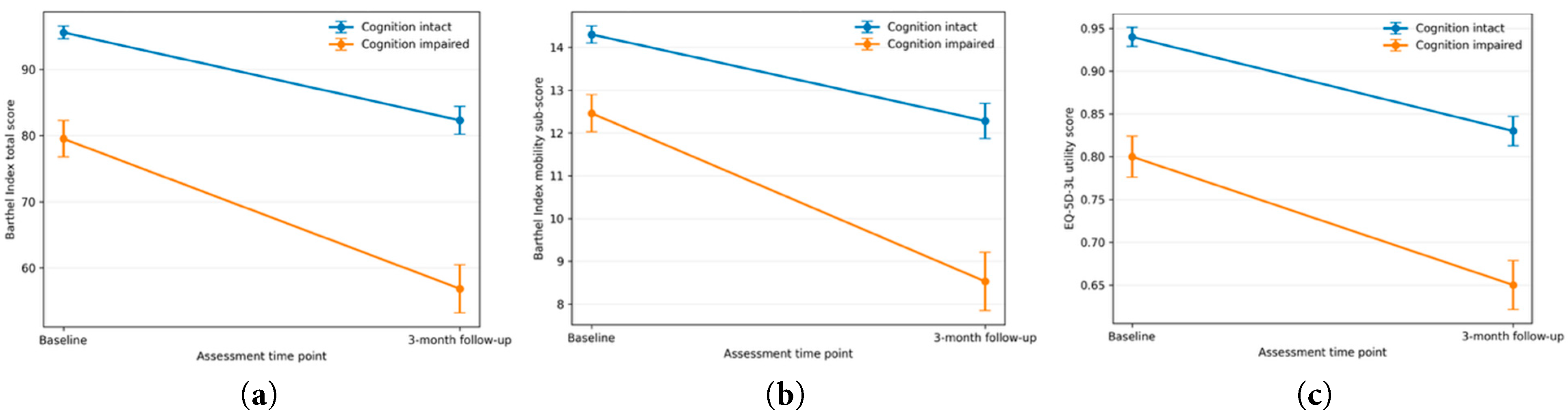
Figure 1: Trajectories of Barthel Index (BI) total score (a), BI sub-score (b), and European Quality of Life 5 Dimensions 3 Level Version (EQ-5D-3L) utility score (c) over three months by cognition status. Error bars represent 95% confidence intervals (95% CIs) around the group means.
The RM-ANOVA showed significant changes over time for EQ-5D-3L utility score (p < 0.001, ω2 = 0.106), the BI (p < 0.001, ω2 = 0.146), and BI Mobility sub-score (p < 0.001, ω2 = 0.121), indicating a decline in QoL, functional independence, and mobility over the three-month follow-up period (Table 2). Cognitive status had a significant main effect on all three measures: EQ-5D-3L utility score (p < 0.001, ω2 = 0.123), BI (p < 0.001, ω2 = 0.139), and BI Mobility sub-score (p < 0.001, ω2 = 0.087), indicating overall differences in these scores between the cognition-intact and cognition-impaired groups, with the latter group consistently showing lower scores. A significant interaction effect between time and cognitive status was observed for the BI (p < 0.001, ω2 = 0.011) and BI Mobility sub-score (p < 0.001, ω2 = 0.013). This suggests that the change in functional independence and mobility over time differed significantly based on cognitive status, although the interaction effects were small. No such interaction was found for the EQ-5D-3L utility score (p = 0.09).
Table 2: Repeated Measures Analysis of Variance (RM-ANOVA) for examining time (baseline vs. three-month follow-up) and group (cognition intact vs. cognitive impaired) in EQ-5D-3L utility score, Barthel Index (BI), and BI mobility sub-score.
| Mean ± SD | F-Value/p-Value (ω2) | ||||
|---|---|---|---|---|---|
| Baseline | Follow-Up | Time Comparison | Group Comparison | Time × Cognitive Status | |
| EQ-5D-3L utility score | 234.463/<0.001 (0.106) | 181.786/<0.001 (0.123) | 2.880/0.09 (<0.001) | ||
| Cognition intact | 0.94 ± 0.11 | 0.83 ± 0.17 | - | - | - |
| Cognition impaired | 0.80 ± 0.20 | 0.65 ± 0.24 | - | - | - |
| BI | 381.072/<0.001 (0.146) | 209.300/<0.001 (0.139) | 26.010/<0.001 (0.011) | ||
| Cognition intact | 95.58 ± 9.61 | 82.31 ± 20.86 | - | - | - |
| Cognition impaired | 79.52 ± 23.08 | 56.85 ± 30.39 | - | - | - |
| BI Mobility sub-score | 247.550/<0.001 (0.121) | 123.700/<0.001 (0.087) | 25.410/<0.001 (0.013) | ||
| Cognition intact | 14.30 ± 1.96 | 12.28 ± 4.09 | - | - | - |
| Cognition impaired | 12.46 ± 3.63 | 8.53 ± 5.71 | - | - | - |
The GEE analysis, adjusted for various covariates, further explored the trajectories of QoL and functional ability (Table 3). At baseline, individuals with cognitive impairment demonstrated significantly diminished QoL (EQ-5D-3L utility score, B = −0.114, p < 0.001), inferior overall functional ability (BI, B = −11.569, p < 0.001), and decreased mobility (BI Mobility sub-score, B = −1.221, p < 0.001) compared with those with intact cognition. The EQ-5D-3L utility score showed a significant overall decline over time (B = −0.028, p < 0.001). However, the interaction term for Group × Time for EQ-5D-3L was nonsignificant (B = −0.009, p = 0.112), indicating that the rate of decline in QoL did not significantly differ between the cognitively impaired and intact groups. In contrast, for functional ability measures, a significant Group × Time interaction was found for both the BI (B = −3.113, p < 0.001) and the BI Mobility sub-score (B = −0.633, p < 0.001), indicating that participants in the cognitively impaired group experienced a significantly faster decline in both overall functional ability and mobility over the three-month period compared to those in the cognitively intact group.
Several other factors independently influenced these results. Increasing age was associated with a lower QoL (B = −0.002, p = 0.004) and overall functional ability (B = −0.251, p = 0.007). Poorer general health, indicated by a higher ASA grade, was strongly associated with declines across all three measures: EQ-5D-3L (B = −0.053, p < 0.001), BI (B = −7.082, p < 0.001), and BI Mobility sub-score (B = −1.151, p < 0.001). Living without family was also a significant predictor of diminished QoL (B = −0.054, p < 0.001), total functional capacity (B = −9.209, p < 0.001), and mobility (B = −1.507, p < 0.001). Sex, BMI, and educational level did not show significant independent effects on the trajectories of these outcomes in the GEE model.
Table 3: Generalized estimating equation results comparing the trajectories of quality of life and functional ability between groups with and without cognition impairment (N = 647).
| B (SE)/p-Value | |||
|---|---|---|---|
| EQ-5D-3L Utility Score | BI | BI Mobility Sub-Score | |
| Group (Ref. = intact) | −0.114 (0.0151)/<0.001 | −11.569 (1.6262)/<0.001 | −1.221 (0.2700)/<0.001 |
| Time (Ref. = baseline) | −0.028 (0.0078)/<0.001 | −1.239 (0.8347)/0.138 | −0.028 (0.1763)/0.874 |
| Sex (Ref. = female) | −0.022 (0.0122)/0.069 | −2.199 (1.4402)/0.127 | −0.358 (0.2564)/0.163 |
| Age | −0.002 (0.0008)/0.004 | −0.251 (0.0932)/0.007 | −0.030 (0.0163)/0.070 |
| BMI | 0.001 (0.0014)/0.388 | 0.221 (0.1675)/0.187 | 0.033 (0.0323)/0.314 |
| ASA Grading | −0.053 (0.0108)/<0.001 | −7.082 (1.2660)/<0.001 | −1.151 (0.2388)/<0.001 |
| Educational level (Ref. = elementary) | 0.003 (0.0091)/0.749 | 0.643 (1.0770)/0.551 | −0.071 (0.1967)/0.717 |
| Living status (Ref. = with family) | −0.054 (0.0155)/<0.001 | −9.209 (1.8927)/<0.001 | −1.507 (0.3506)/<0.001 |
| Group × Time (Ref. = intact at baseline) | −0.009 (0.0059)/0.112 | −3.113 (0.6496)/<0.001 | −0.633 (0.1313)/<0.001 |
The present study elucidated the divergent functional ability and QoL trajectories of older adults following hip fractures, demonstrating that cognitive impairment is a critical determinant of functional outcomes. More specifically, individuals with cognitive impairment experienced a significantly accelerated decline in both overall functional ability and mobility over the three-month post-fracture period compared to those with intact cognition, a finding that aligns with existing evidence suggesting that cognitive impairment exacerbates functional limitations in aged care settings [29]. This accelerated deterioration may be attributed to the complex interplay of cognitive deficits and physical challenges, where difficulties in adhering to rehabilitation protocols, poorer pain management, and increased susceptibility to complications compound the effects of underlying frailty [27,36]. Indeed, while enhanced rehabilitation strategies and geriatrician-led recovery may offer some benefits for individuals with cognitive impairment following hip fracture surgery, the certainty of evidence remains low, and the optimal care model for this population is unclear [37]. The present study’s findings corroborate previous research indicating that cognitive impairment is a robust predictor of limited functional recovery during rehabilitation among older patients after hip fractures [7,36].
The RM-ANOVA demonstrated a statistically significant decline in EQ-5D-3L utility scores over the three-month follow-up period. However, the time-by-cognitive status interaction was not statistically significant, indicating that the pattern of change in QoL did not differ significantly between cognitively impaired and cognitively intact patients. Although patients with cognitive impairment had lower utility scores across the assessment period, the GEE analysis similarly showed no significant difference in the rate of utility-score change between cognitive-status groups. These findings suggest that cognitive impairment was associated with poorer perceived health status overall, but not with a statistically distinguishable acceleration of QoL decline during the three-month follow-up. Interpretation should nevertheless consider the potential influence of self- or proxy-reported EQ-5D-3L assessments, particularly among participants with cognitive impairment because proxy ratings may not fully reflect patients’ subjective QoL [38].
Moreover, the profound baseline disparities observed in the cognitively impaired group—characterized by older age, lower BMI, poorer general health, and less supportive living arrangements—underscore the concept of cumulative disadvantage, where pre-existing vulnerabilities predispose these individuals to exacerbated adverse outcomes following a physiological stressor such as a hip fracture [30,39]. These pre-existing vulnerabilities, including advanced age and higher ASA grading indicative of poorer general health, were identified as significant independent predictors of diminished recovery across functional and QoL domains, emphasizing the necessity for holistic geriatric assessments that extend beyond cognitive status alone [40].
Such comprehensive evaluations must incorporate modifiable social determinants because the present study’s results indicated that living without family was a notable predictor of diminished QoL, total functional capacity, and mobility, independent of clinical factors [7,37]. Consequently, healthcare systems must prioritize the integration of specialized multidisciplinary rehabilitation pathways that address the complex interplay of cognitive, medical, and social needs to mitigate the accelerated functional decline observed among this high-risk population [41]. Therefore, future research should focus on validating multidisciplinary interventions that specifically target the synergistic effects of cognitive deficits and medical comorbidities on postoperative recovery [42].
There is also a critical need to recognize and act upon the risk of poor outcomes among the hip fracture subpopulation that presents with multiple risk factors, because the integration of documentation regarding pre-fracture functional status and cognitive impairment can potentially lead to enhanced postoperative care that encourages greater mobility [30]. This necessitates a paradigm shift towards multidimensional rehabilitation interventions that address physical, mental, and social health simultaneously rather than focusing solely on physical functioning [36]. By adopting a holistic framework that encompasses cognitive support, optimized medical management, and enhanced social engagement, clinicians can better tailor patient-centered care plans to facilitate smoother transitions from the perioperative period to post-acute rehabilitation [43].
Multidisciplinary hospital treatment, including rapid mobilization, is suggested as the first essential step for the optimization of care immediately after a hip fracture, with subsequent subacute exercise interventions to improve mobility [44]. To achieve optimal recovery, an integrated multidisciplinary team comprising orthopedic surgery, geriatric evaluations, and rehabilitation medicine is required to manage these poor outcomes because comprehensive multidisciplinary treatment has been shown to improve gait function more effectively than usual treatment at four- and twelve-months post-surgery [45].
Beyond cognitive status, recovery after hip fracture surgery among older adults is strongly influenced by perioperative and postoperative clinical factors [46,47]. Comprehensive preoperative cardiovascular assessment, optimization of hemodynamic stability, prevention and early recognition of postoperative complications, and timely evaluation of rehabilitation readiness are essential components of care in this vulnerable population [46]. Comorbidity burden may further limit physiological reserve and reduce the capacity to participate effectively in postoperative rehabilitation, thereby increasing the risk of poor functional recovery, reduced quality of life, and mortality [46,47]. Moreover, the physiological burden associated with cardiovascular instability, perioperative complications, and reduced functional reserve may further compromise cognitive resilience and heighten susceptibility to postoperative anxiety and depressive symptoms in this vulnerable population [46,47]. Recent evidence also highlights the relevance of preoperative cardiac risk factors among older adults undergoing hip fracture surgery, with atrial fibrillation and elevated pulmonary artery systolic pressure identified as predictors of in-hospital mortality [46]. In addition, emerging prediction models for myocardial injury after non-elective surgery may improve risk stratification beyond conventional indices and support individualized perioperative monitoring and postoperative care planning [47]. These considerations suggest that cognitive impairment should be interpreted as one important component of a broader risk profile that includes cardiovascular status, comorbidity burden, perioperative stability, and rehabilitation potential.
The present study has several limitations that warrant consideration. First, the relatively short follow-up period of three months restricted the ability to capture long-term recovery trajectories, stabilization, or further decline, which is particularly relevant given the protracted nature of functional recovery after hip fracture surgery. Second, the use of only two timepoints (baseline and three months) precluded the detection of potential nonlinear recovery or decline patterns within or beyond the observed period. Third, reliance on standardized and valid measures such as the BI, BI Mobility sub-score, and EQ-5D-3L utility score, while appropriate, may have overlooked more specific or objective assessments of physical function and psychological status that could provide deeper insights into patient challenges after surgery. Fourth, the present study did not include measures of social activity or social engagement, which may be important determinants of functional status and health-related quality of life among older adults. Future studies should incorporate these factors to provide a more comprehensive understanding of recovery trajectories after hip fracture.
Fifth, although educational level was included as a proxy socioeconomic indicator, the dataset did not contain direct measures of socioeconomic status, such as income, occupation, household resources, or health insurance status. Therefore, the potential influence of broader socioeconomic conditions on functional recovery and health-related quality of life was not fully examined. Future longitudinal studies should incorporate more comprehensive socioeconomic measures to better understand how social disadvantage may shape recovery trajectories after hip fracture. A final limitation of the study was that orthopedic characteristics, including fracture type (e.g., femoral neck or intertrochanteric fracture) and surgery type (e.g., internal fixation or arthroplasty) were not collected. These factors may influence short-term functional recovery, mobility outcomes, and rehabilitation trajectories after hip fracture.
The present study showed pronounced baseline disparities between older adults with cognitive impairment and their cognitively intact counterparts undergoing hip fracture surgery. Those with cognitive impairment exhibited significantly poorer health status, lower QoL, and diminished functional ability and mobility at baseline. Over the three-month postoperative period, both groups experienced declines in functional independence and mobility. However, the cognitively-impaired cohort demonstrated significantly accelerated deterioration in these domains, highlighting the critical influence of cognitive status on recovery trajectories.
Notably, despite these functional differences, the rate of QoL decline did not differ significantly between groups, indicating that factors beyond cognitive impairment may modulate perceived well-being following surgery. Moreover, advanced age, elevated ASA grade, and absence of familial living arrangements independently predicted poorer outcomes across QoL, functional capacity, and mobility measures. These findings underscore the imperative for individualized postoperative management strategies that integrate cognitive assessment alongside broader health and social determinants to enhance recovery outcomes and QoL among individuals in this specific population.
Future research should examine the potential mediating role of functional ability in the relationship between cognitive impairment and health-related quality of life after hip fracture. Studies with three or more repeated assessments are needed to establish clearer temporal ordering between cognitive status, functional recovery, and subsequent quality-of-life outcomes. Longitudinal mediation analysis or structural equation modeling may help determine whether cognitive impairment influences quality of life directly or indirectly through poorer functional recovery.
Acknowledgement:
Funding Statement: The APC for the paper was supported by the National Science and Technology Council of Taiwan (112-2314-B-650-001-MY3) and E-Da Hospital (EDPJ114023, EDAHJ114008, and EDAHP115027). The funders had no role in the study design, methods, data collection, analysis, or preparation of the manuscript.
Author Contributions: The authors confirm contribution to the paper as follows: Conceptualization, Tri Laksono, Yu-Pin Chen, Chi Hsien Huang, and Chung-Ying Lin; Methodology, Tri Laksono, Yu-Pin Chen, Yi-Jung Chen, Kah-Ying Yap, Fang-Wen Hu, Chi Hsien Huang, Lien-Chen Wu, Yi-Jie Kuo, Mark D. Griffiths, and Chung-Ying Lin; Formal analysis, Tri Laksono and Chung-Ying Lin; Validation, Tri Laksono, Yu-Pin Chen, Chi Hsien Huang, and Chung-Ying Lin; Data curation, Yu-Pin Chen; Writing—original draft preparation, Tri Laksono, Yu-Pin Chen, and Chi-Hsien Huang; Writing—review and editing, Tri Laksono, Yu-Pin Chen, Yi-Jung Chen, Kah-Ying Yap, Fang-Wen Hu, Chi Hsien Huang, Lien-Chen Wu, Yi-Jie Kuo, Mark D. Griffiths, and Chung-Ying Lin; Supervision, Chung-Ying Lin. All authors reviewed and approved the final version of the manuscript.
Availability of Data and Materials: The data that support the findings of this study are available from the Corresponding Author, Chung-Ying Lin, upon reasonable request.
Ethics Approval: Informed consent was obtained from each participant in strict conformity with the Declaration of Helsinki throughout the entire study procedure, and the study was approved by the Institutional Review Boards in Taipei Medical University (approval no.: TMU-JIRB N201709053) on 23 October 2017.
Conflicts of Interest: The authors declare no conflicts of interest.
References
1. Feng JN , Zhang CG , Li BH , Zhan SY , Wang SF , Song CL . Global burden of hip fracture: The Global Burden of Disease Study. Osteoporos Int. 2024; 35( 1): 41– 52. doi:10.1007/s00198-023-06907-3. [Google Scholar] [CrossRef]
2. Michaëlsson K , Baron JA , Byberg L , Larsson SC , Melhus H , Gedeborg R . Declining hip fracture burden in Sweden 1998–2019 and consequences for projections through 2050. Sci Rep. 2024; 14( 1): 706. doi:10.1038/s41598-024-51363-6. [Google Scholar] [CrossRef]
3. Sing CW , Lin TC , Bartholomew S , Bell JS , Bennett C , Beyene K , et al. Global epidemiology of hip fractures: Secular trends in incidence rate, post-fracture treatment, and all-cause mortality. J Bone Mineral Res. 2023; 38( 8): 1064– 75. doi:10.1002/jbmr.4821. [Google Scholar] [CrossRef]
4. Chen YP , Kuo YJ , Liu CH , Chien PC , Chang WC , Lin CY , et al. Prognostic factors for 1-year functional outcome, quality of life, care demands, and mortality after surgery in Taiwanese geriatric patients with a hip fracture: A prospective cohort study. Ther Adv Musculoskelet Dis. 2021; 13: 1759720X211028360. doi:10.1177/1759720X211028360. [Google Scholar] [CrossRef]
5. Kraaijkamp JJM , Stijntjes M , De Groot JH , Chavannes NH , Achterberg WP , van Dam van Isselt EF . Movement patterns in older adults recovering from hip fracture. J Aging Phys Act. 2024; 32( 3): 312– 20. doi:10.1123/japa.2023-0090. [Google Scholar] [CrossRef]
6. Penrod JD , Litke A , Hawkes WG , Magaziner J , Doucette JT , Koval KJ , et al. The association of race, gender, and comorbidity with mortality and function after hip fracture. J Gerontol A Biol Sci Med Sci. 2008; 63( 8): 867– 72. doi:10.1093/gerona/63.8.867. [Google Scholar] [CrossRef]
7. Yang TI , Kuo YJ , Huang SW , Chen YP . Minimal short-term decline in functional performance and quality of life predicts better long-term outcomes for both in older Taiwanese adults after hip fracture surgery: A prospective study. J Orthop Surg Res. 2023; 18( 1): 791. doi:10.1186/s13018-023-04278-3. [Google Scholar] [CrossRef]
8. Orive M , Aguirre U , García-Gutiérrez S , Hayas CL , Bilbao A , González N , et al. Changes in health-related quality of life and activities of daily living after hip fracture because of a fall in elderly patients: A prospective cohort study. Int J Clin Pract. 2015; 69( 4): 491– 500. doi:10.1111/ijcp.12527. [Google Scholar] [CrossRef]
9. Low S , Wee E , Dorevitch M . Impact of place of residence, frailty and other factors on rehabilitation outcomes post hip fracture. Age Ageing. 2021; 50( 2): 423– 30. doi:10.1093/ageing/afaa131. [Google Scholar] [CrossRef]
10. Goh EL , Png ME , Metcalfe D , Achten J , Appelbe D , Griffin XL , et al. The impact of complications on quality of life and mortality after hip fracture. Bone Joint J. 2025; 107-B( 10): 1118– 24. doi:10.1302/0301-620x.107B10.bjj-2024-1448.r1. [Google Scholar] [CrossRef]
11. Ju JB , Zhang PX , Jiang BG . Risk factors for functional outcomes of the elderly with intertrochanteric fracture: A retrospective cohort study. Orthop Surg. 2019; 11( 4): 643– 52. doi:10.1111/os.12512. [Google Scholar] [CrossRef]
12. Prieto-Alhambra D , Moral-Cuesta D , Palmer A , Aguado-Maestro I , Bravo Bardaji MFB , Brañas F , et al. The impact of hip fracture on health-related quality of life and activities of daily living: The SPARE-HIP prospective cohort study. Arch Osteoporos. 2019; 14( 1): 56. doi:10.1007/s11657-019-0607-0. [Google Scholar] [CrossRef]
13. Amarilla-Donoso FJ , López-Espuela F , Roncero-Martín R , Leal-Hernandez O , Puerto-Parejo LM , Aliaga-Vera I , et al. Quality of life in elderly people after a hip fracture: A prospective study. Health Qual Life Outcomes. 2020; 18( 1): 71. doi:10.1186/s12955-020-01314-2. [Google Scholar] [CrossRef]
14. Gjertsen JE , Baste V , Fevang JM , Furnes O , Engesæter LB . Quality of life following hip fractures: Results from the Norwegian hip fracture register. BMC Musculoskelet Disord. 2016; 17( 1): 265. doi:10.1186/s12891-016-1111-y. [Google Scholar] [CrossRef]
15. Kjærvik C , Gjertsen JE , Stensland E , Uleberg B , Taraldsen K , Søreide O . Impact of physiotherapy access on health-related quality of life following hip fracture: An observational study on 30 752 hip fractures from the Norwegian Hip Fracture Register 2014–2018. BMJ Open. 2024; 14( 6): e086428. doi:10.1136/bmjopen-2024-086428. [Google Scholar] [CrossRef]
16. Kjærvik C , Gjertsen JE , Stensland E , Dybvik EH , Soereide O . Patient-reported outcome measures in hip fracture patients. Bone Joint J. 2024; 106-B( 4): 394– 400. doi:10.1302/0301-620X.106B4.BJJ-2023-0904.R1. [Google Scholar] [CrossRef]
17. Chen LH , Liang J , Chen MC , Wu CC , Cheng HS , Wang HH , et al. The relationship between preoperative American Society of Anesthesiologists Physical Status Classification scores and functional recovery following hip-fracture surgery. BMC Musculoskelet Disord. 2017; 18( 1): 410. doi:10.1186/s12891-017-1768-x. [Google Scholar] [CrossRef]
18. Mayoral AP , Ibarz E , Gracia L , Mateo J , Herrera A . The use of Barthel index for the assessment of the functional recovery after osteoporotic hip fracture: One year follow-up. PLoS One. 2019; 14( 2): e0212000. doi:10.1371/journal.pone.0212000. [Google Scholar] [CrossRef]
19. Gruber-Baldini AL , Zimmerman S , Morrison RS , Grattan LM , Hebel JR , Dolan MM , et al. Cognitive impairment in hip fracture patients: Timing of detection and longitudinal follow-up. J Am Geriatr Soc. 2003; 51( 9): 1227– 36. doi:10.1046/j.1532-5415.2003.51406.x. [Google Scholar] [CrossRef]
20. Umoh ME , Sharma A , Leoutsakos JS , Lyketsos CG , Inouye SK , Marcantonio ER , et al. Cognitive outcomes after hip fracture surgery: The association of postoperative delirium on previously cognitively normal older adults. Am J Geriatr Psychiatry. 2026; 34( 6): 857– 66. doi:10.1016/j.jagp.2025.10.002. [Google Scholar] [CrossRef]
21. Hsu YH , Liang J , Tseng MY , Chen YJ , Shyu YL . A two-year longitudinal study of the impact of cognitive status and depression on frailty status in older adults following hip fracture. Geriatr Nurs. 2025; 62( Pt B): 12– 8. doi:10.1016/j.gerinurse.2025.01.021. [Google Scholar] [CrossRef]
22. Oughli HA , Chen G , Philip Miller J , Nicol G , Butters MA , Avidan M , et al. Cognitive improvement in older adults in the year after hip fracture: Implications for brain resilience in advanced aging. Am J Geriatr Psychiatry. 2018; 26( 11): 1119– 27. doi:10.1016/j.jagp.2018.07.001. [Google Scholar] [CrossRef]
23. Liang CK , Chu CL , Chou MY , Lin YT , Lu T , Hsu CJ , et al. Interrelationship of postoperative delirium and cognitive impairment and their impact on the functional status in older patients undergoing orthopaedic surgery: A prospective cohort study. PLoS One. 2014; 9( 11): e110339. doi:10.1371/journal.pone.0110339. [Google Scholar] [CrossRef]
24. Paunikar S , Chakole V . Postoperative delirium and neurocognitive disorders: A comprehensive review of pathophysiology, risk factors, and management strategies. Cureus. 2024; 16( 9): e68492. doi:10.7759/cureus.68492. [Google Scholar] [CrossRef]
25. Ariza-Vega P , Lozano-Lozano M , Olmedo-Requena R , Martín-Martín L , Jiménez-Moleón J . Influence of cognitive impairment on mobility recovery of patients with hip fracture. Am J Phys Med Rehabil. 2017; 96( 2): 109– 15. doi:10.1097/PHM.0000000000000550. [Google Scholar] [CrossRef]
26. Araiza-Nava B , Méndez-Sánchez L , Clark P , Peralta-Pedrero ML , Javaid MK , Calo M , et al. Short- and long-term prognostic factors associated with functional recovery in elderly patients with hip fracture: A systematic review. Osteoporos Int. 2022; 33( 7): 1429– 44. doi:10.1007/s00198-022-06346-6. [Google Scholar] [CrossRef]
27. Dakhil S , Saltvedt I , Benth JŠ , Thingstad P , Watne LO , Bruun Wyller T , et al. Longitudinal trajectories of functional recovery after hip fracture. PLoS One. 2023; 18( 3): e0283551. doi:10.1371/journal.pone.0283551. [Google Scholar] [CrossRef]
28. Li B , Chang J , Wang Y , Huang C , Shi Y . Geriatric cognitive frailty and short-term prognosis following hip fracture surgery. BMC Geriatr. 2025; 25( 1): 734. doi:10.1186/s12877-025-06412-8. [Google Scholar] [CrossRef]
29. Jorissen RN , Inacio MC , Cations M , Lang C , Caughey GE , Crotty M . Effect of dementia on outcomes after surgically treated hip fracture in older adults. J Arthroplasty. 2021; 36( 9): 3181– 6.e4. doi:10.1016/j.arth.2021.04.030. [Google Scholar] [CrossRef]
30. Haslam-Larmer L , Donnelly C , Auais M , Woo K , DePaul V . Early mobility after fragility hip fracture: A mixed methods embedded case study. BMC Geriatr. 2021; 21( 1): 181. doi:10.1186/s12877-021-02083-3. [Google Scholar] [CrossRef]
31. Pfeiffer E . A short portable mental status questionnaire for the assessment of organic brain deficit in elderly patients. J Am Geriatr Soc. 1975; 23( 10): 433– 41. doi:10.1111/j.1532-5415.1975.tb00927.x. [Google Scholar] [CrossRef]
32. Fitz-Henry J . The ASA classification and peri-operative risk. Ann R Coll Surg Engl. 2011; 93( 3): 185– 7. doi:10.1308/rcsann.2011.93.3.185a. [Google Scholar] [CrossRef]
33. Mahoney FI , Barthel DW . Functional evaluation: The barthel index. Md State Med J. 1965; 14: 61– 5. [Google Scholar]
34. EuroQol G . EuroQol—A new facility for the measurement of health-related quality of life. Health Policy. 1990; 16( 3): 199– 208. doi:10.1016/0168-8510(90)90421-9. [Google Scholar] [CrossRef]
35. Keselman H . A Monte Carlo investigation of three estimates of treatment magnitude: Epsilon squared, eta squared, and omega squared. Can Psychol Rev Psychol Can. 1975; 16( 1): 44– 8. doi:10.1037/h0081789. [Google Scholar] [CrossRef]
36. Cadel L , Kuluski K , Wodchis WP , Thavorn K , Guilcher SJT . Rehabilitation interventions for persons with hip fracture and cognitive impairment: A scoping review. PLoS One. 2022; 17( 8): e0273038. doi:10.1371/journal.pone.0273038. [Google Scholar] [CrossRef]
37. Smith TO , Gilbert AW , Sreekanta A , Sahota O , Griffin XL , Cross JL , et al. Enhanced rehabilitation and care models for adults with dementia following hip fracture surgery. Cochrane Database Syst Rev. 2020; 2( 2): CD010569. doi:10.1002/14651858.CD010569.pub3. [Google Scholar] [CrossRef]
38. Chammout G , Kelly-Pettersson P , Hedbeck CJ , Bodén H , Stark A , Mukka S , et al. Primary hemiarthroplasty for the elderly patient with cognitive dysfunction and a displaced femoral neck fracture: A prospective, observational cohort study. Aging Clin Exp Res. 2021; 33( 5): 1275– 83. doi:10.1007/s40520-020-01651-8. [Google Scholar] [CrossRef]
39. Ouellet JA , Ouellet GM , Romegialli AM , Hirsch M , Berardi L , Ramsey CM , et al. Functional outcomes after hip fracture in independent community-dwelling patients. J Am Geriatr Soc. 2019; 67( 7): 1386– 92. doi:10.1111/jgs.15870. [Google Scholar] [CrossRef]
40. Viramontes O , Luan Erfe BM , Erfe JM , Brovman EY , Boehme J , Bader AM , et al. Cognitive impairment and postoperative outcomes in patients undergoing primary total hip arthroplasty: A systematic review. J Clin Anesth. 2019; 56: 65– 76. doi:10.1016/j.jclinane.2019.01.024. [Google Scholar] [CrossRef]
41. Tang VL , Sudore R , Cenzer IS , Boscardin WJ , Smith A , Ritchie C , et al. Rates of recovery to pre-fracture function in older persons with hip fracture: An observational study. J Gen Intern Med. 2017; 32( 2): 153– 8. doi:10.1007/s11606-016-3848-2. [Google Scholar] [CrossRef]
42. Neuerburg C , Förch S , Gleich J , Böcker W , Gosch M , Kammerlander C , et al. Improved outcome in hip fracture patients in the aging population following co-managed care compared to conventional surgical treatment: A retrospective, dual-center cohort study. BMC Geriatr. 2019; 19( 1): 330. doi:10.1186/s12877-019-1289-6. [Google Scholar] [CrossRef]
43. Xu BY , Yan S , Low LL , Vasanwala FF , Low SG . Predictors of poor functional outcomes and mortality in patients with hip fracture: A systematic review. BMC Musculoskelet Disord. 2019; 20( 1): 568. doi:10.1186/s12891-019-2950-0. [Google Scholar] [CrossRef]
44. Taraldsen K , Polhemus A , Engdal M , Jansen CP , Becker C , Brenner N , et al. Evaluation of mobility recovery after hip fracture: A scoping review of randomized controlled studies. Osteoporos Int. 2024; 35( 2): 203– 15. doi:10.1007/s00198-023-06922-4. [Google Scholar] [CrossRef]
45. Min K , Beom J , Kim BR , Lee SY , Lee GJ , Lee JH , et al. Clinical practice guideline for postoperative rehabilitation in older patients with hip fractures. Ann Rehabil Med. 2021; 45( 3): 225– 59. doi:10.5535/arm.21110. [Google Scholar] [CrossRef]
46. Çiçek V , Cinar T , Hayiroglu MI , Kılıç Ş , Keser N , Uzun M , et al. Preoperative cardiac risk factors associated with in-hospital mortality in elderly patients without heart failure undergoing hip fracture surgery: A single-centre study. Postgrad Med J. 2021; 97( 1153): 701– 5. doi:10.1136/postgradmedj-2020-138679. [Google Scholar] [CrossRef]
47. Cicek V , Babaoglu M , Saylik F , Yavuz S , Mazlum AF , Genc MS , et al. A new risk prediction model for the assessment of myocardial injury in elderly patients undergoing non-elective surgery. J Cardiovasc Dev Dis. 2024; 12( 1): 6. doi:10.3390/jcdd12010006. [Google Scholar] [CrossRef]
Cite This Article
 Copyright © 2026 The Author(s). Published by Tech Science Press.
This work is licensed under a Creative Commons Attribution 4.0 International License , which permits unrestricted use, distribution, and reproduction in any medium, provided the original work is properly cited.
 Downloads
 Citation Tools
