
 Login
Login Register
 Submit a Paper
 Propose a Special lssue
 Open Access
COMMENTARY
Arachidonic Acid Mediators and Nrf2 in Neurodegenerative Diseases
1 Department of the Chemical-Toxicological and Pharmacologic Evaluation of Drugs, Faculty of Pharmacy, Catholic University Our Lady of Good Counsel, Tirana, Albania
2 Department of Pharmacy-Pharmaceutical Sciences, University of Bari “Aldo Moro”, Bari, Italy
3 Department of Biological and Environmental Sciences and Technologies (DiSTeBA), Università del Salento, Lecce, Italy
* Corresponding Author: Malvina Hoxha. Email:
(This article belongs to the Special Issue: Advances in Nrf2 Signaling Pathway in Neurodegenerative Diseases)
BIOCELL 2026, 50(10), 1 https://doi.org/10.32604/biocell.2026.080846
Received 16 February 2026; Accepted 09 April 2026; Issue published 22 September 2026
 View Full Text
 Download PDF
Abstract
Arachidonic acid (AA) and its mediators, including prostaglandins (PGs) and lipoxygenase (LOX) products, have different and sometimes opposing effects on neuronal survival and inflammatory signaling. Evidence indicates a functional and dynamic interaction between AA-derived lipid mediators and the nuclear factor erythroid 2-related factor 2 (Nrf2), a master regulator of antioxidant and cytoprotective responses. Certain AA metabolites, such as the cyclopentenone prostaglandin 15-deoxy-Δ12,14-prostaglandin J2 (15d-PGJ2) and LOX-derived products including 5-oxo-eicosatetraenoic acid (5-oxo-ETE), have been shown to activate Nrf2 signaling. This activation enhances antioxidant defenses, promotes redox homeostasis, and mitigates inflammatory responses in neuronal and glial cells. In contrast, other AA metabolites contribute to sustained neuroinflammation and cytotoxicity, highlighting the dual and context-dependent role of AA signaling in the central nervous system. This duality positions AA mediators as both drivers of pathology and modulators of endogenous protective pathways. Pharmacological strategies targeting cyclooxygenase (COX) enzymes or downstream prostaglandin signaling have therefore been explored for neuroprotective potential; however, clinical translation has been limited by the complex functions of COX-derived products. Arachidonic acid-derived mediators regulating Nrf2 may offer anti-inflammatory yet protective strategies.Keywords
Alzheimer’s disease (AD), Parkinson’s disease (PD), and amyotrophic lateral sclerosis (ALS) are among the neurodegenerative diseases characterized by continuous neuronal loss, synaptic dysfunction, and cognitive or motor impairments [1]. The neuroinflammation and chronic oxidative stress are essential components of these diseases that contribute to disease advancement.
Arachidonic acid (AA) is a polyunsaturated fatty acid present in brain membranes that plays critical roles in regulating inflammation, oxidative stress, and neuronal signalling [2]. Many arachidonic acid-derived mediators have been observed in neurodegenerative diseases, both in humans and in animal models, due to their role in inflammatory processes [3,4]. While arachidonic acid mediators play an essential role in neuroinflammatory and oxidative processes underlying neurodegenerative diseases, increasing attention has turned to the cellular defense mechanisms that counterbalance these effects, particularly the nuclear factor erythroid 2-related factor 2 (Nrf2) signaling pathway. Nrf2 has a neuroprotective role by preventing inflammation and reducing oxidative stress [5]. Different studies have shown that Nrf2 signaling is dysregulated in neurodegenerative disorders [6,7]. Given the growing evidence of interactions between arachidonic acid–derived mediators and Nrf2 signaling, the aim of this paper is to provide a perspective on how these lipid mediators regulate Nrf2 pathways and their potential implications in neurodegenerative diseases.
2 Arachidonic Acid Pathways in Neurodegenerative Diseases
AA can be further transformed by several main pathways, such as the cyclooxygenase (COX), lipoxygenase (LOX), and cytochrome P450 (CYP450) epoxygenase pathways, among others [8]. AA-derived mediators can either have a pro-inflammatory (e.g., prostaglandins (PGs: PGE2, PGD2, PGF2α), leukotrienes (LTB4), thromboxane A2 (TXA2) effect, which promote microglial activation and neuronal damage, or pro-resolving effect (e.g., prostacyclin, lipoxins (LXA4, LXB4), cyclopentenone prostaglandin15-Deoxy-Delta-12,14-PGJ2 (15d-PGJ2), epoxyeicosatrienoic acids (EETs), which limit inflammation and support tissue repair [2,9,10,11]. Classification depends on their cellular targets and functional outcomes, though some mediators may have context-dependent effects [2].
The cyclooxygenase pathway is responsible for the transformation of AA to cyclic endoperoxides (PGG2-PGH2), giving rise to prostaglandins and thromboxane [12]. The two main isoforms of cyclooxygenase are COX-1, which is constitutively expressed also in microglia, neurons, and COX-2, which is inducible in response to inflammatory stimuli and serves as the main contributor to prostaglandin production during neuroinflammation [13]. Prostaglandins are AA pro-inflammatory mediators that play an important role in inflammation, pain, and vascular homeostasis. In addition, TXA2 is a vasoconstrictor and pro-aggregant mediator. Different studies have shown that prostaglandins, such as PGE2, PGF2α, and PGD2, are involved in neurodegenerative processes and neuroinflammation [14]. Prostaglandins regulate blood-flow homeostasis and inflammatory responses during nerve injury, with arachidonic acid metabolism and increased COX and prostaglandin expression contributing to both nerve degeneration and regeneration. In addition, activation of prostanoid receptors modulates Schwann cell function in vivo and plays a key role in neuroinflammatory processes [3]. PGE2 can increase oxidative stress, leading to dysfunction of neurons, particularly in some neurodegenerative diseases, like PD, Alzheimer’s disease, etc. [15]. In AD, COX-1-driven PGE2 signaling via EP2 receptors contributes to chronic neuroinflammation and may exacerbate pathological progression. In PD, elevated COX-2 expression and increased PGE2 levels have been detected in affected dopaminergic neurons, indicating a strong association between COX-driven prostaglandin production, neuroinflammation, and neuronal injury [16,17]. PGE2 plays a dual role in the nervous system, contributing both to neurodegeneration and to nerve regeneration depending on the context. This balance is determined by receptor subtype engagement, concentration, timing of exposure, and the local cellular environment. PGE2 primarily increases intracellular cAMP levels, particularly via EP2 and EP4 receptors, which are involved in modulating inflammatory responses. In microglia, PGE2 can suppress inflammation by inhibiting the production of pro-inflammatory cytokines such as Tumor Necrosis Factor-alpha (TNF-α), Interleukin-12 (IL-12), and Interleukin-18 (IL-18), reducing expression of co-stimulatory molecules like CD86, and decreasing inducible nitric oxide synthase (iNOS), while at the same time promoting anti-inflammatory mediators such as IL-10 [11,15]. However, under other conditions, especially through EP2 receptor activation, PGE2 can contribute to neuroinflammation and neurotoxicity. In contrast, EP4 receptor activation is generally associated with anti-inflammatory and neuroprotective effects [16,18]. Moreover, the effects of PGE2 differ between neurons, microglia, and astrocytes, highlighting the influence of the surrounding inflammatory and oxidative environment [15,16]. Experimental studies have helped delineate these roles, demonstrating that the “threshold” between protective and pathological effects depends on receptor expression, PGE2 concentration, and exposure time [2,12,15,16].
Interestingly, PGD and 15d-PGJ are known to exert dual effects, playing roles in both neuroprotection and neurodegeneration depending on the cellular context [19]. PGD2 plays an important role in neuroinflammation and demyelinating processes in the CNS. It is produced by activated microglia and can act on DP1 receptors on astrocytes, promoting astrogliosis and contributing to inflammatory responses [15,20]. Increased PGD2 production has been observed in experimental models, such as LPS-induced neuroinflammation, and elevated expression of its synthase (HPGDS) and DP1 receptor has also been reported in Alzheimer’s disease in the human brain [20]. PGD2 can additionally induce apoptosis of oligodendrocyte precursor cells, potentially worsening demyelination in conditions like multiple sclerosis [21]. However, its role is complex, as certain PGD2-related pathways, such as those involving lipocalin-type PGDS, may exert protective effects by reducing neuronal and oligodendrocyte apoptosis [22,23]. Its metabolite, 15d-PGJ2, exerts mainly anti-inflammatory actions through activation of PPARγ receptors, leading to reduced production of pro-inflammatory mediators such as TNF-α and nitric oxide, as well as decreased expression of MHC class II and inflammatory enzymes in microglia and astrocytes [15,24].
The lipoxygenase pathway through 5-lipoxygenase (5-LOX), 12-lipoxygenase (12-LOX), and 15-lipoxygenase (15-LOX) is responsible for the transformation of AA into leukotrienes (LTs) and lipoxins [25]. In particular, 5-LOX enzyme and its activating protein (FLAP) are expressed in the brain and, through the production of leukotriene metabolites, influence molecular events linked to AD, including increased oxidative damage, enhanced amyloid-β accumulation, tau pathology, and neuronal dysfunction; animal and genetic studies suggest that altering 5-LOX/FLAP activity can modulate both biochemical markers and behavioral deficits in AD models, making this pathway a promising therapeutic target [26]. LOX expression and activity increase with aging, a characteristic that corresponds to the age-dependent risk of Alzheimer’s disease, suggesting that dysregulated lipid oxidation is an early and sustained contributor to disease vulnerability. Other than 5-LOX, 12/15-LOX are other LOX isoforms expressed in the central nervous system. Evidence shows that these isoforms are associated with enhanced amyloidogenic processing of amyloid precursor protein, leading to increased amyloid-β production, as well as increased tau phosphorylation through kinase activation. In parallel, LOX-derived lipid mediators promote chronic microglial activation and oxidative damage, creating a cycle in which inflammation, lipid peroxidation, and neuronal dysfunction reinforce each other [26]. Leukotrienes are pro-inflammatory AA mediators involved in chronic inflammation, whereas lipoxins have an opposing role as pro-resolving mediators. This shows that the lipoxygenase pathway is important not only for causing inflammation, but also for resolving the inflammatory processes [3]. For example, 5-LOX activation in microglia promotes neuroinflammation by generating leukotrienes that enhance oxidative stress and pro-inflammatory signaling, which can exacerbate neuronal injury [26,27]. In contrast, 12-LOX and 15-LOX pathways in neurons and astrocytes produce specialized pro-resolving lipid mediators, such as lipoxins, that reduce leukocyte recruitment, limit cytokine production, and promote tissue repair and neuronal survival [28,29]. These findings indicate that the dual role of LOX can be experimentally distinguished based on the type of mediator produced (leukotrienes vs. lipoxins), on the LOX isoform involved (5-LOX vs. 12/15-LOX), on the cell type (microglia vs. astrocytes), and on the inflammatory context or timing.
Epoxyeicosatrienoic acids (EETs) are synthesized through the CYP 450 Epoxygenase Pathway and possess anti-inflammatory and vasodilatatory effects [30]. In particular, EETs have an important role in the regulation of neuronal survival under stress conditions, neuroprotection, and modulation of blood-brain barrier function [30]. Pallàs et al. showed that soluble epoxide hydrolase (sEH), which hydrolyzes anti-inflammatory EETs into dihydroxyeicosatrienoic acids (DHETs), is also involved in neuroinflammation. sEH expression is increased in the brains of PD patients, linking excessive EET degradation to chronic neuroinflammation and neurodegeneration [31].
Other than pro-inflammatory mediators, AA also gives rise to pro-resolving mediators. Lipoxin A4 is one of the pro-resolving AA mediators responsible for modulating microglial activation, reducing leukocyte recruitment, and resolving inflammatory responses [32]. In neurodegenerative diseases such as Alzheimer’s disease, multiple sclerosis, and Parkinson’s disease, impaired inflammation-resolution pathways lead to persistent neuroinflammation and neuronal dysfunction, while restoration of pro-resolving arachidonic acid signaling reduces inflammation, protects neurons, and represents a promising therapeutic strategy to slow disease progression [32].
3 Nrf2 Dysregulation in Neurodegenerative Diseases
Nuclear factor-E2-related factor 2 (Nrf2) is a transcription factor, a member of the cap “n” collar family of basic leucine zipper transcription factors, that has a protective role against oxidative stress, leading to the induction of cytoprotective genes [33]. Normally, Nrf2 is kept inactive in the cytoplasm by the Kelch-like ECH-associated protein (KEAP1), which targets it for continuous degradation [34]. When cells are exposed to oxidative or electrophilic stress, Keap1 changes its shape, preventing Nrf2 degradation. As a result, Nrf2 becomes stable, moves into the nucleus, and activates protective antioxidant genes. Stress signals disrupt the Keap1–Nrf2 interaction and allow Nrf2 to function. Other cellular proteins can also compete with Nrf2 for binding to Keap1, further promoting Nrf2 activation under stress conditions [35].
Several studies have evidenced the alteration of Nrf2 activity in neurodegenerative diseases, Alzheimer’s Disease, and Parkinson’s Disease [35]. Nrf2 is identified as a central regulator of resistance to oxidative stress. By controlling antioxidant and cytoprotective responses, Nrf2 plays a protective role in the brain and contributes to defense mechanisms against neurodegenerative diseases [36]. Its activation is most effective in the prevention or early stages of neurodegenerative disease, when oxidative stress and inflammation are beginning, but neuronal loss is still limited [37,38,39]. In PD, Nrf2 activation has a protective role on dopaminergic neurons against toxin-induced damage, whereas a reduction of its activity accelerates neuronal loss and increases susceptibility to oxidative injury [37]. Evidence from human and experimental studies shows that impaired Nrf2 signaling in Alzheimer’s disease reduces antioxidant and cytoprotective responses, increasing neuronal vulnerability to oxidative stress and inflammation, while Nrf2 activation is considered a promising strategy to slow neurodegeneration and support cognitive function [38]. In multiple sclerosis, Nrf2 regulates antioxidant and anti-inflammatory pathways in neural cells, and its activation reduces immune-mediated damage, oxidative stress, and supports remyelination, making it a key therapeutic target [40].
However, chronic Nrf2 activation can alter normal ROS-mediated processes, such as autophagy and immune responses, and may suppress NF-κB–dependent inflammatory pathways excessively, potentially affecting immune surveillance or promoting maladaptive cell responses [41,42,43]. Hence, non-prolonged modulation of Nrf2 activity is needed to maintain redox balance and prevent inflammatory responses [44].
In conclusion, Nrf2 protects the aging brain from oxidative stress and metabolic dysfunction, and its decline contributes to increased vulnerability to neurodegeneration, vascular dementia, and ischemic injury, highlighting its therapeutic potential role. In both amyotrophic lateral sclerosis and Huntington’s disease, impaired Nrf2 signaling reduces antioxidant defenses and cellular resilience, contributing to neuronal degeneration, while activation of Nrf2 in experimental models enhances neuroprotection and slows disease progression [39].
4 Crosstalk between Arachidonic Acid Mediators and Nrf2 Signaling
Since arachidonic acid mediators and Nrf2 both regulate key aspects of inflammation and oxidative stress, their functional interaction represents an important point of convergence in neurodegenerative disease pathology. Understanding this crosstalk helps bridge lipid signaling with cellular antioxidant responses. Eicosanoids produced from arachidonic acid can trigger the NRF2 signaling pathway. Gong et al. showed that arachidonic acid induces CYP2E1-dependent toxicity in HepG2 cells, which is counteracted by Nrf2 activation through increased Nrf2 protein, nuclear translocation, and upregulation of antioxidant genes, including glutamate-cysteine ligase, leading to elevated GSH levels [45]. Suppressing Nrf2 enhances AA toxicity, causing oxidative stress, lipid peroxidation, and mitochondrial damage, while boosting Nrf2 or GSH partially restores cellular protection, showing that Nrf2 is crucial for defending against AA-induced oxidative injury [45].
15-deoxy-Δ12,14-prostaglandin J2 (15d-PGJ2) is a PGD2 metabolite, an arachidonic acid derivative belonging to the cyclopentenone prostaglandins (cyPGs) [46]. Unlike conventional prostaglandins, cyPGs do not bind to cell-surface receptors; instead, they enter cells, accumulate in the nucleus, and induce cell differentiation [47]. Itoh et al. reported that some AA-metabolites, such as PGD2, PGE2, 15d-PGJ2, PGA1, PGB2, and TXB2, activate the Nrf2 pathway in macrophages and increase the expression of Nrf2 target genes [48]. 15d-PGJ2 binds to Keap1 and leads to the release of Nrf2, which therefore moves into the nucleus and activates the genes that have a protective role from inflammation and stress, such as heme oxygenase-1 (HO-1) and peroxiredoxin I (PrxI). A schematic diagram illustrating the key arachidonic acid mediators involved in Nrf2 signaling, along with potential pharmacological targets, is presented in Fig. 1. In a mouse model of inflammation reported by Itoh et al., it was observed that in the case of a lack of Nrf2, the anti-inflammatory effects of 15d-PGJ2 are lost [48]. In addition, the same article also highlights the role of COX-2 in PGJ2 production, suggesting a potential mechanism through which COX-2 mediates the 15d-PGJ2 accumulation, activating Nrf2 and regulating the expression of peroxiredoxin I and other antioxidant genes [48].
Bretscher et al. reported that AA derivatives, such as prostacyclin (PGI2) and Lipoxin B4, neither had any effect on cytokine production nor activated the Nrf2 signaling pathway in myeloid cells [49]. In addition, other studies have assessed the role of two AA derivatives, respectively: 5-hydroxyeicosatetraenoic acid (5-HETE) and 5-hydroxyeicosapentaenoic acid (5-HEPE), produced by the 5-lipoxygenase (5-LOX) pathway in Nrf2 in human umbilical vein endothelial cells (HUVECs) [50]. The results showed an activation of the Keap1-Nrf2 pathway and increased the levels of HMOX1 and SLC7A11. In addition, 5-oxo-EPE (the metabolite of 5-HETE) emerges as a safer and more effective Nrf2 activator in vivo, since it triggers Nrf2 and antioxidant gene expression without strongly activating leukocytes or causing ROS-mediated damage [50].
Although eicosanoids can contribute to Nrf2 activation during early inflammatory or oxidative stress, this interaction mainly functions as an initiating signal for endogenous protective responses. Activation of Nrf2, however, leads to a primary inhibitory effect on arachidonic acid metabolism and neuroinflammatory pathways. In the central nervous system, Nrf2 suppresses mainly NF-κB and downregulates the inducible expression of COX-2 (Fig. 1) [42,43]. At the same time, Nrf2 promotes antioxidant response that enhances neuronal stress resistance and supports blood–brain barrier integrity [51]. Due to suppressed COX-2 activity, the formation of prostaglandins mediated by COX-2 is decreased, with thromboxane synthesis consequently reduced.
Microglia, a major source of leukotrienes, represent another critical target of Nrf2-mediated regulation. Under inflammatory conditions, activated microglia stimulate leukotriene biosynthesis through the 5-LOX and FLAP pathway, thereby amplifying neuroinflammatory responses [52]. Activation of Nrf2 causes microglia to change from a pro-inflammatory state to a more balanced, neuroprotective state. This change is expected to lower leukotriene production via the 5-LOX/FLAP pathway, helping to reduce inflammation in the brain.
While neurons, microglia, and astrocytes all engage in AA signaling, the crosstalk between AA mediators and Nrf2 can vary substantially across these cell types. In neurons, AA-derived eicosanoids can modulate oxidative stress responses directly via Nrf2-dependent antioxidant pathways, affecting survival and synaptic function. Microglia, as the resident immune cells of the CNS, respond to AA metabolites by modulating inflammatory signaling, with Nrf2 activation serving to limit pro-inflammatory responses and neurotoxicity. Astrocytes contribute to redox homeostasis and neuroprotection, where AA-Nrf2 interactions may influence glutathione metabolism and neurotrophic support. These differences suggest that AA-Nrf2 crosstalk is both cell-type- and context-dependent, with potential implications for disease-stage- and region-specific neurodegenerative processes. Systematic studies are needed to delineate these interactions more precisely, which could inform targeted therapeutic strategies.
Concluding, this evidence suggests a paradigm in which Nrf2 functions as a critical feedback regulator of AA-derived lipid signaling in the brain. While eicosanoid production may initially participate in Nrf2 activation, Nrf2 subsequently acts to restrain excessive AA metabolism and inhibit the progression from acute inflammation to chronic neuroinflammation. This mutual interplay illustrates Nrf2’s role as a key regulator connecting lipid mediator signaling, redox homeostasis, and immune regulation, with significant relevance to the understanding and treatment of neurodegenerative diseases.
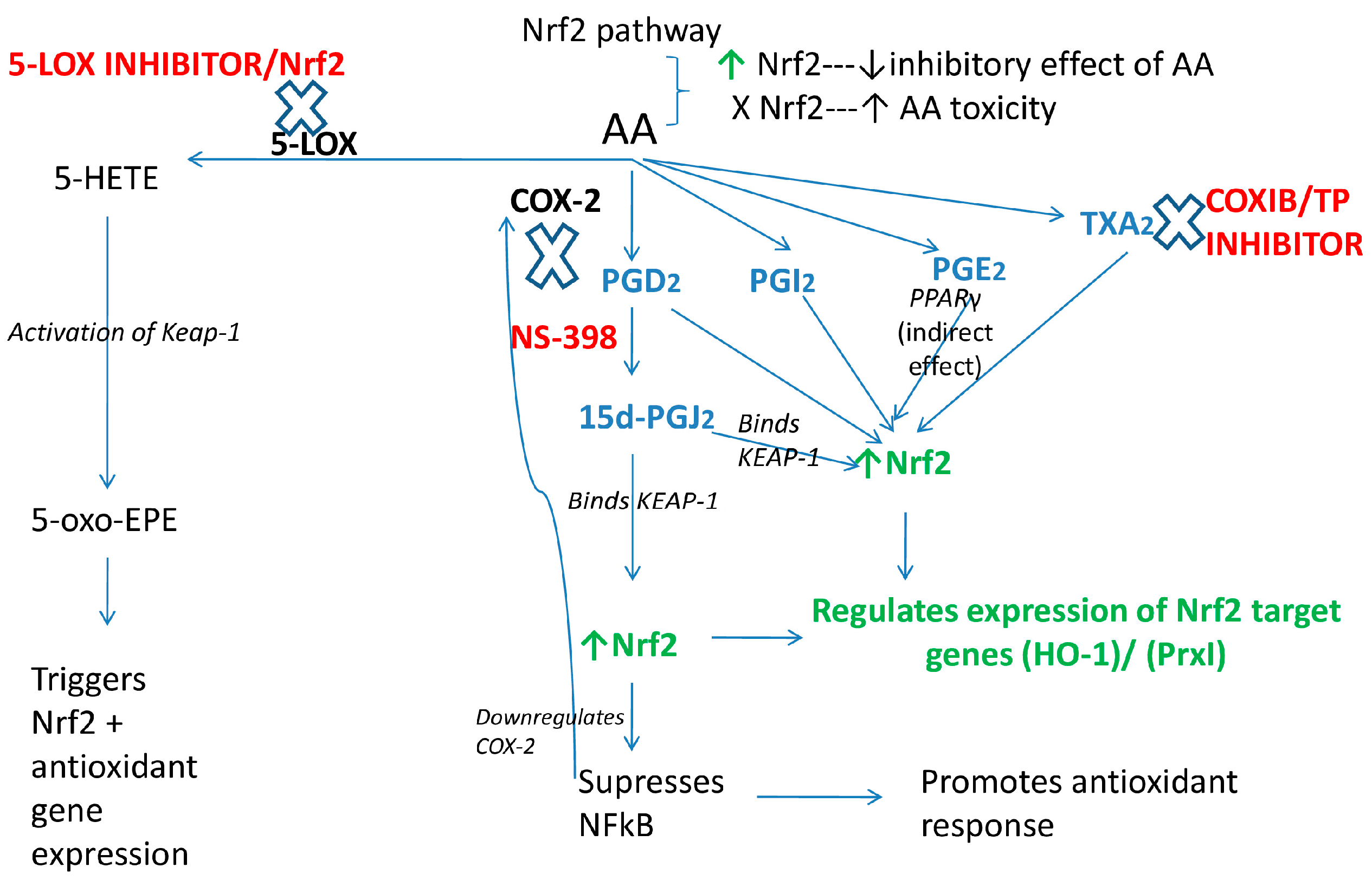
Figure 1: Schematic diagram of Arachidonic Acid Mediators involved in the Nrf2 pathway, and potential pharmacological targets. AA, Arachidonic acid; COX-2, cyclooxygenase-2; COXIB, COX-2 selective inhibitors; KEAP-1, Kelch-like ECH-associated protein 1; 5-HETE, 5-Hydroxyeicosatetraenoic acid; 5-LOX, 5-Lipoxygenase; NF-kB, nuclear factor-kappa B; Nrf2, Nuclear factor erythroid 2-related factor 2; PGD2, prostaglandin D2; PGI2, prostacyclin; 15d-PGJ2, 15-deoxy-Δ12,14-prostaglandin J2; PPARγ, peroxisome proliferator-activated receptor gamma. The COX and 5-LOX pathways are highlighted as key sources of AA-derived mediators involved in modulating Nrf2 activation and redox balance. Selected pharmacological targets are indicated with crosses, representing potential intervention points to influence the crosstalk between AA metabolism and Nrf2 signaling.
Itoh et al. assessed the role of NS-398, a COX-2–specific inhibitor, which alters the normal inflammatory response by interfering with the production of 15d-PGJ2, which in turn activates the Nrf2 pathway [48]. Reduced levels of 15d-PGJ2 and reduced expression of antioxidant genes, such as PrxI, were observed. The results of this study suggest that COX-2 activity contributes to the generation of 15d-PGJ2, and that blocking COX-2 with NS-398 attenuates the downstream activation of Nrf2 and its anti-inflammatory gene responses [48].
Dual compounds, such as COX-2 inhibitors/TP antagonists, could reduce the formation of pro-inflammatory prostaglandins and prevent thromboxane A2 production, that brings to platelet activation, vasoconstriction, and additional inflammatory mechanisms that aggravate barrier disruption and neuronal loss [53]. While Nrf2 boosts antioxidant defenses and makes microglia more protective, blocking COX-2 and TP reduces the initial inflammatory signals. Together, this creates a two-fold protective effect for neurons.
On the other hand, 5-LOX inhibitors can reduce leukotriene-mediated inflammation [27]. Hence, combining Nrf2 and 5-LOX could be a potential strategy for offering strong neuronal protection, delaying neurodegenerative progression, and maintaining cognitive function.
Considering that altered levels of specific AA metabolites have been detected in the cerebrospinal fluid or plasma of patients with neurodegenerative diseases, correlating with disease severity and cognitive decline, measuring these metabolites may serve as potential biomarkers for neurodegenerative disorders [15,16]. Similarly, the expression of Nrf2 target genes and antioxidant enzymes reflects the cellular redox state and may indicate early compensatory responses to oxidative stress in neurodegeneration, suggesting their potential as biomarkers as well [35,36]. Therefore, AA-derived mediators and Nrf2-regulated antioxidant markers can serve as biomarkers of neuroinflammatory and oxidative stress status, aiding in diagnosis, prognosis, and evaluation of therapeutic interventions.
The results indicate a functional interaction between AA-derived lipid mediators and Nrf2 signaling. 15d-PGJ and LOX products like 5-oxo-ETE can activate Nrf2, enhancing antioxidant defenses and mitigating inflammatory responses in neuronal and glial cells. Understanding how these lipid mediators modulate Nrf2 may provide novel insights into therapeutic strategies for neurodegenerative diseases.
While some AA metabolites contribute to neuroinflammation and cytotoxicity, others, such as cyclopentenone prostaglandins (e.g., 15d-PGJ2) and certain lipoxygenase (LOX) products, can exert protective effects by modulating redox-sensitive pathways. The dual role of AA mediators in neuronal injury and protection positions them as important targets in neurodegenerative disease research. The interplay between AA mediators and Nrf2 signaling emerges as a context-dependent regulatory axis in neurodegenerative diseases, rather than a unidirectional pathway. A key insight from this review is that AA metabolites cannot be classified strictly as detrimental or protective; instead, their effects depend on enzymatic context, cellular environment, and disease stage. While certain mediators promote neuroinflammation and oxidative damage, others contribute to adaptive antioxidant and cytoprotective responses. This shows a balance between harmful and protective processes in neurodegenerative conditions.
Because of these pro-inflammatory effects, inhibition of COX enzymes or downstream prostaglandin signaling has been explored for neuroprotective potential, although clinical utility is complicated by the diverse and sometimes opposing roles of COX products. These observations suggest that more selective approaches aimed at modulating specific lipid mediator profiles or enhancing endogenous Nrf2-activating compounds may provide greater efficacy and precision.
Moreover, lipidomics approaches offer a new pathway to address the dynamic changes in AA signaling in human neurodegenerative conditions, enabling the identification of novel biomarkers and therapeutic targets. Integrating these strategies with preclinical and clinical studies will be essential to translate mechanistic insights into effective interventions for neurodegenerative diseases. Longitudinal studies in human populations are needed to clarify how AA-derived mediators evolve during disease progression and treatment. Furthermore, the development of targeted modulators that selectively enhance pro-resolving lipid pathways or fine-tune Nrf2 activation without broadly suppressing essential inflammatory responses represents a critical direction for therapeutic innovation.
Several limitations should be acknowledged. Much of the mechanistic understanding derives from in vitro systems or animal models, which may not fully capture the complexity of human neurodegenerative diseases. In addition, the temporal dynamics of AA mediator production and Nrf2 activation across disease progression remain insufficiently characterized, and the interplay with other signaling pathways is not yet fully resolved. Furthermore, the complexity of lipid mediator networks and variability in experimental approaches may limit the ability to define the specific contribution of individual pathways.
In conclusion, a better understanding of the AA–Nrf2 axis, especially how it changes over time and across systems, could help develop more effective and targeted treatments for neurodegenerative diseases.
Acknowledgement:
Funding Statement: The authors received no specific funding for this study.
Author Contributions: The authors confirm contribution to the paper as follows: Conceptualization, methodology, software, validation, formal analysis, investigation, resources, data curation, writing—original draft preparation, writing—review and editing, visualization, supervision, project administration, funding acquisition, Malvina Hoxha, Domenico Tricarico, Loredana Capobianco. All authors reviewed and approved the final version of the manuscript.
Availability of Data and Materials: Not applicable.
Ethics Approval: Not applicable.
Conflicts of Interest: The authors declare no conflicts of interest.
Nomenclature
| AA | Arachidonic Acid |
| AD | Alzheimer’s disease |
| ALS | Amyotrophic lateral sclerosis |
| COX | Cyclooxygenase |
| EET | Epoxyeicosatrienoic acids |
| HO-1 | Heme oxygenase-1 |
| KEAP1 | Kelch-like ECH-associated protein |
| LOX | Lipoxygenase |
| LT | Leukotrienes |
| Nrf2 | Nuclear factor-E2-related factor 2 |
| PD | Parkinson’s disease |
| PG | Prostaglandin |
| TXA2 | Thromboxane A2 |
References
1. Pathak N , Vimal SK , Tandon I , Agrawal L , Hongyi C , Bhattacharyya S . Neurodegenerative disorders of Alzheimer, Parkinsonism, amyotrophic lateral sclerosis and multiple sclerosis: An early diagnostic approach for precision treatment. Metab Brain Dis. 2022; 37( 1): 67– 104. doi:10.1007/s11011-021-00800-w. [Google Scholar] [CrossRef]
2. Zhang Y , Liu Y , Sun J , Zhang W , Guo Z , Ma Q . Arachidonic acid metabolism in health and disease. MedComm. 2023; 4( 5): e363. doi:10.1002/mco2.363. [Google Scholar] [CrossRef]
3. Hoxha M . Arachidonic acid mediators and their role in neurological disease. CNS Neurol Disord Drug Targets. 2022; 21( 2): 106– 7. doi:10.2174/1871527321666220103204515. [Google Scholar] [CrossRef]
4. Hoxha M , Spahiu E , Prendi E , Zappacosta B . A systematic review on the role of arachidonic acid pathway in multiple sclerosis. CNS Neurol Disord Drug Targets. 2022; 21( 2): 160– 87. doi:10.2174/1871527319666200825164123. [Google Scholar] [CrossRef]
5. Fadoul G , Ikonomovic M , Zhang F , Yang T . The cell-specific roles of Nrf2 in acute and chronic phases of ischemic stroke. CNS Neurosci Ther. 2024; 30( 3): e14462. doi:10.1111/cns.14462. [Google Scholar] [CrossRef]
6. Dinkova-Kostova AT , Kostov RV , Kazantsev AG . The role of Nrf2 signaling in counteracting neurodegenerative diseases. FEBS J. 2018; 285( 19): 3576– 90. doi:10.1111/febs.14379. [Google Scholar] [CrossRef]
7. Gureev PP , Sadovnikova I , Chernyshova E , Krutskih E , Pevzner I , Zorova L , et al. Resveratrol preserves mitochondrial DNA integrity and long-term memory without decreasing amyloid-β levels in Alzheimer’s disease mouse models. BioCell. 2025; 49( 5): 873– 92. doi:10.32604/biocell.2025.063557. [Google Scholar] [CrossRef]
8. Serhan CN , Yacoubian S , Yang R . Anti-inflammatory and proresolving lipid mediators. Annu Rev Pathol. 2008; 3: 279– 312. doi:10.1146/annurev.pathmechdis.3.121806.151409. [Google Scholar] [CrossRef]
9. Gorica E , Calderone V . Arachidonic acid derivatives and neuroinflammation. CNS Neurol Disord Drug Targets. 2022; 21( 2): 118– 29. doi:10.2174/1871527320666210208130412. [Google Scholar] [CrossRef]
10. Abdalla HB , Puhl L , Rivas CA , Wu YC , Rojas P , Trindade-da-Silva CA , et al. Modulating the sEH/EETs axis restrains specialized proresolving mediator impairment and regulates T cell imbalance in experimental periodontitis. J Immunol. 2024; 212( 3): 433– 45. doi:10.4049/jimmunol.2300650. [Google Scholar] [CrossRef]
11. Medeiros A , Peres-Buzalaf C , Fortino Verdan F , Serezani CH . Prostaglandin E2 and the suppression of phagocyte innate immune responses in different organs. Mediat Inflamm. 2012; 2012: 327568. doi:10.1155/2012/327568. [Google Scholar] [CrossRef]
12. Calder PC . Eicosanoids. Essays Biochem. 2020; 64( 3): 423– 41. doi:10.1042/EBC20190083. [Google Scholar] [CrossRef]
13. Korbecki J , Baranowska-Bosiacka I , Gutowska I , Chlubek D . Cyclooxygenase pathways. Acta Biochim Pol. 2014; 61( 4): 639– 49. doi:10.18388/abp.2014_1825. [Google Scholar] [CrossRef]
14. Adelizzi RA . COX-1 and COX-2 in health and disease. J Am Osteopath Assoc. 1999; 99( 11): 7– 12. doi:10.7556/jaoa.1999.99.11.S7. [Google Scholar] [CrossRef]
15. Lima IV , Bastos LF , Limborço-Filho M , Fiebich BL , de Oliveira AC . Role of prostaglandins in neuroinflammatory and neurodegenerative diseases. Mediat Inflamm. 2012; 2012: 946813. doi:10.1155/2012/946813. [Google Scholar] [CrossRef]
16. Andreasson K . Emerging roles of PGE2 receptors in models of neurological disease. Prostaglandins Other Lipid Mediat. 2010; 91( 3–4): 104– 12. doi:10.1016/j.prostaglandins.2009.04.003. [Google Scholar] [CrossRef]
17. Teismann P , Tieu K , Choi DK , Wu DC , Naini A , Hunot S , et al. Cyclooxygenase-2 is instrumental in Parkinson’s disease neurodegeneration. Proc Natl Acad Sci U S A. 2003; 100( 9): 5473– 8. doi:10.1073/pnas.0837397100. [Google Scholar] [CrossRef]
18. Shi J , Johansson J , Woodling NS , Wang Q , Montine TJ , Andreasson K . The prostaglandin E2 E-prostanoid 4 receptor exerts anti-inflammatory effects in brain innate immunity. J Immunol. 2010; 184( 12): 7207– 18. doi:10.4049/jimmunol.0903487. [Google Scholar] [CrossRef]
19. Sheremeta CL , Yarlagadda S , Smythe ML , Noakes PG . Prostaglandins in the inflamed central nervous system: Potential therapeutic targets. Curr Drug Targets. 2024; 25( 13): 885– 908. doi:10.2174/0113894501323980240815113851. [Google Scholar] [CrossRef]
20. Mohri I , Kadoyama K , Kanekiyo T , Sato Y , Kagitani-Shimono K , Saito Y , et al. Hematopoietic prostaglandin D synthase and DP1 receptor are selectively upregulated in microglia and astrocytes within senile plaques from human patients and in a mouse model of Alzheimer disease. J Neuropathol Exp Neurol. 2007; 66( 6): 469– 80. doi:10.1097/01.jnen.0000240472.43038.27. [Google Scholar] [CrossRef]
21. Xiang Z , Lin T , Reeves SA . 15d-PGJ2 induces apoptosis of mouse oligodendrocyte precursor cells. J Neuroinflamm. 2007; 4: 18. doi:10.1186/1742-2094-4-18. [Google Scholar] [CrossRef]
22. Taniike M , Mohri I , Eguchi N , Beuckmann CT , Suzuki K , Urade Y . Perineuronal oligodendrocytes protect against neuronal apoptosis through the production of lipocalin-type prostaglandin D synthase in a genetic demyelinating model. J Neurosci. 2002; 22( 12): 4885– 96. doi:10.1523/JNEUROSCI.22-12-04885.2002. [Google Scholar] [CrossRef]
23. Mohri I , Taniike M , Okazaki I , Kagitani-Shimono K , Aritake K , Kanekiyo T , et al. Lipocalin-type prostaglandin D synthase is up-regulated in oligodendrocytes in lysosomal storage diseases and binds gangliosides. J Neurochem. 2006; 97( 3): 641– 51. doi:10.1111/j.1471-4159.2006.03753.x. [Google Scholar] [CrossRef]
24. Bernardo A , Levi G , Minghetti L . Role of the peroxisome proliferator-activated receptor-γ (PPAR-γ) and its natural ligand 15-deoxy-Δ12,14-prostaglandin J2 in the regulation of microglial functions. Eur J Neurosci. 2000; 12( 7): 2215– 23. doi:10.1046/j.1460-9568.2000.00110.x. [Google Scholar] [CrossRef]
25. Feussner I , Wasternack C . The lipoxygenase pathway. Annu Rev Plant Biol. 2002; 53: 275– 97. doi:10.1146/annurev.arplant.53.100301.135248. [Google Scholar] [CrossRef]
26. Joshi YB , Praticò D . The 5-lipoxygenase pathway: Oxidative and inflammatory contributions to the Alzheimer’s disease phenotype. Front Cell Neurosci. 2015; 8: 436. doi:10.3389/fncel.2014.00436. [Google Scholar] [CrossRef]
27. Liu L , Zhang P , Zhang Z , Liang Y , Chen H , He Z , et al. 5-lipoxygenase inhibition reduces inflammation and neuronal apoptosis via AKT signaling after subarachnoid hemorrhage in rats. Aging. 2021; 13( 8): 11752– 61. doi:10.18632/aging.202869. [Google Scholar] [CrossRef]
28. Spector AA . Arachidonic acid cytochrome P450 epoxygenase pathway. J Lipid Res. 2009; 50: S52– 6. doi:10.1194/jlr.R800038-JLR200. [Google Scholar] [CrossRef]
29. Chandrasekharan JA , Sharma-Walia N . Lipoxins: Nature’s way to resolve inflammation. J Inflamm Res. 2015; 8: 181– 92. doi:10.2147/JIR.S90380. [Google Scholar] [CrossRef]
30. Wang L , Luo G , Zhang LF , Geng HX . Neuroprotective effects of epoxyeicosatrienoic acids. Prostaglandins Other Lipid Mediat. 2018; 138: 9– 14. doi:10.1016/j.prostaglandins.2018.07.002. [Google Scholar] [CrossRef]
31. Pallàs M , Vázquez S , Sanfeliu C , Galdeano C , Griñán-Ferré C . Soluble epoxide hydrolase inhibition to face neuroinflammation in Parkinson’s disease: A new therapeutic strategy. Biomolecules. 2020; 10( 5): 703. doi:10.3390/biom10050703. [Google Scholar] [CrossRef]
32. Ponce J , Ulu A , Hanson C , Cameron-Smith E , Bertoni J , Wuebker J , et al. Role of specialized pro-resolving mediators in reducing neuroinflammation in neurodegenerative disorders. Front Aging Neurosci. 2022; 14: 780811. doi:10.3389/fnagi.2022.780811. [Google Scholar] [CrossRef]
33. Telkoparan-Akillilar P , Panieri E , Cevik D , Suzen S , Saso L . Therapeutic targeting of the NRF2 signaling pathway in cancer. Molecules. 2021; 26: 1417. doi:10.3390/molecules26051417. [Google Scholar] [CrossRef]
34. Itoh K , Wakabayashi N , Katoh Y , Ishii T , Igarashi K , Engel JD , et al. Keap1 represses nuclear activation of antioxidant responsive elements by Nrf2 through binding to the amino-terminal Neh2 domain. Genes Dev. 1999; 13: 76– 86. doi:10.1101/gad.13.1.76. [Google Scholar] [CrossRef]
35. Baird L , Yamamoto M . The molecular mechanisms regulating the KEAP1-NRF2 pathway. Mol Cell Biol. 2020; 40( 13): e00099– 20. doi:10.1128/MCB.00099-20. [Google Scholar] [CrossRef]
36. Ramsey CP , Glass CA , Montgomery MB , Lindl KA , Ritson GP , Chia LA , et al. Expression of Nrf2 in neurodegenerative diseases. J Neuropathol Exp Neurol. 2007; 66( 1): 75– 85. doi:10.1097/nen.0b013e31802d6da9. [Google Scholar] [CrossRef]
37. Yang XX , Yang R , Zhang F . Role of Nrf2 in Parkinson’s disease: Toward new perspectives. Front Pharmacol. 2022; 13: 919233. doi:10.3389/fphar.2022.919233. [Google Scholar] [CrossRef]
38. Chu CT , Uruno A , Katsuoka F , Yamamoto M . Role of NRF2 in pathogenesis of Alzheimer’s disease. Antioxidants. 2024; 13( 12): 1529. doi:10.3390/antiox13121529. [Google Scholar] [CrossRef]
39. Bono S , Feligioni M , Corbo M . Impaired antioxidant KEAP1-NRF2 system in amyotrophic lateral sclerosis: NRF2 activation as a potential therapeutic strategy. Mol Neurodegener. 2021; 16( 1): 71. doi:10.1186/s13024-021-00479-8. [Google Scholar] [CrossRef]
40. Maldonado PP , Guevara C , Olesen MA , Orellana JA , Quintanilla RA , Ortiz FC . Neurodegeneration in multiple sclerosis: The role of Nrf2-dependent pathways. Antioxidants. 2022; 11( 6): 1146. doi:10.3390/antiox11061146. [Google Scholar] [CrossRef]
41. Ngo V , Duennwald ML . Nrf2 and oxidative stress: A general overview of mechanisms and implications in human disease. Antioxidants. 2022; 11( 12): 2345. doi:10.3390/antiox11122345. [Google Scholar] [CrossRef]
42. Saha S , Buttari B , Profumo E , Tucci P , Saso L . A perspective on Nrf2 signaling pathway for neuroinflammation: A potential therapeutic target in Alzheimer’s and Parkinson’s diseases. Front Cell Neurosci. 2022; 15: 787258. doi:10.3389/fncel.2021.787258. [Google Scholar] [CrossRef]
43. Sivandzade F , Prasad S , Bhalerao A , Cucullo L . NRF2 and NF-κB interplay in cerebrovascular and neurodegenerative disorders: Molecular mechanisms and possible therapeutic approaches. Redox Biol. 2019; 21: 101059. doi:10.1016/j.redox.2018.11.017. [Google Scholar] [CrossRef]
44. Lim TST , Ng KH , Zhang Y . NRF2 dysregulation and therapeutic insights across chronic kidney diseases. Int J Mol Sci. 2025; 26( 15): 7471. doi:10.3390/ijms26157471. [Google Scholar] [CrossRef]
45. Gong P , Cederbaum AI . Transcription factor Nrf2 protects HepG2 cells against CYP2E1 plus arachidonic acid-dependent toxicity. J Biol Chem. 2006; 281( 21): 14573– 9. doi:10.1074/jbc.M600613200. [Google Scholar] [CrossRef]
46. Willoughby DA , Moore AR , Colville-Nash PR . Cyclopentenone prostaglandins—New allies in the war on inflammation. Nat Med. 2000; 6: 137– 8. doi:10.1038/72224. [Google Scholar] [CrossRef]
47. Camara-Lemarroy CR , Gonzalez-Moreno EI , Guzman-de la Garza FJ , Fernandez-Garza NE . Arachidonic acid derivatives and their role in peripheral nerve degeneration and regeneration. Sci World J. 2012; 2012( 1): 168953. doi:10.1100/2012/168953. [Google Scholar] [CrossRef]
48. Itoh K , Mochizuki M , Ishii Y , Ishii T , Shibata T , Kawamoto Y , et al. Transcription factor Nrf2 regulates inflammation by mediating the effect of 15-deoxy-Δ12,14-prostaglandin J2. Mol Cell Biol. 2004; 24( 1): 36– 45. doi:10.1128/MCB.24.1.36-45.2004. [Google Scholar] [CrossRef]
49. Bretscher P , Egger J , Shamshiev A , Trötzmüller M , Köfeler H , Carreira EM , et al. Phospholipid oxidation generates potent anti-inflammatory lipid mediators that mimic structurally related pro-resolving eicosanoids by activating Nrf2. EMBO Mol Med. 2015; 7( 5): 593– 607. doi:10.15252/emmm.201404702. [Google Scholar] [CrossRef]
50. Nagahora N , Yamada H , Kikuchi S , Hakozaki M , Yano A . Nrf2 activation by 5-lipoxygenase metabolites in human umbilical vascular endothelial cells. Nutrients. 2017; 9( 9): 1001. doi:10.3390/nu9091001. [Google Scholar] [CrossRef]
51. Hannan MA , Dash R , Sohag AAM , Haque MN , Moon IS . Neuroprotection against oxidative stress: Phytochemicals targeting TrkB signaling and the Nrf2-ARE antioxidant system. Front Mol Neurosci. 2020; 13: 116. doi:10.3389/fnmol.2020.00116. [Google Scholar] [CrossRef]
52. Michael J , Unger MS , Poupardin R , Schernthaner P , Mrowetz H , Attems J , et al. Microglia depletion diminishes key elements of the leukotriene pathway in the brain of Alzheimer’s disease mice. Acta Neuropathol Commun. 2020; 8( 1): 129. doi:10.1186/s40478-020-00989-4. [Google Scholar] [CrossRef]
53. Hoxha M , Buccellati C , Capra V , Garella D , Cena C , Rolando B , et al. In vitro pharmacological evaluation of multitarget agents for thromboxane prostanoid receptor antagonism and COX-2 inhibition. Pharmacol Res. 2016; 103: 132– 43. doi:10.1016/j.phrs.2015.11.012. [Google Scholar] [CrossRef]
Cite This Article
 Copyright © 2026 The Author(s). Published by Tech Science Press.
This work is licensed under a Creative Commons Attribution 4.0 International License , which permits unrestricted use, distribution, and reproduction in any medium, provided the original work is properly cited.
 Downloads
 Citation Tools
