
 Login
Login Register
 Submit a Paper
 Propose a Special lssue
 Open Access
REVIEW

Neuroinflammation and Oxidative Stress: Their Pathophysiological Roles in Amyotrophic Lateral Sclerosis and Alzheimer’s Disease
1 Department of Biophysics, Near East University, Nicosia, North Cyprus via Mersin 10, Türkiye
2 Department of Biochemistry, Faculty of Pharmacy, Eastern Mediterranean University, Famagusta, North Cyprus via Mersin 10, Türkiye
3 Department of Pharmacology, Faculty of Dentistry, Near East University, Nicosia, North Cyprus via Mersin 10, Türkiye
* Corresponding Authors: Aslı Aykaç. Email: ,
BIOCELL 2026, 50(7), 4 https://doi.org/10.32604/biocell.2026.077114
Received 02 December 2025; Accepted 10 February 2026; Issue published 29 June 2026
 View Full Text
 Download PDF
Abstract
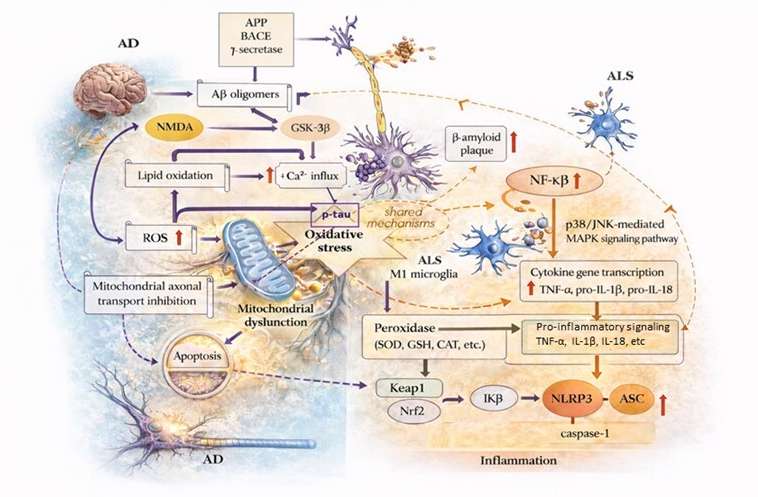
Neurodegenerative diseases such as Amyotrophic Lateral Sclerosis (ALS) and Alzheimer’s disease (AD) are driven by complex, multifactorial mechanisms in which oxidative stress (OS) and neuroinflammation (NI) play central, mutually reinforcing roles. Their interaction is mediated through key signaling pathways, including nuclear factor kappa-light-chain-enhancer of activated B cells (NF-κB), nuclear factor erythroid 2–related factor 2–Kelch-like ECH-associated protein 1 (Nrf2-Keap1), and the mitogen-activated protein kinase (MAPK) pathway, as well as mitochondrial dysfunction, microglial activation, and dysregulated redox homeostasis. Increasing attention has been directed toward understanding how Food and Drug Administration (FDA)-approved neuroprotective agents influence these interconnected processes. Drugs such as riluzole, edaravone, memantine, and acetylcholinesterase inhibitors exhibit diverse effects on glutamate excitotoxicity, free radical production, inflammatory cytokine release, and microglial reactivity, yet their modest clinical efficacy highlights the limitations of single-target approaches. This review synthesizes current evidence on the mechanistic relationship between OS and NI in ALS and AD and evaluates how existing therapeutics modulate these pathways, emphasizing the need for multitarget strategies to achieve meaningful disease-modifying outcomes.Graphic Abstract
Keywords
Cite This Article
 Copyright © 2026 The Author(s). Published by Tech Science Press.
This work is licensed under a Creative Commons Attribution 4.0 International License , which permits unrestricted use, distribution, and reproduction in any medium, provided the original work is properly cited.
 Downloads
 Citation Tools
