
 Login
Login Register
 Submit a Paper
 Propose a Special lssue
 Open Access
REVIEW

Artificial Neural Networks and Taguchi Methods for Energy Systems Optimization: A Comprehensive Review
1 Department of Mechanical Engineering, Payame Noor University, Tehran, P.O. Box 19395-3697, Iran
2 Department of Mechanical Engineering, Babol Noshirvani University of Technology, Babol, P.O. Box 47148-71167, Iran
* Corresponding Author: Homayoun Boodaghi. Email:
Energy Engineering 2025, 122(11), 4385-4474. https://doi.org/10.32604/ee.2025.070668
Received 21 July 2025; Accepted 03 September 2025; Issue published 27 October 2025
 View Full Text
 Download PDF
Abstract
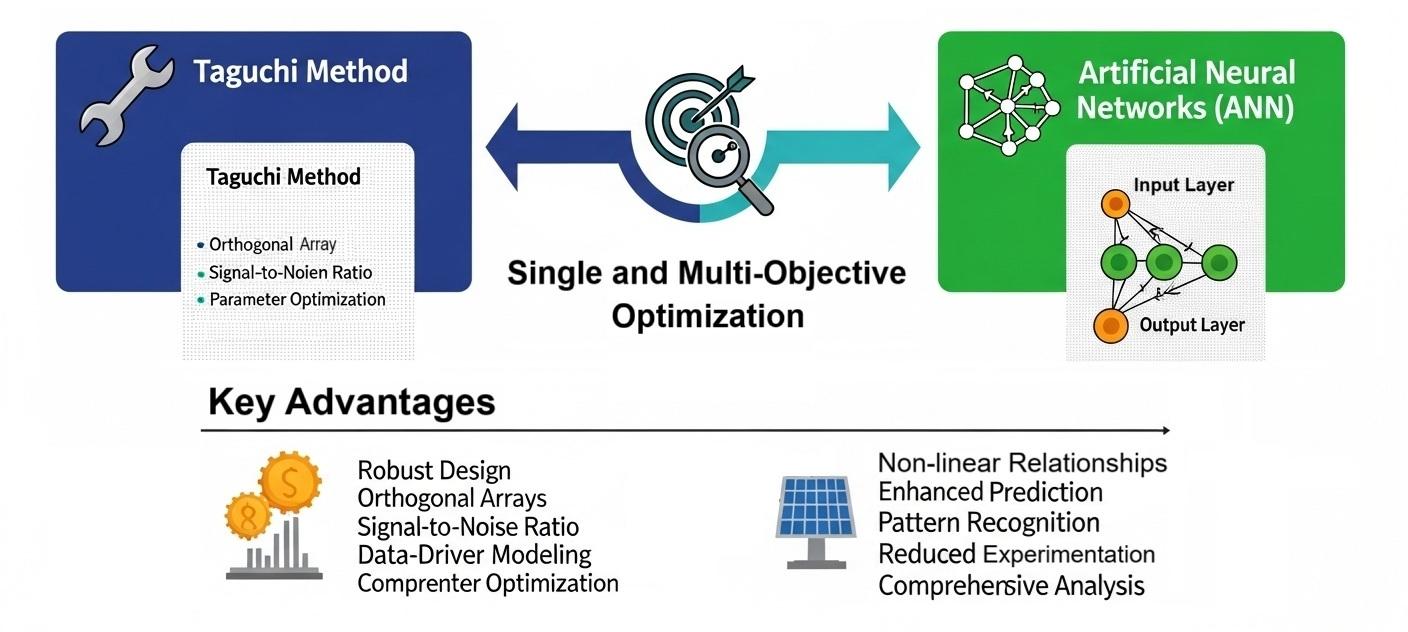
Energy system optimization has become crucial for enhancing efficiency and environmental sustainability. This comprehensive review examines the synergistic application of Artificial Neural Networks (ANN) and Taguchi methods in optimizing diverse energy systems. While previous reviews have focused on these methods separately, this paper presents the first integrated analysis of both approaches across multiple energy applications. We systematically analyze their implementation in: Internal combustion engines, Thermal energy storage systems, Solar energy systems, Wind and tidal turbines, Heat exchangers, and hybrid energy systems. Our findings reveal that ANN models consistently achieve prediction accuracies exceeding 90% when compared to experimental data, while Taguchi-based methods combined with Grey Relational Analysis (GRA) or TOPSIS can improve system performance by up to 20%–30% in multi-objective optimization scenarios. The review introduces novel frameworks for combining these methods and provides critical insights into their complementary strengths. Key statistical metrics, including determination coefficients and error analyses, validate the superior performance of integrated approaches. This work serves as a foundational reference for researchers and practitioners in energy system optimization, offering structured methodologies and future research directions.Graphic Abstract
Keywords
ANN; Taguchi; GRA; TOPSIS; hybrid optimization; renewable energy; machine learning; robust design
Cite This Article
APA Style
Etghani, M.M., Boodaghi, H. (2025). Artificial Neural Networks and Taguchi Methods for Energy Systems Optimization: A Comprehensive Review. Energy Engineering, 122(11), 4385–4474. https://doi.org/10.32604/ee.2025.070668
Vancouver Style
Etghani MM, Boodaghi H. Artificial Neural Networks and Taguchi Methods for Energy Systems Optimization: A Comprehensive Review. Energ Eng. 2025;122(11):4385–4474. https://doi.org/10.32604/ee.2025.070668
IEEE Style
M. M. Etghani and H. Boodaghi, “Artificial Neural Networks and Taguchi Methods for Energy Systems Optimization: A Comprehensive Review,” Energ. Eng., vol. 122, no. 11, pp. 4385–4474, 2025. https://doi.org/10.32604/ee.2025.070668
 Copyright © 2025 The Author(s). Published by Tech Science Press.
This work is licensed under a Creative Commons Attribution 4.0 International License , which permits unrestricted use, distribution, and reproduction in any medium, provided the original work is properly cited.
 Downloads
 Citation Tools
