
 Login
Login Register
 Submit a Paper
 Propose a Special lssue
 Open Access
ARTICLE

Transient Thermo-Hydraulic Behavior of a Thermocline Thermal Energy Storage Tank: A CFD Investigation
1 Laboratory of Energy Engineering and Materials (LEEM), Faculty of Sciences and Technologies, Sultan Moulay Slimane University, Beni Mellal, Morocco
2 LMPEQ, National School of Applied Sciences, Safi, Morocco
3 EnR2E Laboratory, National Center for Studies and Research on Water and Energy, Cadi Ayyad University, Marrakesh, Morocco
4 L3G, Faculty of Science and Technology Cadi Ayyad University, Marrakesh, Morocco
* Corresponding Author: Abdellah Idrissi. Email:
(This article belongs to the Special Issue: Next-Generation Solar Thermal and Energy Storage Systems: Modeling, Optimization and Performance)
Energy Engineering 2026, 123(10), 16 https://doi.org/10.32604/ee.2026.083896
Received 13 April 2026; Accepted 16 June 2026; Issue published 30 August 2026
 View Full Text
 Download PDF
Abstract
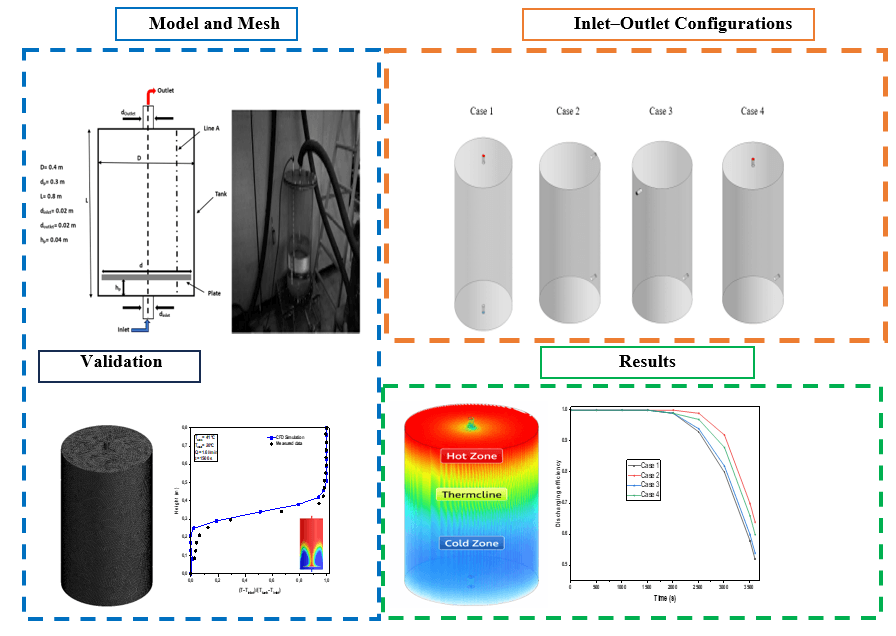
This study numerically investigates the influence of inlet–outlet arrangement on the thermo-hydraulic performance of a thermocline thermal energy storage (TES) tank using three-dimensional transient CFD simulations in ANSYS Fluent. Four different inlet–outlet configurations were analyzed under identical discharge conditions to evaluate their effects on thermal stratification, discharge efficiency, and internal flow behavior. The numerical model was developed using the continuity, momentum, and energy equations with the Boussinesq approximation and validated against reference experimental data with deviations below 5%. The results showed that the inlet–outlet arrangement significantly affects thermocline evolution and thermal mixing inside the storage tank. Among the investigated configurations, Configuration 2 exhibited the most favorable thermo-hydraulic behavior, improving thermal stratification and discharge efficiency by approximately 18%–22% compared with the baseline configuration because of reduced recirculation intensity and weaker thermal mixing. Although Configuration 2 produced a moderate increase in pressure drop and pumping power, the improved thermal performance justified the associated hydraulic penalty. The obtained findings indicate that relatively simple modifications in inlet–outlet positioning can improve thermocline preservation and thermal energy recovery in compact TES systems.Graphic Abstract
Keywords
Cite This Article
 Copyright © 2026 The Author(s). Published by Tech Science Press.
This work is licensed under a Creative Commons Attribution 4.0 International License , which permits unrestricted use, distribution, and reproduction in any medium, provided the original work is properly cited.
 Downloads
 Citation Tools
