
 Login
Login Register
 Submit a Paper
 Propose a Special lssue
 Open Access
ARTICLE

A Data-Driven Method for Rapid Prediction of Polarization Curves in Proton Exchange Membrane Electrolysis Cell
1 Institute for Clean Energy Technology, North China Electric Power University, Beijing, China
2 School of Mathematics and Physics, North China Electric Power University, Beijing, China
* Corresponding Authors: Hao Cheng. Email: ; Yongli Li. Email:
(This article belongs to the Special Issue: Hydrogen Energy Systems: Storage, Power-to-Hydrogen, and AI-Enabled Design, Planning, and Operation)
Energy Engineering 2026, 123(9), 9 https://doi.org/10.32604/ee.2026.082907
Received 25 March 2026; Accepted 08 May 2026; Issue published 06 August 2026
 View Full Text
 Download PDF
Abstract
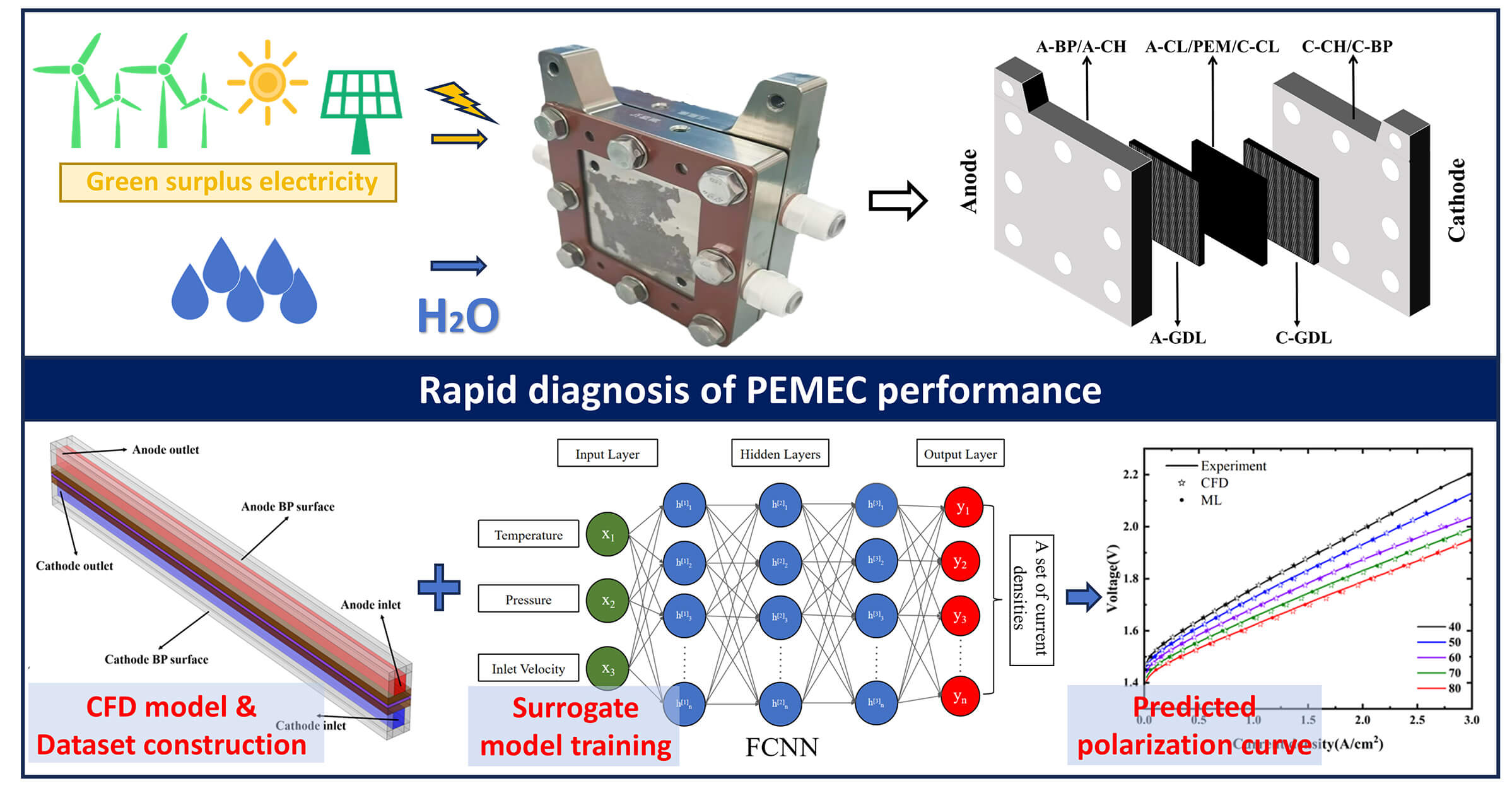
The prediction of the steady-state performance of the electrolysis cell is not only crucial for evaluating the rationality of its design and operational benchmarks, but also provides an important foundation for understanding its dynamic response behavior. This paper presents an efficient data-driven method based on three-dimensional two-phase numerical simulation and machine learning (ML) to rapidly predict the steady-state performance of proton exchange membrane electrolysis cells (PEMEC) under multi-physics field coupling conditions. The framework is based on three key operating parameters—temperature, pressure, and inlet flow velocity. A polarization curve dataset was constructed through multi-condition numerical simulations, and surrogate models were systematically trained using five distinct ML algorithms: random forest (RF), extreme gradient boosting (XGBoost), support vector regression (SVR), gaussian process regression (GPR), and fully connected neural network (FCNN). The results show that the constructed surrogate models can efficiently output complete polarization curves using only operating parameters as inputs. Validation against experimental results confirms that the FCNN performs the best overall prediction performance, achieving high accuracy with prediction errors consistently within ±0.5% of the actual values across the interpolation temperature range, and demonstrating adaptability in extrapolation under varying temperatures. This ML collaborative method is applicable to the rapid performance assessment and analysis of PEMEC and provides valuable insights for operation optimization under extreme conditions.Graphic Abstract
Keywords
Cite This Article
 Copyright © 2026 The Author(s). Published by Tech Science Press.
This work is licensed under a Creative Commons Attribution 4.0 International License , which permits unrestricted use, distribution, and reproduction in any medium, provided the original work is properly cited.
 Downloads
 Citation Tools
