Guest Editor(s)
Prof. Dr. Zhengmao Li
Email: zhengmao.li@aalto.fi
Affiliation: Department of Electrical Engineering and Automation, Aalto University, Espoo, 02150, Finland
Homepage:
Research Interests: hydrogen-based green energy transition for future energy systems,AI+energy

Prof. Dr. Xianbang Chen
Email: xianbang.chen@cornell.edu
Affiliation: Department of Systems Engineering, Cornell University, Ithaca, 14850, United States
Homepage:
Research Interests: AI-based application in energy system management

Prof. Dr. Ammar Al-Bazi
Email: a.al-bazi@aston.ac.uk
Affiliation: Department of Operations and Service Management, Aston University, Birmingham, B4 7ET, United Kingdom
Homepage:
Research Interests: AI applications in energy supply chain management

Dr. Om Hari Gupta
Email: omhari.ee@nitjsr.ac.in
Affiliation: Department of Electrical Engineering, NIT Jamshedpur, Jharkhand, India, 831014
Homepage:
Research Interests: power system protection, green hydrogen generation, renewable energy, distributed generation, microgrids, and electric power quality

Summary
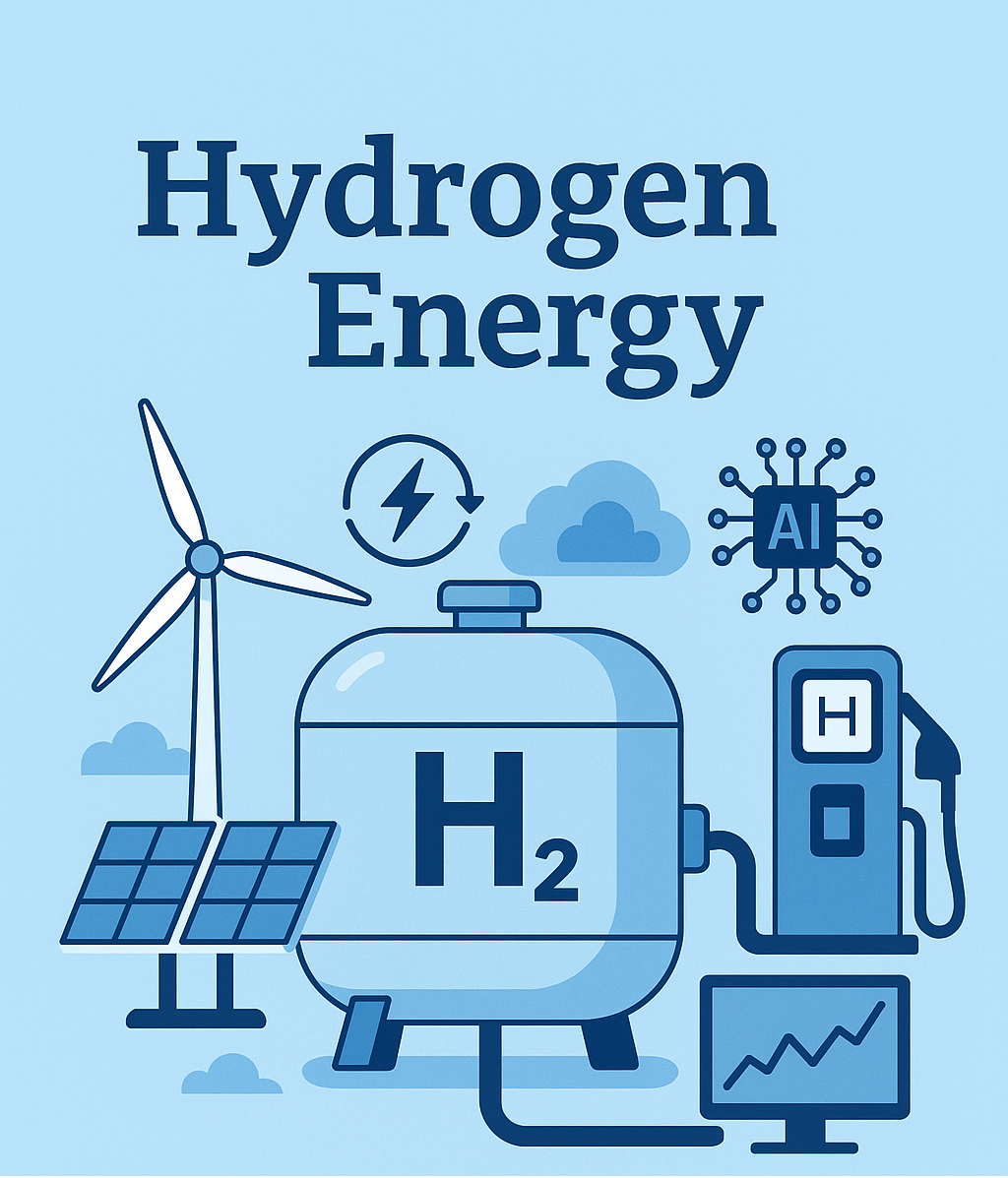
Hydrogen energy is rapidly becoming a practical pathway to decarbonize power systems and hard-to-electrify sectors, while also providing long-duration flexibility to renewable-dominant grids. However, large-scale deployment still faces key engineering barriers, including cost-effective and safe hydrogen storage, efficient and grid-aware power-to-hydrogen operation, and robust planning and control under uncertainty. At the same time, the growing availability of operational data and advanced computational methods creates a timely opportunity to accelerate hydrogen system design, operation, and reliability through modern AI tools.
This Special Issue on Hydrogen Energy aims to collect high-quality, engineering-oriented contributions that advance the modeling, design, optimization, control, and real-world deployment of hydrogen technologies. The scope covers hydrogen production (especially power-to-hydrogen), storage and delivery infrastructure, hydrogen energy supply chain management, integration with electricity markets and network constraints, and AI-enabled methods that improve performance, safety, and scalability. Both original research papers and review articles are welcome, with an emphasis on works that provide clear technical insights, practical relevance, and reproducible methodologies.
Suggested themes include (but are not limited to):
· Hydrogen storage: compressed, liquid, cryogenic, solid-state, LOHC, and underground storage
· Power-to-hydrogen and sector coupling: electrolyzer modeling, degradation-aware operation, hub planning
· Hydrogen energy supply chain management: production to storage coordination, logistics optimization, and infrastructure planning
· Grid integration: co-optimization with renewables, market participation, congestion and ancillary services
· AI tools for hydrogen systems: forecasting, anomaly detection, digital twins, surrogate modeling, RL/MPC
· Safety, monitoring, standards-relevant testing, and reliability engineering
· Techno-economic analysis (TEA), life-cycle assessment (LCA), and uncertainty-aware planning
Graphic Abstract
Keywords
hydrogen energy, hydrogen storage, energy supply chain management, power-to-hydrogen, electrolyzers, grid integration, sector coupling, artificial intelligence, digital twins, techno-economic analysis, safety and reliability
Published Papers

 Login
Login Register
 Submit a Paper
 Propose a Special lssue