
 Login
Login Register
 Submit a Paper
 Propose a Special lssue
 Open Access
ARTICLE

Numerical Assessment of Novel Windbreak Designs for Flow Control and Heat Transfer Enhancement in Natural Draft Dry Cooling Towers
1 School of Nuclear Science, Energy and Power Engineering, Shandong University, Jinan, China
2 Shenzhen Research Institute of Shandong University, Shenzhen, China
3 China Nuclear Power Engineering Co., Ltd., Beijing, China
4 Shandong Qinglei Environmental Science and Technology Co., Ltd., Jinan, China
5 Shandong Hetong Information Technology Co., Ltd., Jinan, China
* Corresponding Author: Suoying He. Email:
# These authors contributed equally to this work as the first author
(This article belongs to the Special Issue: Fluid Mechanics & Thermodynamics in Renewable Energy and HVAC Systems)
Fluid Dynamics & Materials Processing 2026, 22(2), 3 https://doi.org/10.32604/fdmp.2026.077360
Received 08 December 2025; Accepted 11 February 2026; Issue published 04 March 2026
 View Full Text
 Download PDF
Abstract
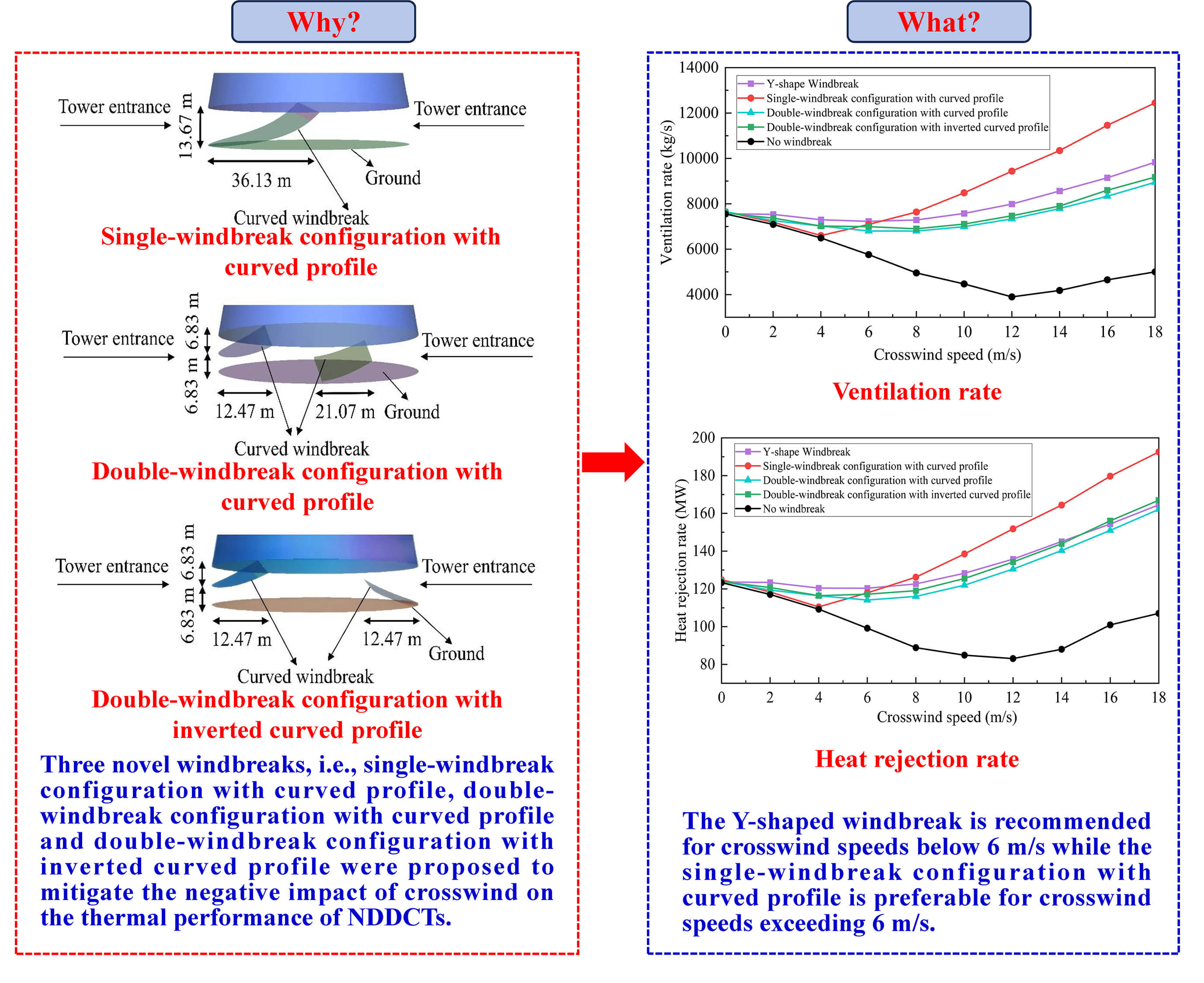
This study aims to mitigate crosswind-induced performance degradation in Natural Draft Dry Cooling Towers used in power plants by developing and assessing windbreak configurations that enhance ventilation while minimizing additional airflow resistance. Three novel windbreak designs, namely single-windbreak configuration with curved profile, double-windbreak configuration with curved profile, and double-windbreak configuration with inverted curved profile, are proposed accordingly and evaluated against conventional solutions. Three-dimensional numerical models of a 120 m high NDDCT equipped with these windbreaks, together with a conventional Y-shaped windbreak, are developed for systematic comparison. The results demonstrate that windbreak effectiveness strongly depends on crosswind intensity. At low crosswind speeds of 0–6 m/s, the Y-shaped windbreak provides the greatest enhancement, increasing the ventilation rate by 25.45% and the heat rejection rate by 21.37% at 6 m/s compared with the no-windbreak configuration. In contrast, under moderate to strong crosswinds of 6–18 m/s, the single-windbreak configuration with curved profile exhibits superior performance. At 18 m/s, it increases the ventilation rate by 148.88% and the heat rejection rate by 79.74% relative to the baseline case, outperforming the Y-shaped windbreak by 26.59% in ventilation rate and 17.01% in heat rejection capacity. Analysis of airflow structure, temperature fields, and velocity distributions confirms that the single-windbreak configuration with curved profile more effectively suppresses crosswind penetration and promotes stable upward airflow at higher wind speeds. Based on a comprehensive assessment of aerodynamic and thermal performance, the Y-shaped windbreak is recommended for regions where crosswind speeds remain below 6 m/s, whereas the single-windbreak configuration with curved profile is preferable for sites exposed to stronger crosswinds exceeding this threshold.Graphic Abstract
Keywords
Cite This Article
 Copyright © 2026 The Author(s). Published by Tech Science Press.
This work is licensed under a Creative Commons Attribution 4.0 International License , which permits unrestricted use, distribution, and reproduction in any medium, provided the original work is properly cited.
 Downloads
 Citation Tools
