
 Login
Login Register
 Submit a Paper
 Propose a Special lssue
 Open Access
ARTICLE

Development of Mycelium Leather (Mylea) from Oil Palm Empty Fruit Bunch (OPEFB) Waste Using White Rot Fungi as a Renewable Leather Material
1 School of Life Sciences and Technology, Institut Teknologi Bandung, Jalan Ganesha No. 10, Bandung, 40132, Indonesia
2 Department of Chemical Engineering, Faculty of Industrial Technology, Institut Teknologi Bandung, Bandung, 40132, Indonesia
3 Research Center for Biomass and Bioproducts, National Research and Innovation Agency (BRIN), JI Raya Bogor KM 46, Cibinong, 16911, Indonesia
* Corresponding Author: Rudi Dungani. Email:
Journal of Renewable Materials 2026, 14(1), 5 https://doi.org/10.32604/jrm.2025.02025-0113
Received 13 June 2025; Accepted 12 August 2025; Issue published 23 January 2026
 View Full Text
 Download PDF
Abstract
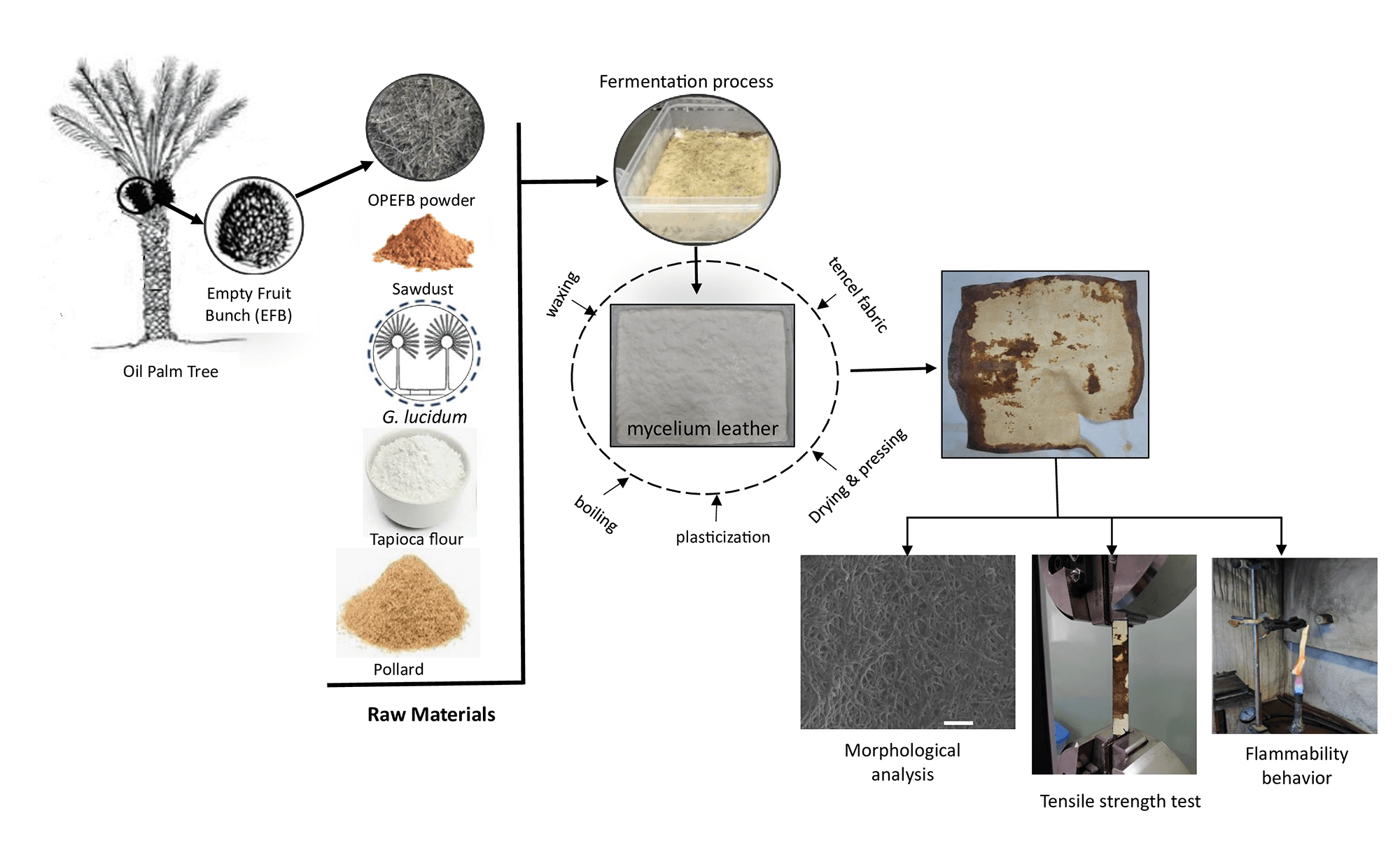
This study aimed to produce and characterize mycelium leather (Mylea) derived from oil palm empty fruit bunch (OPEFB). Variations in OPEFB composition (10%, 20%, 30%, and 40%) were tested using a 10% w/w Ganoderma lucidum inoculum. The mycelium underwent boiling, plasticization, drying, pressing, waxing, and Tencel fabric reinforcement to form Mylea. The physical, mechanical, and flammability properties of OPEFB-based Mylea were evaluated as a potential animal leather substitute. The highest tensile strength (8.47 MPa) was observed in the 0% OPEFB sample due to reinforcement with the Tencel fabric layer. Meanwhile, the 20% OPEFB sample after drying exhibited a tensile strength of 5.78 MPa and a lower elastic modulus (14.48 MPa), indicating increased flexibility but reduced stiffness. Among the tested compositions, 20% OPEFB provided the best balance between growth time and material quality. Flammability tests showed that Mylea with 20% OPEFB had a longer burn time (43.5 ± 7.78 s) compared to 0% OPEFB (21.0 ± 1.41 s). However, the addition of OPEFB did not improve fire resistance, as none of the samples met UL 94 V-0, V-1, or V-2 standards.Graphic Abstract
Keywords
Cite This Article
 Copyright © 2026 The Author(s). Published by Tech Science Press.
This work is licensed under a Creative Commons Attribution 4.0 International License , which permits unrestricted use, distribution, and reproduction in any medium, provided the original work is properly cited.
 Downloads
 Citation Tools
