
 Login
Login Register
 Submit a Paper
 Propose a Special lssue
 Open Access
ARTICLE
Eco-Friendly Materials Composed of Cellulose Fibers from Agave Bagasse with Silver Nanoparticles and Shrimp Chitosan
1 Department of Water and Energy, University of Guadalajara Campus Tonalá, Tonalá, 45425, México
2 Department of Wood Cellulose and Paper, University of Guadalajara, Zapopan, 44430, Mexico
3 Department of Biomedical Sciences, University of Guadalajara Campus Tonalá, Tonalá, 45425, México
4 Laboratory of Polymer Science and Technology (POLIUNA), School of Chemistry, Universidad Nacional, Campus Omar Dengo, Heredia, 40101, Costa Rica
* Corresponding Author: Belkis Sulbarán-Rangel. Email:
Journal of Renewable Materials 2025, 13(5), 849-863. https://doi.org/10.32604/jrm.2025.02024-0061
Received 15 December 2024; Accepted 14 February 2025; Issue published 20 May 2025
 View Full Text
 Download PDF
Abstract
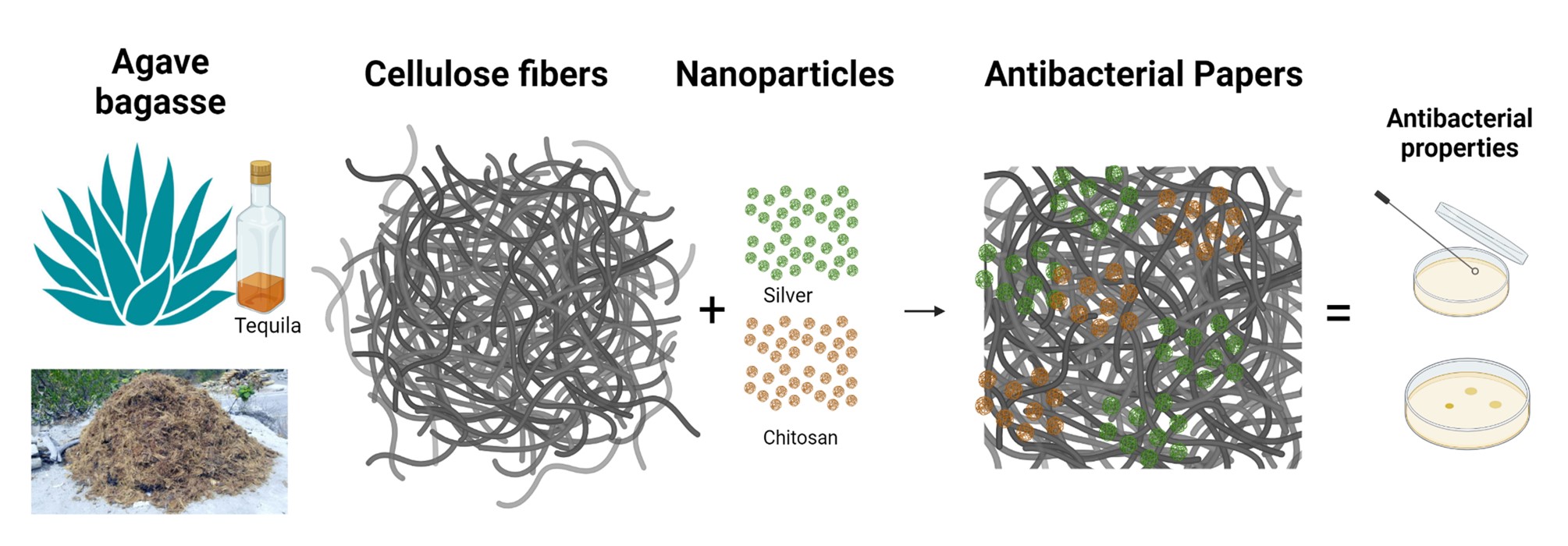
In this research, the antibacterial properties of a composite material prepared from agave bagasse cellulose fibers doped with silver nanoparticles and chitosan were studied. The development of composite materials with antibacterial properties and environmentally friendly based on cellulose fibers from agave bagasse with silver nanoparticles prepared by green synthesis and chitosan from shrimp waste enhances the value of these agro-industrial wastes and offers the opportunity for them to have biomedical applications since these raw materials have been poorly reported for this application. The antibacterial properties of chitosan and silver nanoparticles are already known. However, the combination of silver nanoparticles with cellulose fibers and chitosan has been studied poorly. Green synthesis of silver nanoparticles was carried out, and spherical shape nanoparticles with a size between 20 and 50 nm were obtained by ultraviolet-visible (UV-Vis) spectroscopy and transmission electron microscopy (TEM) analysis. Additionally, in this research, the cellulose obtained from agave bagasse, the chitosan extracted from shrimp shells, and the composite material were characterized by infrared spectroscopy, mechanical analysis, and antibacterial tests. A decrease in the growth of Escherichia coli bacteria with 100% growth inhibition on cellulose, chitosan, and silver nanoparticles composite material and an increase in mechanical properties from 13.67 MPa of cellulose pure to 110 MPa of composite material was observed. These findings support the idea that the composite material has potential use in wound care dressings for antibacterial care.Graphic Abstract
Keywords
Cite This Article
 Copyright © 2025 The Author(s). Published by Tech Science Press.
This work is licensed under a Creative Commons Attribution 4.0 International License , which permits unrestricted use, distribution, and reproduction in any medium, provided the original work is properly cited.
 Downloads
 Citation Tools
