
 Login
Login Register
 Submit a Paper
 Propose a Special lssue
 Open Access
REVIEW
Performance Enhancement of Chitosan for Food Packaging: Impact of Additives and Nanotechnology
1 Magister of Nanotechnology, Graduate School, Institut Teknologi Bandung, Jalan Ganesha No. 10, Bandung, 40132, West Java, Indonesia
2 Nano and Quantum Technology Research Group, Faculty of Industrial Technology, Institut Teknologi Bandung, Jalan Ganesha No. 10, Bandung, 40132, West Java, Indonesia
3 Research Center for Nanoscience and Nanotechnology, Center for Advance Science, Institut Teknologi Bandung, Jalan Ganesha No. 10, Bandung, 40132, West Java, Indonesia
4 Materials Science and Engineering Research Group, Faculty of Mechanical and Aerospace Engineering, Institut Teknologi Bandung, Jalan Ganesha No. 10, Bandung, 40132, West Java, Indonesia
5 Physics of Instrumentation and Computation Research Group, Faculty of Mathematics and Natural Sciences, Institut Teknologi Bandung, Jalan Ganesha No. 10, Bandung, 40132, West Java, Indonesia
* Corresponding Author: Damar Rastri Adhika. Email:
(This article belongs to the Special Issue: Special issue from 1st International Conference of Natural Fiber and Biocomposite (1st ICONFIB) 2024 )
Journal of Renewable Materials 2025, 13(6), 1043-1070. https://doi.org/10.32604/jrm.2025.02024-0002
Received 30 September 2024; Accepted 09 January 2025; Issue published 23 June 2025
 View Full Text
 Download PDF
Abstract
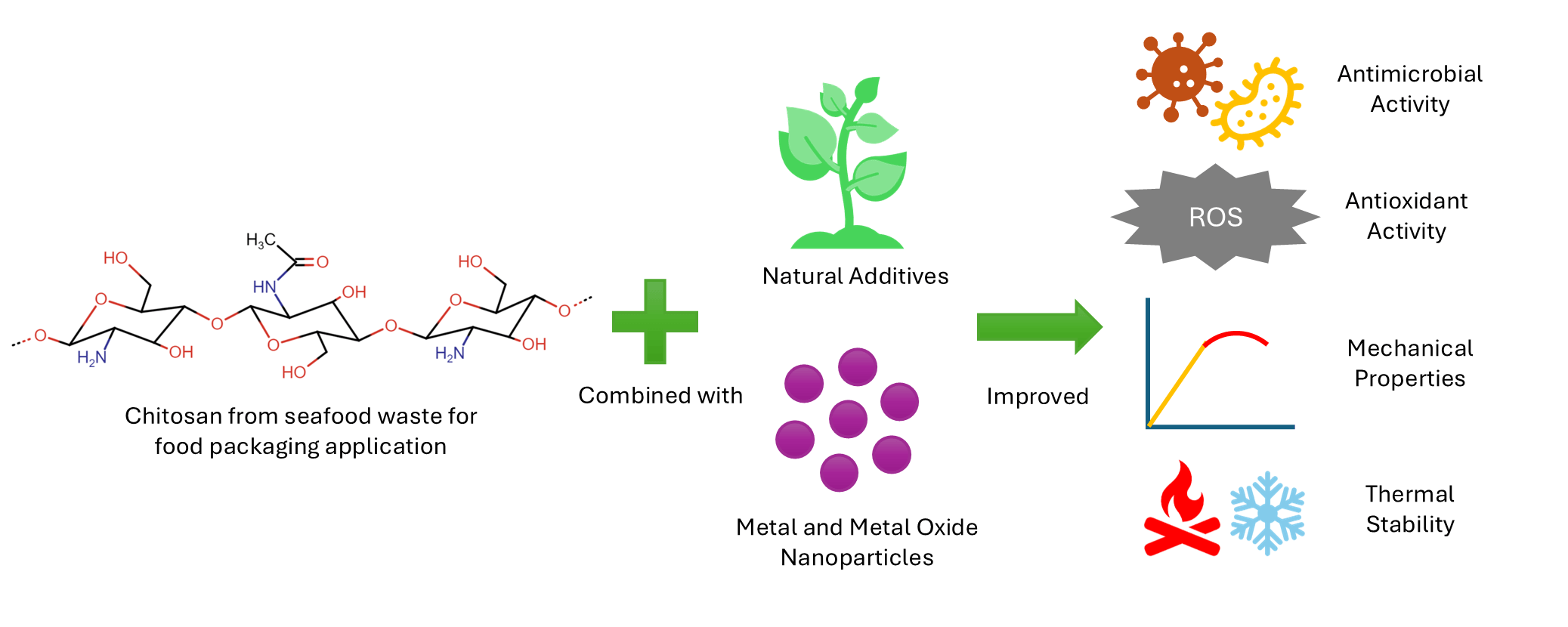
The continuous increase in petroleum-based plastic food packaging has led to numerous environmental concerns. One effort to reduce the use of plastic packaging in food is through preservation using biopolymer-based packaging. Among the many types of biopolymers, chitosan is widely used and researched due to its non-toxic, antimicrobial, and antifungal properties. Chitosan is widely available since it is a compound extracted from seafood waste, especially shrimps and crabs. The biodegradability and biocompatibility of chitosan also showed good potential for various applications. These characteristics and properties make chitosan an attractive biopolymer to be implemented as food packaging in films and coatings. Chitosan has been tested in maintaining and increasing the shelf life of food, especially seafood such as fish and shrimp, and post-harvest products such as fruits and vegetables. In addition to its various advantages, the properties and characteristics of chitosan need to be improved to produce optimal preservation. The properties and characteristics of chitosan are improved by adding various types of additive materials such as biopolymers, plant extracts, essential oils, and metal nanoparticles. Research shows that material additives and nanotechnology can improve the quality of chitosan-based food packaging for various types of food by enhancing mechanical properties, thermal stability, antimicrobial activity, and antioxidant activity. This review provides a perspective on the recent development and properties enhancement of chitosan composite with additives and nanotechnology, as well as this material’s challenges and prospects as food packaging.Graphic Abstract
Keywords
Cite This Article
 Copyright © 2025 The Author(s). Published by Tech Science Press.
This work is licensed under a Creative Commons Attribution 4.0 International License , which permits unrestricted use, distribution, and reproduction in any medium, provided the original work is properly cited.
 Downloads
 Citation Tools
