
 Login
Login Register
 Submit a Paper
 Propose a Special lssue
 Open Access
ARTICLE
Impact of Pyrolysis Parameters on Biochar and Activated Carbon Properties from Cistus ladaniferus for Environmental Applications
1 Chemical Engineering for Resources Valorization Group (UAE/L01FST), Faculty of Science and Technology, Abdelmalek Essaadi University, Tangier, 90002, Morocco
2 Laboratory of Environment and Applied Chemistry, Team: Physical Chemistry of the Natural Resources and Processes, Faculty of Sciences, Mohammed First University, Oujda, 60000, Morocco
3 Materials Science and Nano Engineering Department, Mohammed VI Polytechnic University, Ben Guerir, 43150, Morocco
4 Radiation-Matter and Instrumentation Laboratory, Faculty of Sciences and Technology (FST), Hassan First University, Settat, 926000, Morocco
5 Laboratory of Applied Chemistry and Environment, Faculty of Sciences, University Mohammed the First, MB 524, Oujda, 60000, Morocco
6 Higher School of Education and Training, Mohammed First University, Oujda, 60000, Morocco
* Corresponding Author: Hammadi El Farissi. Email:
(This article belongs to the Special Issue: Recent Advances in Biochar and Carbon-Based Materials Characteristics and Environment Applications)
Journal of Renewable Materials 2025, 13(6), 1251-1266. https://doi.org/10.32604/jrm.2025.02025-0004
Received 04 January 2025; Accepted 27 March 2025; Issue published 23 June 2025
 View Full Text
 Download PDF
Abstract
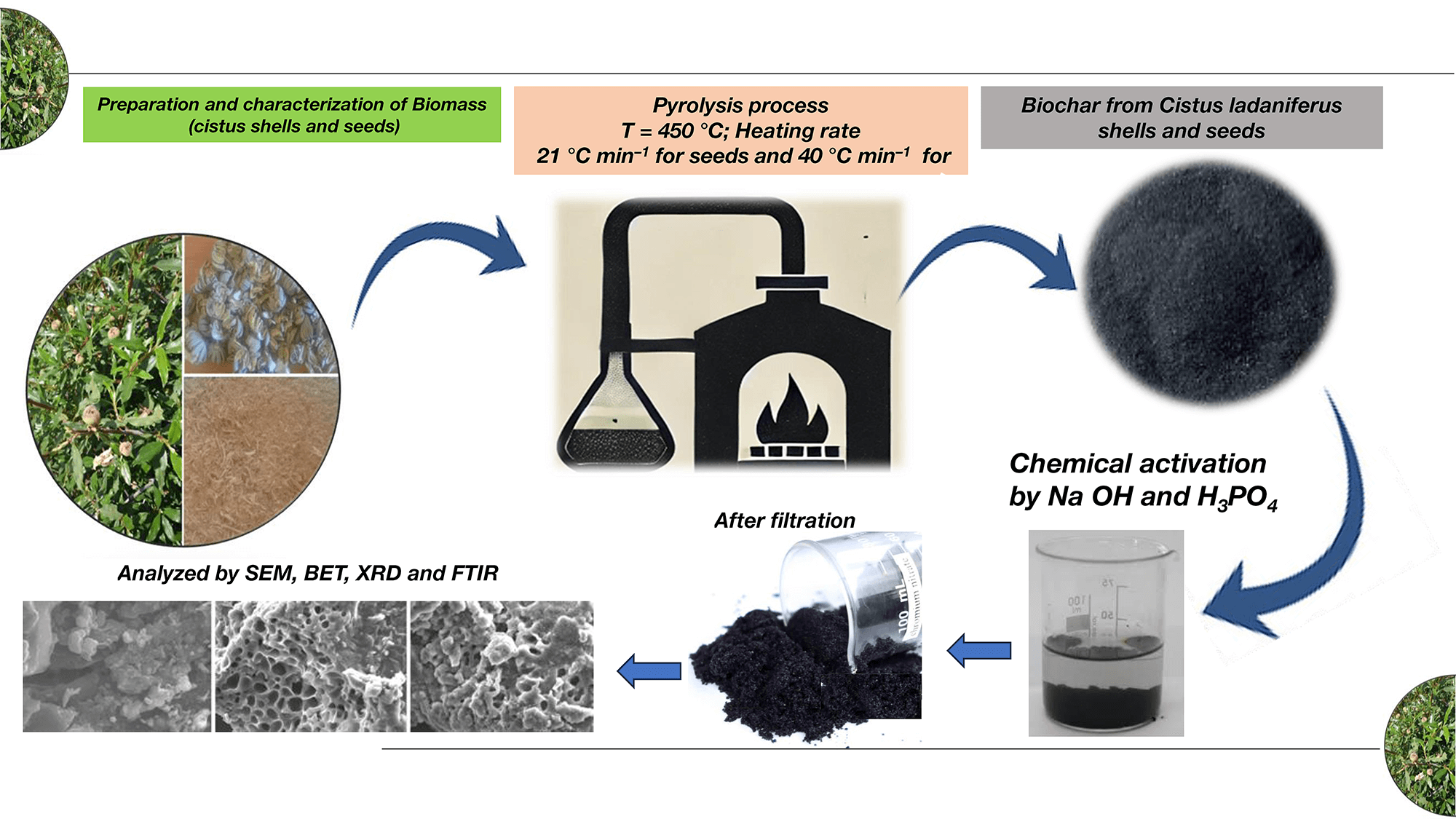
In light of the growing urgency to address environmental degradation and improve carbon sequestration strategies, this study rigorously investigates the potential of Cistus ladaniferus as a viable feedstock for biochar and activated carbon production. The influence of pyrolysis temperature, heating rate and particle size on biochar yield was systematically examined. The results demonstrate that increasing pyrolysis temperature and heating rate significantly reduces biochar yield, while particle size plays a crucial role in thermal degradation and biochar retention. To evaluate the structural and chemical properties of the materials, various characterization techniques were employed, including Fourier-transform infrared spectroscopy (FTIR), scanning electron microscopy (SEM), and energy-dispersive X-ray analysis (EDXA). FTIR identified key functional groups, while SEM and EDXA provided valuable insights into the morphology and elemental composition of the materials. Activated carbons exhibited enhanced porosity and carbon content compared to their biochar counterparts, achieving specific surface areas of up to 1210 m2 g−1 for acid-activated shells (AC-Sha). The Brunauer-Emmett-Teller (BET) method confirmed the mesoporous characteristics of these materials, with AC-Sa displaying a surface area of 678.74 m2 g−1 and an average pore size of 2.73 nm. Elemental analysis revealed that activated carbons possessed a higher carbon content (96.40 wt.% for AC-Sha) and lower oxygen content (2.37 wt.%), highlighting their suitability for applications in adsorption and catalysis. These findings underscore the significant impact of activation processes on the stability and adsorption capabilities of Cistus-derived biochars and activated carbons, paving the way for future research and practical applications in pollution control, carbon sequestration, and bioenergy.Graphic Abstract
Keywords
Cite This Article
 Copyright © 2025 The Author(s). Published by Tech Science Press.
This work is licensed under a Creative Commons Attribution 4.0 International License , which permits unrestricted use, distribution, and reproduction in any medium, provided the original work is properly cited.
 Downloads
 Citation Tools
